Virima vs. Native ServiceNow Discovery: What’s Different and When You Need Both

TLDR
- ServiceNow Discovery is an agentless, pattern-based automated discovery approach, deeply integrated with the ServiceNow platform
- Coverage gaps appear in on-premises infrastructure depth, ITAM lifecycle integration, and specialized network devices and asset types
- Virima provides broader device support, agentless plus optional agent discovery, and built-in ITAM reconciliation for improved asset discovery
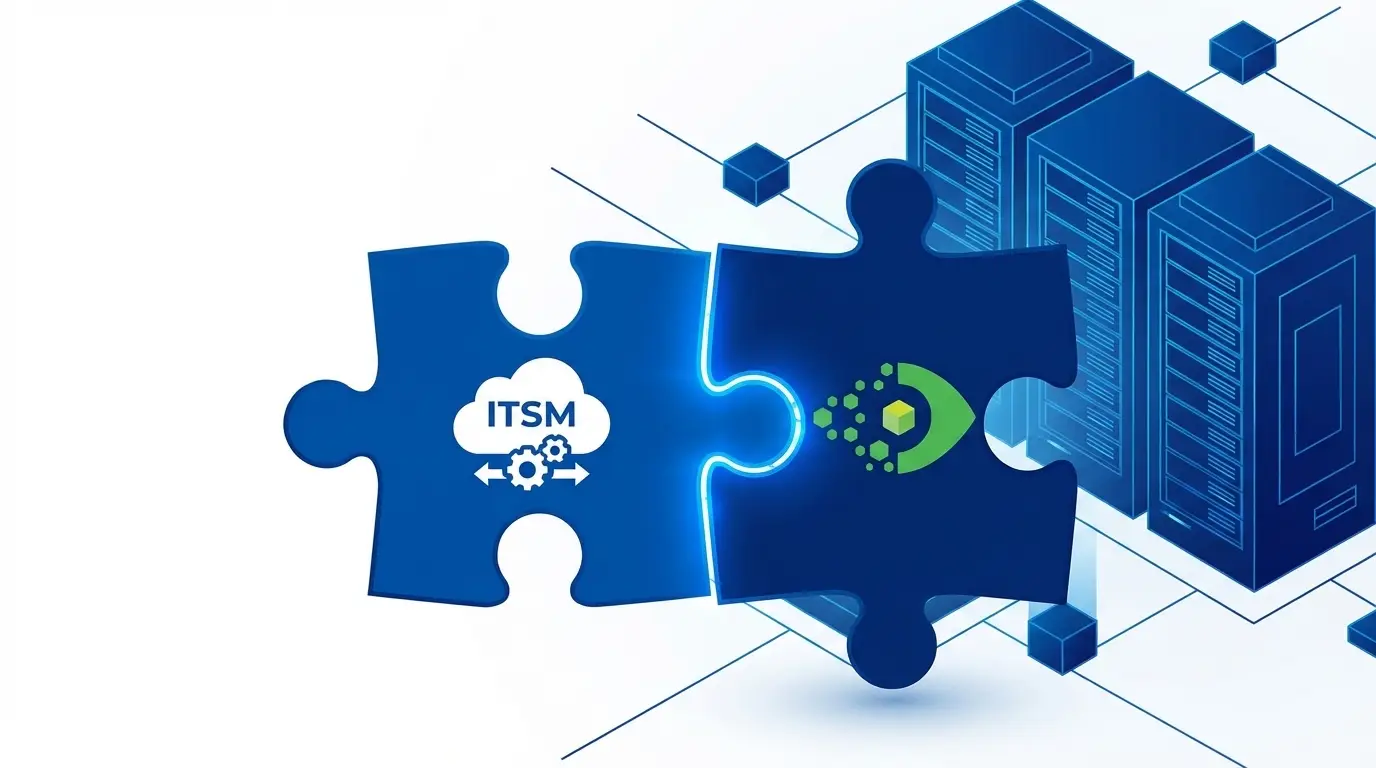
- Most enterprise IT teams use both together: Virima enriches the configuration management database CMDB with detailed CI data, and ServiceNow manages service management ITSM processes
- The integration story is additive, not competitive: Virima pushes enriched configuration items CIS into ServiceNow via REST API
Introduction
ServiceNow Discovery is one of the most widely deployed CMDB population tools in enterprise IT, forming a core part of many ITSM platform strategies.
For organizations already running ServiceNow ITSM, it offers an obvious starting point: native integration, no additional middleware, and a pattern library covering hundreds of common device types.
But “widely deployed” does not mean “universally sufficient,” especially when deeper application dependencies and infrastructure relationships must be mapped. A recurring theme across IT operations advisory and community research is that ServiceNow Discovery works well for many environments and falls short in others, typically where infrastructure complexity, ITAM requirements, or specialized asset types push past what native patterns cover.
This guide examines what ServiceNow Discovery does well, where its coverage creates gaps for enterprise IT teams, and how a specialized discovery platform like Virima works alongside ServiceNow to address those gaps. This context is often central to discussions around virima vs servicenow discovery, where the focus is on identifying complementary strengths rather than direct replacement. The goal is not to argue for replaspecialisedcement but to clarify when a two-platform approach, with Virima feeding enriched CI data into ServiceNow, delivers more complete and reliable CMDB outcomes.
What ServiceNow Discovery Does
ServiceNow Discovery is an agentless scanning tool that uses MID Servers for IP-based scanning to identify IT assets and populate the ServiceNow CMDB. It performs two types of scans:
- Horizontal discovery: Identifies all reachable devices on a given IP range
- Vertical (classification) discovery: Probes each identified device for detailed attribute data
Discovery uses credential-based patterns (SSH, WMI, SNMP, REST APIs) to classify devices and extract CI attributes. ServiceNow’s IRE processes incoming data and either creates new CI records or updates existing ones, with deduplication built into the reconciliation logic.
ServiceNow also offers Service Graph Connectors: pre-built integrations with third-party systems that import CI data using the same IRE-based reconciliation model.
For organizations whose infrastructure runs on standard platforms (AWS, Azure, Windows Server, common hardware vendors) and whose primary need is keeping the ServiceNow CMDB populated enough to support ITSM processes, native Discovery is often a sufficient foundation.
This comparison builds on the foundational question of whether the ServiceNow Discovery tool alone provides sufficient coverage for your environment, or whether Virima’s agentless probes, Windows discovery agent, and API integrations fill critical gaps in cloud, remote, and hybrid infrastructure discovery that native ServiceNow discovery does not address.
Where Native ServiceNow Discovery Has Gaps
Agent-Based Discovery for Continuous Monitoring
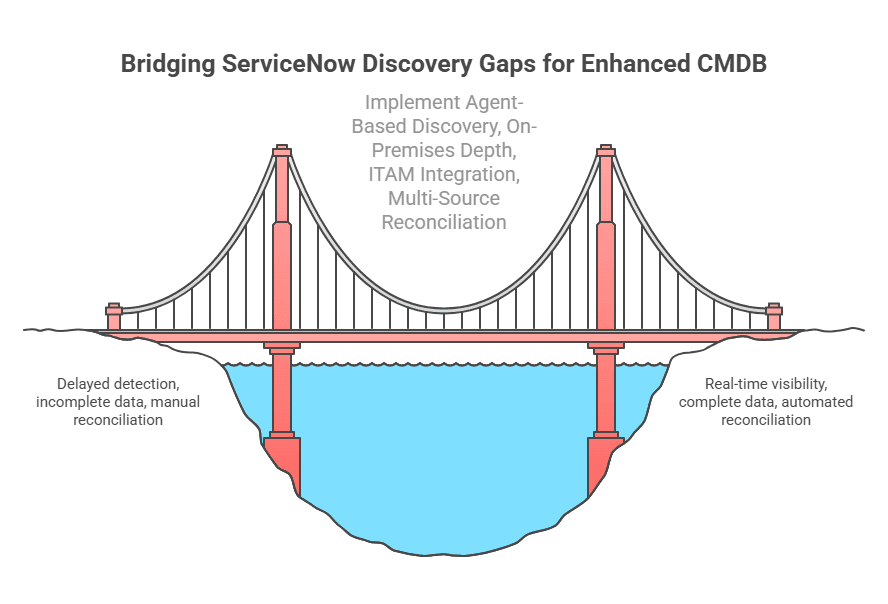
ServiceNow Discovery is primarily agentless: it scans on a schedule and captures a point-in-time snapshot. For dynamic environments where configurations change frequently, a scheduled scan may be too slow to reflect the current reality, impacting real-time impact analysis and decision-making. An agent installed on endpoints provides near-real-time change detection, capturing configuration changes, software installs, or process state changes as they happen rather than at the next scan interval.
ServiceNow does offer an Agent Client Collector (ACC) for endpoint monitoring, but it primarily addresses performance telemetry rather than CMDB population and requires additional configuration to contribute meaningfully to CI data.
On-Premises Infrastructure Depth
ServiceNow Discovery works best in environments where devices are reachable via standard IP networking with well-supported credential protocols. For specialized on-premises infrastructure, such as legacy network vendors, older storage arrays, or physical assets in air-gapped network segments, native patterns may not capture the full attribute depth required to understand service dependency relationships across infrastructure. that ITAM and capacity planning workflows require.
IT teams managing large data center footprints frequently find that ServiceNow Discovery captures device presence but misses granular hardware specifications (firmware version, slot population, disk arrays, power configuration) that support operational decision-making.
ITAM Integration and Software License Reconciliation
ServiceNow ITAM is a separate licensed module. Native Discovery does not automatically connect discovered software installations to software asset records, contract entitlements, or license position calculations. That reconciliation requires additional configuration within ServiceNow ITAM or supplementary manual processes.
For organizations that want a unified picture of what software is installed, what is licensed, and whether the two are in alignment, the gap between discovery data and ITAM records is a persistent operational challenge affecting overall service delivery efficiency when relying solely on native discovery.
Multi-Source Import Reconciliation
Organizations that ingest CI data from multiple sources, including cloud inventory APIs, endpoint managers, hardware asset databases, and vendor portals, need a reconciliation layer that intelligently merges these feeds without creating duplicates. ServiceNow’s IRE handles in-platform reconciliation well, but normalizing and pre-processing data from varied external sources before it reaches ServiceNow often falls to custom integration development, complicating ITSM records consistency. Reducing that custom development burden is where API automation IT operations workflows help, connecting external sources and automating the flow of reconciled data into ServiceNow.
What a Specialized Discovery Platform Adds
Broader Device and Vendor Support
Purpose-built discovery tools develop device-specific scan patterns, enabling more seamless integration across diverse environments as a primary product focus. This results in broader coverage of storage vendors, network infrastructure vendors, and specialized hardware categories that ServiceNow patterns may handle inconsistently.
Agentless Plus Optional Agent Discovery
A hybrid discovery model provides both breadth and depth across business services and infrastructure layers. Agentless scans establish the full asset inventory; agents track configuration changes and software usage on critical systems between scan cycles.
Virima supports both discovery modes. Agentless discovery covers the full network without requiring software deployment on every device. Optional agents on servers and workstations deliver software usage data and configuration change detection between scheduled scans. For a detailed comparison, read Virima’s guide on agent-based vs. agentless discovery.
Built-In ITAM Reconciliation
Virima combines IT discovery and ITAM in a single platform, strengthening Virima ServiceNow integration use cases. Discovered software installations link directly to software asset records. Hardware CIs tie to procurement and contract data. The result is a reconciled view of what exists, what is licensed, and what is under contract, all within the same system whose discovery data feeds ServiceNow.
Pre-Built ServiceNow Integration
Virimaintegrates with ServiceNow through a pre-built connector using the ServiceNow REST API. The integration uses configurable CI class mapping profiles, per-CI sync status tracking to prevent duplicates, and picklist translation to ensure data lands cleanly in ServiceNow tables. IT teams configure the integration rather than build it.
When Organizations Use Both Together
The typical enterprise use case for Virima alongside ServiceNow Discovery is additive rather than a replacement model:
- Virima handles discovery: Scans the environment, discovers all CI types, including those underserved by native patterns, and reconciles with ITAM data
- ServiceNow manages ITSM: Incident, change, problem, and service request processes run on ServiceNow using CI data as context
- Virima feeds ServiceNow: Enriched CI records sync to ServiceNow on schedule, supporting accurate service dependency visibility, keeping the ServiceNow CMDB current
This model is common in organizations with significant on-premises infrastructure, complex hardware environments, or formal ITAM programs. ServiceNow remains the system of record for ITSM processes; Virima ensures the CI data that ITSM processes depend on is accurate and complete.
Some organizations run both ServiceNow Discovery and Virima in parallel, using ServiceNow Discovery for cloud and standard infrastructure where native patterns perform well, and Virima for specialized on-premises hardware, ITAM integration, and agent-based monitoring environments.
The Integration Approach: Virima Enriches, ServiceNow Manages
Virima’s relationship with ServiceNow is specifically designed to be complementary, enabling consistent service delivery across platforms. Virima is a certified ServiceNow Technology Partner with a pre-built integration designed around the ServiceNow CMDB schema and IRE reconciliation model.
When Virima pushes CI data to ServiceNow:
- CI records follow the appropriate ServiceNow class table structure
- Attribute values conform to ServiceNow field types and picklist options
- Per-CI sync status prevents redundant pushes that could create duplicates
- The integration updates existing ServiceNow CI records rather than overwriting them
For IT leaders evaluating their CMDB strategy, the question is not whether to choose Virima or ServiceNow. It is whether the CMDB that feeds ServiceNow ITSM processes is accurate enough for your environment, and whether native Discovery alone achieves that accuracy.
Virima: The Complementary Layer Your ServiceNow CMDB Needs
ServiceNow Discovery is a capable native tool that works well for standard infrastructure on a scheduled scan model. For organizations with deep on-premises hardware complexity, ITAM integration requirements, or a need for more granular CI attribute data than native patterns provide, a specialized discovery platform fills the gap without requiring a ServiceNow replacement.
Virima operates as that complementary layer, improving visibility across business services and infrastructure with accurate dependency mapping: broader discovery coverage, built-in ITAM reconciliation, and a pre-built integration that keeps ServiceNow CMDB data accurate and up to date through the full IT asset lifecycle.
See how Virima integrates with your ServiceNow environment. Schedule a Demo.