Why Virima is the best CMDB integration for your ITSM processes

Updated September 2026 for ITIL-aligned CMDB integration and current discovery wording.
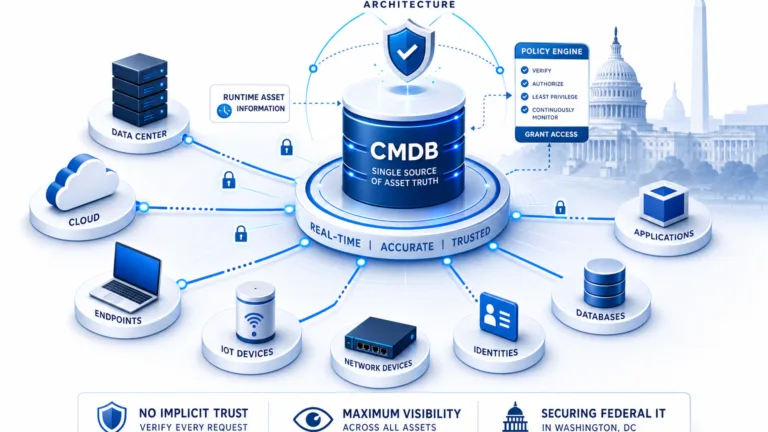
A reliable Configuration Management Database (CMDB) can reshape how your organization handles IT Service Management (ITSM), forming the foundation of a successful CMDB strategy.
This is especially true in complex, hybrid IT environments where assets span on-premise data centers, cloud instances, and remote endpoints.
But many teams hit a wall with CMDB integrations that fall short. In fact, research shows that up to 80% of CMDB projects fail to deliver business value. Manual updates lead to incomplete data, and studies show the average CMDB is only about 60% accurate without automation. Maintenance gaps let configuration items go stale. The fallout: overlooked threats, costly change failures, and sluggish incident resolution.
Virima addresses these problems head-on. Our CMDB integration gives you a complete view of your IT environment through automated hybrid IT discovery and service mapping, with visual overlays from ViVID™.
The result is a single source of truth for your IT assets, stronger cross-team collaboration, lower risk during changes, improved business outcomes, and faster time to value. Your CMDB becomes the operational backbone for daily ITSM workflows and data-driven decisions.
What is a CMDB integration in IT Service Management?
A CMDB integration connects automated discovery engines, cloud platforms, and ITSM tools to maintain a centralized inventory of configuration items and dependencies refreshed on a scheduled discovery cycle. That synchronized baseline supports incident triage, change impact analysis, and compliance reporting across hybrid IT environments.
Why CMDB integration matters for ITSM operations
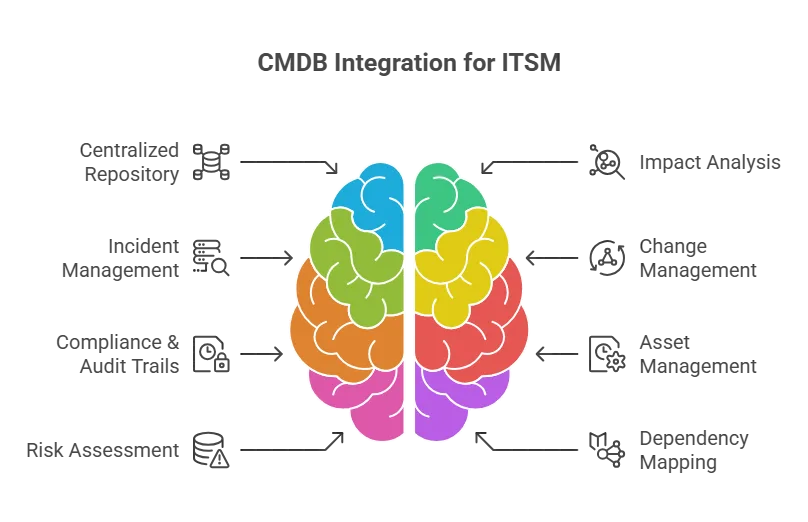
Its core purpose is managing Configuration Items (CIs), every asset involved in delivering IT services, along with their attributes and relationships. For IT operations teams, that centralized data drives faster decisions across every ITSM process:
Centralized repository
A CMDB integration consolidates data about all CIs, their attributes, and relationships into one place. IT teams get full visibility into their environment, instead of chasing spreadsheets or tribal knowledge during an incident.
Impact analysis
When a change is proposed, the CMDB shows which CIs depend on each other. IT teams can assess how changes affect business operations before anything is approved. That translates to fewer surprises during change windows.
Incident management
The CMDB maps relationships between CIs, so when an incident hits, your team can trace the root cause quickly. Instead of manually checking which systems are affected, the dependency data points you to the right place. Response times drop and downtime shrinks when dependency data points responders to the right systems first.
Change management
CMDB integration supports change management by showing how proposed changes will impact existing infrastructure. Every change to a CI gets documented and reviewed, giving your change advisory board the data they need to approve or push back.
Compliance and audit trails
Accurate CMDB records help your organization meet regulatory requirements. The audit trail for CI changes provides the accountability evidence auditors look for, the kind that matters for IT governance and compliance frameworks.
Asset management
The CMDB tracks the lifecycle of each CI — its status, ownership, and dependencies, supporting asset management ITAM initiatives across the organization. This supports IT Asset Management by helping teams optimize resource use and control asset costs across the full lifecycle.
Risk assessment
By mapping relationships and dependencies among CIs, the CMDB strengthens risk assessment. Your team can spot infrastructure vulnerabilities and take proactive steps before they cause outages or compliance gaps.
Dependency mapping
One of the CMDB’s most useful functions is visualizing dependencies among CIs. When a single component fails, dependency maps show the blast radius — which systems, services, and business processes are affected.
A well-maintained CMDB strengthens every ITSM process: faster incident response, informed change decisions, compliance evidence, and clear asset visibility across the environment.
How Virima approaches CMDB integration for ITSM teams
Virima’s CMDB integration stands out because it tackles the exact problems ops teams face with CMDB data quality, visibility, and cross-platform workflows. Here is what sets Virima apart.
Need discovery-sourced ground truth under your ITSM workflows? See how Trusted Runtime Truth keeps CMDB and service context explainable for change, incident, and audit work. Explore Trusted Runtime Truth for Agentic IT. |
Automated hybrid IT discovery
Virima automates asset identification and relationship mapping across your environment. Its agentless discovery and discovery agents collect thorough data without heavy manual input, so your CMDB stays accurate and current.
Here is how Virima IT discovery supports CMDB integration:
- Automated discovery and maintenance: Virima Discovery finds and tracks IT assets across on-premise, cloud (AWS, Azure), and hybrid setups. This keeps your CMDB populated with accurate data, cutting the manual effort and errors that plague traditional CMDB management.
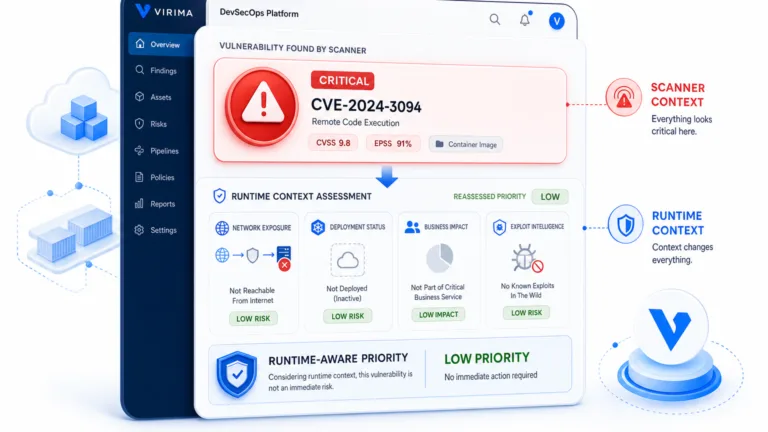
- Vulnerability context from NIST NVD on Windows Servers: Virima pulls NIST National Vulnerability Database CVE data and overlays that context onto ViVID™ maps for discovered Windows Servers. Teams can prioritize remediation using asset and business-service criticality alongside severity. This Windows Server overlay pairs with dedicated vulnerability management scanners when you need broader multi-OS coverage, and it does not require a separate Virima vulnerability license add-on for that overlay path.
Enhanced service mapping
Virima’s service mapping uses automated discovery data to build detailed application dependency maps after your team supplies service definitions (manually, by spreadsheet import, or through architecture tools such as Lean IX). Those maps show how components interact, which is the context you need when assessing change or incident impact on business services.
- High-frequency CMDB refresh cycles: Scheduled discovery scans keep the CMDB populated with accurate relationship and dependency data. CI records stay current between scan windows, which reduces manual errors and improves data integrity.
- Proactive incident management: By mapping business services to their CIs, Virima supports fast impact analysis during incidents. When a component fails, your team can assess which broader services are affected — leading to faster resolution.
- Change impact analysis: Service maps display pending changes alongside current configuration data. Teams see potential impacts before implementation, which improves coordination with stakeholders during the change approval process.
ViVID™ (Virima Visual Impact Display)
Good ITSM depends on clear visibility into your infrastructure. ViVID™ delivers that by overlaying ITSM incidents, changes, event management alerts, and NIST NVD vulnerability context for discovered Windows Servers onto the dependency maps built by Discovery and Service Mapping.
Here is why CMDB visualization through ViVID™ matters for ops teams:
- Dynamic CI mapping: ViVID™ maps configuration items and their relationships visually across multiple view modes, infrastructure relationships, application dependency mapping (ADM), communication flows, and network topology. During troubleshooting, your team sees exactly how components interconnect, no more tracing dependencies through raw database records.
- Intuitive interface: ViVID™’s design lets teams get productive quickly. Views are filterable, saveable, and shareable — so each stakeholder can personalize their heads-up display to match their role, whether they’re managing changes, triaging incidents, or reviewing vulnerabilities.
- Scheduled visual refresh: ViVID™ keeps visual data current through recurring scheduled scans, so teams can make decisions on maps that reflect the latest completed discovery cycle.
- Operational overlays: By displaying ITSM data (incidents, changes, problems) directly on the service map, ViVID™ gives ops teams the context to prioritize and respond without switching between tools. This capability is unique to Virima — standard service maps from other vendors do not include ITSM record overlays.
Bi-directional integration with ITSM platforms
Virima integrates bi-directionally with major ITSM platforms, including ServiceNow, Ivanti, HaloITSM, Jira Service Management, Xurrent, and Hornbill, with additional connectors available for other environments. See the full list of ITSM platform integrations for CMDB enrichment paths. Cherwell remains supported where customers still run it; prioritize active platforms in evaluation discussions. These connections are built on an open API layer, the same REST API asset management integrations that let you sync CI data with any platform, including custom internal tools.
- Operational insight for ITSM teams: ITSM data overlays on CIs in the CMDB, providing context during incident, change, problem, and vulnerability management. Teams see the full picture without switching between platforms.
- Faster MTTR: With accurate, complete CI data at hand, your team pinpoints affected systems faster during incidents. That cuts Mean Time to Repair (MTTR) and limits business disruption.
- PinkVERIFY ITIL 4 certified: Virima holds PinkVERIFY ITIL 4 certification covering service asset and configuration management (SACM), change management, incident management, problem management, request management, and knowledge management, independently validating that these processes meet ITIL best-practice standards.
What is the ROI of CMDB integration?
The return on CMDB integration shows up in three areas: faster incident resolution, fewer failed changes, and reduced audit preparation time.
Teams using accurate CMDB data typically see MTTR drop because dependency maps eliminate the guesswork during triage. Change failure rates decrease when the change advisory board reviews current impact data instead of stale records. And when audit time arrives, the CMDB provides the CI change history and relationship evidence auditors need, which can reduce weeks of preparation to days.
How Virima strengthens your ITSM operations through CMDB integration
Virima’s CMDB integration is built for teams that need accurate data, clear visibility, and smooth ITSM workflows. Automated discovery, ViVID™ visualization, and bi-directional ITSM sync work together so your CMDB stays reliable without constant manual upkeep.
For ops teams already running ServiceNow, Jira Service Management, or Ivanti, Virima plugs directly into your existing ITSM platform, enriching your CMDB with accurate discovery data and visual dependency context. Teams keep their existing ITSM platform without a rip-and-replace project, and without duplicate data entry between systems.
When you are ready to validate CMDB integration against your own hybrid estate, request a demo and walk through discovery, ViVID™ maps, and ITSM sync with your team.
CMDB integration FAQs
What is the difference between a CMDB and ITSM?
A CMDB stores configuration items and their relationships. ITSM is the process layer that includes incident, change, problem, and request workflows. The CMDB feeds those workflows with impact and dependency data so teams are not working from spreadsheets or memory during a priority incident.
Why do CMDB implementation projects stall?
Most programs struggle with stale data, incomplete discovery coverage, and low trust. When updates depend on manual entry, new assets never land in the database and relationships go missing. Automated discovery, clear ownership, and maps people actually use in tickets are what keep a CMDB alive after go-live.
How should a CMDB integrate with an ITSM platform?
Prefer bi-directional sync of CIs and relationships into the ITSM CMDB tables your incident and change workflows already use. Codeless mapping to standard and custom tables reduces import jobs and keeps ticket context aligned with the latest completed discovery cycle.
Does Virima replace ServiceNow or Jira Service Management?
No. Virima is built to enrich the ITSM platform you already run. Discovery-sourced CI and relationship data sync into tools such as ServiceNow and Jira Service Management so existing ticket and change processes operate on fuller dependency context without a rip-and-replace program.