Future-Proofing IT: ServiceNow CMDB Integration with Virima

| TL;DR – Summary of key takeaways ServiceNow CMDB integration with Virima enables accurate, reliable, and secure configuration management. Virima combines agent-based and agentless discovery to deliver complete CI data coverage. Integration also helps organizations achieve up to 40% cost savings and 82% fewer failed changes. ViVID™ visualizations and ADM improve decision-making, change planning, and root cause analysis. Virima also strengthens cybersecurity and compliance, a dimension many competitors overlook. Alternatives like DIY or iPaaS exist, but Virima offers a future-proof, purpose-built approach. Overall, for CMDB accuracy, automation, and ITSM/ITOM success, Virima is a top-tier integration partner. |
IT leaders are often searching for effective ways to integrate ServiceNow CMDB with asset discovery tools. Their goal: improve visibility, automate updates, and eliminate operational blind spots.
This blog explores how ServiceNow CMDB integration with Virima delivers on those needs. We explain the integration architecture and discovery methods. We also share real-world use cases. Finally, we compare integration options like native ServiceNow tools, iPaaS solutions, and DIY scripts.
Why choose ServiceNow CMDB integration with Virima?
The ServiceNow CMDB integrations are powerful. Further, they provide a high-frequency and accurate view of your IT setup. That visibility also helps improve change success, accelerate incident resolution, strengthen compliance, and reduce risk. With so many options available, choosing the right CMDB software for ServiceNow depends on how well a tool handles discovery, data quality, and ongoing synchronization.
Virima’s integration with ServiceNow CMDB includes reconciliation logic designed to prevent ServiceNow CMDB duplicate CIs by using attribute-based matching rules that identify existing records before creating new ones, ensuring clean bidirectional sync without manual deduplication overhead.
Improve incident resolution and root cause identification with CMDB data
With Virima’s fast and accurate IT discovery, data enters the CMDB. Plus, IT teams get quick and accurate insights into Configuration Items (CIs) and their dependencies. When integrated with problem management workflows, teams can identify root causes more effectively and reduce recurrence.
Reduce failed changes and prevent downtime in ServiceNow CMDB
Manually updated CMDBs are error-prone and also lead to failed changes or outages. Running data sync on a regular cadence with ServiceNow CMDB and Virima reduces failed changes by 82% (IDC White Paper: The Business Value of ServiceNow). This also improves change governance.
Cut IT costs and eliminate shadow IT with CMDB automation
Clean and accurate configuration data helps avoid duplication. It also reduces license bloat and improves asset lifecycle management.
this can lead to IT cost savings of up to 40%. (Forrester Total Economic Impact Report). With visibility across ITSM and ITOM processes, organizations can further eliminate blind spots and uncover shadow IT.
Virima’s integration capabilities extend beyond ServiceNow. Organizations running Atlassian’s JSM platform benefit from a purpose-built Jira integration that delivers the same discovery-backed CMDB enrichment, ViVID dependency views, and bidirectional sync that ServiceNow customers receive, ensuring multi-platform environments get consistent data quality regardless of which ITSM platform manages their workflows.
How ServiceNow CMDB integration works: Architecture and discovery
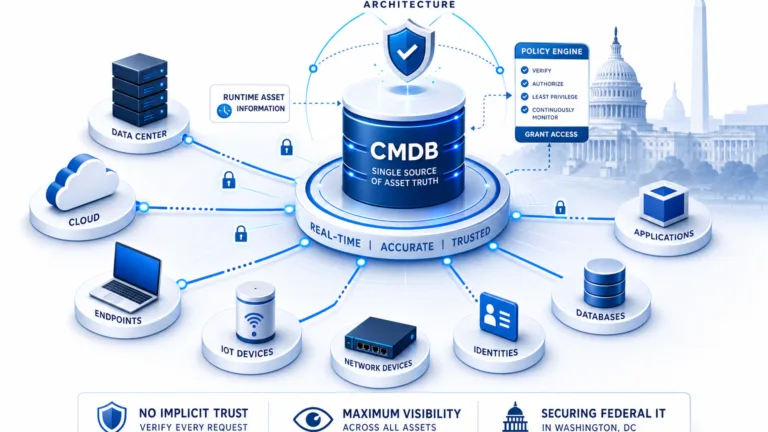
Behind every effective ServiceNow CMDB integration lies a robust architecture built for automation and scale.
Understand CMDB data flow with Virima integration
Virima collects CI data using both agent-based and agentless methods. It captures:
- Hardware specifications
- Installed software
- Network device settings
- Application dependencies
- Patch and vulnerability details
This data is then normalized and securely transferred to the ServiceNow CMDB using certified APIs. Subsequently, updates occur in near real time, keeping records fresh and accurate. For a detailed walkthrough of how the CMDB in ServiceNow stays synchronized with Virima’s discovery engine, see our step-by-step sync guide.
Combine agent-based and agentless discovery for complete coverage
- Agentless discovery scans across cloud, on-premises, and virtual machines without requiring installations, ideal for less intrusive environments.
- Agent-based discovery ensures constant monitoring, even if assets temporarily disconnect. Agents on Windows and Linux further report configuration changes.
By combining both, Virima ensures comprehensive coverage. Its built-in Application Dependency Mapping (ADM) automatically outlines service relationships, further enriching the CMDB.
Integration alternatives: iPaaS, DIY, or Virima?
When integrating with ServiceNow CMDB, IT leaders have several options. Each has trade-offs depending on your environment, resources, and goals. Here, let’s examine the most common alternatives:
Native ServiceNow tools (e.g., Discovery, Service Graph)
These built-in tools offer:
- Tight platform integration with ServiceNow’s CMDB structure and CSDM model.
- Out-of-the-box workflows that simplify basic discovery and integration.
Limitations:
- Coverage gaps in complex, hybrid, or multi-cloud environments.
- High implementation costs
- Limited flexibility when customizing CI data flows or integrating with non-ServiceNow ecosystems.
- May require additional licensing or configuration for advanced use cases.
iPaaS platforms (Integration Platform as a Service)
Examples: MuleSoft, Dell Boomi, Workato
iPaaS solutions provide:
- Broad, generic integration capabilities across SaaS apps, databases, and APIs.
- Visual low-code/no-code builders for connecting disparate systems.
Limitations:
- Lack of ITOM-specific intelligence (e.g., asset relationship mapping, application dependency modeling).
- Require custom mapping to align CI attributes with CMDB structure.
- Not purpose-built for high-frequency asset discovery or CMDB accuracy.
DIY Integrations (Custom scripts & ETL pipelines)
Some organizations build their own pipelines using Python, PowerShell, or data management tools to extract and populate CI data.
Benefits:
- Maximum control over data transformation logic and cadence.
- Potentially lower licensing cost (if built internally).
Limitations:
- High maintenance burden; DIY scripts can break with API changes or platform updates.
- Greater risk of managing data inconsistency due to manual mapping or scheduling failures.
- Difficult to scale across multiple data sources or discovery types.
Why Virima stands out
Virima offers a purpose-built integration approach that blends flexibility, speed, and ITSM depth:
- Fast time to value with minimal configuration effort.
- Agentless + agent-based discovery further ensures complete and continuous visibility.
- ViVID™ visualizations surface CMDB relationships, dependencies, and service impact clearly.
- ITOM-aligned architecture supports auto-synchronization, compliance, and near real-time CMDB updates.
- Designed for hybrid IT, cloud, and complex infrastructures where accuracy and automation matter most.
In short, iPaaS and DIY methods offer flexibility. ServiceNow tools provide basic coverage. However, Virima gives a secure, scalable solution. The design further meets the needs of modern IT operations. As IT environments evolve toward Agentic AI, having a discovery-grounded CMDB becomes the essential foundation for any autonomous workflow to act on trusted, real-time data. For a deeper comparison of the top options available today, explore our guide to the best CMDB software for ServiceNow users in 2026\.
Integrating with ServiceNow CMDB successfully requires more than just technical connectivity; it also requires a thoughtful strategy, disciplined data hygiene, and the right automation tools.
However, based on real-world examples and top implementations, here are the key best practices and challenges organizations should expect:
Best practices for ServiceNow CMDB integration
1. Run high-frequency discovery cycles
Manual CI data entry is labor-intensive; it’s error-prone and unsustainable. High-frequency discovery cycles: Tools like Virima eliminate this bottleneck by scanning IT environments on a high-frequency schedule and feeding accurate data into the CMDB.
2. Use both agentless and agent-based discovery
Hybrid environments demand flexible visibility. Agentless discovery is quick and non-invasive. It also works well for cloud or virtual asset management systems.
On the other hand, agent-based discovery provides deeper insights and high-frequency tracking. This is true even for endpoints that are temporarily offline. Also, combining both methods ensures no blind spots.
3. Support Application Dependency Mapping (ADM)
A CMDB is only as useful as its relationship data. ADM provides critical visibility into how apps and infrastructure interact. This further enables better impact assessment, change planning, and root cause investigations.
4. Align with the Common Service Data Model (CSDM)
The CSDM framework of ServiceNow defines how the CMDB should structure data. Ensuring your integration populates CIs according to CSDM practices improves downstream compatibility and data normalization. Teams that want to operationalize these standards day-to-day can benefit from configuring a dedicated CMDB workspace in the ServiceNow environment for managing CI health, data quality dashboards, and governance tasks in one place.
5. Schedule regular reconciliation and data cleansing
Even with automation, data drift can occur. Regular reconciliation helps detect stale, duplicate, or orphaned CIs. Integrations should support regular updates, de-duplication, and version tracking to maintain data health.
6. Integrate with security and compliance workflows
Discovery data can be leveraged beyond IT operations. By integrating CMDB updates with security tools and vulnerability databases (like NIST), organizations can also automate policy enforcement and risk response.
7. Build stakeholder consensus and governance
Integration isn’t just a technical exercise. Set up governance frameworks, assign data ownership, and include stakeholders from ITSM, ITOM, SecOps, and compliance. This will also help improve adoption and data accuracy.
Common challenges to watch for
Despite best intentions, several hurdles can disrupt integration efforts:
1. Incomplete CI coverage
Relying on a single discovery approach often results in missed assets, especially in hybrid or remote environments. This also leads to a fragmented CMDB and reduced value for service management ITSM workflows.
2. Siloed or inconsistent data
CI data may reside in multiple, disconnected systems. Without centralized integration, reconciling and validating CI records becomes a manual, error-prone task.
3. Complex toolchains
Many organizations use multiple monitoring, ticketing, and orchestration tools. However, integrating them all into the CMDB ecosystem requires careful planning and scalable architecture.
4. Lack of CSDM alignment
Failing to align with ServiceNow’s CSDM can result in misclassified CIs, incorrect relationships, and downstream reporting challenges.
5. Low stakeholder engagement
Without clear ownership and incentives, CI data stewardship often falls through the cracks. Also, stakeholders must understand the value of an accurate CMDB and be part of its ongoing maintenance.
How Virima helps overcome these challenges
Virima directly addresses these challenges with:
- Pre-built connectors for ServiceNow and other tools
- Fast and accurate, bidirectional synchronization of CIs
- Agentless \+ agent-based discovery to ensure complete coverage
- Integrated ADM and ViVID™ visualizations for actionable insights
- CSDM-ready structuring to ensure clean, consistent CMDB data
The result is a CMDB you can trust. Beyond that, the system fully automates processes, updates on a recurring schedule, and follows modern ITSM and ITOM best practices.
Automate ServiceNow CMDB updates to strengthen security and compliance
An accurate CMDB is key to both cybersecurity and compliance readiness.
Strengthen your cybersecurity posture with accurate CMDB data
Virima’s integration enhances ServiceNow CMDB through:
- Fast and accurate discovery of rogue or unauthorized assets
- Monitoring of configuration drift
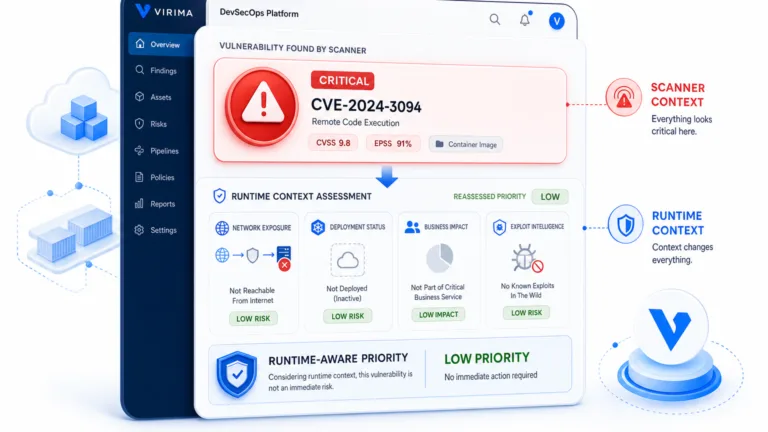
- Integration with the NIST vulnerability database for automated risk scoring (NIST NVD)
Security teams benefit from faster threat identification, prioritized remediation, and improved overall posture.
Ensure compliance with up-to-date CMDB records
Automated asset and change history logs support easier audits and continuous compliance. CMDB records that show high-frequency status further help reduce audit fatigue. They also help prove compliance with HIPAA, SOC 2, and ISO 27001 standards.
Visualize and analyze dependencies with ViVID™ for CMDB
Virima’s ViVID™ (Virima Visual Impact Display) gives teams interactive views into service dependencies, network topologies, and system relationships. When integrated into ServiceNow CMDB, it enables:
- Faster root cause detection
- Better impact analysis during change management
- Easier optimization of service performance
Overall, these insights improve cross-team collaboration and ensure all stakeholders understand IT interdependencies. For teams evaluating network topology mapping tools, ViVID™ goes beyond static diagrams by delivering continuously refreshed maps that reflect your live hybrid environment.
CMDB integration outcomes that matter
Boost change success rates with dependency awareness
ViVID helps visualize all affected components before implementing a change. This proactive insight reduces failure rates and validates CI accuracy.
Speed up incident resolution with CMDB intelligence
With accurate relationship mapping, support teams can identify incident impact faster and further resolve issues more efficiently.
Eliminate shadow IT by discovering and populating the CMDB
Virima uncovers unmanaged or untracked assets and automatically registers them in the ServiceNow CMDB, improving governance and further reducing risk.
Turn Your ServiceNow CMDB Into a Source of Trusted, Discovery-Backed Data
The ServiceNow CMDB integration with Virima does more than sync data. It gives you a foundation for faster, safer IT management.
From hybrid discovery and ADM to interactive ViVID views, Virima and ServiceNow together unlock transformative ITSM and ITOM capabilities. Whether your goal is modernization, compliance, or cost control, this integration lays a powerful foundation.
Ready to improve your CMDB data quality, high-frequency asset discovery, and eliminate blind spots? Book a demo to experience how ServiceNow CMDB integrations with Virima redefine what’s possible in IT service management.
Common questions about ServiceNow CMDB integrations (FAQs)
What is ServiceNow CMDB integration?
The process of linking ServiceNow’s Configuration Management Database CMDB with other systems or tools, like Virima, exists. This also helps automate the updating and management of configuration item (CI) data.
Why is CMDB integration important?
Integration ensures your CMDB is accurate, up-to-date, and useful. It further reduces manual entry, prevents data silos, supports compliance, and improves incident and change management workflows.
What are the challenges of ServiceNow CMDB integration?
Common challenges include incomplete discovery, data inconsistency, lack of stakeholder alignment, integration complexity, and keeping CI data current across hybrid environments.
How does Virima help solve integration problems?
Virima offers both agentless and agent-based discovery. It also provides ADM to visualize service relationships. Also, it ensures secure and automated syncing with the ServiceNow CMDB. This ensures comprehensive, accurate data.
Is Virima better than using ServiceNow Discovery or iPaaS?
Virima provides special benefits such as hybrid discovery, ViVID™ visualizations, and lower operational costs. This is better than iPaaS or basic native discovery tools, especially in complex or hybrid IT settings.
Can this integration support cybersecurity and compliance?
Yes. By maintaining up-to-date configuration data and integrating with the NIST vulnerability database, Virima’s discovery enhances cybersecurity readiness and simplifies audit compliance.