ServiceNow Adopters: Unlocking Discovery for Hybrid IT with Virima

Discovery for hybrid IT has become a critical factor in maintaining an accurate Configuration Management Database (CMDB) for organizations running both on-premises infrastructure and cloud environments. Closing that gap requires the right tool for the job. When your discovery foundation has gaps, every downstream decision carries hidden risk.
ServiceNow is a well-established platform in IT service management. Its native discovery tooling works for many environments but can be costly and complex to configure at scale. Organizations looking to extend their coverage, reduce cost, or fill gaps in cloud and on-premises visibility are increasingly evaluating complementary discovery solutions.
Virima’s hybrid IT discovery is built for exactly that situation. It works alongside ServiceNow, enriching your CMDB with discovery-driven data without duplicating effort or adding noise. This post explains what Virima brings to ServiceNow adopters, and why teams choose it.
The case for a cost-effective discovery for hybrid IT solution
ServiceNow Discovery offers solid out-of-the-box workflows for basic CMDB population. For many organizations, though, the licensing cost and configuration overhead of scaling it across complex hybrid environments prompts a search for alternatives or complements.
Virima fills that role. It provides discovery for hybrid IT that covers on-premises infrastructure, AWS, and Azure via API-based cloud discovery, and physical network assets, all in one platform. The data flows directly into your ServiceNow CMDB via a no-code ServiceNow integration, preserving your existing workflows while giving you a more complete asset picture.
The result is a CMDB that teams can actually trust, not one they have to audit quarterly just to catch what was missed.
What sets Virima’s discovery for hybrid IT apart
Virima combines agentless scanning and an optional Windows discovery agent to cover the broadest possible range of assets. Here is what that looks like in practice.
Hybrid environment coverage
Virima’s extendable probes scan from traditional data centers through to cloud platforms. Coverage spans on-premises servers, virtual machines, network devices, AWS resources, and Azure subscriptions. Every discovered asset feeds directly into your CMDB, keeping configuration item (CI) data fresh and accurate across the full estate. For teams looking to improve CMDB hygiene, the CMDB best practices guide covers the architectural patterns that make discovery-driven accuracy sustainable.
Secure by design
Virima runs on AWS infrastructure and enforces strict access controls and encrypted data transmission throughout the discovery process. Security teams can audit data sources at any time, with clear attribution on every CI showing exactly where each record originated.
Flexible discovery methods
Virima supports both non-invasive agentless scanning and an optional Windows Discovery Agent for deeper asset examination. That flexibility is important in hybrid environments where some assets are not reachable agentlessly. For a full breakdown of the tradeoffs, see the agent-based vs. agentless discovery comparison.
ViVID service maps for dynamic dependency visibility
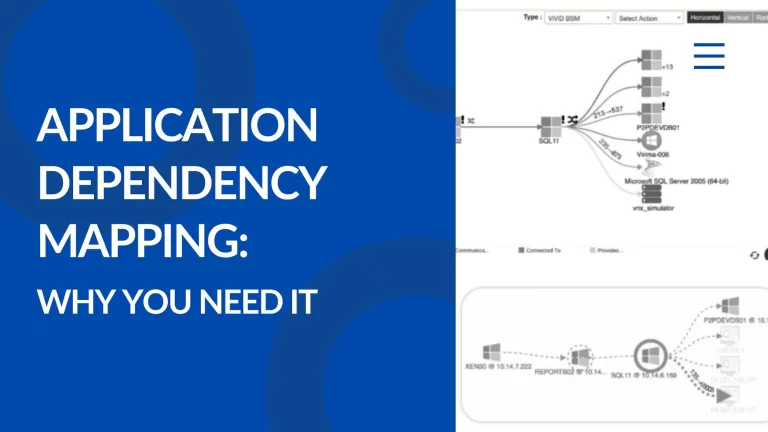
Once assets are discovered, Virima Visual Impact Display (ViVID) builds dynamic service dependency maps from that data. When you define a service (by manual input, spreadsheet import, or an integration such as Lean IX), ViVID maps the relationships between applications, servers, and infrastructure automatically. This turns static CMDB data into a visual tool for impact analysis and change planning.
Vulnerability intelligence with NIST NVD
Virima integrates vulnerability data from the NIST National Vulnerability Database (NVD) at the asset level. Every CI carries its associated CVE exposure, so security teams can prioritize remediation based on actual deployment context rather than a flat vulnerability list.
Integration with your existing ITSM toolset
Virima integrates with the major ITSM platforms your team already uses, ServiceNow, Ivanti, Halo, Jira Service Management, and Xurrent. This means the enriched discovery data lands in the workflows your team relies on, without requiring a platform switch. For more on the ServiceNow-specific integration architecture, see future-proofing your ServiceNow CMDB with Virima.
Beyond discovery: ITAM and license visibility
Virima’s IT Asset Management (ITAM) capabilities extend well beyond asset inventory. For ServiceNow adopters managing software licensing, hardware lifecycle, and financial forecasting, this is where the platform adds significant operational value.
Full asset lifecycle visibility
Virima tracks assets from procurement through end of life. Coverage spans data center hardware, network edge devices, cloud resources, stockroom inventory, and non-IT assets. For organizations running hybrid cloud environments, this breadth of coverage means fewer gaps in the financial model and more reliable depreciation schedules.
Software license tracking
Virima’s high-frequency discovery cycles track software license entitlements against actual installations at the device level. Each record includes ownership details and usage data, giving license managers a reliable foundation for software IT asset management decisions.
Cost control through license metering
The Windows Discovery Agent enables license metering, letting teams identify and reclaim underused software licenses across mobile or distributed device fleets. This is particularly useful for organizations where PCs move between sites and license counts drift out of sync with actual deployments.
ViVID in practice: from discovery for hybrid IT to operational intelligence
The real value of accurate discovery data becomes clear in three operational scenarios.
ITIL-aligned CMDB with service dependency visibility
Virima’s CMDB aligns with ITIL standards for service asset and configuration management. When ViVID maps service dependencies on top of discovery data, teams can visualize what will be affected by a given change before it happens, not after.
Proactive change impact planning
ViVID overlays planned ITSM changes onto the current dependency map. Teams can identify potential change collisions and resolve them before the change window opens, reducing unplanned disruptions.
Sharper vulnerability prioritization
With NIST NVD data mapped to specific CIs and their service relationships, security teams can rank vulnerabilities by actual business impact rather than CVE score alone. A critical vulnerability on an isolated test server is a different risk than the same CVE on a CI supporting a production payment service.
Building a more reliable CMDB alongside ServiceNow
Virima’s approach to discovery for hybrid IT is designed to complement ServiceNow, not compete with it. Organizations that have invested in ServiceNow workflows get a more complete and accurate data foundation without disrupting what is already working. The integration is no-code and bidirectional, so enriched CI data flows into ServiceNow while ITSM signals flow back to Virima for change context.
The combination addresses the core problem: ServiceNow workflows are only as reliable as the CMDB data underneath them. When discovery for hybrid IT is handled by a tool built specifically for that job, the CMDB stays current, service maps stay accurate, and teams spend less time reconciling data discrepancies.
IT teams managing complex hybrid estates need a CMDB that reflects reality. Virima delivers that foundation with high-frequency discovery cycles, flexible agent and agentless methods, and a direct integration path into your ServiceNow environment.
| What is discovery for hybrid IT? Discovery for hybrid IT is the process of automatically identifying and cataloging all IT assets, both on-premises and across cloud platforms like AWS and Azure, in a single unified inventory. It feeds accurate configuration item data into a CMDB so IT teams have a current, complete view of their infrastructure. |
| Does Virima replace ServiceNow Discovery? Virima does not replace ServiceNow. It complements it. Virima’s discovery for hybrid IT enriches the ServiceNow CMDB with additional coverage, especially in complex hybrid environments, at lower cost and without duplicating existing workflows. |
| How does Virima handle cloud discovery? Virima uses API-based discovery for AWS and Azure environments. It pulls resource inventory from cloud APIs and maps those assets as configuration items in the CMDB. On-premises assets are covered through agentless scanning and an optional Windows Discovery Agent. |
| What happens to existing ServiceNow CMDB data when you add Virima? Virima adds to your existing CMDB data rather than replacing it. The no-code integration writes enriched CI records into ServiceNow, filling gaps and updating stale records. Your existing configuration items, workflows, and relationships remain intact. |
Your next step toward discovery-driven CMDB accuracy
Accurate CMDB data starts with reliable discovery for hybrid IT. Virima gives ServiceNow adopters a cost-effective, flexible path to fuller asset coverage, dynamic service mapping, and vulnerability intelligence, all without disrupting what is already working in your environment.
If your CMDB has blind spots in your cloud estate or on-premises infrastructure, Virima can help close them. Explore discovery for hybrid IT on our features page, or take the next step below.
| See what discovery-driven CMDB accuracy looks like for your environment. Schedule a demo. |
Frequently asked questions
How does discovery for hybrid IT improve CMDB accuracy in ServiceNow?
High-frequency discovery cycles from Virima keep your CMDB current by scanning on-premises and cloud assets on a recurring schedule. Each scan updates CI records in ServiceNow with fresh data, catching new assets, configuration changes, and decommissioned items that native discovery might miss. Over time, this reduces the gap between what is in your CMDB and what is actually running in your environment.
Is Virima suitable for organizations with both on-premises and cloud assets?
Yes. Virima was built for exactly this scenario. It covers traditional data center infrastructure through agentless scanning, cloud resources in AWS and Azure through API-based discovery, and virtual machines, network devices, and edge assets across all of those environments. Everything feeds into a single unified CMDB view.
Does adding Virima require changes to existing ServiceNow workflows?
No changes to existing workflows are required. Virima’s no-code ServiceNow integration writes enriched CI data into the CMDB without modifying your incident, change, or problem management processes. Teams continue working in ServiceNow as normal, with better data underneath.
How does ViVID service mapping work alongside ServiceNow CMDB?
ViVID builds dynamic service dependency maps from Virima’s discovery data. You define the service composition, and ViVID maps the relationships between components automatically. Those maps can be used inside ServiceNow change workflows to identify blast-radius risk before a change window opens. For more on service mapping in this context, see ServiceNow Discovery vs. Service Mapping.