Virima vs Freshservice 2026: CMDB and ITSM compared

If you’re searching Virima vs Freshservice, something specific is usually broken. Probably this: Freshservice runs your service desk fine, but the CMDB has quietly become a fiction nobody updates, and the dependency map you need at 2 AM doesn’t exist. That’s the comparison most mid-market IT teams are actually having in 2026.
It got sharper after late 2024, when Freshworks acquired Device42 and shipped its first integration release within five months. Freshworks reported nearly 3x net new ARR from the unification in a single quarter. Device42 had its biggest quarter ever as a subsidiary. The signal was hard to miss: even Freshservice customers were outgrowing Freshservice’s native asset module.
So if you’re weighing whether to scale up Freshservice now that Device42 is folding in, or move asset intelligence to a platform built around it from day one, this is the comparison for you.
Full transparency: this is Virima’s take. We’ve tried to be fair about where Freshservice genuinely wins, and you’ll see those calls in the scorecard.
Virima vs Freshservice: the snapshot
Skim this before you read anything else.
| Dimension | Virima | Freshservice |
|---|---|---|
| Industry fit | Mid-market to enterprise, hybrid IT, regulated industries | Mid-market service desks, cloud-first teams, IT and shared services |
| Scalability | Built for 100k+ CIs and complex dependency graphs | Strong for ticketing at scale; native CMDB plateaus beyond mid-market |
| Core functionality | Discovery, CMDB, ViVID™ service mapping, ITAM, change risk analysis | ITSM workflows, ticketing, native CMDB, ITAM (Device42-powered on higher tiers) |
| AI and automation | High-frequency discovery cycles, confidence scoring, AI-ready CMDB | Freddy AI for ticket triage, summarization, agent assist |
| Entry cost | Annual subscription, starts at $15,000/year | $19/agent/month (Starter) up to ~$119/agent/month (Enterprise) |
| Best for | Teams whose asset reality is more complex than their ITSM admits | Teams whose primary IT job is running a great service desk |
What is Virima?
Virima is an IT asset intelligence platform built around three things most ITSM tools treat as afterthoughts: discovery, CMDB accuracy, and service dependency mapping. The product has been around since 2017 and sells primarily into mid-market and enterprise IT teams that need a defensible source of asset truth, not a help-desk-plus-asset-tracker.
Virima sits at 4.4/5 on G2 and Gartner Peer Insights as of March 2026 (Gartner profile), and 4.6/5 on Capterra (Capterra profile).
What Virima helps teams do:
- Run high-frequency discovery cycles across on-prem, AWS, Azure, and hybrid footprints. Agentless where it can, lightweight agents where it has to.
- Build a multi-source CMDB that resolves conflicts against rules you define.
- Visualize service dependencies with ViVID™, the interactive map that shows ownership, blast radius, and downstream impact.
- Manage hardware, software, and SaaS assets through their full lifecycle, with software usage metering tied to license records.
- Sync bidirectionally with popular ITSM platforms: ServiceNow, Ivanti, Halo, Xurrent, Jira Service Management, and TeamDynamix.
One reviewer on Capterra called Virima “a world-class ITAM/ITIL tool that will easily take market share from some of the big guns.” Another said the ViVID service maps were “the differentiator during our POC selection.” (Source: Capterra reviews)
Virima pricing
Virima is sold as annual subscriptions in three bundles: Discovery, ITAM, and MSP. You can buy them separately or combine them. Annual subscriptions start at $15,000/year, scaled by asset count (Virima pricing page).
- Discovery bundle. ITIL-compliant CMDB, agentless and agent-based discovery, ViVID service mapping, cloud discovery, application dependency mapping.
- ITAM bundle. Hardware and software lifecycle, software usage metering, license and certificate management, contract and vendor tracking, IT finance and procurement.
- MSP bundle. Multi-tenant environment, client-specific portals, CMDB-as-a-Service, flexible billing. Built for service providers.
Per-asset pricing isn’t published publicly. Most teams scope their bundles and asset counts with a Virima partner during evaluation.
What is Freshservice?
Freshservice is the IT service management product from Freshworks. It launched in 2014 as a cloud-native, easier-to-deploy alternative to ServiceNow, and that’s still its strongest argument. The platform unifies ITSM, ITOM, IT asset management, and enterprise service management on a shared data layer. It’s particularly strong with mid-market teams that want to go live in weeks rather than quarters.
Freshservice sits at 4.6/5 on G2 with thousands of reviews (G2 profile). Reviewers consistently praise the ease of use, mobile experience, and Freddy AI assistant.
What Freshservice helps teams do:
- Run a full ITSM service desk: incidents, requests, problems, changes, releases.
- Track basic IT assets with the included native CMDB.
- Run discovery and richer dependency mapping on Pro and Enterprise tiers (Device42-powered since the late-2024 integration release).
- Automate ticket routing and approval workflows.
- Extend into HR, finance, and facilities with Enterprise Service Management.
- Get AI assistance through Freddy for ticket summarization, agent reply suggestions, and triage.
Freshservice pricing
Per-agent, per-month, billed annually (Freshworks pricing page):
- Starter. $19/agent/month. Ticketing, knowledge base, basic SLA management.
- Growth. $49/agent/month. Automation, custom roles, marketplace apps.
- Pro. $99/agent/month. Project management, advanced analytics, IT asset management (Device42-powered), problem and release management.
- Enterprise. Custom (typically around $109 to $119/agent/month). Freddy AI, audit logs, sandbox.
Two things worth knowing before you sign. First, monthly billing runs meaningfully higher than annual; most published Freshworks tiers carry roughly 17 to 35% annual discounts. Second, real-world TCO tends to land well above sticker once you add Freddy AI sessions, orchestration transactions, and asset-count overages (see this Freshservice TCO breakdown).
Who buys Virima vs Freshservice?
These tools attract different buyers, which is why most Virima vs Freshservice evaluations are run against the wrong baseline.
Who buys Virima?
- IT Directors and IT Asset Managers at organizations with hybrid IT (on-prem plus multi-cloud).
- Compliance and GRC leaders preparing for SOC 2, ISO 27001, or sector audits.
- Change advisory boards that need real dependency maps before approving infrastructure changes (Virima’s change management use case).
- MSPs managing many client environments who need a multi-tenant CMDB.
Why they choose it: their asset reality is more complex than what their ITSM platform admits. They need a CMDB that reflects what’s actually running, not what someone typed into a form last quarter.
Who buys Freshservice?
- IT service desk managers and IT operations leads at SMBs and mid-market.
- HR, finance, and facilities teams piggybacking on IT’s service platform (the ESM use case).
- Cloud-first companies that don’t want a heavy on-prem ITSM.
- Teams replacing Zendesk or basic ticketing tools with something more IT-shaped.
Why they choose it: time to value. Freshservice goes live in weeks. Most teams need a service desk, and Freshservice gives them one without a six-figure implementation.
Virima’s key features
ViVID Service Mapping. This is what shows up in customer quotes more than anything else. ViVID converts CMDB relationship data into interactive topology maps you can filter by service, owner, application, or business function. When something breaks, you see the blast radius. Before approving a change, you see who’s affected. A Virima customer on Capterra called it “the differentiator during our POC selection.”
High-frequency discovery cycles. Virima runs discovery agentlessly where it can (WMI, SSH, SNMP, cloud APIs) and uses lightweight agents only where it has to. Confidence scoring tells you how fresh each CI’s data is. When an AI agent or a human asks Virima for runtime truth, the platform refreshes on demand rather than scanning everything 24/7.
Multi-source CMDB. Most CMDBs are good at one source. Virima’s CMDB ingests from Virima Discovery, SCCM, Intune, AWS, Azure, vCenter, and your ITSM platform, then resolves conflicts against rules you define. The output is a CMDB that holds up between audits.
Bidirectional ITSM sync. Virima syncs with ServiceNow, Ivanti, Halo, Xurrent, Jira Service Management, and TeamDynamix. Your service desk keeps using its familiar interface while pulling in accurate asset and dependency data underneath.
ITAM with software usage metering. Lifecycle, license, and contract management isn’t a checkbox. It’s tied to discovered usage. You see which licenses are actually used, which ones aren’t, and where you can reclaim spend (more on Virima ITAM).
Freshservice’s key features
Service desk done well. This is Freshservice’s foundation and where reviewers consistently rate it highest. Ticket workflows, SLA management, knowledge base, agent collaboration. All of it just works, and the UI is friendly enough that non-IT users (finance, HR, facilities) don’t push back.
Freddy AI. Freshservice’s AI layer summarizes long tickets, suggests responses, drafts knowledge base articles, and routes incoming tickets to the right agent. G2 reviewers call it useful for triage but inconsistent on complex cases.
Device42-powered ITAM (Pro and Enterprise). Since the late-2024 integration release, Freshservice’s higher tiers carry Device42’s discovery and dependency mapping capabilities. This is the biggest change in Freshservice’s competitive story in years, though it’s gated to those tiers and reviewers are still working out how deep the integration goes today versus what’s on the roadmap (background on the Device42 deal).
Marketplace and integrations. Freshservice has a large app marketplace and connects natively with Slack, Microsoft Teams, Jira, GitHub, and dozens of others. Custom integrations work, though reviewers note that less common platforms can be friction.
Enterprise Service Management. HR, finance, facilities, all run on Freshservice’s shared platform. Reviewers love this for the price; it’s hard to find another ESM platform at this entry point.
The common ground between Virima and Freshservice
Both products live in adjacent neighborhoods, so the Virima vs Freshservice debate has real overlap. Here’s where.
CMDB
Freshservice has one. Virima has one. The difference is depth and freshness. Freshservice’s native CMDB is fine for tracking what assets exist; Virima’s CMDB reflects what’s actually running and how it connects. With Device42 powering Freshservice’s higher tiers, the gap narrows, but the discovery engine still sits in Device42, with its own console and licensing math.
Dependency mapping
Virima has ViVID. Freshservice has Device42’s mapping on Pro and Enterprise. Both produce service dependency mapping. ViVID lives inside the same platform you use for CMDB and ITAM, with ownership pop-ups baked into the map. Device42 mapping is powerful but bolted onto Freshservice; the user experience depends on how completely Freshworks has stitched them together at the moment you’re evaluating.
ITAM
Both handle hardware and software inventory. Virima goes deeper on software usage metering and license optimization. Freshservice’s ITAM is broader for non-IT assets (laptops issued to HR, conference room equipment) because Freshservice doubles as an ESM platform.
What real users say
When teams reach the Virima vs Freshservice decision, customer voices tend to settle it. Here’s what they say.
Virima customers consistently flag service mapping and CMDB accuracy as the reasons they chose the platform. One reviewer on Capterra: “The business service maps are a great visual representation of your CMDB. That was the differentiator for Virima during our POC selection.” Another: “Ease of deployment. Virima got customers up and running in no time.” (Source: Capterra reviews)
Freshservice users praise the UI and time-to-value. On G2, ticketing, asset tracking, and Freddy AI rank highest. Two complaints show up repeatedly: pricing tiers gate critical features behind Pro and Enterprise, and the native CMDB hits limits for complex environments. Reviewers also note that organizations with highly customized requirements often hit walls with Freshservice’s customization model (Source: G2 pros and cons).
For mid-market teams running a relatively flat environment, Freshservice handles both jobs fine. For teams whose infrastructure isn’t flat (multi-cloud, regulated, growing fast), the CMDB limitations become real friction. That’s the moment Virima enters most conversations.
What key problems does each solve?
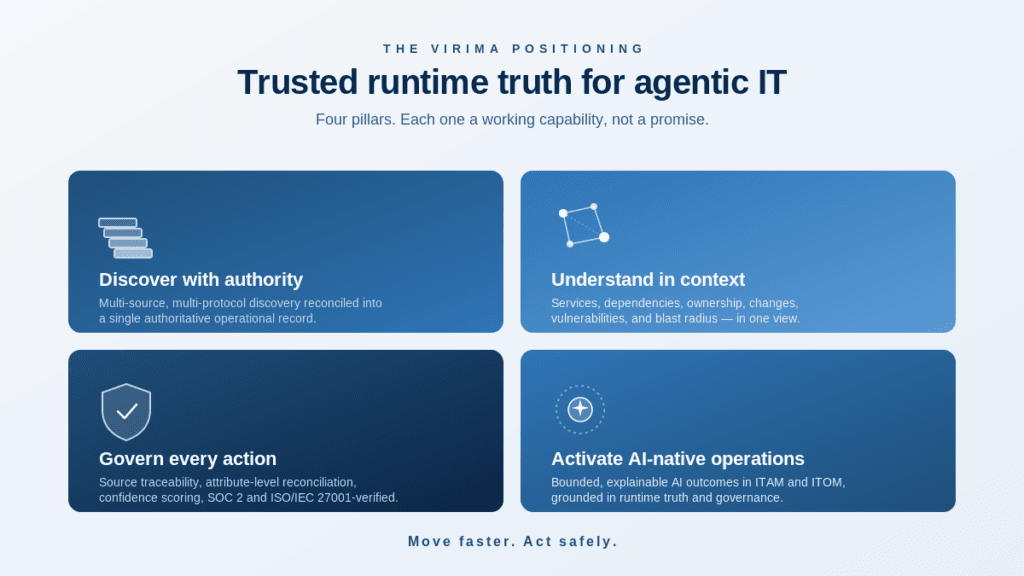
Virima is your dependency-mapping infrastructure
Use Virima when you need to know what depends on what, and you need that map to match reality.
- ViVID blast-radius visualization for change approval and incident triage.
- Multi-source CMDB that holds up between audits.
- High-frequency discovery cycles with confidence scoring for AI-ready data.
- Bidirectional ITSM sync so your service desk keeps its familiar interface.
Freshservice is your modern service desk
Use Freshservice when the primary job is running a great ITSM experience for IT and adjacent teams.
- Fast time-to-value. Most teams go live in weeks, not quarters.
- Freddy AI for ticket summarization and triage.
- ESM. Extending the service desk into HR, finance, and facilities.
- Marketplace with hundreds of integrations.
- Predictable per-agent pricing that scales with your team.
Virima vs Freshservice: decision scorecard
We scored both products on the dimensions IT Directors and ITAM leaders actually weigh during a POC. Virima wins where you’d expect (discovery, CMDB, mapping). Freshservice wins where you’d expect (service desk, time-to-value, pricing transparency).
| Dimension | Virima | Freshservice | Verdict |
|---|---|---|---|
| Asset discovery depth | ★★★★★ | ★★★ (★★★★ on Pro+) | Virima. Discovery is the core product, not a tier upgrade. |
| Service dependency mapping | ★★★★★ | ★★★ | Virima. ViVID™ is the most consistently praised feature in reviews. |
| CMDB accuracy at scale | ★★★★★ | ★★★ | Virima. Multi-source ingestion and conflict-resolution rules. |
| Service desk usability | ★★★ | ★★★★★ | Freshservice. UI and time-to-value are hard to beat at this price. |
| AI and automation | ★★★★ | ★★★★ | Tie. Virima for data freshness, Freshservice for ticket workflows. |
| Time to go live | ★★★★ | ★★★★★ | Freshservice. Most teams go live in weeks. |
| Enterprise CMDB scalability | ★★★★★ | ★★★ | Virima. Built for 100k+ CIs and dense dependency graphs. |
| Pricing transparency | ★★★ | ★★★★ | Freshservice. Published per-agent pricing. |
Choose Virima if: you need defensible asset and dependency data for change management, audit prep, or incident response, and your environment is more complex than a basic service desk can map.
Choose Freshservice if: your primary need is a modern, fast-to-stand-up service desk, and your CMDB requirements are basic enough that the native tools (or Device42 on Pro and Enterprise) cover you.
Your evaluation checklist
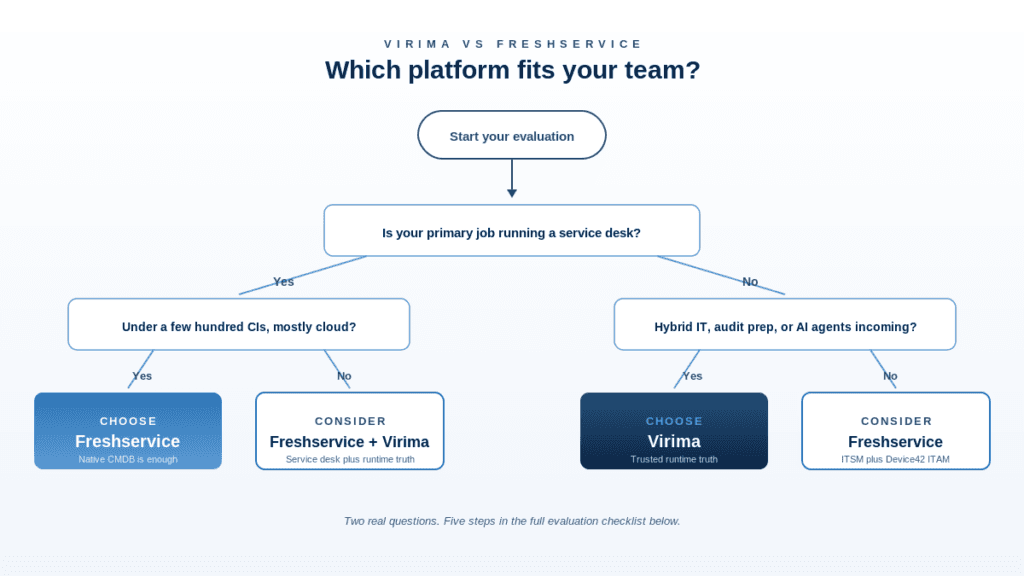
Most teams making the Virima vs Freshservice call do it wrong. They map features against tiers, run a 30-minute demo, and end up surprised six months in. Here are the five steps that actually settle it.
1. Pull your top 50 CIs and walk the dependency map. In both products, list your 50 highest-stakes assets and ask the platform: what depends on this? If the answer is “nothing” for half of them, you have a discovery problem, not a tooling problem.
2. Time a real incident scenario. Pick a recent P1 you’d want to handle better. Walk through it in each platform’s UI. How many clicks to see what’s affected? How fresh is the data the platform shows you?
3. Run the audit prep test. Ask each platform to produce your last quarter’s software license utilization, change-record-to-CI linkage, or asset lifecycle report. Whichever one ships you a clean PDF in 15 minutes wins your audit team.
4. Price the real shape of your team. Freshservice scales with agent count; Virima scales with asset count. If you’re 12 agents managing 8,000 CIs, those two pricing models will diverge wildly. Build a CMDB cost model against both before you sign.
5. Talk to a customer at your size. Both vendors will introduce you. Ask the reference customer one question: what surprised you in year two? That’s the answer that matters.
Where to go from here on Virima vs Freshservice
If you’re still inside Freshservice’s sweet spot (ticketing, ESM, mid-market scale, a CMDB that doesn’t need to back up audit findings), Freshservice is a defensible choice and you should stay where you are.
If your CMDB has become a fiction and your change advisory board is making decisions on dependency maps that haven’t been updated since the last reorg, that’s the moment Virima earns its place in the Virima vs Freshservice debate. Book a Virima walkthrough. Bring your messiest service. We’ll map it together.
Virima vs Freshservice FAQs
Does Virima integrate with Freshservice?
Not natively today. Virima’s bidirectional ITSM integration list is ServiceNow, Ivanti, Halo, Xurrent, Jira Service Management, and TeamDynamix. Some teams run Freshservice for ticketing alongside Virima for asset intelligence using API-based data sharing, but it isn’t a turnkey integration.
Does Freshservice’s Device42 acquisition close the gap?
It narrows the gap on discovery and dependency mapping for teams on Pro and Enterprise tiers. The story is still maturing; Freshworks shipped its first integration release in late 2024 and continues to fold Device42 capabilities into Freshservice’s UI. For teams who want a unified, discovery-first asset intelligence platform today rather than waiting for the integration to mature, Virima is a faster answer.
Which is better for a small IT team?
Freshservice. Per-agent pricing makes sense for small teams, and the native CMDB is sufficient for environments under a few hundred CIs.
Which is better for regulated industries?
Virima, particularly when audit prep, software license compliance, and change risk analysis matter. The CMDB accuracy story is the differentiator.
Can I use both Virima and Freshservice?
Some teams do, though without a native Freshservice integration on Virima’s side, you’ll be working through APIs and operational handoffs rather than a turnkey sync. If you’re evaluating both, the cleanest Virima vs Freshservice resolution is usually to commit to one platform for the layer you care about most: ITSM workflow with Freshservice, or asset intelligence with Virima.
Is Virima a Freshservice alternative for CMDB?
Yes, when your CMDB needs outgrow what Freshservice’s native CMDB or even Device42-powered tiers can deliver. Virima is purpose-built around CMDB accuracy and service dependency mapping, whereas Freshservice treats CMDB as one module among many. Teams making this Virima vs Freshservice call for CMDB reasons usually land on Virima.
Top patterns detected and fixed: