Virima vs BMC Helix 2026: which CMDB and ITSM platform should you choose?

Virima vs BMC Helix comes down to scope, evidence model, and price point. BMC Helix is the enterprise-suite play for organizations that want one vendor running ITSM, Discovery, and CMDB end-to-end. Virima delivers trusted runtime truth for agentic IT — a multi-source CMDB and ViVID™ service mapping that show what exists, how it’s connected, what changed, what could break, and who owns it — for mid-market IT teams enriching the ITSM tool they already use, at significantly lower TCO.
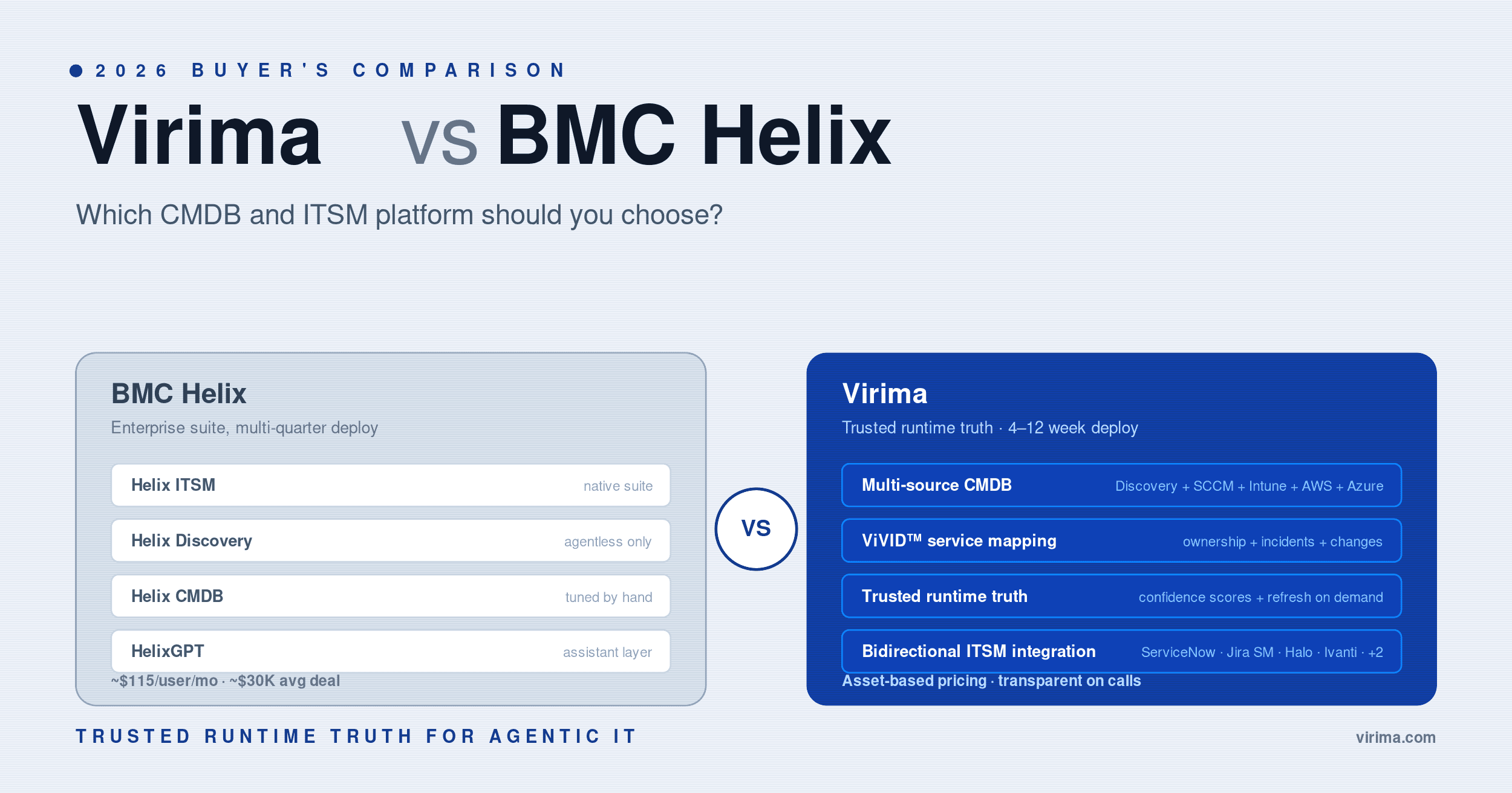
BMC Helix has been one of the heavyweight CMDB and ITSM platforms for two decades. The list price reflects that pedigree. According to procurement data from Vendr aggregated in SmartSuite’s 2026 BMC Helix pricing review, BMC Helix ITSM runs around $115 per named user per month, with annual deals averaging $30,000.
For mid-market IT teams sitting under a Director or IT Asset Manager, that math gets harder. The pattern shows up across G2, Gartner Peer Insights, and vendor comparison roundups: high TCO, long deployment cycles, and a platform that often does more than the team needs.
Virima plays the same game from a different starting position. By the end of this Virima vs BMC Helix comparison, you’ll know which platform fits your team, what each genuinely does well, and what to ask on a demo.
Why IT teams compare Virima vs BMC Helix in 2026
Most Virima vs BMC Helix conversations start the same way. A mid-market IT Director needs an accurate CMDB and service map this quarter. The ITSM tool is already in place. The team is small. And the BMC quote came back with a six-figure professional services line item.
That’s the buying context this Virima vs BMC Helix comparison is written for. Both platforms are credible. They solve overlapping problems. But they solve them at very different price points, deployment timelines, and operating models. So the right BMC Helix alternative depends on which trade-offs your team can absorb.
Virima vs BMC Helix at a glance
| Dimension | Virima | BMC Helix |
| Best industry fit | Mid-market to enterprise IT, hybrid estates | Large enterprise, regulated industries |
| Scalability | Scales to enterprise; lighter to deploy | Scales deep; needs a dedicated team |
| Core functionality | Discovery, multi-source CMDB, ViVID™ service mapping, trusted runtime truth | ITSM, Discovery, CMDB suite |
| AI readiness | Trusted runtime truth grounding for AI agents | HelixGPT assistant layer |
| Entry cost | Asset-based pricing, transparent on calls | ~$115 per named user/month; not publicly posted |
| Implementation | 4–12 weeks typical | Multi-quarter engagement with professional services |
| Best for | IT teams enriching existing ITSM with accurate CMDB data | Large enterprises standardizing on the BMC stack |
What is Virima?
Virima is an IT visibility platform that combines discovery, a multi-source CMDB, and ViVID™ service mapping to deliver trusted runtime truth for agentic IT. The result is one view where IT teams see what they have, how it connects, who owns it, and what’s at risk. No enterprise software project required to get there.
It holds a 4.6 out of 5 rating on Capterra across reviews that consistently call out ease of deployment, responsive support, and reasonable pricing. The buyer is usually an IT Director, IT Asset Manager, Service Owner, or Infrastructure Manager. Plus CISOs and compliance leaders who need auditable, discovery-sourced records for IT audits and vulnerability tracking.
Here’s what teams typically use Virima for:
- Discovery across hybrid IT — agentless, agent-based, and API-based methods that find devices, applications, services, and cloud workloads on the same pass.
- Multi-source CMDB — live, reconciled CI data drawn from Virima Discovery plus connectors to SCCM, Intune, AWS, Azure, and other sources of operational truth. Use it to build a CMDB in weeks, not quarters.
- ViVID™ service mapping — visual service mapping that overlays ownership, open incidents, recent changes, pending changes, and known vulnerabilities directly on the topology.
- Trusted runtime truth — confidence scores flag when data is getting stale, with refresh on demand so AI agents and humans know whether the data is fresh enough to act on.
- Bidirectional ITSM integration — with ServiceNow, Ivanti, HaloITSM, Xurrent, Jira Service Management, and TeamDynamix.
Virima pricing
Virima uses asset-based pricing. Discovery, CMDB, and maps ship together — they ship together. See Business Pro for packaging; confirm details on a call. Capterra reviewers often cite value-for-money and ease of deployment as renewal themes; treat third-party review sites as directional, not a price sheet.
What is BMC Helix?
BMC Helix is the cloud-native suite from BMC Software: Helix ITSM, Helix Discovery, Helix CMDB, plus HelixGPT for AI workflows. It’s the modern packaging of a product line that has been in market since the Remedy days. The platform holds a 4.2 on Gartner Peer Insights and a 3.7 on G2.
The pattern across both review sites is consistent. Reviewers praise breadth of capability and the support team’s responsiveness. Plus they flag deployment time, training overhead, and TCO as the recurring trade-offs. Which is why a BMC Helix alternative (or specifically a BMC Helix CMDB alternative) often comes up in 2026 evaluations.
Here’s what Helix typically delivers:
- Helix Discovery — agentless discovery for multi-cloud, hybrid, and on-prem environments, with NIST STIG-hardened virtual appliances and FIPS 140-2 encryption.
- Helix CMDB — a deep CI data model with reconciliation and normalization rules.
- Helix ITSM — native incident, problem, change, and request management.
- Dynamic service modeling — service maps generated from discovered relationships.
- HelixGPT — generative AI layer for assist, summarize, and search workflows.
BMC Helix pricing
BMC doesn’t publish list prices. But third-party aggregators put Helix ITSM at around $115 per named user per month, roughly 18–21% above ITSM-tool industry averages per Vendr’s deal data. Average annual contracts run near $30,000. And the starter bundle reportedly opens at $50,000 because professional services are required to stand the platform up.
Who chooses Virima vs BMC Helix?
Different buyer profiles, different decision pressures. So before any BMC Helix comparison turns into a buy decision, it’s worth being honest about which side of the line your team sits on.
Who chooses Virima
- IT Directors and IT Asset Managers in mid-market and enterprise organizations (500–10,000 employees is the sweet spot, though Virima runs well beyond that).
- IT Operations leaders, Service Owners, and Infrastructure Managers who need accurate CMDB data enriching their existing ITSM tool.
- CISOs and compliance leaders focused on auditable, discovery-sourced records for vulnerability management and change management.
- Teams that already pay for ServiceNow, Jira Service Management, or another ITSM platform and don’t want to rip and replace.
Who chooses BMC Helix
- Large enterprises (typically 5,000+ employees) with dedicated ITSM and platform teams.
- Organizations already standardized on the BMC stack — TrueSight, Discovery, or Remedy heritage.
- Regulated industries with deep customization needs and the budget to fund a multi-quarter implementation.
- IT teams that want incident, problem, change, request, and CMDB managed from a single vendor.
Honest note: many organizations run a CMDB platform alongside an established ITSM tool. That’s where Virima slots in cleanly. It enriches the ITSM workflows already in place rather than competing with them.
Virima’s key features
Virima delivers on three things every IT team and AI agent needs: discover with authority, understand in context, and govern every action. Here’s how each shows up in product.
Multi-source CMDB (discover with authority)
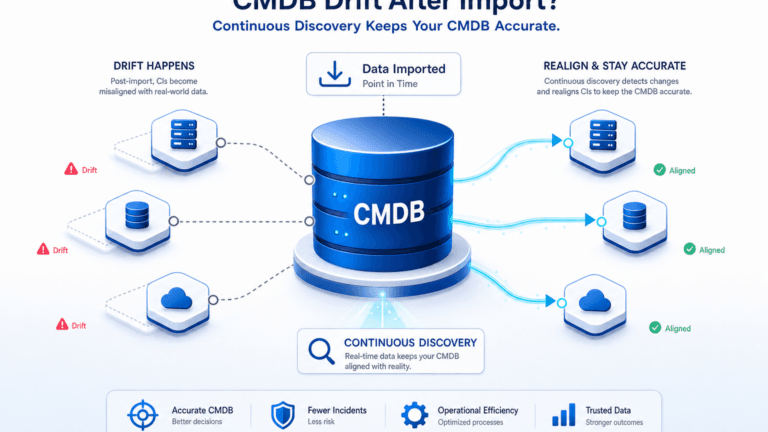
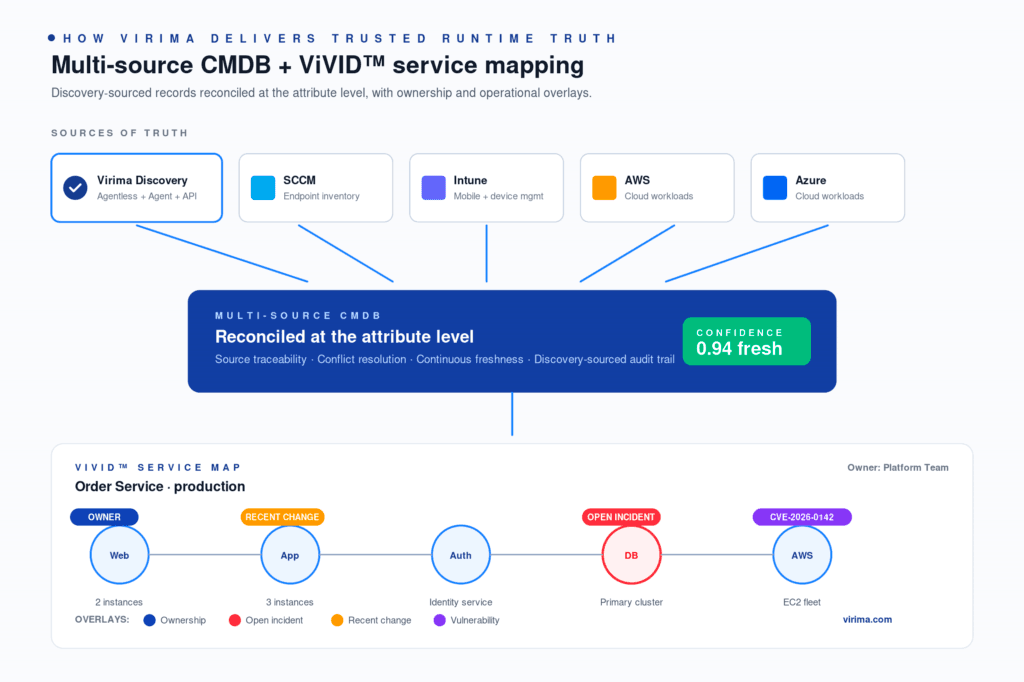
Most CMDBs ingest from one discovery source and hope. Virima’s CMDB takes feeds from Virima Discovery plus connectors to SCCM, Intune, AWS, Azure, and other authoritative sources, then reconciles them into a single record at the attribute level. The result is fewer duplicate CIs, fewer arguments about which source is right, and less noise downstream. Plus a CMDB that doesn’t degrade six weeks after deployment.
ViVID™ service mapping (understand in context)
ViVID turns the CMDB into a heads-up display. Service maps show topology. But they also show ownership, open incidents, recent changes, pending changes, and known vulnerabilities, each overlay pinned to the specific CI it applies to. So when an incident lands, the team sees who owns the affected systems, what changed near them, and the blast radius without flipping between four tools.
Trusted runtime truth (the foundation)
Trusted runtime truth means knowing what exists, how it’s connected, what changed, what could break, and who owns it — sourced from authoritative multi-source discovery, not workflow logs or static records. Every CI record carries a confidence score; when confidence degrades, Virima refreshes on demand. AI agents (yours, ours, or a customer’s) can ask: “Is this fresh enough for the decision I’m about to make?” and either get a refresh or a graceful warning that the data is stale.
Four things make this claim credible:
- Source traceability — every CI traces back to its discovery source, protocol, and timestamp.
- Multi-source reconciliation — when sources disagree, the most authoritative value wins at the attribute level.
- Freshness — continuous discovery reflects what’s actually running now, not a snapshot from last quarter.
- Impact mapping — every asset connects to the services and people it affects, with blast radius visible at change time.
On top of that, SOC 2 Type 2 and ISO/IEC 27001:2022 certifications independently verify the process that produces the truth.
High-frequency discovery cycles
Agentless, agent-based, and API-based discovery across hybrid estates. Credentials, schedules, and conflict resolution don’t require a consultant to tune. Most teams start seeing discovered assets within the first day or two.
Governance and auditability (govern every action)
Trust has to be operational, not just a marketing word. Virima makes that visible through role-based permissions tied to existing identity providers, encrypted credentials, explainable AI recommendations that cite their source data, and discovery-sourced audit trails that map cleanly to SOC 2 and ISO/IEC 27001:2022 evidence requirements. Every action is traceable. Every recommendation is reviewable.
Bidirectional ITSM integration
Virima has bidirectional sync with ServiceNow, Ivanti, Halo, Xurrent, Jira Service Management, and TeamDynamix. Plus one-way connectors for AWS, Azure, SCCM, Intune, and other cloud and endpoint sources.
BMC Helix’s key features
Helix Discovery
Agentless discovery for multi-cloud and on-prem, with a hardened virtual appliance and granular access control. According to Gartner Peer Insights reviews, accuracy is strong once the platform is fully tuned. The “fully tuned” part is what takes time.
Helix CMDB
A deep data model with reconciliation and normalization rules. Customization is genuinely deep. If your environment is unusual, BMC will likely accommodate it. The trade-off: “deep” means “tuned by hand,” and that hand-tuning is where consultant hours stack up.
Helix ITSM
Native incident, problem, change, and request management with a polished UI in the newer modules. For organizations that want one vendor running every part of the service desk, this is the play.
Dynamic service modeling
Service maps built from discovered relationships. Detailed and accurate when modeling is invested in. Teams report it works best with dedicated service-mapping owners.
HelixGPT
The AI assistant layer for Helix. Useful for analyst-side workflows like summarization, ticket assist, and search.
Where Virima and BMC Helix overlap
Both platforms cover discovery, CMDB, service mapping, and ITSM integration. Where they diverge is how they get there. So the Virima vs BMC Helix decision comes down to how each platform handles the same four jobs.
Discovery
Helix Discovery uses an agentless model with a hardened appliance and broad cloud coverage. Meanwhile, Virima combines agentless, agent-based, and API-based discovery so teams pick the right method per environment, and use all three on the same estate when needed.
CMDB
Helix CMDB is the deep enterprise model, configured by hand to match the customer’s environment. In contrast, Virima CMDB ingests from multiple sources by default and reconciles on the way in. So less hand-tuning before the data is usable. For mid-market teams looking at a BMC Helix CMDB alternative, that ingest-and-reconcile model is usually the deciding factor.
Service mapping
Helix builds detailed dynamic service models for teams willing to invest in modeling. Virima’s ViVID™ adds the ownership, incident, change, and vulnerability overlays that turn a map from “what connects to what” into “what should I do next.”
ITSM
This is where the two platforms part ways philosophically. Helix wants to be the ITSM tool. Virima wants to make the ITSM tool you already use smarter.
What real users say about Virima and BMC Helix
A pattern shows up across G2, Gartner Peer Insights, and aggregated comparison reviews.
BMC Helix wins on breadth of capability and quality of support. Reviewers consistently flag the support team as responsive. They flag the platform as battle-tested. Where the rating dips is around UI age in some modules, training time for new admins, and the consulting overhead required to keep the platform tuned.
Virima wins on time-to-value and pricing transparency. Capterra reviewers (4.6/5 average) call out ease of deployment, fast support, and clear pricing as repeat themes. The flagged areas are smaller: UI polish in a few corners, plus depth-building in some advanced enterprise features that BMC has had for decades.
The takeaway: BMC is the platform you pick when you want everything from one vendor and you have the team to absorb the operating cost. Virima is the BMC Helix alternative you pick when you want trusted runtime truth, an accurate CMDB, and a service map you can actually use, without the multi-quarter project to get there.
What key problems Virima and BMC Helix each solve
BMC Helix: your enterprise battleship
Helix is the platform for organizations that want one ITSM-and-CMDB stack from one vendor. Deep customization. Mature integrations across the BMC product line. And a dedicated platform team to run it. If the IT operating model is “we configure the platform to match the org,” Helix is built for that.
Virima: trusted runtime truth for agentic IT
Virima plugs into whatever ITSM tool the team already pays for. Then it adds the operational context that ITSM platforms don’t natively provide: a multi-source CMDB that knows what exists, ViVID™ service mapping that shows how it’s connected and who owns it, confidence scores that flag what’s getting stale, and governance that makes every action auditable. If the IT operating model is “we keep what works and make it smarter — with guardrails AI agents can actually use,” Virima slots in.
Decision scorecard: Virima vs BMC Helix
| Dimension | Virima | BMC Helix | Verdict |
| Discovery coverage | 4 / 5 | 4 / 5 | Tie. Both cover hybrid IT well. |
| Multi-source CMDB accuracy | 5 / 5 | 4 / 5 | Virima. Multi-source ingest plus confidence scores. |
| Service mapping clarity | 5 / 5 | 4 / 5 | Virima. ViVID™ overlays add ownership and operational context. |
| Implementation time | 5 / 5 | 2 / 5 | Virima. 4–12 weeks vs. multi-quarter engagements. |
| ITSM breadth (native) | 3 / 5 | 5 / 5 | BMC. Helix ITSM is a full native suite. |
| Pricing transparency | 4 / 5 | 2 / 5 | Virima. Asset-based, on a call vs. RFP. |
| AI agent readiness | 5 / 5 | 4 / 5 | Virima. Trusted runtime truth grounds agent decisions. |
| Governance and explainability | 5 / 5 | 4 / 5 | Virima. Source traceability, audit trails, SOC 2 + ISO 27001. |
| Total cost of ownership | 5 / 5 | 2 / 5 | Virima. Faster time to value at significantly lower TCO. |
Choose BMC Helix if you’re a large enterprise that wants one vendor running ITSM, Discovery, and CMDB. And you’ve already invested in the BMC stack or have a platform team that can run it long-term. The depth is real, and so is the operating cost.
Choose Virima if you need trusted runtime truth grounded in a multi-source CMDB and ViVID™ service mapping that enriches the ITSM tool you already pay for. With discovery, deployment, and ongoing maintenance that don’t require a consulting engagement to keep running.
Next steps for evaluating Virima vs BMC Helix
If you’re evaluating BMC Helix alternatives for a 2026 platform decision, the next move is a side-by-side BMC Helix comparison on your actual environment, not a feature-list exercise. Bring a few representative CIs, your ITSM platform, and the question you’re actually trying to answer. So you can see how the data flows before you sign anything. For broader context, see Virima’s Device42 vs BMC discovery comparison too.
Move faster. Act safely. Book a Virima demo . Review Business Pro, then see how trusted runtime truth — multi-source CMDB, ViVID™ service mapping, discovery-sourced confidence scores, and bidirectional ITSM integration — comes together in 30 minutes.
FAQ
Can Virima replace BMC Helix entirely?
For organizations that need ITSM, Discovery, and CMDB from a single vendor, no. Virima isn’t a native ITSM ticketing platform. For organizations that want to replace Helix Discovery and Helix CMDB while keeping (or moving to) a different ITSM tool, yes. That’s a common Virima deployment, and a frequent path for teams looking for a BMC Helix CMDB alternative.
Does Virima work alongside BMC Helix?
Virima focuses bidirectional integrations on ITSM platforms including ServiceNow, Ivanti, Halo, Xurrent, Jira Service Management, and TeamDynamix. So customers running Helix typically use Virima alongside it for multi-source CMDB and ViVID™ service mapping.
How long does Virima take to deploy compared to BMC Helix?
Virima deployments typically run 4–12 weeks, with discovered assets appearing within the first day or two. BMC Helix deployments run multi-quarter engagements with required professional services to stand the platform up.
Is Virima as secure as BMC Helix?
Both platforms support enterprise security requirements. BMC Helix Discovery uses NIST STIG-hardened virtual appliances and FIPS 140-2 encryption. Virima enforces role-based permissions tied to existing identity providers, encrypted credentials, and discovery-sourced audit trails, with SOC 2 Type 2 and ISO/IEC 27001:2022 certifications verifying the process. For most mid-market and enterprise IT environments, both meet the bar.
What’s the difference in Virima vs BMC Helix pricing?
BMC Helix runs around $115 per named user per month with annual deals near $30,000, and pricing is not publicly posted. Virima uses asset-based pricing, published transparently on calls, with no separate licensing for discovery, CMDB, or service mapping.