ServiceNow Implementation Best Practices: How to Optimize ServiceNow for Your Organization

Go-live week exposes the gap. The ServiceNow project plan is green, the first incident and change workflows are configured, and the CMDB still carries last quarter’s owners, missing edges, and CIs that never survived the import. ServiceNow remains the system of engagement. The practices below keep the rollout sequenced correctly: CMDB accuracy before heavy workflow build, phased modules, limited custom code, and change management beside the technical work.
| When ServiceNow is the desk of record but go-live still inherits stale CIs and weak blast radius, start with discovery-backed accuracy under that desk. Explore Trusted Runtime Truth. |
What are ServiceNow implementation best practices?
ServiceNow implementation best practices are the sequencing and governance rules that keep a rollout from stalling. The highest-impact rule is CMDB accuracy before workflow configuration: clean CI records, relationships, owners, and service maps first, then phase modules, limit custom code, and run change management beside the technical build.
Does Virima replace ServiceNow in an implementation?
No. ServiceNow remains the system of engagement for ITSM workflows, tickets, and the CMDB of record. Virima supplies multi-method discovery and multi-source inventory on high-frequency scheduled cycles, then syncs CI context into ServiceNow so go-live and later waves sit on current owners, edges, and maps.
Three paths for ServiceNow implementation programs. Stay on ServiceNow alone when ITOM Discovery (or equivalent) already keeps in-scope CIs current, health dashboards drive remediation, and early waves do not stall on missing owners or edges. Pair ServiceNow with discovery-sourced inventory when the desk is correct as the system of engagement, but go-live and later modules still inherit stale CIs, duplicate rows, and incomplete relationship maps. Choose a multi-desk discovery layer when ServiceNow sits beside Jira Service Management, Ivanti, HaloITSM, Xurrent, or another desk and the same CI and map context must travel across systems of engagement. Virima does not replace ServiceNow. Confirm desk coverage on the integrations hub.
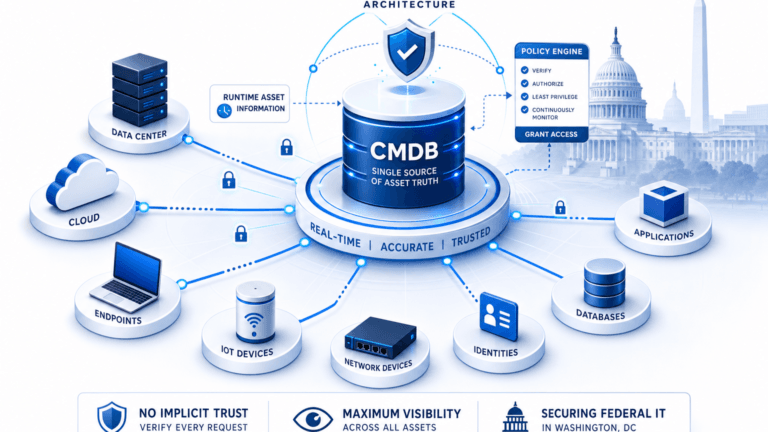
Federal asset-visibility guidance, including CISA Binding Operational Directive 23-01, treats complete asset visibility as a prerequisite for vulnerability and operations programs. That is the same bar ServiceNow implementations face when discovery and CMDB readiness lag the workflow build.
ServiceNow implementation best practices are the sequencing rules that decide whether your rollout succeeds or stalls. The most important rule gets skipped most often: establish CMDB accuracy before you configure workflows, not after. Get that order right, and almost everything downstream gets easier.
The stakes are clear. Gartner found that only about 25 percent of organizations get meaningful value from their CMDB, and poor configuration data quality is a leading reason ITSM investments fall short. So the data layer is not a side task , it is the foundation on which everything else stands.
Many IT leaders know the pattern well. Your organization invests in ServiceNow and expects faster service and clear returns. Within months, duplicate CMDB records pile up. Platform updates break critical processes. Your team spends its days on cleanup instead of innovation. Adoption stalls, and people quietly slip back to old workarounds.
This outcome is common, not rare. Research points to two recurring causes: poor configuration data quality and excessive customization. In 2026, a third risk now compounds both. Teams that add AI agents to ServiceNow without governed CMDB data set themselves up to fail at scale. An agent acting on stale records does not make one wrong call , it repeats that call at machine speed.
This guide gives you a defensible plan: a sequencing framework, a CMDB readiness checklist, a module selection guide, cost and timeline benchmarks, and industry-specific guidance. You will also see how Virima provides the discovery-driven data foundation ServiceNow needs to deliver value early.
| Most important ServiceNow implementation best practice: Validate CMDB data before any dependent workflow goes live. Workflows built on accurate configuration items produce trustworthy outputs. Workflows built on bad data produce confident, wrong answers. Discovery-sourced CI records, named ownership, and freshness timestamps are the minimum viable foundation before go-live. |
Key Takeaways
- CMDB accuracy is a prerequisite, not a post-launch chore. Workflows that rely on CI data produce wrong outputs when records are wrong.
- Most organizations underuse their investment. Favor out-of-the-box functionality before custom builds to lower risk.
- Heavy customization creates technical debt. Custom code often breaks during biannual upgrades, so customize with a clear reason.
- Phased rollout tends to beat big-bang. Wave 1: ITSM. Wave 2: Problem and Change. Wave 3: ITOM and ITAM.
- AI agents need governed CMDB data. Four prerequisites: provenance, policy attributes, named ownership, and freshness timestamps.
- Plan realistic timelines. Expect 6 to 12 weeks for a focused single-module deployment and 6 to 12 months for a full enterprise rollout.
- Budget by scope. Mid-market projects commonly fall in the $150K to $500K range.
Sequence Your Data Before Your Workflows
Most ServiceNow methodologies treat data quality as a parallel track, addressing it alongside workflow configuration rather than before it. This framework flips that order with one rule: no workflow goes live until its data foundation has been validated.
The framework runs in three stages. Each one has a clear gate that ties IT discovery completion to workflow readiness.
| Stage | Action | CMDB Gate | Workflow Goes Live When |
| Stage 1: Foundation | Run scheduled discovery scans. Load CI records and relationships. | Minimum viable CI accuracy for ITSM modules is validated | Incident-routing CI data is confirmed accurate for the target scope |
| Stage 2: Expansion | Add service catalog, change, and problem management | CI relationships for in-scope services are mapped and verified | Service-to-CI mappings are accurate for each catalog item in scope |
| Stage 3: Agentic Readiness | Enable AI automation and agentic workflows | CI records carry provenance, policy, ownership, and freshness metadata | All four readiness attributes are present for CIs in automation scope |
Teams that follow this sequence tend to report higher change success rates and faster incident resolution. For broader context on how IT operations and service management interact, see our dedicated guide.
CMDB Accuracy as an Implementation Prerequisite
Most plans treat CMDB best practices as a post-launch optimization. Teams configure workflows, build catalogs, train users, and deploy. Then they spend 12 to 18 months fixing data problems that grow with every new workflow. This sequencing is backwards.
You should establish CMDB accuracy before, or alongside, workflow configuration. Every ServiceNow workflow that relies on CI data produces wrong outputs when records are inaccurate , that includes incident routing, change impact analysis, service health, and compliance reporting. For supporting context, the EMA ServiceOps research report shows how central discovery and CMDB maturity are to operational outcomes.
What CMDB data do you need before a ServiceNow go-live?
Before the first workflow wave, you need discovery-sourced CI records for in-scope assets, relationship and dependency edges, named owners, and service-to-CI maps for catalog items. For agentic or automated paths, add provenance, policy attributes, ownership, and freshness timestamps so agents do not act on stale rows at scale.
Pre-Go-Live CMDB Readiness Checklist
This checklist sets a minimum viable data foundation for each workflow before that workflow goes live. You expand the foundation as scope grows.
| CMDB Readiness Item | Required Before | Owner |
| Run scheduled discovery scans across in-scope environments (on-prem, AWS, Azure) | First change workflow | CMDB / Discovery Lead |
| Validate CI relationship data (parent-child, dependency) | Service catalog go-live | CMDB / Discovery Lead |
| Confirm every CI has a named ownership record | Change Management enablement | IT Asset Manager |
| Verify CI attribute completeness above 90% for in-scope modules | Incident routing activation | CMDB / Discovery Lead |
| Map service definitions to supporting CI relationships (ViVID™ Service Mapping) | Service catalog items | Service Mapping Lead |
| Enable scheduled discovery scans and delta validation | Sustained operations | IT Ops / Platform Admin |
| Add provenance metadata to CI records (source system and authority level) | AI / agentic automation | Platform Architect |
| Add policy attributes to CIs (change tier, impact threshold) | AI / agentic automation | Change Manager |
| Add freshness timestamps to all CIs in automation scope | AI / agentic automation | Platform Architect |
Virima’s ServiceNow integration supports this approach with a no-code discovery layer. It populates accurate CI records and relationship data into the ServiceNow CMDB before and throughout the lifecycle. For additional context on ServiceNow CMDB best practices , including health scoring and ownership governance , see our dedicated guide.
| How does CMDB accuracy affect ServiceNow implementation success? Poor CMDB data quality is the leading cause of ServiceNow implementations failing to deliver full value. Gartner research shows only about 25% of organizations reach meaningful CMDB value. Workflows built on inaccurate CI records produce wrong incident routing, failed change approvals, and unreliable compliance reporting , regardless of how well the workflows themselves are configured. |
ServiceNow Module Selection Guide
ServiceNow offers a broad suite of modules. Selecting the right set and sequencing it well is one of your most consequential decisions. This table outlines key modules, their CMDB dependency, and the recommended wave.
| Module | Primary Use Case | CMDB Dependency | Wave | Start OOTB? |
| ITSM | Incident, problem, change, request | Medium (CI routing, change impact) | Wave 1 | Yes |
| Service Catalog | Self-service request workflows | High (service-to-CI mapping) | Wave 1-2 | Yes |
| ITOM | Event management, discovery, service mapping | Very high (core CMDB consumer) | Wave 3 | Yes |
| ITAM | Hardware and software asset lifecycle | High (CI accuracy critical) | Wave 3 | Yes |
| HRSD | Employee onboarding, HR cases | Low (minimal CI dependency) | Wave 3-4 | Yes |
| CSM | Customer service, case tracking | Low to medium | Wave 3-4 | Yes |
| GRC / SecOps | Risk, compliance, vulnerability | High (CI plus ownership mapping) | Wave 2-3 (regulated: Wave 1) | Yes |
How to Build a ServiceNow Project Plan with Milestones
A strong project plan needs more than dates on a calendar. It needs a roadmap that ties goals to milestones and accounts for data, integrations, and governance from the start.
1. Define Clear Objectives
Start with what you want ServiceNow to achieve. Common goals include faster incident resolution, centralized asset data, and automated change approvals. Set measurable targets before you touch configuration. Vague goals like ‘improve IT efficiency’ become scope creep by Week 3. Specific goals like ‘cut mean time to resolution by 30 percent within 90 days’ become accountable targets.
2. Engage Key Stakeholders Early
Bring stakeholders in from day one. Include service desk staff, IT managers, process owners, and business leaders. Their input builds buy-in and prevents surprises after go-live. Misaligned expectations cause more delays than technical failure does.
3. Assess Your IT Environment
Understand your current infrastructure before you decide how ServiceNow fits in. Many teams struggle with disconnected systems that produce poor data and partial visibility. An agent-based vs. agentless discovery assessment helps you choose the right scanning approach for your environment.
4. Plan Integrations Before Configuration
Identify which tools must connect with ServiceNow: discovery tools, CMDB data sources, HR systems, and monitoring platforms. Integrations with Jira, Xurrent, and Ivanti are common first considerations. When you plan integrations early, ServiceNow becomes a true single source of truth rather than another silo.
5. Build a Phased Roadmap
Break the work into phases: design, build, test, train, and go-live. Add interim milestones such as configuration completion, training, and pilot launches. A phased approach lets you test and refine at every stage, reducing risk instead of betting on one big launch.
11 Best Practices for Implementing ServiceNow Successfully
Implementing ServiceNow is not purely technical. It also takes strong project management, smart process design, data governance, and change management. The following 11 practices give your team the highest leverage.
1. Define the Scope and Business Problem Clearly
Many implementations fail because the design does not reflect a shared definition of success. Set clear boundaries and measurable objectives before any configuration begins.
- Be specific: ‘cut incident resolution time by 30 percent’ or ‘replace five legacy help desks with ServiceNow ITSM.’
- Engage support teams, asset managers, and business units to surface their top pain points.
- Decide which services to roll out first. Start where poor service delivery is most visible.
- ViVID™ service mapping shows service dependencies and identifies quick wins before configuration begins.
2. Develop a Detailed Project Plan
Treat your rollout as a formal project with timelines, milestones, and accountable owners. Assign a dedicated project manager, secure an executive sponsor, and form a cross-functional team.
- Outline required resources: administrators, developers, process owners, and consulting budget.
- Add buffer time for unexpected challenges or scope changes.
- List every system that must connect to ServiceNow.
- Plan data migration explicitly, and assign a CMDB data owner from day one.
3. Select the Right Solutions for Your Needs
ServiceNow offers many modules. Your goal is not to use them all at once. Focus on modules that match your immediate objectives, then follow the module guide above.
- Use guided setup and ITIL-aligned templates for incident, problem, change, and request.
- Do not roll out every module at the same time. Succeed in critical areas first, then expand.
- If asset tracking is critical, bring IT asset management into scope and pair it with discovery from Virima to improve accuracy and coverage.
4. Provide Thorough Training and Change Management
No implementation succeeds without engaged, trained people. Training and change management drive adoption directly. According to a ServiceNow analysis of key success metrics (July 2024), change success rate and portal adoption are the first indicators that training investment is paying off.
- Communicate the benefits before go-live to win buy-in.
- Run a pilot with a small group to gather feedback and build advocates.
- Create role-based training , admins, developers, and end-users need different content.
- Stand up a strong support channel so users get quick answers after launch.
5. Engage Stakeholders Throughout the Process
Stakeholder engagement is not a one-time task. Involve department heads, process owners, and IT leaders in status meetings, design reviews, and testing across the full lifecycle.
- Set up a steering committee with IT and business leaders to resolve priority conflicts.
- Name an executive sponsor who supports the work visibly. Projects without sponsorship tend to underperform.
- Involve frontline staff in feedback loops, and invite agents to workshops and UAT sessions.
6. Use Out-of-the-Box Functionality First
ServiceNow’s out-of-the-box (OOTB) features cover incident, change, and the service catalog with ITIL-standard workflows. These are tested starting points for most deployments.
- OOTB functions keep working across upgrades because ServiceNow maintains them.
- Custom code often breaks after updates, which creates rework for your admins.
- Leaning on OOTB wherever possible reduces the technical debt that custom code accumulates.
7. Customize Wisely and Keep It Simple
Some customization will be necessary. The key is to customize with a clear purpose and documented justification. Favor configuration over code, and work through this checklist before approving custom development.
- Is this feature on the ServiceNow roadmap for the next release?
- Could this script break during a standard biannual upgrade?
- Can low-code Flow Designer logic meet the requirement instead?
- Is the long-term maintenance cost lower than the short-term build cost?
A governance board for customization requests helps prevent ad-hoc changes that compound technical debt.
8. Ensure Data Quality from the Outset
ServiceNow implementations succeed or fail largely on data quality. That covers CMDB records, user data, and process data. Accurate, consistent information is the foundation for reliable operations and trustworthy reporting.
- Before importing data, remove duplicates, fix errors, and standardize field values.
- Define clear standards for important fields, then enforce them with validation rules and mandatory fields.
- Use the Identification and Reconciliation Engine (IRE) to merge multiple sources against your rules.
- Schedule regular data audits to catch CIs without owners, uncategorized incidents, and stale records.
9. Use a Phased Go-Live and Monitor Closely
When you go live, avoid turning ServiceNow on for everyone at once. A phased rollout is safer, easier to manage, and tends to produce better adoption metrics.
- Wave 1: Incident Management and Service Catalog. Sets ServiceNow as your system of record and generates quick wins.
- Wave 2: Problem Management and Change Management. Once incidents are stable and CI relationships are verified, mature your ITIL processes. Understanding the relationship between change management and configuration management is critical at this stage.
- Wave 3: ITOM and ITAM. Both need clean CMDB data, so earlier waves are a structural prerequisite.
- Wave 4: HRSD and GRC/SecOps where applicable. These benefit from earlier governance patterns.
10. Stay Current with Releases and Features
ServiceNow delivers two major releases each year. Staying current keeps your platform aligned with new capabilities, security fixes, and AI features.
- Plan to adopt at least one major release per year to keep support eligibility.
- Older versions lose vendor support over time, raising security and compatibility risk.
- Staying current keeps the platform ready for new automation features as they mature.
ServiceNow’s Zurich and Australia releases expand agentic AI capabilities across incident triage, change advisory automation, and predictive impact analysis. These features depend on CI records that carry provenance, ownership, and freshness metadata. Teams without a governed CMDB foundation will find these capabilities unavailable or unreliable from day one. The CMDB readiness checklist in this guide covers the four attributes required before turning agentic features on.
11. Embrace Continuous Improvement
Go-live is not the finish line. The strongest organizations treat ServiceNow as an ongoing investment and iterate on workflows, data quality, and capabilities based on real performance data.
- Set a quarterly cadence for platform health reviews.
- Make changes in small, testable cycles.
- Use Performance Analytics to find optimization opportunities, like an approval step slowing resolution.
Agentic IT Readiness: What the CMDB Needs for AI Automation
In 2026, the data-foundation gap has a second dimension: agentic IT readiness. Teams adding AI agents to ServiceNow need more than CI attribute values. They need four classes of metadata for each CI in automation scope.
| What does the CMDB need before enabling AI agents? Before enabling AI agents, every in-scope CI needs four things: provenance metadata (source and authority level), policy attributes (change tier, impact threshold), named ownership (who is accountable), and freshness timestamps (when was this last discovery-validated). Without them, agents act on data of unknown reliability at machine speed. |
| Attribute Class | What It Means | What Happens Without It |
| Provenance metadata | Source identity and authority level for each CI attribute | Agents act on data of unknown reliability from manual entries or conflicting sources |
| Policy attributes | Change tier and impact threshold for each CI | Agents apply one default tier to everything (risky) or require manual approval for all (no value) |
| Ownership records | A named accountable owner for each CI | Automated decisions go ungoverned, audit trails break, and compliance frameworks fail |
| Freshness validation | Timestamp of the most recent discovery validation | Agents act on data that may not match current state , changes and new deployments stay invisible |
Teams that establish these four classes before enabling automation are better positioned for reliable outcomes. This is directly tied to how your organization can build a CMDB that supports autonomous operations.
Industry-Specific Implementation Priorities
The best practices above are universal. Even so, the sequencing of specific modules and governance varies by industry.
Financial Services and Banking
Compliance and regulatory mandates drive sequencing here. Move GRC modules into Wave 2 rather than Wave 3. Banks also need tight integration between ITSM and audit workflows to show control effectiveness.
The EU Digital Operational Resilience Act (DORA) has applied to in-scope financial entities since January 2025. It requires firms to demonstrate operational resilience across IT systems. Map CI ownership and change history to DORA reporting from the first wave.
Healthcare and Life Sciences
GxP compliance for pharmaceutical organizations requires validation of system changes under GAMP 5 guidelines. Every configuration change must be documented and tested before production. FDA 21 CFR Part 11 requires electronic signatures and timestamped audit trails for system changes.
ServiceNow supports these needs through audit logging, but your CI ownership records must be accurate for that evidence to hold up.
Manufacturing and Industrial Operations
Operational technology and IT convergence keeps accelerating. IT asset management becomes a Wave 2 priority for organizations with distributed equipment. Discovery should reach beyond traditional IT to include IoT devices and industrial control systems where network access allows.
When you tie Field Service Management to CMDB-backed asset records, field technicians work from accurate equipment data.
ServiceNow Implementation Cost and Timeline Benchmarks
Cost and timeline are the two questions executives ask first. The benchmarks below reflect commonly cited industry ranges. Your numbers will vary with scope, data readiness, and integration complexity.
| Scope | Typical Timeline | Typical Cost Range | CMDB Readiness Impact | Risk Level |
| Single module, single department | 6-12 weeks | $50K-$150K | Low (focused CI scope) | Low |
| Multi-module ITSM (Incident, Problem, Change, Catalog) | 3-6 months | $150K-$350K | Medium (CI relationships for change impact) | Medium |
| Mid-market enterprise (ITSM + ITOM + CMDB) | 6-9 months | $350K-$500K | High (discovery-driven data before ITOM go-live) | Medium to high |
| Full enterprise rollout (ITSM + ITOM + ITAM + HRSD + GRC) | 9-18 months | $500K-$2M+ | Very high (multi-source discovery and full CI governance) | High without CMDB-first approach |
ServiceNow Implementation KPI Tracking Framework
Tracking the right metrics is one of the most overlooked best practices. It keeps stakeholders accountable, surfaces adoption problems early, and proves value to executives.
| KPI | Definition | Baseline Target | Where to Track | Cadence |
| MTTR | Average time from incident creation to resolution | Target 20-30% reduction in 90 days | Performance Analytics | Weekly |
| Change Success Rate | Percent of changes with no unplanned incidents within 7 days | Above 95% for standard changes | Change Management dashboard | Per release |
| CMDB Accuracy Score | Percent of in-scope CIs with validated relationships and named ownership | Above 90% for ITSM; above 95% before ITOM | Virima / CMDB Health dashboard | Weekly |
| Portal Adoption Rate | Percent of tickets created via self-service | 40% or more within 60 days | Service Portal analytics | Weekly |
| SLA Compliance Rate | Percent of incidents resolved within SLA | Above 90% in the first quarter | SLA dashboards | Daily / Weekly |
| CSAT | Post-resolution survey score | Above 4.0 out of 5.0 in Q1 | Survey module | Monthly |
| Knowledge Deflection | Percent of self-service searches that resolve without a ticket | 20-30% within 90 days | Knowledge Management analytics | Monthly |
What Most Implementations Miss: The Data-Layer Gap
Most implementations focus on workflow configuration. Teams spend months designing approval chains, catalog items, and routing rules. Yet they routinely miss the layer that feeds every workflow: the CMDB.
The CMDB is not just a feature to configure. It is the operational truth layer that decides whether your workflows make correct calls. A change workflow built on accurate CI relationships sends managers to the right impact analysis. The same workflow built on stale data approves changes that break services nobody expected to touch.
Why do ServiceNow implementations miss full value?
Most shortfalls trace to a data-layer gap and over-customization, not missing UI configuration. Teams configure incident and change on incomplete CIs, then spend months on cleanup. Sequencing discovery and CMDB health before heavy workflow build reduces failed changes, MTTR noise, and rework after go-live.
That is the gap in most implementations. Teams build strong workflow infrastructure on a data layer nobody has owned. Gartner’s research links poor CMDB data to failed changes and missed MTTR targets. Reviewing ServiceNow CMDB best practices early in planning helps you close that gap before it forms.
| Why do ServiceNow implementations fall short of full value? Two causes account for most underperformance: poor CMDB data quality and excessive customization. Gartner found only ~25% of organizations get meaningful value from their CMDB. Implementations that skip a discovery-driven data foundation before workflow go-live build technical debt into every process from day one. |
How Virima Strengthens Your ServiceNow Implementation
Virima helps you build a trusted data foundation in ServiceNow faster and with less manual effort. It works as the complementary discovery and data layer for the platform.
Discovery and CMDB Population
IT discovery with Virima identifies and catalogs assets across on-premises, AWS, and Azure environments using agent-based scanning, agentless IP scanning, and API integrations. Accurate CI data enters the ServiceNow CMDB without spreadsheet imports or manual entry.
ViVID™ Service Maps
Once you provide service definitions, ViVID™ service mapping builds and maintains dynamic dependency maps from discovered data. ViVID™ also overlays open incidents, pending changes, and Windows Server NIST NVD vulnerabilities at the CI level , so change managers and responders get impact context in one view.
Codeless ServiceNow Integration
Virima’s ServiceNow integration is no-code. Pre-built blueprints map to ServiceNow tables, including custom objects. Bi-directional sync keeps both platforms consistent. Business rules automate CI promotion and CMDB maintenance without custom development.
Scheduled Discovery and Delta Validation
Virima runs scheduled scans on a recurring cadence. When assets change, discovery data flags the delta against what the CMDB currently records. This keeps the CMDB trustworthy over time. Virima also integrates bi-directionally with ServiceNow, Ivanti, HaloITSM, Jira, and Xurrent.
Benefits of Following These Best Practices
- More efficiency and productivity. Streamlined workflows cut time on repetitive tasks, so your team focuses on high-value work.
- Higher adoption. Clean data and proper training drive use. When the system is accurate and intuitive, people rely on it.
- Better decisions from better data. Clean CMDB data lets leaders decide with confidence, because dashboards reflect reality.
- Less risk, downtime, and cost. Accurate impact analysis reduces failed changes, and avoiding heavy customization lowers upgrade rework.
- Agentic IT readiness. A trusted data foundation positions you to enable AI workflows safely as those capabilities mature.
For broader context, new EMA research on ServiceOps ties shared visibility and discovery maturity to better resilience and faster resolution.
Walk one of your own ServiceNow go-live or early-wave paths with discovery-sourced CI context under the desk you already run. Leave with a clearer picture of how much rework and missing-CI risk your implementation sequence can still remove.
Keep ServiceNow as the desk. Sequence the data layer so go-live holds
ServiceNow implementation best practices succeed when CMDB readiness, phased modules, limited custom code, and ownership stay ahead of the workflow build. Virima does not replace ServiceNow. It supplies Trusted Runtime Truth under the tickets and change windows where ownership, dependency, and blast radius decide whether a rollout compounds value or compounds cleanup.
Disclaimer: Product capabilities, packaging, and ServiceNow module names change over time. Confirm current ServiceNow and Virima features on vendor documentation. Timelines and outcomes vary by estate, discovery scope, credentials, integrations, and CMDB configuration.
Frequently Asked Questions
What are the most important ServiceNow implementation best practices?
Lead with CMDB data quality before go-live, not as later cleanup. Define specific scope and measurable outcomes before configuration. Prefer out-of-the-box functionality before custom code. Run organizational change management and training beside the technical build. Use a phased rollout so you can measure and adjust before expanding. Poor data quality and over-customization remain the two most common causes of underperformance.
What CMDB data do I need before implementing ServiceNow?
Before the first workflow wave, you need discovery-sourced CI records for in-scope assets, relationship and dependency edges, named ownership, and service-to-CI mappings for catalog items. If you plan agentic or automated paths, each CI should also carry provenance, policy attributes, ownership, and a freshness timestamp before those workflows go live.
Does Virima replace ServiceNow?
No. ServiceNow is the ITSM desk and CMDB of record for service management workflows. Virima discovers and maps the estate on high-frequency scheduled cycles, then supplies multi-source inventory and ViVID™ context into ServiceNow. Used together, they cover engagement and discovery-sourced truth without replacing either product.
How long does a ServiceNow implementation take?
Timelines often range from roughly 6 to 12 weeks for a focused single-module deployment to 6 to 18 months for a full enterprise rollout. The main driver of variance is CMDB readiness and integration complexity, not configuration speed alone. Teams with discovery-driven CI data in place tend to move through early phases faster. Confirm ranges with your SI and current ServiceNow packaging.
How can Virima improve a ServiceNow implementation?
Virima closes the data-foundation gap many implementations leave open. It provides multi-method discovery that feeds CI records and relationships into the ServiceNow CMDB through a no-code integration path, builds ViVID™ maps after service definitions exist, and keeps inventory current on high-frequency scheduled cycles so go-live and later waves sit on usable owners, edges, and blast-radius context.