Strengthening ServiceNow Service Management with Virima

ServiceNow Service Management is an ITIL-aligned platform that routes, prioritizes, and automates IT workflows across incident, problem, change, and configuration management using the CMDB as its source of record. Organizations that add Virima gain discovery-driven CI data and ViVID™ service maps that keep that CMDB accurate, giving every ServiceNow module the verified infrastructure context it needs to perform.
This guide covers the core capabilities of ServiceNow Service Management, explains where data gaps create hidden drag, and shows how Virima’s discovery-driven CMDB enrichment and ViVID™ service maps help you get more from your existing ServiceNow investment.
What ServiceNow Service Management Covers
ServiceNow Service Management follows ITIL best practices across a broad set of modules, including incident management, problem management, change management, release management, and configuration management. Each module uses the CMDB as its source of record. Accurate CI data means faster incident routing, lower change failure rates, and reliable root-cause analysis.
The platform also includes a self-service portal where end-users can submit requests, track status, and resolve common issues without contacting the help desk. This reduces ticket volume and frees IT staff for higher-value work. The portal’s effectiveness depends on the same CMDB quality that drives every other module in ServiceNow Service Management.
Key Capabilities in ServiceNow Service Management
Virtual Agent for Efficient Request Handling
The Virtual Agent is an AI-powered interface that handles common user requests without routing them to a human agent. According to ServiceNow, the self-service approach can save users approximately 20 minutes per incident, giving IT teams back time that would otherwise go to repeatable, low-complexity tickets.
Performance Analytics for Consistent Service Delivery
Performance Analytics monitors KPIs and surfaces delivery trends so IT leaders can identify bottlenecks and adjust workflows with actual data. A ServiceNow customer case study reported a 60% drop in critical incident resolution time and a 70% reduction in backlog cases after adopting these dashboards. Those results grow more reliable when the underlying CI records are current and complete.
DevOps Change Acceleration
DevOps Change Acceleration streamlines coordination between development and operations teams. It reduces friction in change management workflows so IT teams can deploy faster without sacrificing stability. Change acceleration works best when risk assessment has accurate dependency data to draw from.
Predictive Intelligence for Faster Incident Resolution
Predictive Intelligence analyzes historical incident data, identifies patterns, and triggers automated responses before issues escalate. It can create tickets, escalate alerts, or apply pre-defined resolutions without human intervention. The accuracy of those predictions depends on how well ServiceNow Service Management understands your infrastructure relationships.
Process Optimization Through Process Mining
Process Mining maps end-to-end workflows inside your organization. It surfaces bottlenecks, identifies where handoffs break down, and highlights where automation would have the highest impact. Getting full value from this capability requires that the process data reflects how your IT environment actually operates.
Where ServiceNow Service Management Needs Better Data
All five capabilities above share a common dependency: they perform better when the records they run on are accurate. ServiceNow Service Management is a workflow engine. It routes, prioritizes, and predicts based on CI data in your CMDB. If those records are 18 months old, missing relationships, or maintained by hand, the engine works with incomplete inputs.
This is where most ServiceNow deployments hit a ceiling. The platform is configured and active. The modules are running. But incident response still takes longer than expected, and change risk scores still return “Medium” on nearly everything. The problem usually traces back to CMDB health: discovery coverage gaps and missing relationship data.
Virima closes this gap through high-frequency discovery cycles and ViVID™ service maps that feed verified, discovery-driven data directly into your ServiceNow CMDB.
Does Virima replace ServiceNow?
Virima does not replace ServiceNow. It works alongside ServiceNow as a data and visualization layer, syncing discovery-sourced CI records and dependency maps directly into the CMDB so existing ITSM workflows run on verified, current data. Many organizations keep ServiceNow for ticket management, change workflow, and service catalog while using Virima to eliminate ServiceNow ITOM licensing costs and improve CMDB accuracy.
How Virima Strengthens ServiceNow Service Management
ViVID™ Service Maps for Dependency Clarity
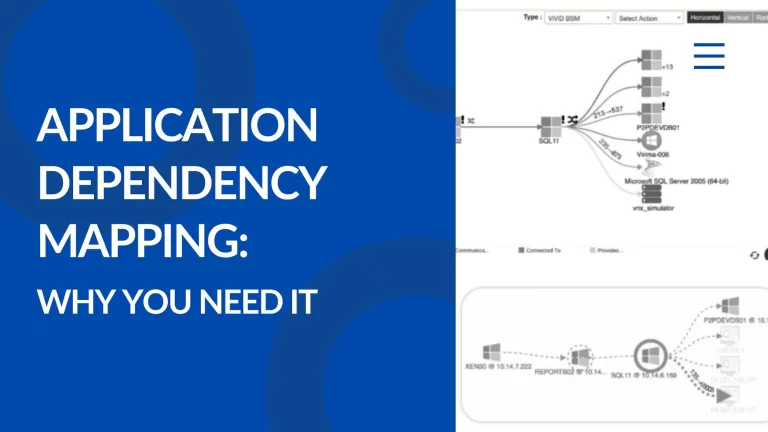
Virima’s ViVID™ service mapping builds dynamic dependency maps across your infrastructure. Once you define which applications and components make up a service (manually, via spreadsheet import, or through an integration with tools like Lean IX), Virima builds the map showing how those components connect, communicate, and depend on each other. Understanding how ServiceNow ITOM service mapping compares to Virima’s approach helps teams choose the right coverage model for their environment, especially when balancing ServiceNow licensing costs against discovery depth.
These maps integrate directly with ServiceNow ITSM, giving IT teams impact visibility before they act. During incident triage, you trace a disruption to the affected component and see everything else it touches. Before a change window, you assess exactly which services are at risk. These capabilities reduce mean time to repair (MTTR) and lower change failure rates. ViVID™ overlays also let teams layer known vulnerabilities onto service maps, so remediation prioritization connects to business service impact, not just CVE scores.
How does ViVID™ service mapping work with ServiceNow?
ViVID™ service mapping works by letting teams define which applications and components make up a service, then automatically building a dependency map of how those components connect and communicate. That map integrates directly with ServiceNow ITSM, giving IT teams impact visibility during incident triage and before change windows. This reduces MTTR and lowers change failure rates.
Discovery-Driven CMDB Enrichment
Virima’s high-frequency discovery cycles keep your CMDB current without requiring manual updates. Virima discovers assets across your environment, captures relationship data, and syncs verified CI records back to ServiceNow. That means the CIs that Predictive Intelligence, Performance Analytics, and change risk scoring rely on reflect what actually exists in your environment.
Teams using ServiceNow AIOps alongside Virima benefit from a tighter feedback loop. AIOps models run on discovery-validated CI data, which reduces false positives and improves confidence in automated responses.
What does Virima add to ServiceNow Service Management?
Virima adds discovery-driven CI data and ViVID™ service maps to ServiceNow Service Management. It runs high-frequency discovery cycles that keep the ServiceNow CMDB current without manual updates, and it builds dynamic dependency maps that show how infrastructure components connect. Teams gain accurate records for Predictive Intelligence, Performance Analytics, and change risk scoring.
IT Asset Lifecycle Visibility
ServiceNow Service Management becomes more effective when asset lifecycle data stays current. Virima tracks hardware refresh cycles, software licenses, and ownership across your infrastructure, then syncs that data with ServiceNow. This supports IT Asset Management workflows directly within the platform your team already uses.
For teams on the Atlassian stack, Jira Service Management paired with Virima delivers the same discovery-driven CMDB enrichment and dependency mapping through a different ITSM interface.
Which ITSM platforms does Virima support beyond ServiceNow?
Virima integrates with ServiceNow, Ivanti, Halo, Xurrent, and Jira Service Management. Teams on any of these platforms receive the same discovery-driven CMDB enrichment and ViVID™ service maps that improve incident response, change management, and asset lifecycle visibility.
Tighter Integration with Monitoring Tools
Virima connects ViVID™ service maps into ServiceNow’s monitoring workflows. When a monitoring alert fires, it cross-references the service map to determine scope and impact before anyone has picked up the phone. This gives teams context that raw alert data alone cannot provide. The incident reduction and MTTR improvements these integrations deliver can be tracked through ServiceNow reporting dashboards, making the value of better discovery data visible to leadership.
Teams in cloud-heavy environments also benefit from understanding how ServiceNow tag-based service mapping aligns with Virima’s infrastructure tags for faster change assessment and deployment validation.
What infrastructure does Virima discover?
Virima discovers assets across on-premises environments and cloud infrastructure, including AWS and Azure, via API-based discovery. It captures hardware, software, and network devices, then maps the relationships between them. Discovered CI records are synced back to ServiceNow, ensuring that change risk assessments, incident routing, and AI-driven modules have an accurate picture of the environment.
Better ServiceNow Outcomes Start with Accurate Discovery Data
The value you extract from ServiceNow Service Management scales directly with the quality of the data it runs on. Accurate CIs mean faster incidents, lower change risk, and AI models that produce results you can act on. Virima provides the discovery-driven foundation that makes those outcomes achievable.
Explore Virima’s Trusted Runtime Truth and see how discovery-sourced data powers every module in ServiceNow Service Management.
Frequently Asked Questions
What does Virima add to ServiceNow Service Management?
Virima adds discovery-driven CI data and ViVID™ service maps. These keep your ServiceNow CMDB current, improve change impact assessments, and give Predictive Intelligence and Performance Analytics more accurate records to work from.
Does Virima replace ServiceNow?
No. Virima works alongside ServiceNow as a data and visualization layer. It syncs discovery-sourced CI records and dependency maps directly into ServiceNow, so your existing ITSM workflows run on better data.
How does ViVID™ service mapping work with ServiceNow?
You define service composition (which applications and components make up a service), and Virima builds the dependency map. That map integrates with ServiceNow so teams can assess impact during incidents and evaluate change risk before any action is taken.
Is Virima only for ServiceNow teams?
No. Virima integrates with ServiceNow, Ivanti, Halo, Xurrent, and Jira Service Management. Teams on any of these platforms benefit from the same discovery-driven CMDB enrichment and ViVID™ service maps.
What infrastructure does Virima discover?
Virima discovers assets across on-premises environments and cloud infrastructure, including AWS and Azure, via API-based discovery. It captures hardware, software, and network devices, then maps relationships between them to build a complete picture of your environment.
Schedule a demo today and see Virima’s CMDB enrichment and ViVID™ maps in your own environment.