What K26 Is Really Telling IT Leaders About Their CMDB

Every year at ServiceNow Knowledge, two kinds of sessions fill the rooms: the headline sessions that draw standing-room crowds and the sessions that turn into the work that matters most in the months after.
Knowledge 2026 followed that pattern precisely. The headline: Bill McDermott’s keynote “Welcome to Agentic Business,” with Jensen Huang on stage, FedEx demonstrating a reinvented operating model, and a clear declaration that the autonomous enterprise is open for business.
The session that belongs on the CIO’s follow-up agenda: “CMDB/CSDM Foundation: Build It Right or Fix It Now.”
Attend the headline. But the work that determines whether your agentic AI roadmap succeeds or stalls comes from the CMDB roundtable. Here is what K26 is really telling IT leaders — and why it cannot wait until the next planning cycle.
The Signal Hidden in Plain Sight
The CMDB/CSDM session description at K26 used a specific word that should appear in IT leadership briefings this quarter: essential.
Not “helpful.” Not “recommended.” Essential.
The session framing was direct: “Your CMDB foundation is essential to get right for AI, automation, and product deployments.” This is a vendor telling its entire enterprise customer base — in the same week it announced autonomous AI agents — that the data layer underneath those agents is the constraint. That kind of language from ServiceNow is not filler content. It is an honest acknowledgment of where production deployments are likely to fail.
The CMDB has been part of enterprise IT conversations for two decades. What K26 changed is the consequences of getting it wrong.
From Inefficiency to Autonomous Failure
In the automation era, outdated CMDB data created operational drag. An incident took longer to route. A change took longer to plan. A service outage took longer to diagnose. The cost was real, but humans absorbed it through judgment, workarounds, and institutional knowledge.
In the agentic era, stale data causes autonomous failure — at machine speed, with no human in the loop to catch the gap.
An AI agent reads a CI record that was accurate eight months ago. It reads a service dependency map that was last reconciled before the most recent major cloud deployment. It acts on that data because nothing else is available. The gap between “imprecise” and “wrong” collapses when an agent is executing independently.
IT discovery that runs on a schedule and populates CMDB with periodic snapshots was acceptable infrastructure for rule-based automation. For agentic workflows that think, plan, and execute without human intervention, it is not.
The Four Questions Boards Are Starting to Ask
Technology risk conversations at the board and C-suite level are shifting. The new question emerging from audit committees, risk councils, and executive teams is not “are you using AI?” — it is “how do you govern your AI agents?”
That question breaks into four specific lines of inquiry:
Can you explain what they did and why?
Agentic AI that cannot produce an explainable audit trail is an accountability risk. When an AI agent resolves an incident, modifies a configuration, or triggers a downstream change, the record of what it acted on — CI data, ownership, change history, policy alignment — must be available and accurate.
Can you contain the blast radius when one acts incorrectly?
Autonomous workflows operating across interconnected services create cascading risk. Service dependency mapping is not optional in this environment. If your organization cannot answer “what breaks if this CI changes?” before the agent acts, the risk is uncontained.
Are they operating on governed, policy-aligned data?
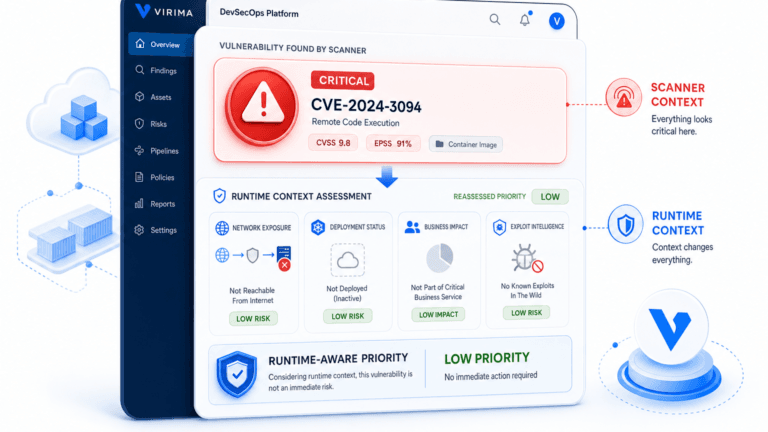
AI agents are only as trustworthy as the data they read. Discovery-sourced, policy-aware runtime truth — not manually maintained CI records — is the standard that makes oversight claims credible.
Do you know what runtime data they are reading before they act?
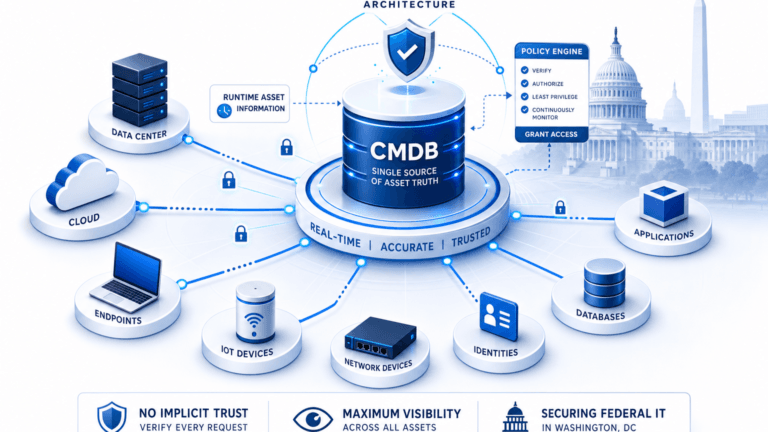
This is the question most IT teams cannot yet answer. The answer requires a current, authoritative view of what exists in your environment, how it is connected, what changed, what will break, and who owns it. That is Trusted Runtime Truth: current, explainable, policy-aware, and discovery-sourced.
All four answers flow from the same foundation. If your CMDB is incomplete, stale, or manually maintained, your answers to all four questions are qualified at best.
What CSDM 5.0 Actually Requires
ServiceNow’s Common Service Data Model 5.0 provides the data model for governing agentic operations. The K26 sessions on CSDM 5.0 focused on its role as the structural framework for AI-native workflows: aligning CI ownership, service relationships, and operational dependencies to the oversight layer.
But a data model is a structure, not a source of truth. CSDM 5.0 defines where data belongs. Discovery determines whether that data is accurate.
Organizations that deploy CSDM 5.0 without authoritative, multi-source IT discovery feeding it will have a well-structured CMDB with unreliable content. That is worse than a disorganized one — because it creates the appearance of oversight without the substance.
The production requirement is both: the data model and the discovery-driven runtime truth that keeps it current as your environment changes. According to ServiceNow’s own Blueprint for Agentic Business (2026), a reliable data foundation is one of the three non-negotiable technical requirements for agentic deployments.
The AI Control Tower Runs on What Your CMDB Tells It
One of the most-attended tracks at K26 focused on the AI Control Tower: ServiceNow’s governance layer for managing, monitoring, and enforcing policy on AI agents at enterprise scale.
The value proposition is significant. But the AI Control Tower governs based on what your runtime data tells it. It enforces policy against the CI records, ownership data, and service context currently in your CMDB. If those records are incomplete or stale, the Control Tower enforces policy against a partial picture.
That is not a failure of the control framework. It is a CMDB problem. And it is the CMDB problem that K26 spent an entire session acknowledging.
An ITAM and CMDB program that produces accurate, regularly validated CI data — with verified ownership, lifecycle status, and policy compliance — is what gives the AI Control Tower a complete picture to govern against.
What AI Agents Need to Be Tracked as CIs
One of the breakout topics at K26 was non-human identity (NHI) security: the oversight challenge created by the proliferation of service accounts, API keys, and now AI agents themselves.
AI agents are infrastructure. They have owners, dependencies, and policy requirements. They interact with systems, read data, and trigger actions across your environment. If they are not tracked as CIs in your CMDB — with verified ownership, documented dependencies, and policy alignment from day one — you have created a new attack surface without visibility into it.
The organizations that get this right in 2026 will have a significant governance advantage by 2027. The ones that do not will spend the following year backfilling the audit trail their regulators are asking for.
What IT Leaders Should Do After K26
The practical follow-on from K26 is not to put “CMDB improvement” on a backlog. The practical follow-on is to treat CMDB accuracy as a gate for agentic deployment — because that is what it is.
Before you build autonomous incident resolution, confirm that your CI records are grounded in discovery data and reconciled. Before you enable zero-touch change workflows, validate that your service dependency maps reflect how services are actually connected in production. Before you connect AI agents to your ServiceNow integration, audit your ownership data and track the agents themselves as CIs.
And before any of that, run a CMDB health assessment. Enterprise CMDBs frequently have accuracy rates below what agentic workflows require. Knowing your current baseline is where the agentic readiness conversation should start.
The agentic era is not coming. K26 confirmed it is here. The organizations that build on trusted runtime truth as their foundation will operate on a different tier by 2027. The capability gap that emerges from this moment is data-shaped — and CMDB is where it starts.
Ready to assess your CMDB foundation before your next agentic deployment? Schedule a demo with Virima to see how Virima delivers Trusted Runtime Truth for enterprise IT teams running on ServiceNow.