Why Is Your ServiceNow CMDB Always Inaccurate?

After every ServiceNow Knowledge Forum, the conversations about CMDB accuracy follow a predictable pattern. IT teams return from sessions on AI-powered workflows, automated change management, and intelligent service operations and they walk straight into the same gap: their CMDB is the weakest link in every automated process they just learned about.
The frustration lands in a specific way. The data is stale. Attributes conflict with what teams know to be true. Relationship records are incomplete or wrong. And nobody can trace exactly where the bad value came from or how long it has been sitting there.
This is not a ServiceNow failure. It is not a team failure either. It is a structural gap that exists because CMDB governance and runtime discovery are two distinct engineering problems, and ServiceNow was purpose-built to solve the first one.
Understanding why your ServiceNow CMDB is inaccurate means understanding four gaps that are built into how scheduled discovery cycles, native attribute handling, multi-source ingestion, and relationship mapping work at scale. These gaps compound over time, and the organizations that resolve them do so by adding a runtime truth layer to their ServiceNow environment, not by replacing it.
The Four Structural Gaps Behind ServiceNow CMDB Inaccuracy
Gap 1: Discovery Frequency vs. Infrastructure Change Velocity
ServiceNow Discovery runs on scheduled cycles. In dynamic hybrid environments, infrastructure changes faster than those cycles can capture.
Between discovery runs, new virtual machines spin up, configurations drift, software versions update, and CI relationships shift. The CMDB continues to reflect last week’s infrastructure state. Every change management decision, every incident response action, and every automated workflow built on that data operates against a stale version of reality.
This is not a configuration error. It is a timing problem built into the design of scheduled discovery. Even well-administered ServiceNow environments document it: CIs appear stale in CMDB Health dashboards even when system processes are actively updating them, because the discovery schedule and CI update cadence do not align cleanly across all CI classes and environments. The ServiceNow Community has documented this exact problem in active production deployments.
The accuracy gap widens in direct proportion to how fast your infrastructure changes. Cloud-native, containerized, and hybrid environments change fastest. They are also the environments where stale CMDB data carries the most risk. Organizations running CMDB with automated discovery close this timing gap by layering recurring multi-source scans on top of the scheduled cycles that ServiceNow provides natively.
Gap 2: No Attribute-Level Source Traceability
When two discovery sources report conflicting values for the same CI attribute, ServiceNow applies the last write. The platform does not maintain a native record of which source provided a given attribute value, when it was written, or under what conditions it was accepted.
This creates a specific and persistent operational problem. When CMDB data is wrong, your team cannot audit back to the source. They cannot determine whether a conflicting value came from native ServiceNow Discovery, an endpoint management platform, a cloud inventory API, or a manual import. Without source traceability at the attribute level, remediating inaccurate data requires guesswork about root cause rather than correction at the source.
Teams end up cleaning the same data repeatedly because the underlying source conflict that produced the bad value is never identified and resolved. This is one of the most reliable explanations for why ServiceNow CMDB data drifts back toward inaccuracy even after deliberate manual remediation. The symptom gets fixed; the cause stays active. Understanding what a configuration item must carry in 2026, including provenance metadata and authority ranking, highlights why last-write-wins is no longer a defensible reconciliation strategy.
Gap 3: Multi-Source Conflicts Without Governed Reconciliation
Most organizations running ServiceNow also run monitoring tools, endpoint management platforms, cloud-native inventory services, and CMDB connectors from third-party vendors. Each of these feeds CI data into the CMDB through different mechanisms, at different intervals, and with different attribute coverage.
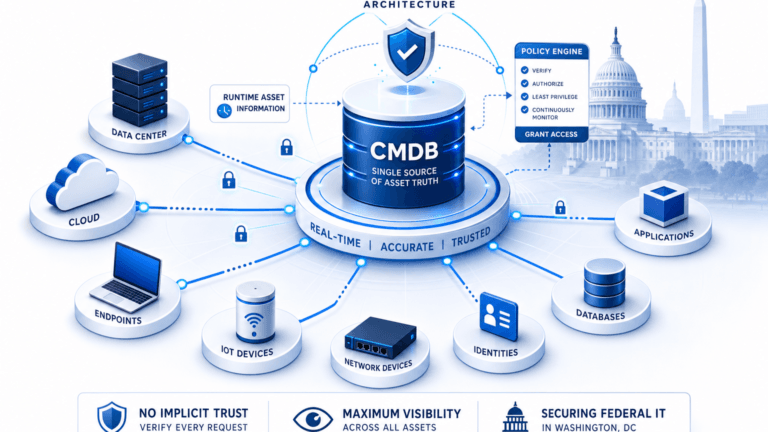
Without a governed reconciliation layer, duplicate CI records accumulate. Relationship data fragments. The “single source of truth” that the CMDB is supposed to provide breaks down because no governed policy determines which source wins for which attribute, under what conditions, or with what audit trail when sources disagree.
This is not unique to ServiceNow. Any CMDB that accepts data from multiple sources without a reconciliation policy will drift. The specific risk in ServiceNow environments is that organizations using the platform assume CI data governance is included. ServiceNow governs the workflows that consume CI data. It does not govern the authority of the CI data itself. That governance layer must come from somewhere outside the workflow platform.
IT discovery that runs across all contributing sources, with a governed policy for attribute authority, is the missing component. Without it, multi-source ingest is the mechanism by which CMDB accuracy degrades at scale. If you are in the process of building a CMDB or rebuilding a degraded one, establishing this reconciliation policy before connecting additional sources is the single highest-leverage decision you can make. For teams already running ServiceNow, a practical walkthrough of ServiceNow CMDB governance best practices covers how to implement this governance layer without disrupting existing workflows.
Gap 4: Relationship Data That Doesn’t Support Blast Radius Analysis
CMDB accuracy for compliance and auditing requires CI inventory completeness. CMDB accuracy for change management requires accurate CI relationships. These are different data requirements, and they degrade at different rates.
CI inventory accuracy, the completeness of your CI records, is what most CMDB health scoring measures. Relationship accuracy, knowing which services, dependencies, and downstream assets a change will affect, requires current, complete, multi-tier relationship data. This is the data that makes blast radius and change impact analysis reliable.
ServiceNow’s native relationship mapping requires specialist CMDB administration to maintain. Relationship records drift faster than CI inventory because infrastructure dependencies change more frequently than individual CI attributes. A new service connection, a retired middleware component, a shifted cloud dependency: each of these changes the blast radius of the affected CIs without triggering a CI record update that would surface in standard CMDB health reporting.
When change management teams approve a change against incomplete relationship data, they approve against an incomplete blast radius calculation. The risk is invisible until something downstream breaks. And when it does, the CMDB gets blamed rather than the relationship maintenance gap that caused it.
To understand how pervasive this dynamic is and what it costs organizations operationally, the determination of CMDB accuracy framework covers the measurement side in detail. The broader pattern of why these accuracy failures compound is covered in common reasons behind CMDB failure, which maps directly to the structural gaps described here.
The Common Thread
None of these gaps exist because ServiceNow is flawed. They exist because ServiceNow was designed to govern workflows, not to be a discovery engine. The solution is not to rebuild your ITSM platform. It is to give it a runtime truth layer that does the discovery and reconciliation job it was never designed to do.
For context on what CMDB inaccuracy costs in operational and financial terms, the EMA ServiceOps report connects CMDB maturity directly to outage frequency and mean time to resolution. And as organizations begin deploying AI agents that act on CMDB data at machine speed, the tolerance for these gaps drops to zero. The CMDB requirements for safe AI agent operations make that case in detail.
What Virima Adds to a ServiceNow Environment
Virima operates as the runtime truth layer alongside ServiceNow, feeding it accurate, reconciled, source-traced CI data rather than competing with it. Each of the four gaps above maps to a specific Virima capability.
- Multi-source reconciliation. Virima ingests data from native ServiceNow Discovery alongside monitoring platforms, endpoint management tools, and cloud APIs. A governed reconciliation policy determines which source wins for each attribute, with a full audit trail. Duplicate CI records are identified and resolved through policy, not manual intervention.
- Attribute-level source traceability. Every CI attribute in Virima carries source metadata. When a value is wrong, your team can trace it to the originating discovery source and fix the policy that produced the error, not just the data record that surfaced it.
- ViVID service mapping. Virima builds multi-tier service dependency maps that support real blast radius analysis. When a proposed change touches a CI, ViVID shows which services and downstream assets sit in the blast radius, based on current relationship data rather than a static snapshot that was accurate at last scan time.
- Bidirectional ServiceNow sync. Virima pushes reconciled, source-authoritative CI data back into ServiceNow so every workflow that depends on the CMDB, including change management, incident response, and IT asset management processes, operates on trusted runtime truth.
Keith Lee, VP of Disaster Recovery and IT Risk at The Bancorp, describes the outcome directly: “Virima’s integration with ServiceNow has allowed us to enhance and fully integrate our CMDB into all of our ITIL processes. The seamless integration gives us the ability to leverage the best of both Virima and ServiceNow.”
For organizations evaluating whether to supplement ServiceNow Discovery with a dedicated discovery layer, the Virima vs. Lansweeper comparison covers the discovery-specific capability differences in depth. Teams comparing broader platform options can also review the full ServiceNow competitors and alternatives analysis for a side-by-side view.
The real financial cost of leaving CMDB inaccuracy unaddressed is documented if you need the business case.
The Path Forward
ServiceNow governs your workflows. Virima governs the truth behind them.
Your CMDB will not become accurate by adding more administrators or shortening discovery schedules. The four gaps described above are structural. They require a dedicated runtime truth layer with governed multi-source reconciliation, attribute-level source traceability, and multi-tier relationship mapping that supports real blast radius visibility.
Organizations that close these gaps operate from a CMDB that change management trusts, that incident response can act on, and that automated workflows can use without compounding the inaccuracy they were supposed to eliminate. For a step-by-step implementation approach that addresses all four gaps, the ServiceNow CMDB best practices guide walks through proven governance frameworks, data quality scoring, and the new agentic IT requirements.
Schedule a demo to see how Virima closes each of these gaps in a live ServiceNow environment. Or see how Virima compares head-to-head on our ServiceNow integration page.