Service Mapping in Pharma and Life Sciences: The Dependencies Regulators Check

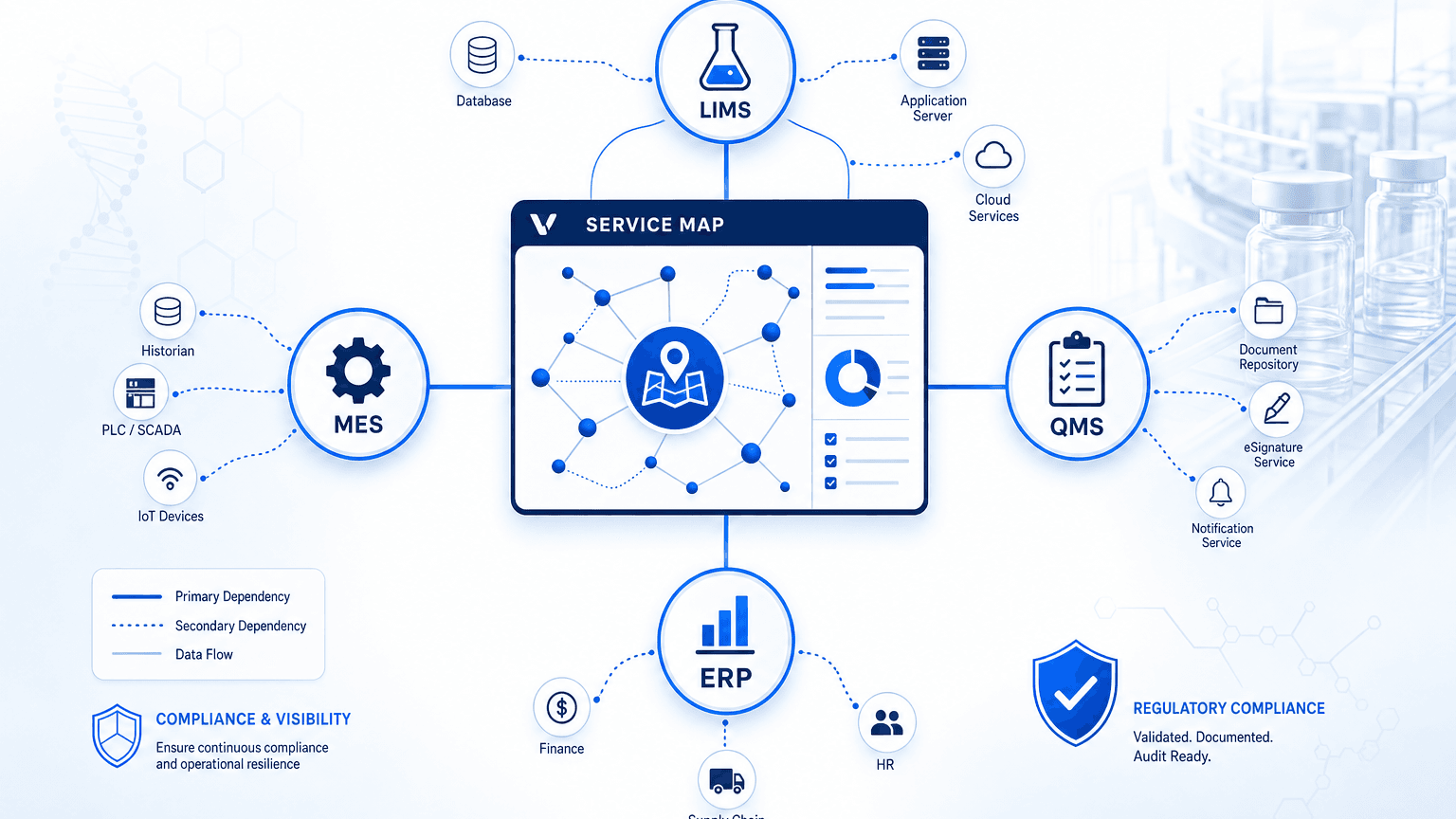
Regulated data integrity depends on an interconnected chain of corporate systems, applications, and physical infrastructure. While third-party contract research organizations present obvious operational risks, identical blind spots exist inside a company’s internal IT estate. Enterprise resource planning (ERP), manufacturing execution systems (MES), laboratory information management systems (LIMS), and quality management systems (QMS) run on shared networks, virtual hosts, and cloud storage. Maintaining regulatory readiness requires complete visibility into these underlying relationships. Implementing discovery-sourced service mapping benefits life sciences IT teams by transforming fragmented configuration records into clear, auditable operational dependencies.
What Is Service Mapping in a Regulated Life Sciences Context?
In standard IT service management frameworks, service mapping documents and visualizes the connections between underlying technology components and the business services they support. In pharmaceuticals and life sciences, service mapping extends this concept to GxP-relevant computerized systems governed by ISPE GAMP 5, FDA 21 CFR Part 11, and EU GMP Annex 11.
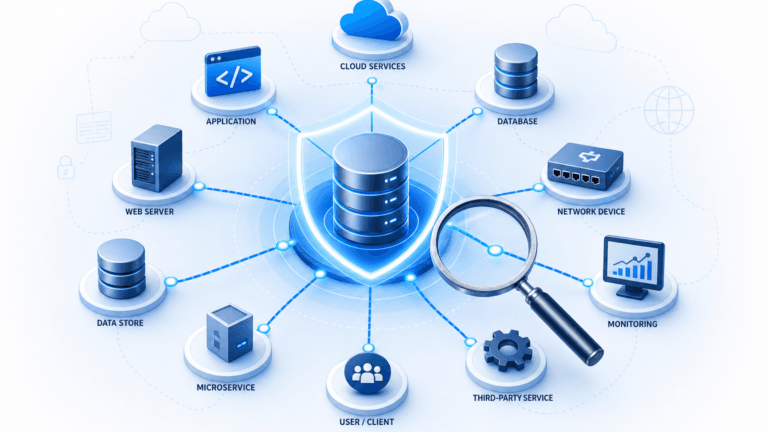
A validated LIMS or MES application does not operate in isolation. It relies on specific database clusters, Active Directory domains, network subnets, hypervisors, and storage arrays. When an auditor or quality reviewer examines a validated system, they evaluate the complete operating environment. Service mapping captures these dependencies, showing how virtual machines, storage LUNs, and network switches support regulated business workflows.
What is service mapping in pharmaceuticals and life sciences?
Service mapping in pharmaceuticals and life sciences is the process of discovering and visualizing how underlying IT infrastructure components connect to support validated GxP systems such as LIMS, MES, QMS, and ERP. It provides IT and quality teams with an auditable map of dependencies to evaluate change risks and maintain regulatory data integrity.
Regulated life sciences environments demand specific operational controls across all technology layers:
- Validation Lifecycle Awareness: Understanding which infrastructure components support validated versus non-validated applications before executing system changes.
- Audit Trail Traceability: Maintaining historical records of infrastructure modifications, component retirements, and dependency updates.
- Data Integrity Alignment: Supporting ALCOA+ principles (Attributable, Legible, Contemporaneous, Original, Accurate) by ensuring system configuration records reflect current operational states.
- Change-Control Impact Assessment: Evaluating downstream risks to validated software before executing network maintenance or operating system patches.
The Hidden Problem: Unmapped Dependency Scenarios
Without automated dependency mapping, IT operations teams rely on static spreadsheets, tribal knowledge, and manual documentation. This creates significant operational risk during audits and system updates.
| Operational Scenario | Risk Without Service Mapping |
|---|---|
| Subnet Upgrade Ticket Network team executes routine maintenance on a local subnet. | Unflagged GxP Disruption IT fails to realize a validated LIMS instance resides on the subnet. The change proceeds without quality approval, causing a validation deviation. |
| Legacy ERP Retirement On-premises core application is replaced by a cloud solution. | Ghost Assets & Licensing Penalties Unmapped legacy servers remain active in the inventory. Regulators flag incomplete data retention records during a routine inspection. |
| Post-M&A Infrastructure Consolidation Merging two distinct corporate IT environments after an acquisition. | Revalidation Scramble Engineers migrate hypervisors supporting a manufacturing execution system before completing required GxP revalidation protocols. |
| Incident Escalation to Quality IT policy requires notifying Quality of infrastructure incidents affecting GxP systems. | Notification Delays Without mapped services, engineers spend hours determining if an outage touched regulated systems, missing mandatory reporting windows. |
Why Service Mapping Is Critical for Life Sciences Compliance
The financial and regulatory consequences of unmapped IT infrastructure in life sciences are significant. According to the FDA CDER Office of Compliance 2025 Annual Report, the agency issued 314 warning letters to human drug companies in calendar year 2025. Many of these enforcement actions cited inadequate data controls, unapproved system modifications, or incomplete audit trails.
Furthermore, general industry benchmarks highlight the cost of security disruptions. The 2025 IBM Cost of a Data Breach Report states that the average data breach cost in the pharmaceutical sector reached $4.61 million. When a security vulnerability or system blackout impacts a validated manufacturing line, the cost increases rapidly due to lost batch yields and extended investigation timelines.
To establish complete operational visibility and protect GxP systems from unmapped change risks, enterprise IT leaders use Virima’s Trusted Runtime Truth to maintain an accurate, audit-ready inventory of all hardware, software, and service dependencies.
Four Critical Failure Modes Caused by Blind Spots
When pharmaceutical companies manage dependencies using manual tools, four primary operational failure modes occur:
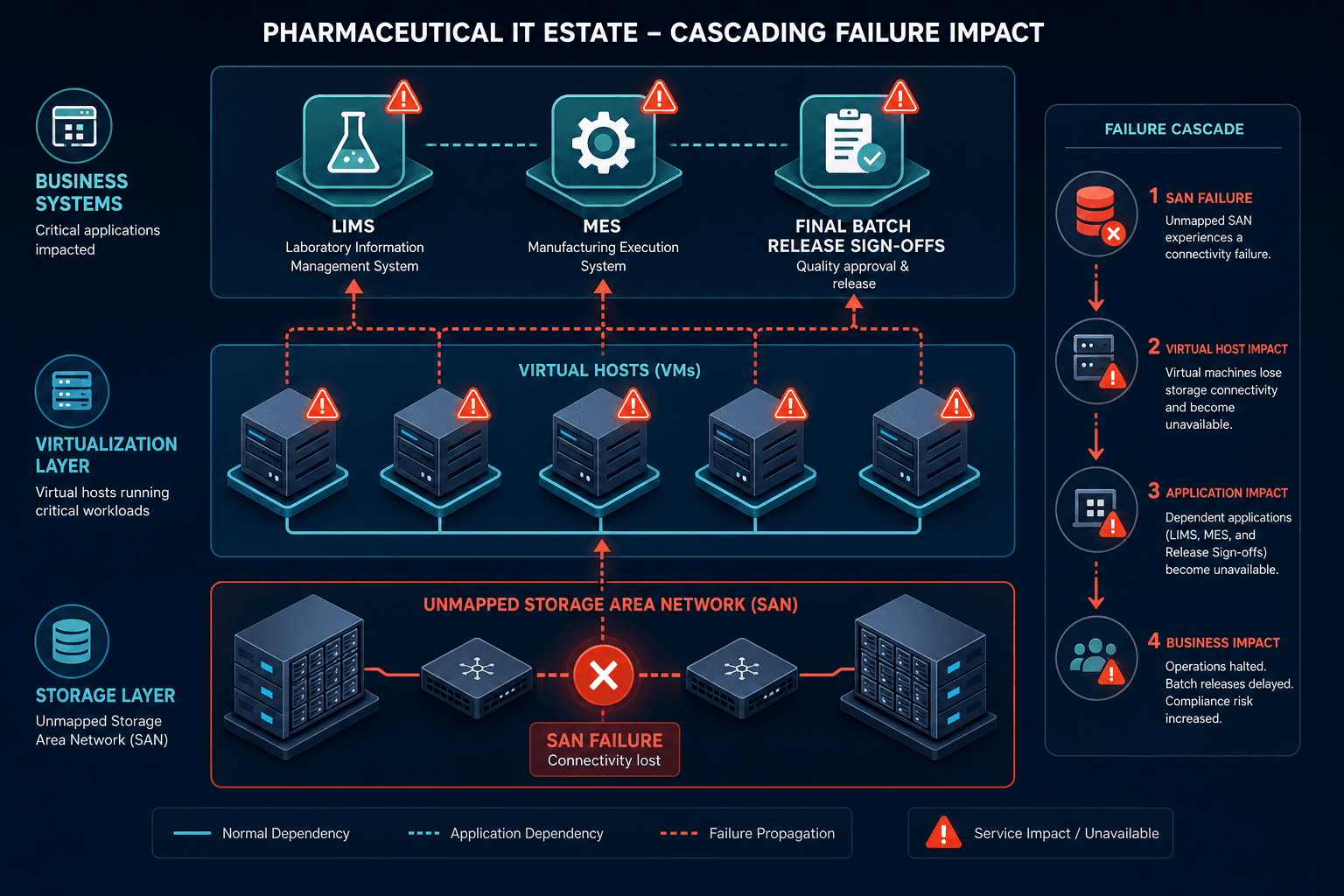
- Change Control Blind Spots: Emergency infrastructure updates move through IT change workflows without triggering quality reviews. Result: Unplanned software revalidation cycles, batch release halts, and regulatory deviation filings.
- Ghost Systems and Orphaned CIs: Decommissioned hardware remains listed in asset records, or new cloud instances operate without central registration. Result: Audit findings regarding inventory accuracy and unpatched security vulnerabilities on unmonitored assets. Teams can manage vulnerabilities and reduce risks with Cybersecurity Asset Management by identifying unmapped CIs before attackers exploit them.
- Cross-System Data Lineage Gaps: Batch production data flows across MES, LIMS, QMS, and ERP systems without a mapped technology path. Result: Quality assurance teams spend weeks manually reconciling batch records across four disconnected databases during annual product reviews.
- Third-Party Integration Boundary Risks: Internal corporate systems exchange data with contract development and manufacturing organizations (CDMOs) through unmonitored API gateways. Result: When a contractor suffers a system outage or data integrity failure, the sponsor cannot quickly identify which internal batches were affected.
How does service mapping prevent change control failures in pharma IT?
Service mapping links underlying IT infrastructure directly to validated GxP applications. When a network or server change is proposed, the service map automatically highlights all connected GxP systems, allowing IT and Quality teams to evaluate the blast radius and mandate revalidation reviews before execution.
The Real Cost of Unmapped Dependencies Across Key IT Roles
Unmapped system dependencies create operational friction and financial exposure across every tier of the IT organization.
For IT Operations Managers
IT Operations Managers bear the burden of system availability and incident resolution. When a server or database fails, engineers must determine if the affected component supports a standard office application or a validated manufacturing line.
Without mapped dependencies, triage teams waste hours identifying system owners while manufacturing equipment sits idle. Furthermore, unmapped assets create major security blind spots. Operational technology (OT) and MES environments in pharmaceutical plants often run on legacy operating systems tied to specialized manufacturing machinery. Touching these systems without precise dependency maps risks breaking validated plant operations.
For CMDB Owners and Configuration Managers
CMDB Owners face the continuous challenge of maintaining accurate data in a dynamic environment. Manual configuration updates degrade rapidly, leading to stale relationship records.
Reconciling multi-source data across hybrid cloud and on-premises environments requires significant manual effort. Configuration managers spend hundreds of hours annually preparing for internal and external quality audits, manually verifying that database CIs reflect live production setups. Establishing a discovery-sourced CMDB for life sciences replaces manual data collection with automated, timestamped asset records.
For Chief Information Officers
At the executive level, unmapped infrastructure introduces board-level regulatory and strategic risk. During merger and acquisition activity, integrating two distinct pharmaceutical IT estates represents a major operational hurdle.
According to Deloitte’s M&A integration analysis across 30 corporate transactions, IT integration drives more than half of total deal synergies. However, in life sciences, validated applications cannot be migrated on standard 90-day timelines. Unmapped dependencies delay system consolidation, extend dual-licensing costs, and increase the risk of regulatory enforcement during corporate transitions.
Additionally, the regulatory landscape is expanding. FDA CDER site catalog data indicates the number of inspected drug manufacturing sites continues to grow, with a significant portion located internationally. Managing a global, multi-site infrastructure footprint without automated service mapping exposes the organization to systemic compliance failures.
How Service Mapping Resolves Infrastructure Blind Spots
Automated service mapping replaces guesswork with an accurate, visual dependency graph across all enterprise technology layers.
1. Discovery-Sourced CMDB Accuracy
High-frequency scheduled discovery scans discover devices, applications, virtual machines, and cloud resources across the enterprise. Rather than relying on static documentation, the system automatically captures hardware specifications, software versions, and active network connections. Every discovered attribute carries a source tag and timestamp, providing an auditable record of asset state changes over time.
2. Dependency Visualization for Change Review
Visualizing service relationships allows Change Advisory Boards (CAB) and Quality Assurance reviewers to see the exact blast radius of any proposed maintenance ticket.
Before approving a server reboot or firewall rule modification, engineers review the interactive service map to identify connected LIMS databases, MES application servers, or QMS file repositories. Implementing an automated CMDB in pharmaceutical companies ensures change management teams identify GxP impact before execution.
3. Cross-Platform ITSM Synchronization
Enterprise pharmaceutical organizations frequently run multiple ITSM platforms across different business units or post-merger divisions. Bidirectional synchronization with platforms such as ServiceNow, Jira Service Management, Ivanti, HaloITSM, Xurrent, and TeamDynamix ensures configuration data remains consistent across all operational teams.
| Evaluation Dimension | Manual / Spreadsheet Mapping | Discovery-Sourced Service Mapping |
|---|---|---|
| Update Frequency | Point-in-time, updated manually ahead of scheduled audits | High-frequency scheduled discovery cycles |
| Relationship Mapping | Manually drawn diagrams that degrade immediately after changes | Automatically rendered from discovered CI connections |
| Change Blast Radius | Estimated through manual inquiries and tribal knowledge | Visualized automatically before change ticket approval |
| Ghost Asset Detection | Identified during regulatory inspections or asset write-offs | Reconciled continuously against live network discovery data |
| Post-M&A Integration | Rebuilt from scratch across disparate spreadsheets | Synced seamlessly across multiple ITSM platform instances |
Real-World Service Mapping Scenarios in Regulated Environments
Automated service mapping delivers practical operational value across daily IT activities:
- Regulatory Inspection Preparation: When auditors request proof of infrastructure controls for a validated LIMS, IT teams generate a complete, timestamped dependency map showing all supporting servers, databases, and network paths.
- Emergency Patch Evaluation: When a critical vulnerability affects a core hypervisor, engineers query the service map to identify connected GxP application guests, allowing Quality to pre-approve maintenance windows without halting production.
- Post-Acquisition System Rationalization: Following a corporate acquisition, IT leaders discover all inherited infrastructure CIs and reconcile duplicate software licenses before retiring redundant legacy systems. Organizations can evaluate how to optimize these integrations by reviewing why Virima is the best CMDB integration for your ITSM processes.
- Decommissioning Validated Systems: When retiring a legacy QMS, the service map reveals secondary applications that still pull archival data from its underlying database, preventing premature system shutdowns. Following a structured process for what happens to CIs when IT assets are decommissioned ensures compliance remains intact throughout the asset lifecycle.
How Virima Powers Service Mapping for Regulated Life Sciences IT
Virima delivers an enterprise-grade operational context layer designed specifically to address the complex governance demands of pharmaceutical and life sciences organizations. By combining automated discovery, intelligent multi-source reconciliation, and dynamic dependency mapping, Virima provides IT, Quality, and Compliance teams with authoritative runtime truth across hybrid technology estates.
Automated Asset Discovery Across Hybrid Estates
Maintaining compliance requires visibility into every IP-enabled asset supporting regulated workflows. Virima’s agentless and agent-based IT discovery capabilities scan local subnets, remote facilities, plant floor networks, private virtual infrastructure, and public cloud environments (AWS and Azure). The discovery engine uncovers physical servers, virtual machines, containerized microservices, storage arrays, network switches, and installed software packages, capturing essential configuration details without disrupting sensitive operational technology.
Source-Priority Attribute Normalization and CMDB Reconciliation
When multiple discovery sources, hypervisors, and cloud management consoles feed asset records into an enterprise IT environment, data duplication and attribute conflicts frequently occur. Virima’s centralized CMDB applies multi-source data reconciliation rules to normalize incoming attributes into a single, authoritative record for every Configuration Item (CI). Every captured attribute carries a source-priority tag and timestamp, providing compliance officers with a clear, auditable trail of asset state changes over time. Leveraging automated asset discovery and reconciliation eliminates ghost assets and keeps configuration inventories accurate ahead of regulatory audits.
Dynamic ViVID™ Dependency Visualization
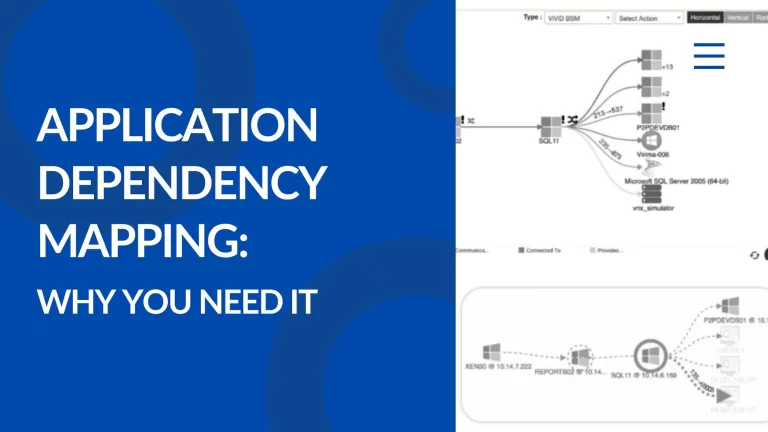
Static architecture diagrams fail the moment an emergency patch or server migration occurs. Virima’s dynamic ViVID™ service mapping engine automatically translates raw CI relationship data into clear, multi-tiered visual service maps. These interactive maps illustrate communication paths across web, application, database, and infrastructure tiers. When evaluating a maintenance window or investigating a performance bottleneck, engineers trace impact paths directly from physical hosts up to named business services like LIMS, MES, or QMS.
Native Workflow Integration with Enterprise ITSM Platforms
Service mapping delivers maximum value when integrated directly into daily IT management workflows. Virima provides bidirectional synchronization with major ITSM solutions, including ServiceNow, Jira Service Management, Ivanti, HaloITSM, Xurrent, and TeamDynamix. In complex environments, implementing a dedicated ServiceNow Context Engine integration feeds authoritative runtime truth directly into existing change and incident management workflows. Furthermore, Virima correlates discovered assets with NIST NVD security vulnerability data, enabling security teams to prioritize patches based on GxP business service criticality while maintaining essential CMDB capabilities across the IT service desk.
Note: Virima maps underlying IT infrastructure and system dependencies. It operates upstream of formal validation processes and does not perform Computer System Validation (CSV), Computer Software Assurance (CSA), or GxP data classification. Similar to how healthcare organizations manage HIPAA compliance via CMDB capabilities, Virima provides the infrastructure context required by internal quality and compliance teams.
Transitioning to Map-Driven Audit Readiness
Moving from manual documentation to automated service mapping improves operational efficiency and reduces compliance risk.
| Legacy Manual Operational Model | Modern Map-Driven Operational Model |
|---|---|
| Dependency records updated manually before scheduled audits | Dependency maps maintained automatically via scheduled discovery |
| Change impact evaluated through manual inquiries and guesswork | Change impact assessed instantly using visual service blast radius maps |
Five Steps to Implement Automated Service Mapping
- Catalog Regulated Corporate Systems: Identify all core applications supporting GxP data, including ERP, MES, LIMS, and QMS platforms.
- Execute Automated Discovery: Run comprehensive discovery across all supporting network subnets, virtual hosts, and cloud accounts.
- Map High-Risk Services First: Construct service dependency maps for critical, high-audit systems before expanding coverage across secondary applications.
- Embed Maps in Change Workflows: Require CAB reviewers to consult live service maps before approving infrastructure modifications.
- Establish Governance Cadences: Define discovery schedules and data ownership models to maintain long-term CMDB accuracy.
Protecting GxP Data Integrity with Infrastructure Visibility
Managing regulated pharmaceutical IT environments requires moving beyond static spreadsheets and tribal knowledge. Unmapped dependencies create severe change control risks, delay incident resolution, and expose the organization to regulatory enforcement actions. Discovery-sourced service mapping gives IT operations, CMDB owners, and executive leaders the clarity needed to maintain continuous system availability and regulatory readiness.
To eliminate infrastructure blind spots and protect your GxP systems from unmapped change risks, schedule a personalized Virima demonstration to see how discovery-sourced runtime truth simplifies life sciences IT governance.
Why is service mapping important for life sciences compliance?
Service mapping provides verifiable proof of how IT infrastructure supports validated GxP systems. It ensures change management teams identify downstream risks before executing updates, helping life sciences organizations prevent unapproved modifications, maintain data integrity, and satisfy FDA audit requirements.
Frequently Asked Questions
What is service mapping in a pharmaceutical IT environment?
Service mapping in pharmaceuticals discovers and visualizes relationships between underlying IT infrastructure and validated GxP systems like LIMS, MES, and QMS. It provides visibility into how hardware, software, and cloud resources support regulated manufacturing and quality operations.
Why is service mapping important for life sciences compliance?
Service mapping proves how technology infrastructure supports regulated data workflows. It enables automated change blast radius analysis, preventing unapproved infrastructure modifications from disrupting validated GxP systems and causing regulatory compliance deviations during FDA inspections.
What are examples of service mapping for regulated data?
Examples include mapping virtual hosts and database clusters supporting a validated LIMS, tracing network switch dependencies for plant floor MES devices, and visualizing API gateway paths connecting internal ERP systems to contract testing laboratories.
Does service mapping replace computer system validation (CSV) in pharma?
No. Service mapping operates upstream of CSV and Computer Software Assurance (CSA). It discovers and maps underlying IT infrastructure dependencies, supplying quality teams with accurate configuration data required to perform formal validation and risk assessments.
How does service mapping support FDA and GxP audit readiness?
Service mapping generates timestamped, auditable dependency records for all configuration items supporting GxP systems. During inspections, IT teams quickly demonstrate complete operational visibility, accurate change history, and controlled infrastructure governance to regulatory auditors.