Asset discovery and reconciliation automation: how multi-source discovery works

| QUICK SUMMARY 1.Installed software and virtual machine records drift out of date when discovery writes over the configuration management database (CMDB) without a reconciliation layer. 2.Agent-based discovery, agentless network scans, and cloud services API pulls each surface different discovered assets, none cover the full environment alone. 3.Automated asset discovery for IT asset management (ITAM) needs source-priority logic to resolve conflicts, since continuously scans from different tools can disagree on the same attribute. 4.Real-time visibility and real-time asset claims oversell what discovery-driven, high-frequency scan cycles actually deliver. 5.Poor asset tracking and stale asset visibility widen security posture gaps, increasing security risks, security vulnerabilities, and slower security incident response. 6.Reconciled, source-attributed CI records are what turn raw discovered assets into a CMDB your team can trust for change and compliance decisions. |
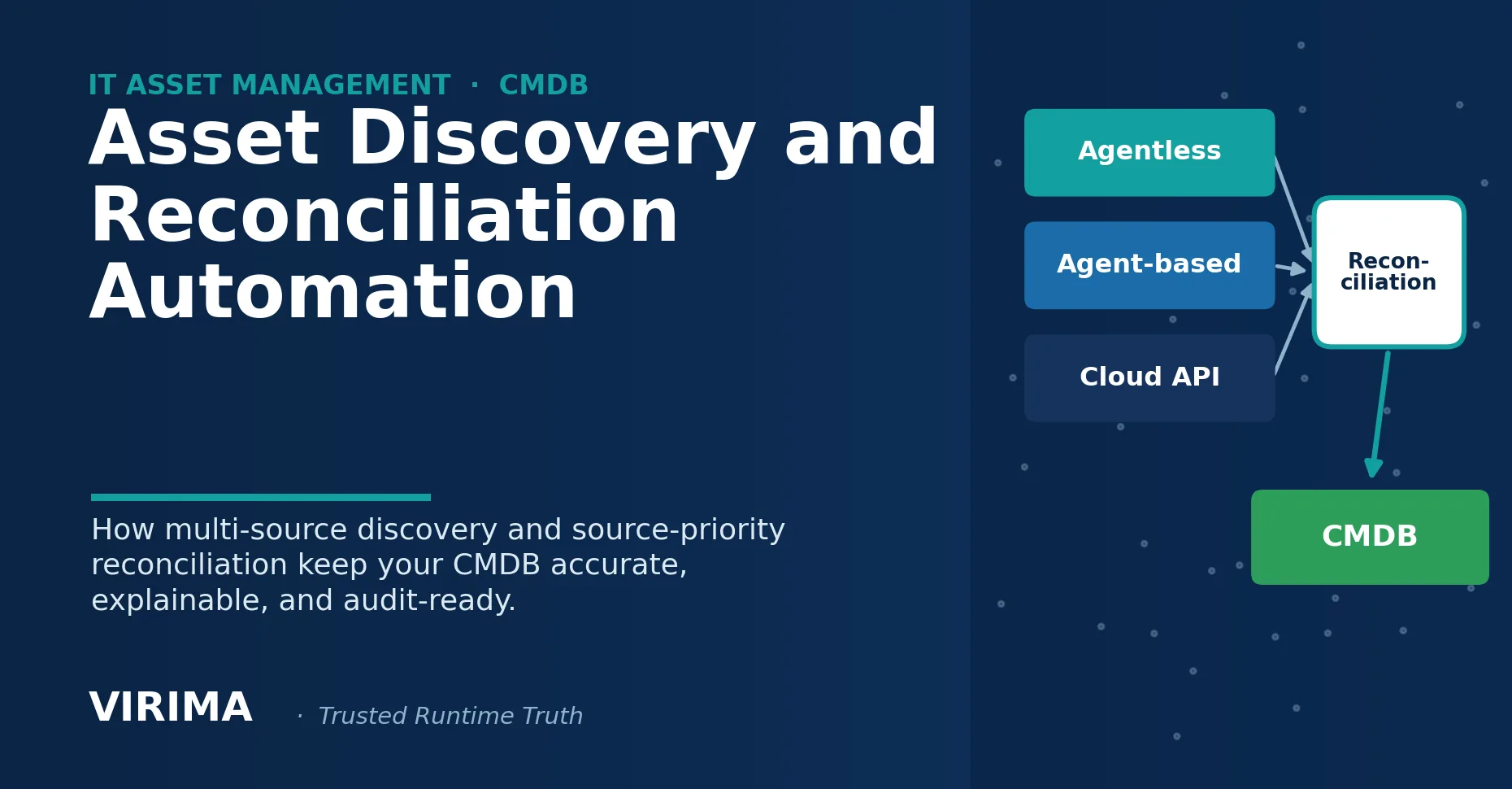
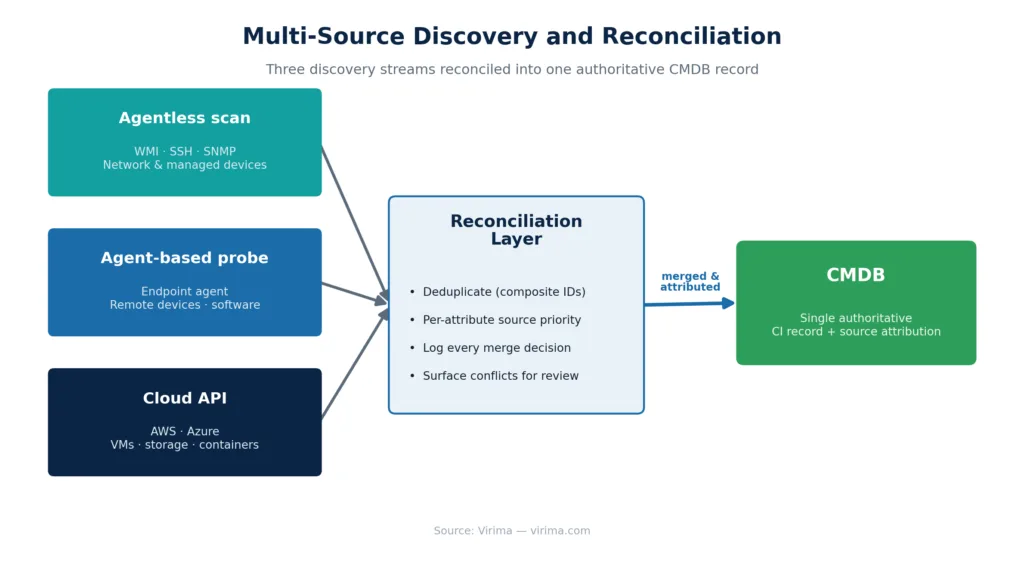
Most CMDB failures trace back to the same point: discovery runs, but reconciliation does not. A scan returns hundreds of CI records, and the system either writes them directly over existing data or queues them for a manual review that never happens. The result is a database where the hostname matches but the owner, location, and patch level are six months out of date. Asset discovery and reconciliation automation solves this by coordinating multiple discovery methods, agentless network scans, agent-based endpoint probes, and cloud API pulls, then applying source-priority logic to merge conflicting values into a single authoritative record before the data reaches the CMDB.
Why single-source discovery always leaves gaps
When discovery relies on one method, WMI-based agentless scanning, for example, it reaches only what that protocol can access. Managed Windows endpoints respond. Linux servers using SSH may return partial data if credentials are not current. Cloud-provisioned VMs spun up through an API do not appear at all. Remote endpoints that were off-network during the scan window remain invisible.
The result is a CMDB that reflects a snapshot of the environment as one scanning method saw it on one schedule. Anything outside that method’s reach becomes a gap, and gaps are where ghost assets accumulate, where shadow IT thrives, and where security blind spots persist.
According to a December 2025 Kaspersky analysis of ownerless corporate IT assets, organizations routinely operate with undiscovered APIs, servers, and application accounts that no single discovery method surfaces. Gartner has long estimated that configuration data in a typical CMDB degrades when it is not continuously reconciled against discovery, which is why multi-source IT discovery is the baseline architecture for accurate, automated ITAM, not an advanced option.
How multi-source discovery works in practice
Multi-source IT discovery runs three distinct scan types, each with different coverage, data depth, and refresh cadence:
| Discovery method | Protocols / source | Best at covering | Update cadence | Authoritative for |
|---|---|---|---|---|
| Agentless | WMI, SSH, SNMP | Managed infrastructure, network devices (routers, switches, firewalls) | Scheduled scans | Network device data |
| Agent-based | Lightweight endpoint probe | Remote / off-network endpoints, high-fidelity software inventory | Near-continuous | Locally installed software |
| Cloud API | AWS, Azure APIs | Cloud-native VMs, storage, load balancers, container clusters | Frequent (hourly+) | Cloud resource IDs, tags, metadata |
Agentless discovery uses protocols like WMI, SSH, and SNMP to interrogate network-reachable devices without installing endpoint software. It covers managed infrastructure, network devices (routers, switches, firewalls), and any system that responds to credential-based probes. Scans run on a defined schedule and capture hardware specs, OS version, installed software, and IP/MAC addresses.
Agent-based discovery deploys a lightweight probe on endpoints. The agent runs locally and reports data back, useful for remote devices that are not reliably on-network during scan windows, and for high-fidelity software inventory where process-level detail matters. Agent data tends to be more current and more complete on endpoint attributes that agentless scans approximate.
Cloud API discovery pulls asset data directly from AWS and Azure. It captures cloud-native resources, virtual machines, storage volumes, load balancers, container clusters, that network scanning cannot reach. API-sourced records include cloud-specific metadata like tags, resource groups, and subscription hierarchy that on-prem scans cannot infer.
Each method returns different data shapes, different attribute coverage, and different update frequencies. Before any of it reaches the CMDB, a reconciliation layer is required.
The reconciliation problem: when sources disagree
Reconciliation, not coverage, is where most CMDB reconciliation automation falls apart. The common pattern is “last writer wins”: whatever source ran most recently overwrites the existing CMDB record. This sounds efficient until you realize that a cloud API scan running hourly will overwrite an agent-based record with richer endpoint data, not because the API data is more accurate, but because it ran last.
The reconciliation challenge has three components:
Deduplication. The same physical or virtual asset may appear in all three discovery streams under different identifiers: a hostname from agentless, a serial number from the agent, a resource ID from the cloud API. Before reconciliation can resolve attribute conflicts, the system must confirm these records refer to the same CI.
Source priority. Different attributes have different authoritative sources. The cloud API is the most reliable source for cloud resource IDs and tags. The agent is the most reliable source for locally installed software. Agentless scanning is the most reliable source for network device data. A rigid “most recent wins” rule cannot account for this — it needs per-attribute source priority logic.
Conflict preservation. When two authoritative sources disagree on the same attribute, the right outcome is surfacing the conflict for review, not silently picking one value. Silent overwriting is how stale data earns a recent timestamp and survives in the CMDB. Virima’s guide on CMDB authoritative source reconciliation logic covers exactly why most-recent-wins logic fails and what source-priority rules look like in practice.
What asset discovery and reconciliation automation should actually do
Effective reconciliation does four things.
First, it deduplicates by matching records across sources using composite identifiers, not just hostname, but hostname plus serial number plus MAC address where available.
Second, it applies a configurable source-priority matrix so each attribute resolves to its most authoritative source, not just the most recent one.
Third, it logs every merge decision so there is an audit record showing which source won, which lost, and why. This is the source attribution on every CI that makes CMDB data explainable, not just current.
Fourth, it surfaces genuine conflicts, cases where two sources disagree and no priority rule applies, for human review rather than silent resolution.
The output of this process is a CI record that reflects multiple sources of truth rather than the opinion of whichever scanner ran last. That record is what belongs in the CMDB. For teams evaluating their agent-based vs agentless discovery approach, the reconciliation layer is what determines whether running both methods produces additive value or just more conflicting data.
This architecture matters more as IT environments grow. A 300-seat shop running managed endpoints on a flat network can operate with a single agentless scan. An enterprise running hybrid cloud, remote endpoints, and containerized workloads across multiple regions cannot. The reconciliation layer is what keeps the CMDB trustworthy at scale.
How Virima handles multi-source discovery and reconciliation
Virima runs IT discovery across all three methods simultaneously: agentless scanning via WMI, SSH, and SNMP; agent-based probes for Windows, macOS, and Linux endpoints; and cloud API pulls from AWS and Azure. Each scan type feeds into a reconciliation layer that applies source-priority rules before writing to the CMDB.
The reconciliation engine handles deduplication using composite identifiers, matching records from different sources against each other before merging. Per-attribute source priority means the cloud API wins on cloud resource metadata, the agent wins on locally installed software, and the agentless scan wins on network device data. Conflicts that cannot be resolved automatically surface as CMDB health flags rather than silent overwrites.
The result populates a CMDB with CI records carrying source attribution on every attribute, showing which discovery method contributed each data point and when it was last confirmed. That CMDB auto discovery approach feeds accurate, explainable data into change impact analysis, service dependency maps, and ITSM workflows.
For IT asset management, this approach to IT asset reconciliation means asset records reflect the full estate, including cloud-provisioned assets, remote endpoints, and network devices, rather than just what the most recent single-method scan reached. For change management, it means blast radius analysis runs against a CMDB that reflects what actually exists, not a partial snapshot.
Virima integrates reconciled CI data with ServiceNow, Jira Service Management, Ivanti, Cherwell, HaloITSM, Xurrent, Hornbill, and TeamDynamix, so the discovery output flows into the ITSM workflows your team already runs, without a parallel data maintenance effort.
From accurate discovery to Trusted Runtime Truth
Accurate discovery and reconciliation are the foundation for everything downstream: change management, incident response, service mapping, compliance audits, and agentic IT operations where automated systems need to act on asset data without a human confirming every decision.
A multi-source discovery strategy that covers the full environment, combined with a reconciliation layer that resolves source conflicts, produces CI records that are discovery-sourced, explainable, and governed. That is what Virima calls Trusted Runtime Truth: not a single scan result, but a reconciled, attributed, multi-source record that your ITSM workflows, service maps, and AI-assisted operations can act on with confidence.
Organizations that treat discovery as a single-method or one-time task find their CMDBs drifting within weeks. High-frequency discovery cycles across multiple methods, combined with automated reconciliation, keep asset data current without ongoing manual intervention.
If your CMDB is drifting despite running scheduled scans, the problem is usually reconciliation rather than coverage. Asset discovery and reconciliation automation closes that gap, turning raw scan output into a discovery-sourced CMDB you can trust. See how Virima’s approach to Trusted Runtime Truth works across multi-source discovery and reconciliation.
Discover with Authority. Move Faster. Act Safely.
Your CMDB is only as trustworthy as the reconciliation logic behind it. Virima brings multi-source discovery and source-priority reconciliation together in a single platform, covering your full hybrid environment and feeding your ITSM tools with CI data you can defend on a change call or in an audit. Schedule a demo at virima.com to see how it works in your environment.
Frequently Asked Questions
Why does CMDB data go stale even when discovery is running?
Discovery schedules leave gaps between scan windows, and single-method scans miss assets outside their protocol’s reach. When reconciliation logic defaults to “last writer wins,” accurate existing records get overwritten with stale or less complete data from a later scan. The CMDB reflects a recent timestamp but not necessarily accurate data.
What is the difference between agentless and agent-based discovery?
Agentless discovery uses network protocols (WMI, SSH, SNMP) to scan devices without installing software on them, fast to deploy but limited by network reach and credential freshness. Agent-based discovery installs a lightweight probe on each endpoint, providing richer data and coverage for remote devices that are not reliably on-network during scan windows.
How do ghost assets accumulate in a CMDB?
Ghost assets are CI records for devices that no longer exist in the environment. They accumulate when discovery only adds new records without reconciling against the existing CI inventory, so decommissioned assets stay in the CMDB until someone manually removes them. Automated reconciliation with a deduplication step catches these by comparing current discovery output against existing CI records.
How does Virima reconcile data from multiple discovery sources?
Virima runs agentless, agent-based, and cloud API discovery simultaneously, then applies a source-priority reconciliation layer before writing to the CMDB. Each CI attribute resolves to its most authoritative source rather than the most recently written value. Conflicts that cannot be auto-resolved surface as CMDB health flags for review.
Can automated discovery and reconciliation replace manual CMDB maintenance?
For most IT environments, yes. Multi-source discovery with automated reconciliation eliminates the need for manual CI updates on assets that discovery can reach. Exceptions include assets with restricted network access or CIs where business ownership needs human confirmation. Virima handles the discovery and reconciliation layer; ownership and business context still benefit from defined governance processes.