How Virima Augments the ServiceNow Context Engine with Trusted Runtime Truth

What the ServiceNow Context Engine Does
In April 2026, ServiceNow described the Context Engine as “an enterprise context solution that connects relationships, policy, and decision history behind every AI agent decision.” Built on the Service Graph, Knowledge Graph, and data inventory, it draws from identity relationships, asset dependencies, business intelligence, and data lineage to give AI agents the workflow context they need to route, recommend, and act.
For decisions that live inside ServiceNow’s workflows — approving a change, recommending a process precedent, routing an incident — the Context Engine is the right layer. ServiceNow’s investment in building it is well-placed.
| What is the ServiceNow Context Engine? The ServiceNow Context Engine is an enterprise context layer built on Service Graph and Knowledge Graph. It connects relationships, policy, and decision history so AI agents can act intelligently inside ServiceNow workflows. It draws from asset dependencies, identity data, and business intelligence to contextualize every AI agent decision on the platform. |
The Discovery Gap the Context Engine Cannot Close
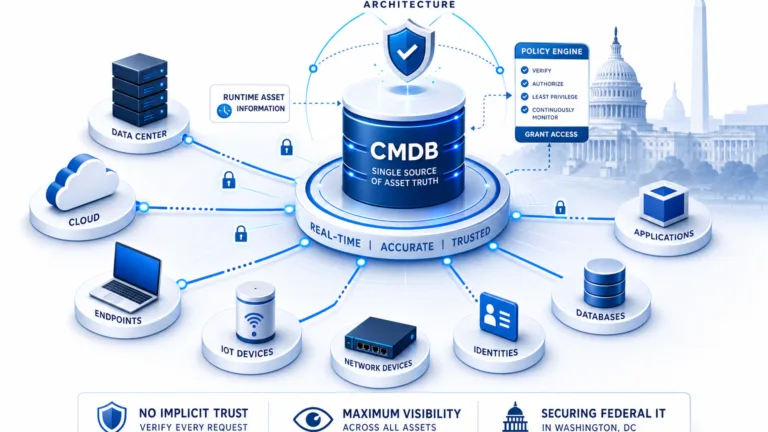
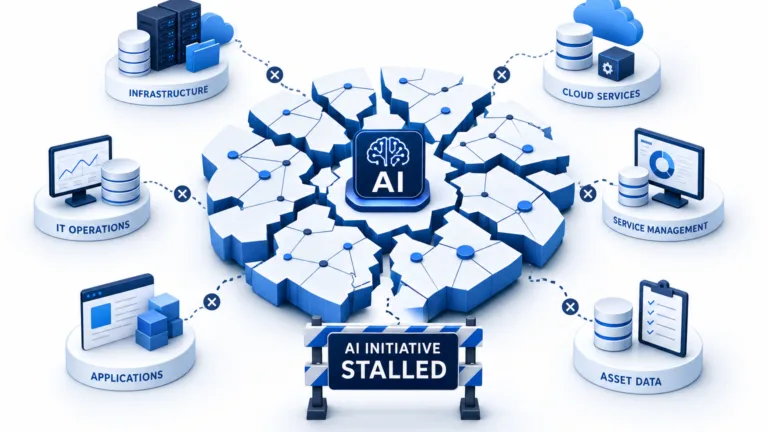
The Context Engine names “asset dependencies” as one of its data sources. The accuracy of those dependencies depends entirely on the discovery layer feeding them. A workflow engine built on stale CI records produces confident decisions on inaccurate data. That gap — between what the Context Engine expects and what your CMDB actually contains — is where agentic IT deployments run into trouble.
This is not a ServiceNow problem. It’s a data problem. The CMDB has always required a disciplined, multi-source discovery process to stay accurate across hybrid and cloud environments. What’s changed is the cost of getting it wrong. When AI agents act autonomously on that data, a stale CI record is not just an audit issue. It’s a blast radius waiting to happen.
The EMA ServiceOps 2025 report found that CMDB accuracy is the top bottleneck organizations cite when scaling AI-driven IT operations. Fixing the data layer is a precondition for the agentic workflows ServiceNow is building toward.
| Why does CMDB accuracy matter for AI agents in ServiceNow? AI agents act on what they’re told exists. If the CMDB feeding ServiceNow’s Context Engine contains stale, conflicting, or incomplete CI records, agents make decisions based on data that no longer reflects your environment. Discovery-driven Trusted Runtime Truth keeps CI data reconciled across sources so agents act safely and with verifiable attribution. |
How Virima Augments the ServiceNow Context Engine
Virima provides the operational layer beneath the Context Engine. It gives AI agents in ServiceNow workflows the four answers that determine whether an action is safe:
- What exists — across the estate, reconciled from every source you already run
- How it’s connected — service topology, dependencies, blast radius
- What changed — drift detection across authoritative sources
- Who owns it — accountable owners surfaced on the CI record
Discover with Authority
Virima’s IT discovery reconciles multi-source, multi-protocol inputs into one operational record — source-attributed and conflict-resolved across agent, agentless, cloud, and on-premises inputs. The result is a CMDB with fewer duplicate CIs and less noise across hybrid estates.
For a ServiceNow shop, that reconciled CI record — with attribute-level source-of-record — flows into ServiceNow through bidirectional integration. The Context Engine reads from a CMDB augmented with current, source-attributed, conflict-resolved data. For teams looking to build a CMDB that holds up under agentic workloads, multi-source reconciliation is the foundation the Context Engine depends on.
Understand in Context
ServiceNow’s Context Engine provides workflow context: approvals, history, process records. Virima provides the operational layer beneath that — live service topology, blast radius, ownership, change history, and vulnerability context tied to what actually exists.
ViVID service maps give that operational picture a visual dimension. Service definitions, once provided, generate dependency maps that show which assets back which services, who owns them, and what breaks if one changes. That blast-radius picture is what makes AI-driven change decisions defensible.
Workflow context and Trusted Runtime Truth are different layers. ServiceNow’s AI agents have the workflow side from the Context Engine. Virima feeds them the runtime side.
Govern Every Action
Autonomous IT without explainability creates liability. Virima makes every augmentation traceable: source attribution on every CI, change approval workflows, role-based access controls, secure discovery protocols, and full auditability. Every AI action in ServiceNow is backed by verifiable, explainable discovery data.
Virima’s SOC 2 Type 2 and ISO 27001:2022 certifications provide independently audited security and process controls to support enterprise governance requirements.
| How does Virima augment the ServiceNow Context Engine? Virima adds discovery-driven Trusted Runtime Truth beneath the Context Engine. It reconciles CI data from agent, agentless, cloud, and on-premises inputs into one source-attributed record, integrates bidirectionally with ServiceNow, and gives AI agents accurate service topology, blast radius, ownership, and change context before every action. |
What “Live” Actually Means in Practice
“Live” in the context of Trusted Runtime Truth does not mean always-on scanning of every CI at every moment. It means confidence-scored data that refreshes when it needs to — re-discovered, source-attributed, and explained on demand.
Virima monitors confidence on CI records. When data is getting stale relative to the expected discovery frequency for that asset type, Virima proactively refreshes it. If an AI agent needs a current picture before executing an action, it can request a discovery refresh and get source-attributed data before proceeding. If a device is offline and cannot be refreshed, the agent surfaces that caveat rather than acting on outdated data.
This is demand-driven discovery, triggered by confidence thresholds and agent requests. The efficiency argument is direct: why scan everything every hour if most assets have not changed? The moment a decision depends on a specific CI’s current state, Virima surfaces it with source attribution. For IT teams evaluating agent-based vs agentless discovery approaches, understanding how these protocols interact in a multi-source environment is part of getting the data foundation right.
The Integration: Bidirectional Sync with ServiceNow and Beyond
Virima integrates bidirectionally with ServiceNow, Jira Service Management, Ivanti, Halo, Xurrent, Hornbill, and TeamDynamix — so CI, incident, and change records sync both ways. For CMDB best practices that hold up in an agentic environment, bidirectional sync is the mechanism that prevents your CMDB from drifting the moment a ticket closes.
The result is a ServiceNow investment that gets stronger with Virima’s Trusted Runtime Truth layer, not redundant. The Context Engine handles workflow intelligence. Virima handles operational ground truth.
| Trusted Runtime Truth — See how our discovery-driven ground truth complements ServiceNow’s workflow intelligence |
Getting Your ServiceNow Investment Ready for Agentic IT
Knowledge 2026 positioned autonomous workflows, the AI Control Tower, and the Workflow Data Fabric as the near-term direction for ServiceNow customers. The teams positioned to get the most from those capabilities are the ones who have already addressed the data layer beneath them.
The Context Engine is well-built for what it does. Feeding it Trusted Runtime Truth — current, reconciled, source-attributed — is what turns agentic IT from a conference theme into a defensible operational reality.
Frequently Asked Questions
Does inaccurate CMDB data affect ServiceNow AI agent decisions?
Yes. ServiceNow’s AI agents act on the data available in the CMDB and Context Engine. Stale, duplicate, or incomplete CI records produce decisions based on an environment that no longer exists. Trusted Runtime Truth keeps that data current, conflict-resolved, and source-attributed — so agent decisions reflect the actual operational state.
What’s the difference between the ServiceNow Context Engine and Virima Trusted Runtime Truth?
The Context Engine provides workflow context: routing history, approval chains, process precedents, decision records. Virima provides operational context — what exists, how it’s connected, what changed, what could break, who owns it. The two layers work together. ServiceNow’s AI agents have the workflow side from the Context Engine; Virima feeds them the runtime side.
Does Virima replace ServiceNow?
No. Virima works with ServiceNow and makes the investment more trustworthy. Virima is the Trusted Runtime Truth layer that makes ServiceNow’s AI workflows, change decisions, and CMDB defensible. The positioning: Virima enriches your ServiceNow CMDB with discovery-driven Trusted Runtime Truth, without duplicates or extra noise.
What does a ServiceNow shop risk in the agentic era without a runtime truth layer?
An accurate workflow engine sitting on an incomplete operational record. ServiceNow’s AI agents become capable of executing changes faster than your CMDB can confirm the blast radius. The risk is not that ServiceNow is wrong — it’s that it’s acting on data that was accurate six months ago but has not been reconciled since. The CMDB accuracy gap is the silent constraint on every agentic IT initiative.
How does Virima handle hybrid and multi-cloud environments?
Virima’s discovery runs across on-premises, cloud, and hybrid infrastructure using agent, agentless, and cloud-native protocols. It reconciles data from multiple sources — including SCCM, Intune, AWS, and Azure — into one conflict-resolved operational record with attribute-level source attribution. That record integrates bidirectionally with ServiceNow so the CMDB reflects the full estate. For a detailed comparison of discovery approaches, see our guide on active vs passive IT asset discovery.
| Does Virima compete with the ServiceNow Context Engine? No. Virima and the ServiceNow Context Engine operate at different layers. The Context Engine provides workflow context. Virima provides Trusted Runtime Truth — the discovery-driven operational layer that determines what exists, how it’s connected, and what could break. Together, they give ServiceNow AI agents both workflow intelligence and operational ground truth. |