CMDB in Healthcare: Building a Single Source of Truth for Medical Devices and Clinical IT

A clinical server fails during business hours. The alert arrives in the ITSM queue, and within minutes the question comes from every direction: what does that server support? Most teams in that moment discover they cannot answer quickly. Clinical engineering knows its devices. Infrastructure knows its servers. Application teams know their systems. Nobody has a model that connects all three.
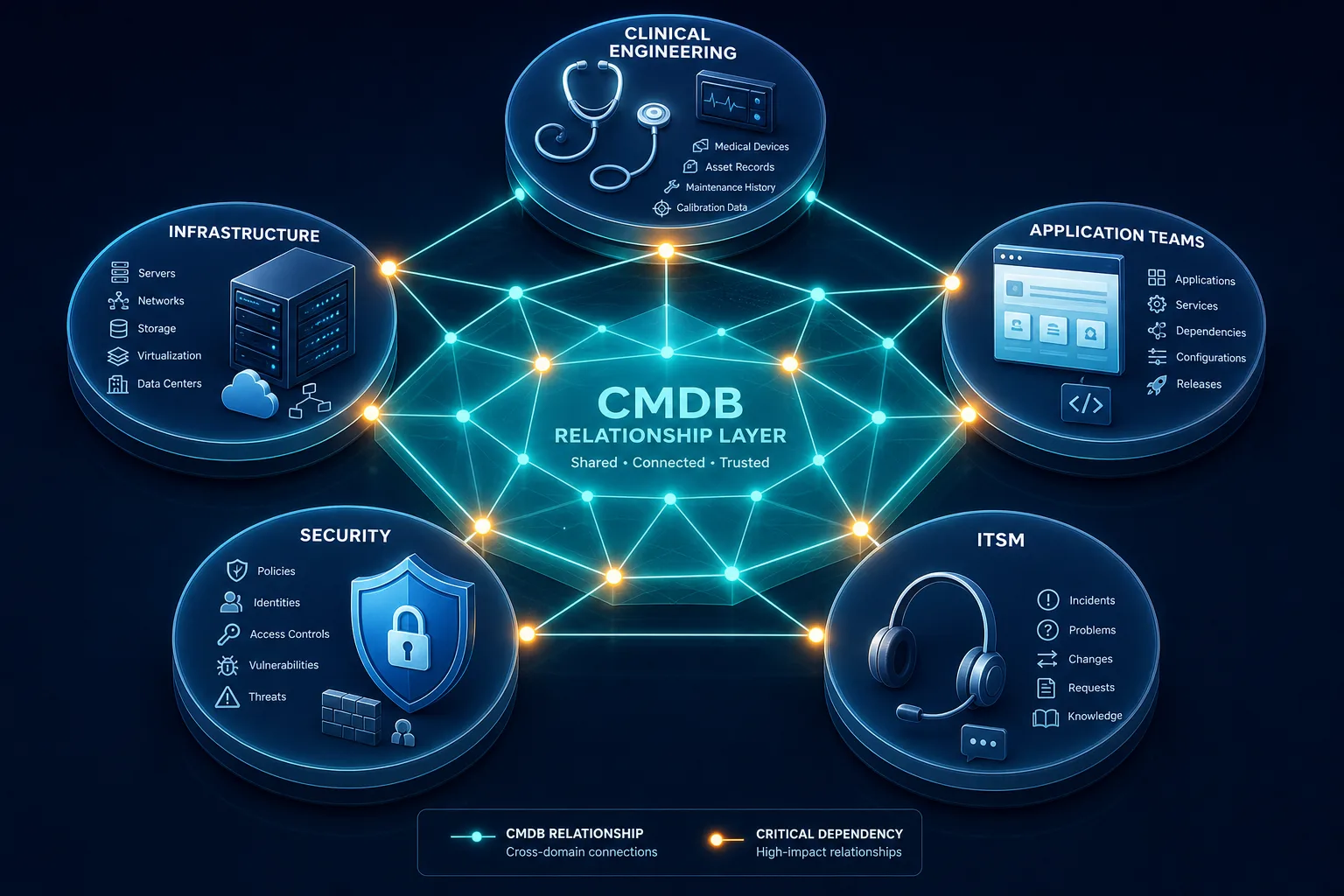
That is the healthcare CMDB problem. It is not that hospitals lack technology records. Clinical engineering, endpoint management, network operations, application teams, and ITSM each maintain their own. The missing asset is a shared dependency model showing how those records combine into the clinical services that clinicians rely on every day.
This article covers that dependency model specifically. The questions of software licensing, hardware lifecycle, warranty, and device retirement are addressed in the ITAM in Healthcare discussion.
Healthcare Already Has Multiple Sources of Truth
Clinical engineering may track device identity and maintenance context. Infrastructure platforms track servers, virtual machines, databases, and network hardware. Application teams understand EHR, PACS, LIS, pharmacy, and other clinical systems. Security platforms hold vulnerability telemetry. ITSM holds incidents, changes, and service requests.
Each system can be accurate about its domain. The problem appears when a question crosses those domains. Which application depends on this database? Which server hosts that service? Which clinical departments use the affected application, and which devices connect through it?
The CMDB should not replace these specialist systems. Its role is to reconcile the configuration information needed across them, so a question that crosses domain boundaries has a single model to interrogate.
A Medical Device Becomes Operationally Meaningful Through Relationships
A device record without relationships is an inventory item. A device CI with relationships becomes operational context.
A connected clinical device may depend on network connectivity, authentication services, middleware, vendor applications, databases, integration engines, and storage infrastructure. The device hardware can remain functional while the clinical workflow fails because a dependency elsewhere broke. Neither the biomedical team nor the network team has an obvious reason to look beyond their own domain.
The CMDB question is not what the device costs or when it retires. Those belong to asset management. The configuration management question is: what does this device depend on, and what depends on it?
The Clinical Application Often Spans More Infrastructure Than Users See
A clinician using an EHR sees one interface. Behind it may sit multiple application servers, several databases, storage volumes, integration engines connecting pharmacy and laboratory systems, an identity provider, and network paths crossing segments and firewalls.
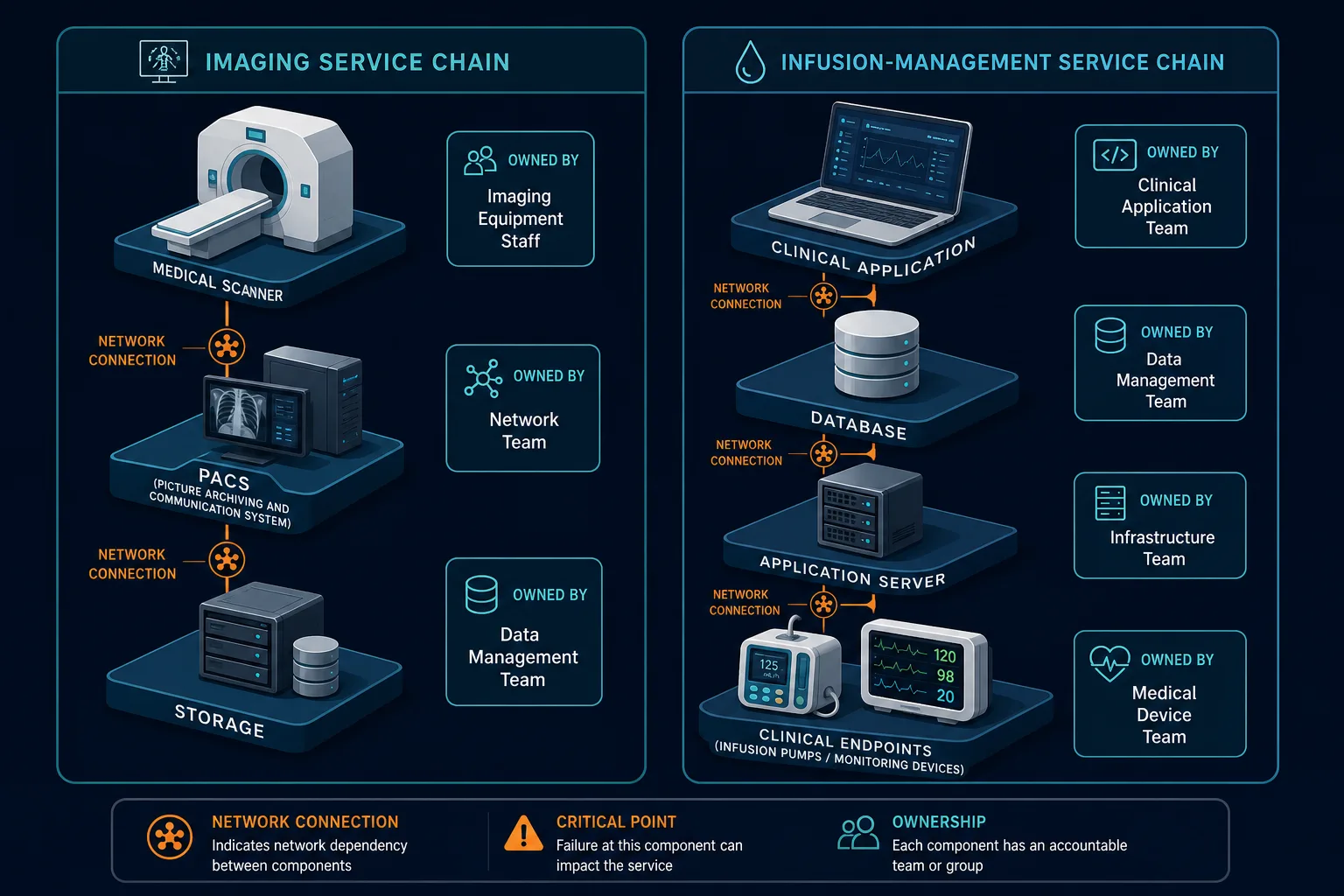
Similar infrastructure chains sit behind PACS, radiology information systems, laboratory information systems, nurse-call platforms, and clinical middleware. Each link in that chain is a candidate CI. Each link is also a potential point of failure that, if not modeled, leaves incident teams without a clear impact path.
Clinical service mapping represents that full chain, from underlying infrastructure through application tiers to the service a clinician uses. A CMDB that holds those relationships can answer impact questions a device inventory cannot.
Eliminate configuration data decay with Virima’s discovery-sourced Trusted Runtime Truth when clinical services depend on infrastructure relationships no single team fully owns.
“Single Source of Truth” Should Not Mean One System Owns Every Record
The phrase “single source of truth” frequently overpromises. A hospital cannot make one CMDB authoritative for every medical-device attribute, network configuration, clinical application setting, and infrastructure detail simultaneously. Attempting that consolidation often produces a CMDB nobody trusts and several source systems nobody maintains.
A more defensible model recognizes source authority:
- Biomedical platforms remain authoritative for medical-device management records.
- Automated discovery populates observed technical configuration.
- Network management platforms hold current network state.
- Virtualization platforms hold VM configuration.
- Application catalogs hold ownership and clinical-service context.
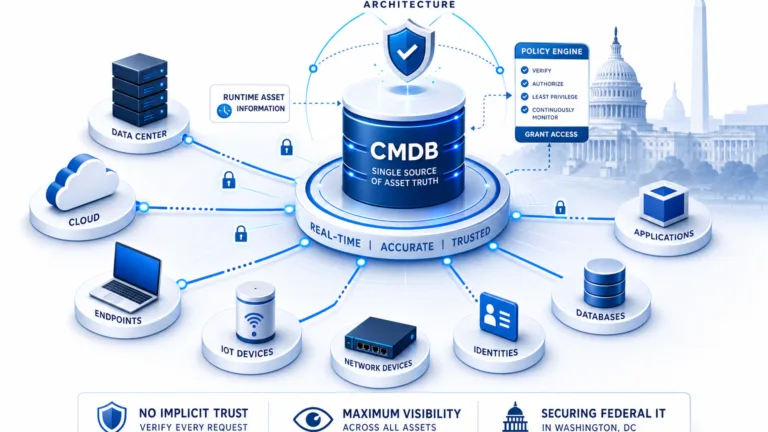
- The CMDB holds the reconciled relationship model across all those sources.
The CMDB does not have to originate every fact. It becomes the place where those facts are reconciled and related. That is what makes “single source of truth” mean something specific: one configuration model where relationships are maintained and interrogated, not one database that overwrites every specialist system.
What does “single source of truth” mean for a healthcare CMDB?
In a healthcare CMDB (Configuration Management Database), a single source of truth means one reconciled model of configuration relationships, not one system that owns every record. Specialist platforms (biomedical, network, virtualization, application) remain authoritative for their domains. The CMDB connects those records to show how clinical technologies depend on one another and which services they support.
Incidents Expose Why Relationships Matter
A hospital receives an alert: a database server failed. Knowing the server exists answers almost nothing about what to do next. Teams need to determine which application depends on it, which clinical departments use that application, which integrations fail downstream, which infrastructure owner should respond, and what other systems share the dependency.
Without a relationship model, operations teams reconstruct those answers manually during the incident. Each reconstruction takes time and carries error risk under pressure.
Published healthcare CMDB program accounts describe exactly this friction. In one pediatric hospital implementation, configuration data scattered across systems made it difficult for teams to relate incidents and changes to the hardware, software, and clinical services involved. The absence of a shared relationship model meant that every cross-team question required manual coordination at the moment it was most expensive.
Why do healthcare IT incidents take longer to resolve without a CMDB?
When configuration data lives in separate domain systems, incident teams must reconstruct relationships manually: which application uses an affected server, which clinical service depends on that application, which teams to contact. A CMDB (Configuration Management Database) with current dependency relationships answers those questions before the manual reconstruction begins, reducing time-to-impact-assessment during clinical incidents.
Change Management Needs the Same Dependency Model
Infrastructure changes in clinical environments carry service risk that the technical specification may not capture. A server patch, database upgrade, network change, or storage migration can each affect clinical applications in ways the infrastructure team did not plan for.
A dependency-aware CMDB helps teams answer the impact question before executing the change. Which applications use this server? Which clinical services depend on those applications? Which departments would experience disruption during the maintenance window?
The CMDB turns a technical CI change into an impact-analysis question before the work begins. That shift can reduce unplanned clinical service disruptions without requiring every team to maintain a separate impact list.
Cybersecurity Needs Context Beyond an Asset List
HHS Healthcare and Public Health Cybersecurity Performance Goals treat asset inventory, configuration management, network segmentation, vulnerability management, and incident preparedness as distinct capabilities. Asset inventory identifies known, shadow, and unmanaged assets. Configuration management and network segmentation are separate goals with separate operational requirements.
That structure reflects an important distinction in practice. An asset list tells security teams which asset is affected. A CMDB relationship model helps determine which applications and services depend on that asset, and which clinical departments those services support.
The CMDB does not calculate clinical risk automatically. Human judgment and clinical knowledge remain necessary. Current configuration relationships provide the operational context that informs that judgment faster and with less reconstruction during an active incident.
Medical Devices and Clinical IT Should Meet in the Configuration Model
Clinical engineering and IT do not need to become one function. Biomedical staff hold specialized device knowledge that general IT teams do not. The goal is not organizational consolidation. It is shared dependency context between domains that currently operate in parallel.
Clinical engineering can remain responsible for medical-device management. IT remains responsible for enterprise infrastructure. Application teams remain responsible for clinical systems. The CMDB provides the relationship layer connecting the configuration information those teams need to share.
A useful model might represent an infusion-management service tracing through an application, a database, a server, a network segment, and connected clinical endpoints. An imaging service might trace through PACS, storage, a database, a network path, and imaging workstations or scanner context. These are illustrative chains, not prescriptions for any specific hospital architecture.
Discovery Keeps the CMDB From Becoming Another Static Inventory
A CMDB populated manually becomes stale quickly. Infrastructure changes, new deployments, server migrations, and decommissions each require manual updates that rarely happen in real time. A static CMDB describes what existed at implementation, not what exists today.
Automated discovery can continuously verify servers, endpoints, network infrastructure, software installations, virtual machines, cloud resources, and configuration attributes against recorded CI data. Observed state challenges recorded state. Where differences appear, teams can determine whether the record or the environment needs correction.
Not every clinical technology is reachable by standard discovery protocols. Medical devices, biomedical systems, and specialized clinical platforms may require structured integrations or approved data imports rather than network scans. The mechanism varies, but the principle holds: the CMDB should reflect current configuration, not historical intention.
What a Healthcare CMDB Should Help Explain
| Question | Configuration context required |
|---|---|
| What is the CI? | Device, server, application, database, network component |
| Where is it? | Hospital, department, datacenter, cloud environment |
| Who supports it? | IT, clinical engineering, vendor, application team |
| What runs there? | Application, software, database, or service |
| What connects there? | Network and application relationships |
| What depends on it? | Clinical and business services |
| What changed? | Current versus previous configuration state |
| What incidents involve it? | Incident and problem record relationships |
| What changes affect it? | Change records and downstream dependencies |
| What happens if it fails? | Downstream service context and affected departments |
Procurement, contracts, licenses, depreciation, and replacement cycles are absent from this table deliberately. Those questions belong to IT asset management, not configuration management.
A Practical Configuration Management Workflow
A practical sequence for healthcare CMDB:
Discover → Reconcile → Relate → Contextualize → Validate → Use
Discover. Collect current enterprise configuration data automatically through agent-based and agentless discovery where infrastructure supports it.
Reconcile. Merge duplicate and conflicting records using source authority. Allow specialist systems to remain authoritative for their domains.
Relate. Map relationships between applications, infrastructure, devices, and clinical services. Apply service definitions provided by application and clinical teams.
Contextualize. Attach owners, locations, departments, and clinical-service context to CI records.
Validate. Confirm that records reflect current configuration using discovery refresh, integrations, and human review where automated methods do not reach.
Use. Apply the model during incidents, changes, cybersecurity analysis, and clinical-service impact assessment.
No discovery or mapping tool identifies every relationship automatically. Human input and source-system data remain part of the process, particularly for clinical applications and medical devices with limited network-discoverable attributes.
Where Virima Fits in Healthcare Configuration Management
Healthcare organizations already operate specialized clinical, biomedical, network, endpoint, and application platforms. Virima’s CMDB provides discovery, reconciliation, and service mapping that can bring relevant enterprise configuration data into a shared operational model alongside those systems.
Consider the moment that defines this problem. A clinical server fails. The war room opens. You are the configuration manager. The question arrives immediately: what does this support? Without a current, related CMDB, the answer requires calling the application team, reviewing a network diagram, checking an outdated spreadsheet, and hoping the incident ticket carries enough context. That manual reconstruction costs time at the moment time matters most. With a current dependency model, the blast-radius question has a starting point in the CMDB, not in a phone call. That is the gap Virima closes for the IT and service-supporting infrastructure layer: not by absorbing every biomedical or clinical system, but by keeping the configuration relationship model current enough to answer impact questions under pressure.
Relevant capabilities include agent-based and agentless discovery, CMDB reconciliation with source authority, CI relationship mapping, application dependency mapping, ViVID service maps built from provided service definitions, configuration change history, and integration with existing ITSM platforms including ServiceNow, Jira Service Management, Ivanti, HaloITSM, Xurrent, and Hornbill.
Boundary statement. Virima does not replace EHR platforms, biomedical engineering systems, medical-device management platforms, or specialized clinical applications. Its role is the configuration and relationship layer around the enterprise and service-supporting infrastructure those systems depend on.
A hospital does not need one application to own every fact about every clinical technology. It needs one configuration model capable of showing how those technologies participate in the services clinicians depend on.
Request a demo to see how discovery-sourced CMDB and service mapping fit alongside your existing clinical and infrastructure platforms.
Frequently Asked Questions
What is the difference between a healthcare CMDB and a medical device inventory?
A medical device inventory records what devices exist, where they are, and when they were serviced or procured. A healthcare CMDB (Configuration Management Database) adds the dependency relationships showing what each device connects to, which applications depend on it, and which clinical services it supports. The inventory answers “what is it?” The CMDB answers “what does it affect if it fails?”
Why do hospitals need a CMDB if clinical engineering and IT already maintain separate inventories?
Separate inventories answer questions within their own domains. Clinical incidents, infrastructure changes, and cybersecurity events cross those domain boundaries. A CMDB provides the shared relationship model that connects clinical engineering records, IT infrastructure records, and application ownership data so teams can answer cross-domain questions without manual reconstruction during incidents.
Can automated discovery capture all medical devices in a hospital CMDB?
Standard agent-based and agentless discovery can identify many enterprise IT devices and servers automatically. Specialized medical devices, biomedical systems, and clinical platforms often require structured integrations or approved data imports rather than network scanning. Discovery populates the enterprise infrastructure layer. Medical device details typically enter the CMDB through integration with biomedical management systems or structured data feeds.
How does a CMDB support HHS Cybersecurity Performance Goals in healthcare?
HHS Healthcare Cybersecurity Performance Goals list asset inventory, configuration management, and network segmentation as distinct capabilities. A CMDB adds relationship context to the asset inventory by showing which clinical applications and services depend on each known asset. During a security incident, that dependency context helps teams assess which clinical workflows are at risk, going beyond knowing which device is affected.
What role does Virima play in a healthcare CMDB program?
Virima provides discovery, CMDB reconciliation, and service mapping for enterprise and service-supporting infrastructure in healthcare environments. It does not replace EHR platforms, biomedical engineering systems, or medical-device management platforms. Its role is the configuration and relationship layer around the infrastructure those clinical systems depend on, integrated with existing ITSM platforms.