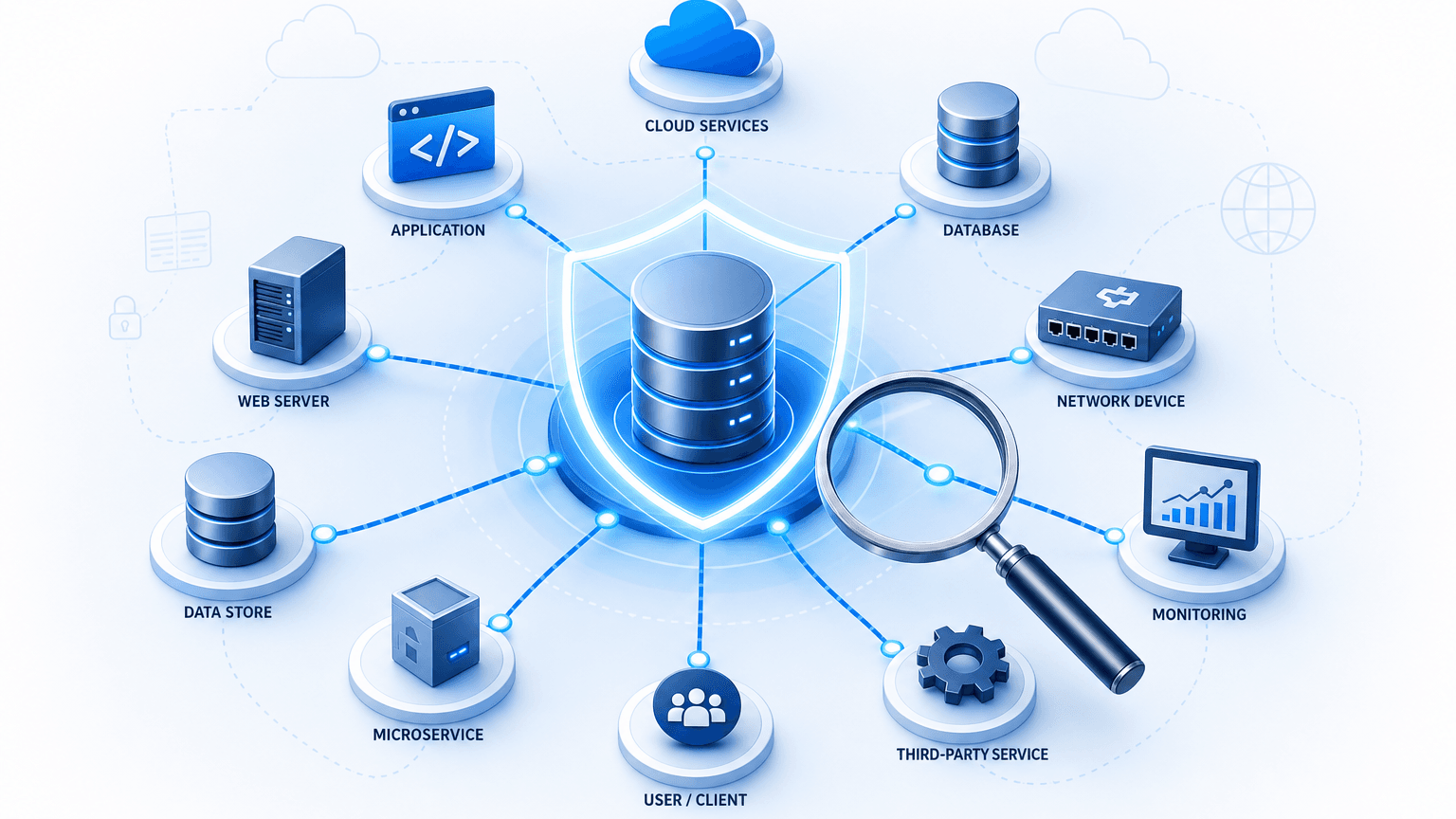
Without Service Mapping, Your Change Advisory Board Blast Radius Is Only an Educated Guess

Every Thursday afternoon, enterprise Change Advisory Boards (CABs) assemble to perform what amounts to high-stakes organizational theater. A project manager presents a ticket proposing a database schema migration, a routing change, or an operating system patch. The board reviews the stated risk and the rollback plan. Then it asks the question that actually decides the change advisory board’s blast radius: “Has anyone verified what else touches this host?”
Silence follows, broken only when a senior engineer unmutes to recall an undocumented connection — maybe an analytics job that queries that database replica every forty minutes, or an internal authentication gateway hardcoded to a port binding configured three years ago. If that engineer is on the call, the board catches the dependency and reschedules. If they’re out sick, switched squads, or left last quarter, the change gets approved.
At 2:00 a.m. Sunday, the alert fires. A core customer transaction service collapses because an unlisted downstream service starved for connections.
Modern engineering organizations keep learning this lesson. On March 25, 2026, Discord Engineering documented how cascading internal queue pressure exposed dependencies nobody had mapped, breaking their voice infrastructure. Discord runs modern distributed systems, not a traditional ITIL review board, but the lesson is the same: complex infrastructure can’t be safely changed based on human memory.
This is the exact problem Virima’s Trusted Runtime Truth solves. Engineering teams, operations leadership, and emerging AI agents need an accurate baseline of what exists and how it connects, not what a ticket submitter remembered to document.
What is a change advisory board’s blast radius?
How do change advisory boards determine blast radius without relying on tribal knowledge?
Change advisory boards calculate blast radius without tribal knowledge by replacing human recollection with service dependency mapping and discovery-sourced CMDB dependencies. Rather than asking engineers what might break, teams inspect dynamic runtime dependency maps that trace relationships across applications, databases, virtual infrastructure, and shared network tiers before approving production releases.
In classic ITSM, a Change Advisory Board exists to weigh proposed changes to production infrastructure against the risk to service stability. But the function itself has shifted. ITIL 4 formally renamed change management to “change enablement,” replacing blanket sign-off boards with delegated change authorities, automated standard changes, and peer validation (Stephen Mann, EasyVista). The term “CAB” still gets used daily across enterprise IT, but modern frameworks discourage manual approval queues that lack data-driven validation, which is the practical issue this article addresses.
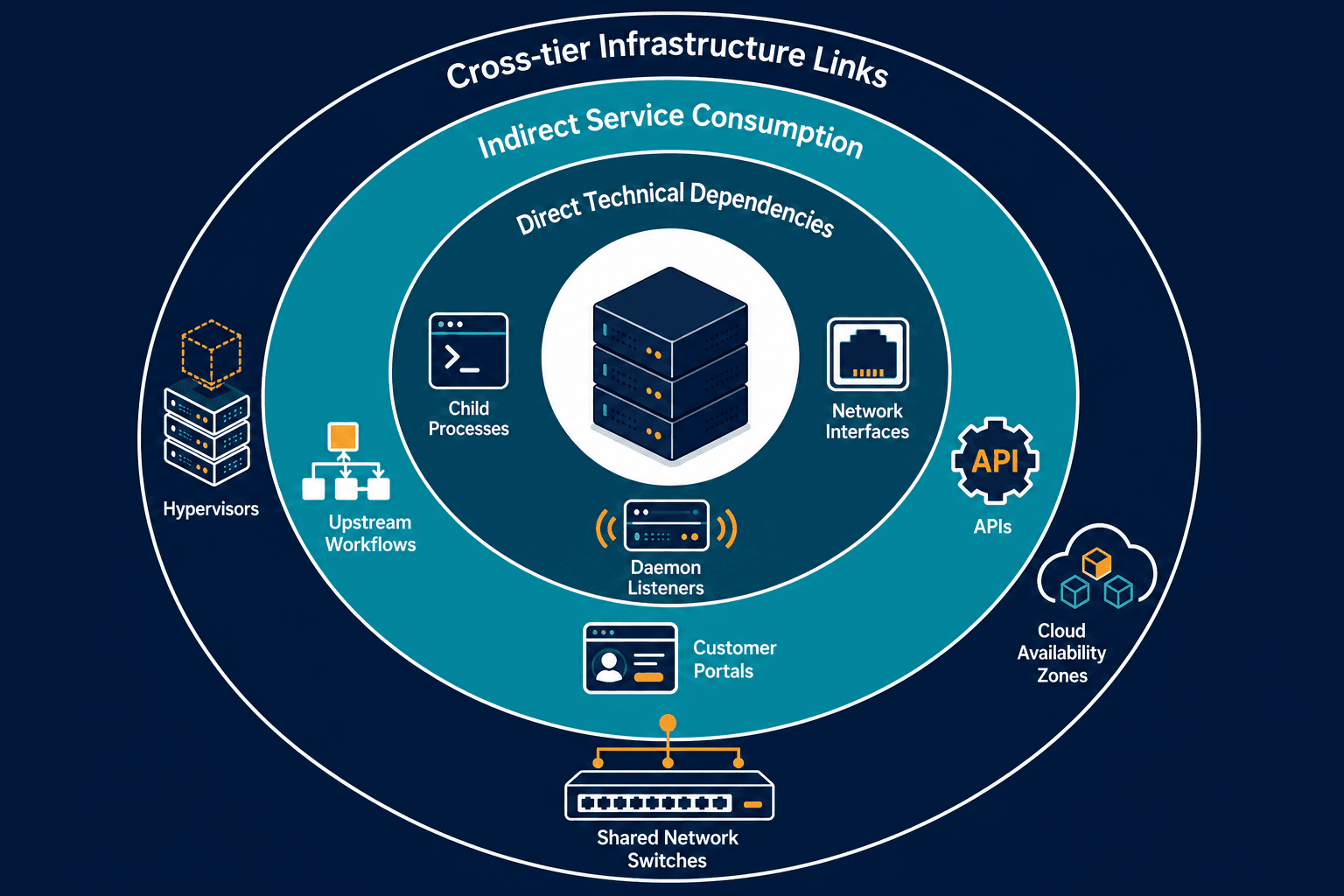
Whether the reviewing body is a traditional board or a delegated change authority, understanding blast radius in IT is what separates a clean deployment from an uncontained outage. Change advisory board blast radius is the total operational, technical, and financial footprint disrupted when a changed configuration item (CI) fails. It is measured across three dimensions:
- Direct technical dependencies: child processes, daemon listeners, and network interfaces bound to the CI.
- Indirect service consumption: upstream workflows, customer portals, and APIs that ingest data from that component.
- Cross-tier infrastructure links: the hypervisors, SANs, cloud availability zones, and shared switches underpinning the workload.
Without discovery-sourced dependency data, boards estimate this footprint from memory instead of measuring it.
Self-declared risk vs. measured blast radius
In most enterprises, the blast radius on a change ticket is self-declared risk, not measured reality — the engineer filing it picks values from a dropdown based on their own awareness of the environment.
| Dimension | Self-declared (manual) | Runtime-mapped |
|---|---|---|
| Source of truth | Individual memory, ticket fields, spreadsheets | High-frequency discovery across network and cloud APIs |
| Hidden dependencies | Ignored until an outage surfaces them | Exposed through active port bindings and host relations |
| Shared resources | Assumed dedicated unless known otherwise | Identified across shared hypervisors, VPCs, and databases |
| Assessment speed | 30–60 minutes of cross-team debate per ticket | Visual topology renders instantly in the ticket |
| Turnover resilience | Degrades the moment the engineer who knew leaves | Persists as a system-managed baseline |
| Audit defensibility | Subjective sign-off, vulnerable to scrutiny | Defensible dependency graph captured at approval |
Why is this still a problem in 2026?
Enterprise systems have grown far more dynamic than the governance processes built to review them. Three structural shifts explain why manual review still dominates.
Institutional knowledge turns over fast
Deep systemic understanding usually lives in the heads of a handful of senior engineers, not in documentation. Deloitte Insights finds that roughly 92 percent of organizations fail to systematically capture the institutional knowledge held by departing staff. When those specialists leave, the informal map of how legacy systems exchange data leaves with them — the board is left reviewing a bare server name with no systemic context.
Infrastructure no longer sits still
Legacy change management assumed a server stayed in a rack, unchanged, for years. Today a single transaction might start on an on-prem gateway, route through an Azure API layer, and read from an AWS database — a hybrid path spanning VMware clusters, Kubernetes, serverless queues, and multi-region databases. Static documentation goes stale within hours of being published.
Ownership is distributed and decoupled
Modern DevOps culture spreads deployment authority across dozens of autonomous squads, each shipping several times a week. That accelerates delivery, but it fractures visibility: Team A changes an API schema assuming only Team B consumes it, unaware Team F built a reporting job against that exact payload six months earlier.
The real cost of getting this wrong
When change review lacks automated dependency insight, organizations pay for it twice: in incidents, and in delivery speed.
Google Cloud’s DORA research on streamlining change approval found that heavyweight, manual approval doesn’t improve stability. Teams relying on it see worse delivery performance and greater change failure rates than teams using peer review with automated testing and monitoring. Manual boards without contextual data don’t prevent outages; they slow engineering down while creating an illusion of security.
Incidents sprawl past their trigger point
When a routine change touches an unknown shared dependency, the failure is rarely contained. An unannounced interface reset drops connections to an internal auth broker and triggers a company-wide login outage, and MTTR stretches from minutes to hours because responders spend the first phase just figuring out what changed.
Release friction compounds
When leadership notices changes keep causing outages, the usual response is more approval steps: longer CAB meetings, review lead times stretching from days to weeks, and more emergency changes as engineers route around the process to hit deadlines.
Audits get harder to pass
During SOC 2, ISO 27001, HIPAA, or PCI-DSS audits, reviewers check whether an organization actually controls its production environment. Showing that changes were reviewed without technical evidence of risk assessment is a real audit gap. Per Virima’s guide to IT compliance reporting and auditing, auditors increasingly want proof that change impact was evaluated against a current, complete asset baseline.
How service mapping fixes this
Service dependency mapping replaces guesswork with a dynamic, top-down topology of the applications powering business operations, binding every server and cloud instance to the business process it supports, not just listing it as an isolated record.
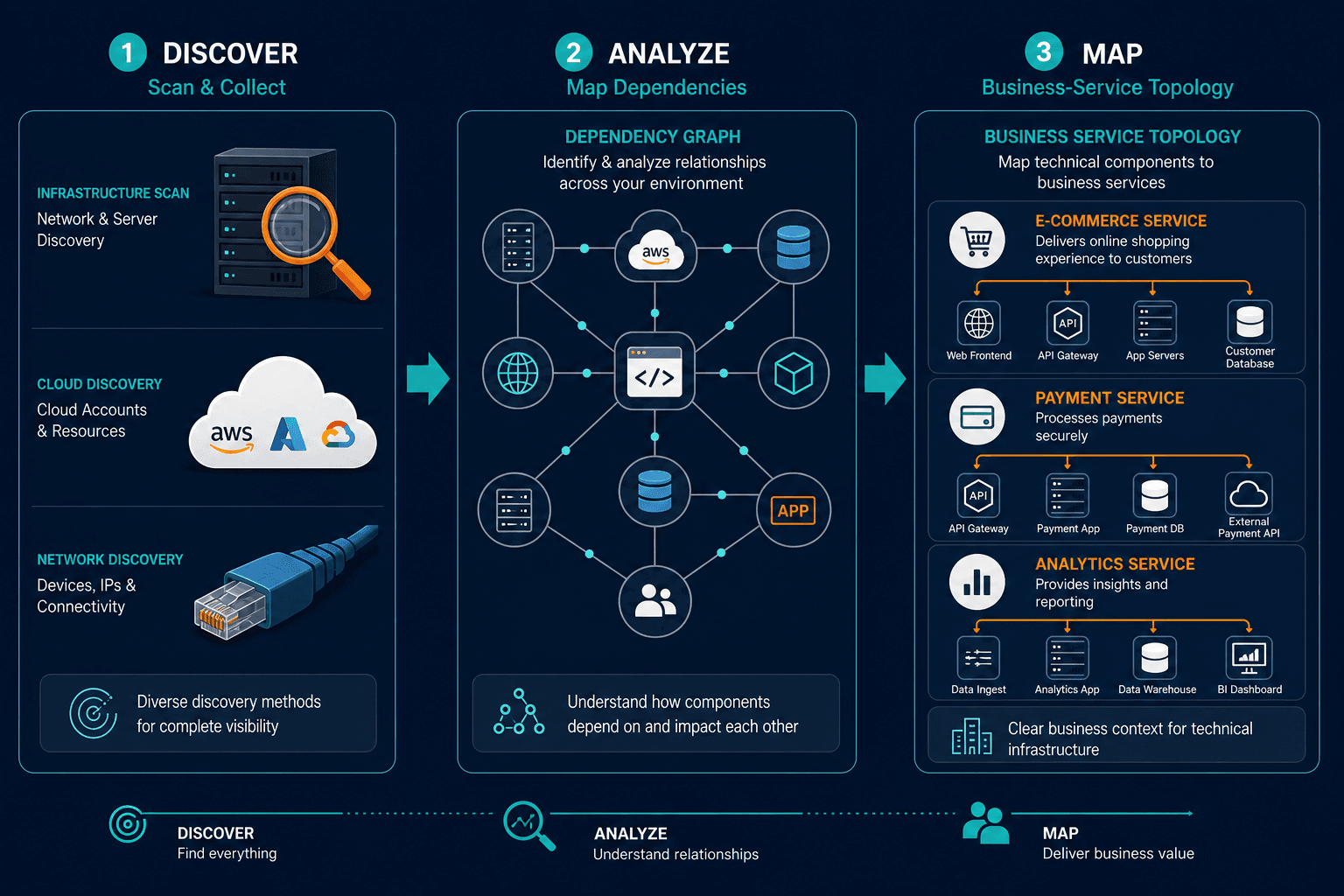
Built into an IT change management workflow, this gives change authorities a verifiable blueprint of every system interaction before a deployment command runs, through three connected stages:
Discovery-sourced ground truth
Through scheduled agentless scanning, lightweight agents, and native cloud API integrations, automated IT discovery continuously catalogs every server, hypervisor, container cluster, network appliance, and running process across the environment.
Dependency and port-binding analysis
Discovery engines analyze active TCP/UDP paths and open sockets. As AWS’s dependency mapping documentation describes it, modern systems inspect running processes and network telemetry to identify which workloads actually transmit data to one another.
Service modeling and business context
Technical connections then get tied to service definitions — web tiers, processing engines, storage, and APIs mapped to the business service they deliver, such as payroll processing or customer mobile banking. The board stops debating an isolated hostname and sees that it’s the primary database behind the core billing pipeline.
What this looks like in practice
To see the operational stakes, consider two documented incidents where an unmapped dependency turned a routine change into a major outage.
The cascading shared storage disruption
In its retrospective on the Amazon S3 disruption in US-EAST-1, AWS described how an operator running an approved playbook to remove a small server cluster supporting the S3 billing subsystem inadvertently removed capacity that also underpinned core index and placement subsystems. The failure cascaded into EC2 launches, EBS snapshots, and Lambda executions.
Without service mapping, a team scheduling maintenance on what looks like an isolated storage pool can’t verify which business workflows share that storage. With it, every upstream dependency on that storage target is visible before the change ever executes.
The unmapped database configuration cascade
On November 18, 2025, Cloudflare experienced the same dynamic from the database side. Per the Cloudflare outage post-mortem, a routine permission change on a backend database caused an automated export script to duplicate entries in a file consumed by the bot management platform. A size threshold in the routing engine couldn’t handle the doubled payload, and proxy nodes worldwide began rejecting traffic.
Without service mapping, a database administrator changing permissions or query schemas is blind to downstream consumer scripts. With it, the change evaluation platform surfaces every service and sync routine bound to that schema, and when something does break anyway, that same dependency data cuts incident response and MTTR by letting teams correlate alerts with recent changes immediately instead of tracing them by hand.
How a mapped service view closes the gap
A modern enterprise CMDB is the centralized store for these relationships, turning raw asset inventories into a structural hierarchy. When changes are logged in ServiceNow, Jira Service Management, or Ivanti, the CMDB is the data layer that makes impact analysis possible.
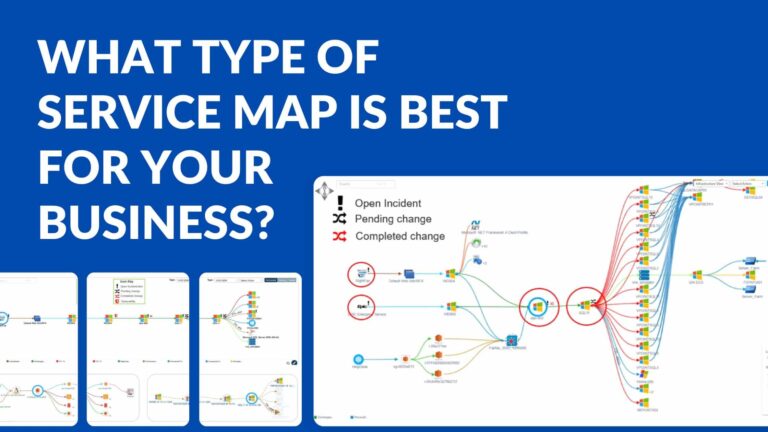
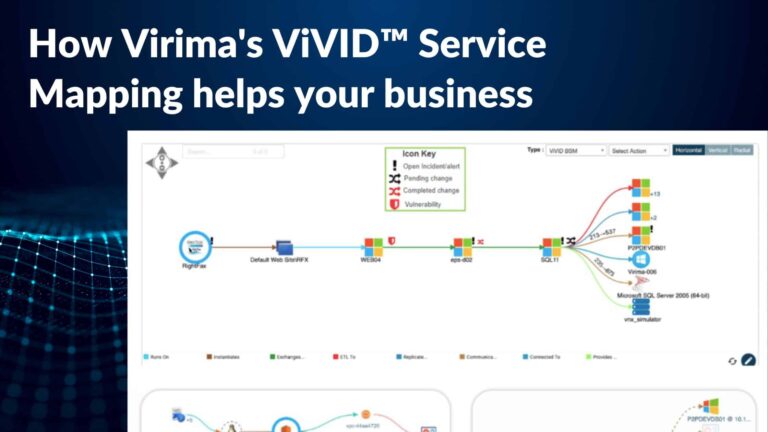
Dynamic service mapping builds on that foundation, turning static configuration tables into interactive relationship diagrams change managers can actually navigate.
For change review boards, this delivers three capabilities:
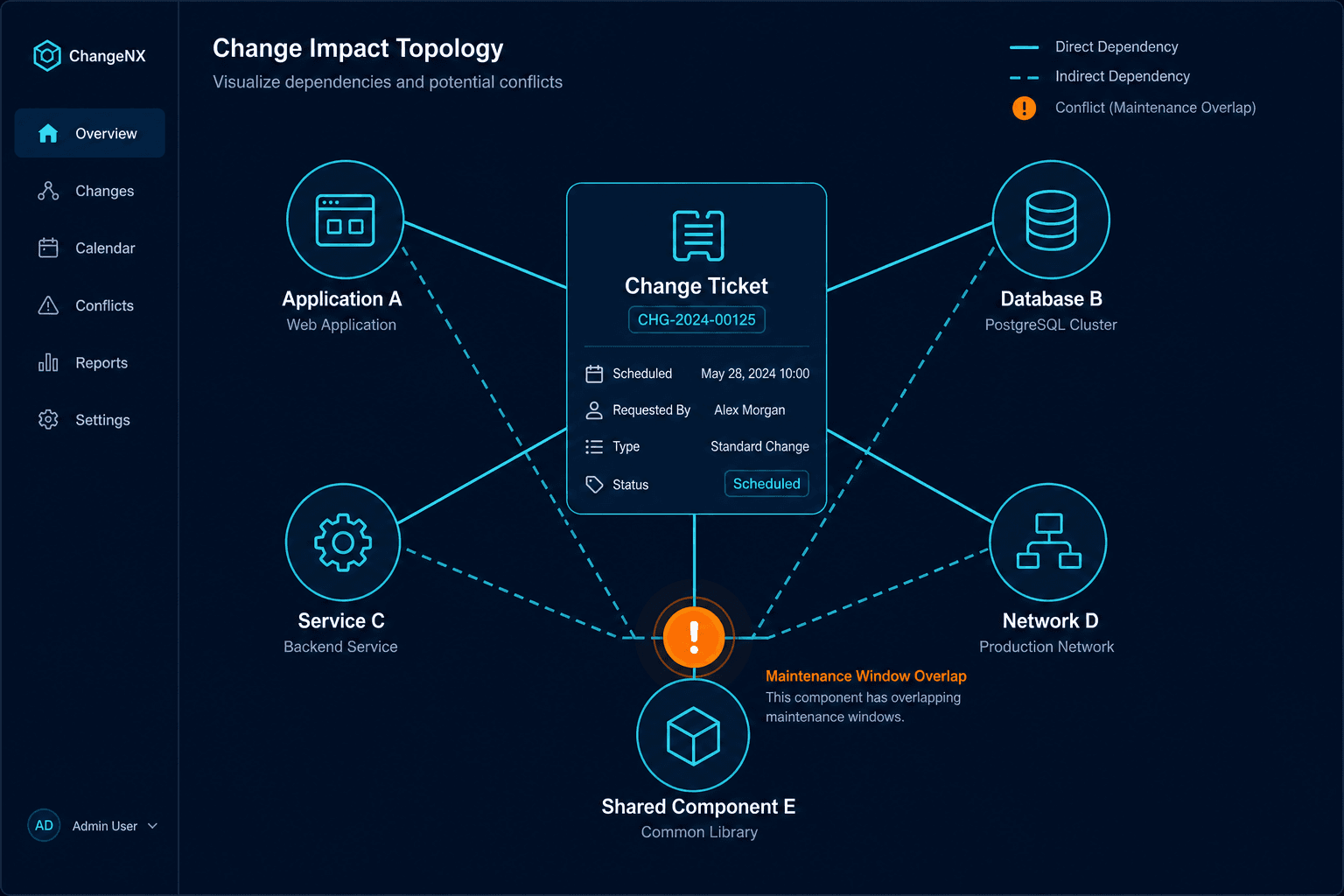
- Automated impact analysis: linking a CI to a change ticket generates a full list of affected business services.
- Visual blast radius exploration: board members expand nodes on the map to check whether alternative paths, load-balanced clusters, or failover instances exist.
- Change collision detection: if two teams schedule maintenance on components sharing a hypervisor, switch, or database instance in the same window, the system flags the conflict automatically.
Moving from memory-based to map-driven change review
Shifting from oral history to data-driven governance takes five deliberate steps:
- Identify high-value business services. Don’t try to map every desktop and printer at once — start with the ten to twenty services that directly drive revenue or carry regulatory weight.
- Deploy discovery across those service footprints. Run discovery across the subnets, cloud accounts, and virtualization managers behind those services, capturing running processes, port connections, and hypervisor topology.
- Establish and verify service definitions. Configure initial service definitions — entry-point URLs, primary applications, web services — and let the mapping engine build dependency maps outward from them.
- Separate risk from impact. Per Virima’s guide to risk assessment vs. impact analysis, risk is the probability a change fails; impact is the consequence if the component goes offline. Service maps give change boards objective impact data instead of a guess.
- Embed maps in the approval workflow. No change rated moderate or high risk should reach scheduling without an attached, validated dependency map. See Virima’s service mapping implementation framework for rollout steps.
Enterprise organizations can’t calculate change advisory board blast radius by relying on the memory of a few senior staff members. Every release approved on assumption is an unmeasured risk. Virima’s automated discovery, CMDB, and ViVID™ service maps give change boards and engineering teams a visual, discovery-sourced baseline of full-stack dependencies before the next release window opens.
Frequently Asked Questions
How does service dependency mapping identify dependencies that engineers miss?
Service dependency mapping identifies dependencies by analyzing active network connections, listening ports, and running process tables across discovered infrastructure. As cataloged in the MITRE D3FEND Service Dependency Mapping matrix, tracking active execution paths reveals obscure interactions that static architecture diagrams and human memory frequently miss.
Can service mapping prevent change collision between distributed teams?
Yes. When disparate teams submit changes against different components, the service map correlates their underlying infrastructure dependencies. If both changes intersect at a shared hypervisor, database cluster, or network switch during overlapping windows, the system automatically alerts the change coordinators.
How does service mapping reduce mean time to resolution (MTTR)?
Service mapping accelerates incident resolution by overlaying recent change records directly on top of live dynamic dependency topologies. According to PagerDuty’s incident response guidance, immediately visualizing which upstream component was altered allows incident commanders to pinpoint the root cause without hours of exploratory triage.
Does service mapping require deploying agents on every enterprise endpoint?
No. Enterprise-grade service mapping solutions employ hybrid architectures combining agentless network protocols, native cloud service provider APIs, hypervisor integrations, and lightweight agents where deep host telemetry or credential-constrained isolation requires local process instrumentation.
How does ITIL 4 change enablement view the traditional Change Advisory Board?
ITIL 4 replaces bureaucratic, one-size-fits-all approval boards with adaptive change authorities. Organizations delegate standard changes to automated pipelines and empower decentralized teams with data-driven impact analysis tools, reserving cross-functional reviews strictly for complex, high-risk modifications.
Does Virima’s service mapping integrate with change tickets in ServiceNow, Jira Service Management, or Ivanti?
Yes. Virima’s CMDB and service maps feed dependency data directly into change tickets logged in ServiceNow, Jira Service Management, and Ivanti, giving change authorities blast-radius evidence inside the ITSM tool they already use rather than requiring a platform replacement.