Why Do AI IT Initiatives Stall When Asset and Service Data Is Fragmented?

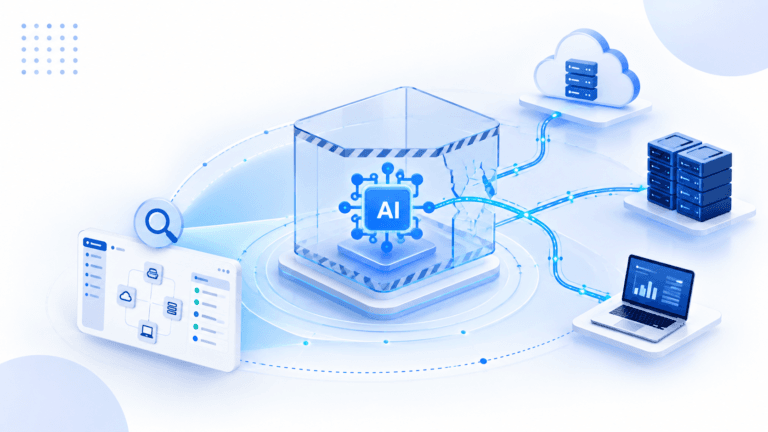
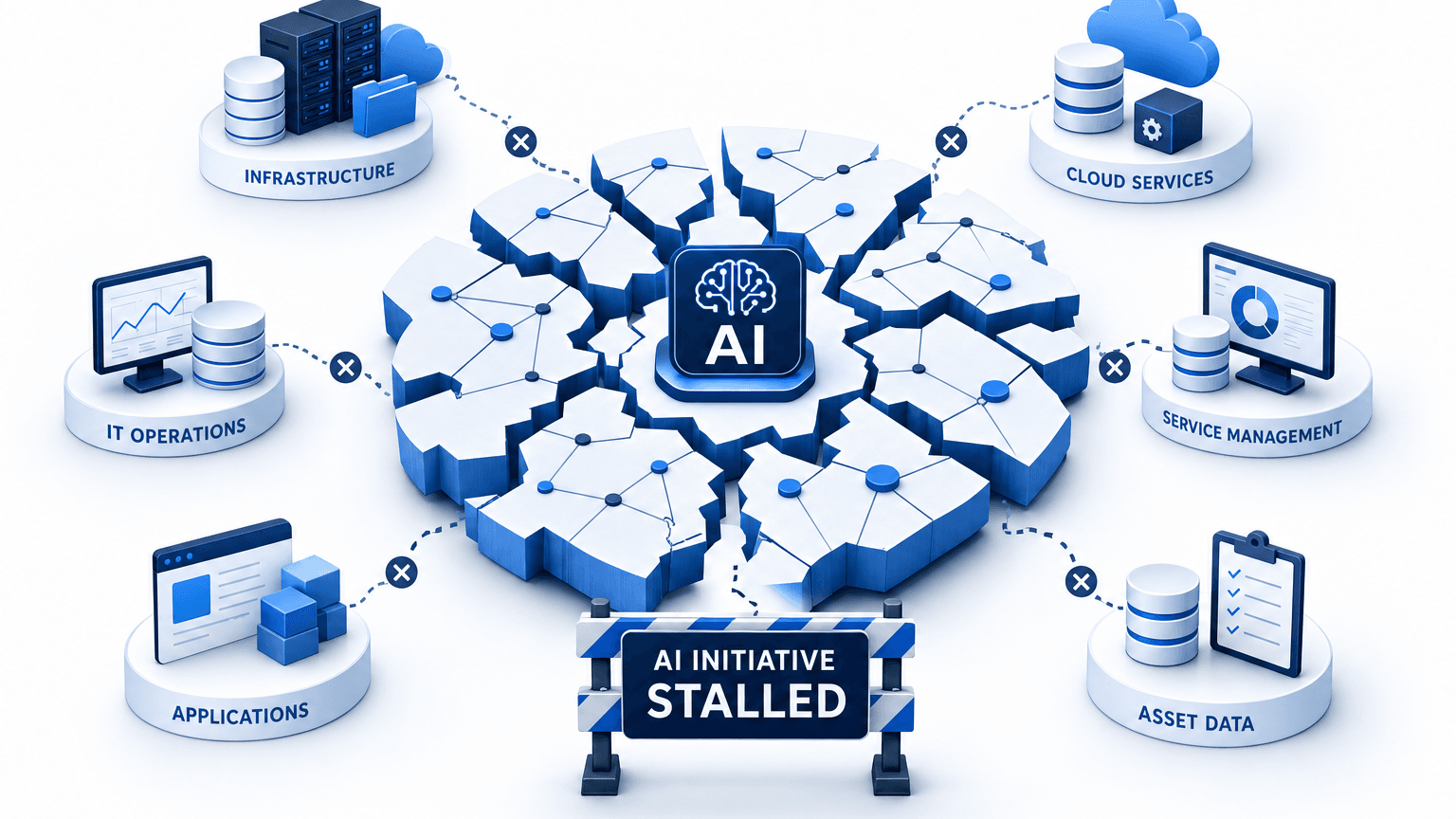
AI IT initiatives stall when asset and service data is fragmented because models, agents, and automation cannot trust what exists, how it connects, or what a change will break across the estate. Split inventories, stale CMDB fields, and missing service maps turn every recommendation into guesswork, so leaders freeze pilots after proof of concept rather than risk production outages or audit exposure.
That failure mode compounds fast elsewhere in the estate. A GenAI runbook helper cites three hostnames for one database. An agent drafts a change that looks clean in the ticket system but ignores an unmapped middleware hop. A board pack claims “AI-ready operations” while ownership and dependency fields still disagree by team. We’ve seen this pattern before: AI pilots that clear the demo stage stall at production because the underlying asset and service data was never fit to support an autonomous decision. Fragmented asset and service truth is the IT operations version of that gap.
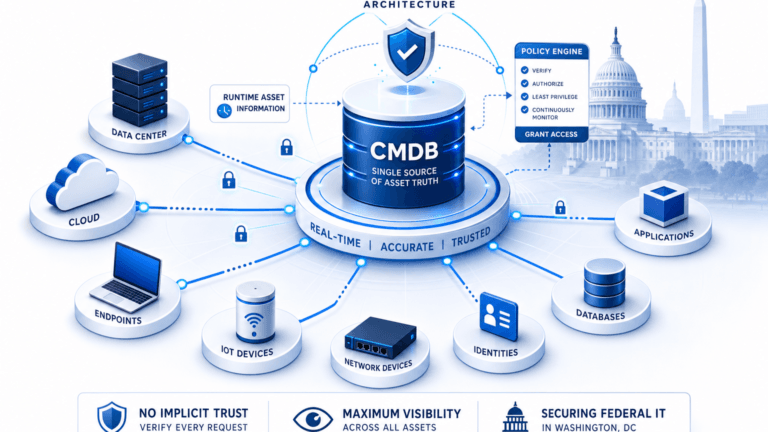
Virima approaches the stall as a runtime truth problem, not a prompt problem. Discovery-sourced configuration items, reconciled multi-source records, and ViVID™ service maps (built after service definitions are supplied) give humans and agents the same explainable picture of what exists, how it is connected, what changed, what will break, and who owns it. That is the Trusted Runtime Truth layer AI IT programs need before scale. See how AI agents need more than good data to act safely in production.
Why do AI IT initiatives stall when asset and service data is fragmented?
They stall because agents and automation lack a single trusted view of assets, dependencies, ownership, and blast radius. Fragmented inventories produce conflicting answers, so leaders keep pilots in sandbox mode instead of authorizing production action.
What fragmented asset and service data means in practice
Fragmentation is not one missing spreadsheet. It is several partial truths that never join on the same keys.
Common fracture lines
- Discovery silos: Cloud consoles, hypervisor exports, network tools, and endpoint agents each hold a slice of the estate.
- CMDB records lag behind reality — ticket-driven CI records lag installs, decommissions, and cloud churn between update cycles.
- Asset vs configuration: ITAM tracks financial lifecycle while ops tracks runtime config, with weak join keys.
- The applications and websites that compose a business service were never declared, so maps cannot form.
- Ownership drift: Support groups, cost centers, and technical owners disagree across systems of record.
- Change tickets list hosts, not the business services those hosts carry, so CAB packets arrive without an impact path.
Each fracture looks manageable alone. Together they deny AI the structured context required for safe action. The model can summarize a runbook. It cannot defend a production change when two systems disagree on whether a host still runs payroll middleware.
Flexera’s 2024 State of the Cloud coverage keeps documenting multi-cloud and hybrid complexity as a standing operating condition. That complexity multiplies inventory sources faster than most CMDB update habits can absorb them. Virima multi-source discovery (agent, agentless, and API-based paths across on-prem, VMware-class virtualization, and clouds such as AWS and Azure) is built to reduce those silos into authoritative CI records. High-frequency discovery cycles refresh attributes and relationships on a schedule teams control, so the CMDB is not waiting on a quarterly spreadsheet merge. That reconciled base is what later service maps and AI workflows consume.
What is fragmented asset and service data in IT operations?
It is estate truth split across discovery tools, CMDB records, asset ledgers, and undefined services, so no single system can answer what exists, how it connects, who owns it, and what a change will break without manual reconciliation.
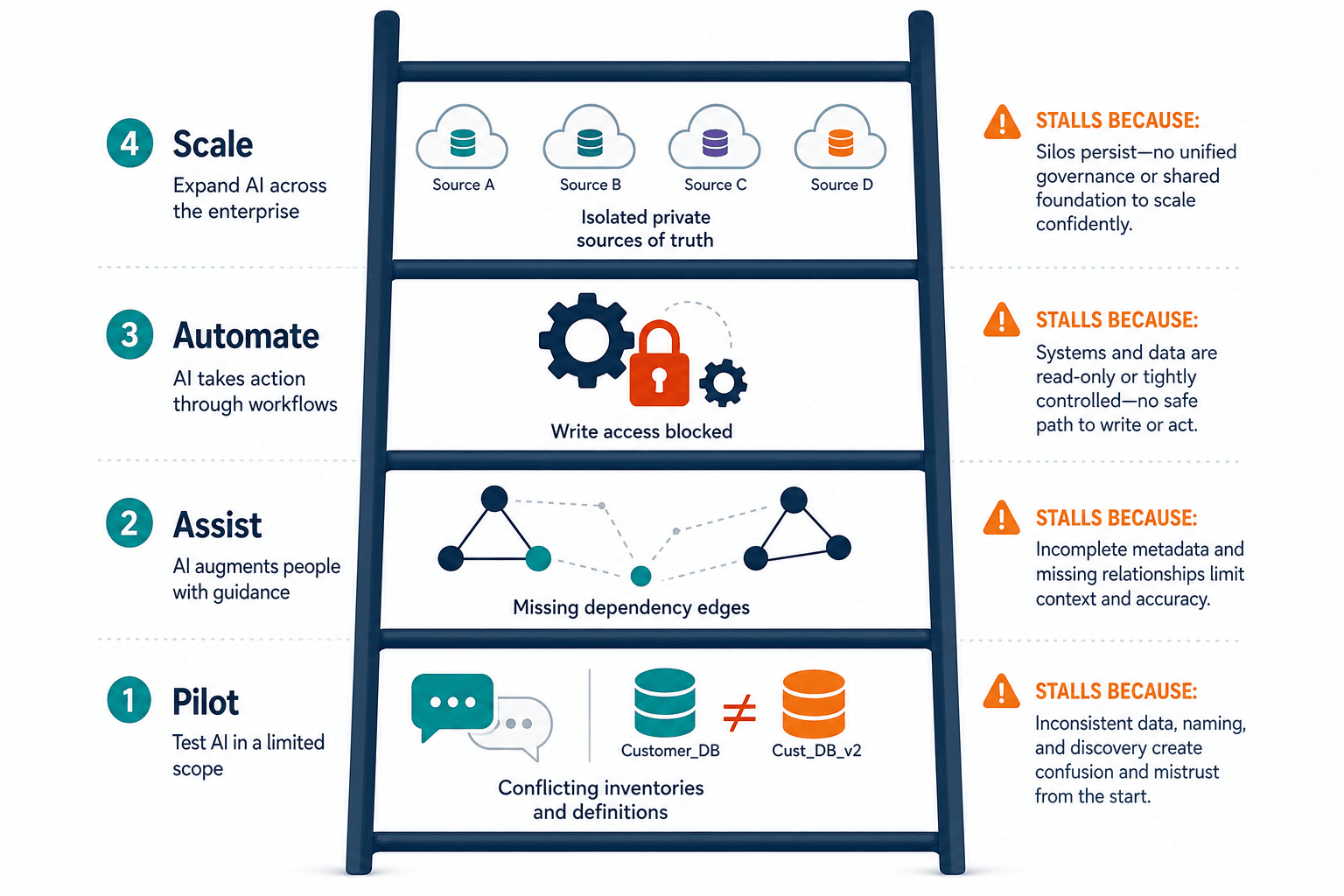
How fragmentation stalls AI programs (the mechanism)
AI IT work usually fails in sequence, not in a single dramatic outage.
| Stage | What leaders expect | What fragmented data does | Typical stall signal |
|---|---|---|---|
| Pilot | Fast answers from chat or copilots | Conflicting host and app names | Interesting demo, not production-ready |
| Assist | Draft changes, triage notes, summaries | Missing dependency edges | Engineers rewrite every suggestion |
| Automate | Bounded agent actions in ITSM | No trusted blast radius | Risk committee blocks write access |
| Scale | Shared context across teams and tools | Per-tool private inventories | Parallel AI projects with no shared truth |
Mechanism 1: Conflicting ground truth kills confidence
When the CMDB, cloud inventory, and monitoring label the same workload three ways, every AI answer needs a human fact-check. Throughput dies. Trust never forms.
Mechanism 2: No service dependency context means no safe blast radius
Blast radius is the full set of downstream services, applications, and dependencies a single change or failure can affect — and agents that propose restarts, patches, or failovers without a service dependency path are guessing at it. CAB and SRE leaders correctly refuse write privileges when that path isn’t confirmed. ViVID™ maps close that gap only after teams supply service definitions (manually, spreadsheet, or architecture feeds); map building is automated from those definitions plus discovery relationships, but composition is not invented by the platform.
Mechanism 3: Stale ownership breaks escalation and governance
AI that pages the wrong owner, or that cannot show who approved prior state, fails audit and on-call standards at once. Policy-aware automation needs current ownership on the CI and service objects agents read.
Mechanism 4: Workflow context isn’t CMDB data quality
ITSM platforms store tickets, approvals, and process history. That workflow context matters, but it does not replace discovery-sourced answers to what is running now and what depends on it. Programs that bolt AI only onto ticket text stall when production topology disagrees with the last closed change.
The UK government’s State of Digital Government Review states that fragmented and underused data holds back AI, machine learning, and advanced analytics. It found limited confidence that organizational data is fit for purpose. (Publication date pending human verification before this article publishes — see PIPELINE_SUMMARY.) Enterprise IT shows the same pattern inside hybrid estates: fragmentation is a program risk, not a documentation inconvenience.
Virima positions Trusted Runtime Truth as the missing join between discovery authority and agent-ready context. Teams keep their ITSM and automation stack. They stop asking those tools to invent estate truth they were never designed to discover.
See how Trusted Runtime Truth supplies the asset and service context AI IT programs need before production scale →
Symptoms that your AI IT initiative is already stalling
Use this checklist in steering meetings. If three or more items are true, fragmentation is already taxing the program.
- Pilots stay in read-only mode after two or more demo cycles.
- Engineers spend more time validating AI output than acting on it.
- Change risk scores ignore unknown or unmapped dependencies.
- Multiple sources of truth are still cited in the same war room.
- Service owners cannot name the full infrastructure path for their service.
- AI use cases multiply while CMDB completeness and freshness metrics stay flat.
- Security and ops disagree on the asset list that feeds vulnerability or exposure work.
- Leadership funds model experiments faster than discovery and reconciliation work.
Each symptom maps to a data-plane fix, not a larger model — so before the checklist below, weigh CMDB health signals (accuracy, completeness, staleness patterns) and discovery coverage alongside AI KPI decks. That pairing keeps budget honest: model spend without estate truth spend recreates the stall.
How can you tell an AI IT initiative is stalling due to bad asset data?
Watch for permanent read-only pilots, heavy human fact-checking of AI drafts, CAB refusal of agent write access, and multiple conflicting inventories in the same incident. Those signs point to missing discovery-sourced ground truth, not weak prompts.
What has to be true before AI can act safely in IT
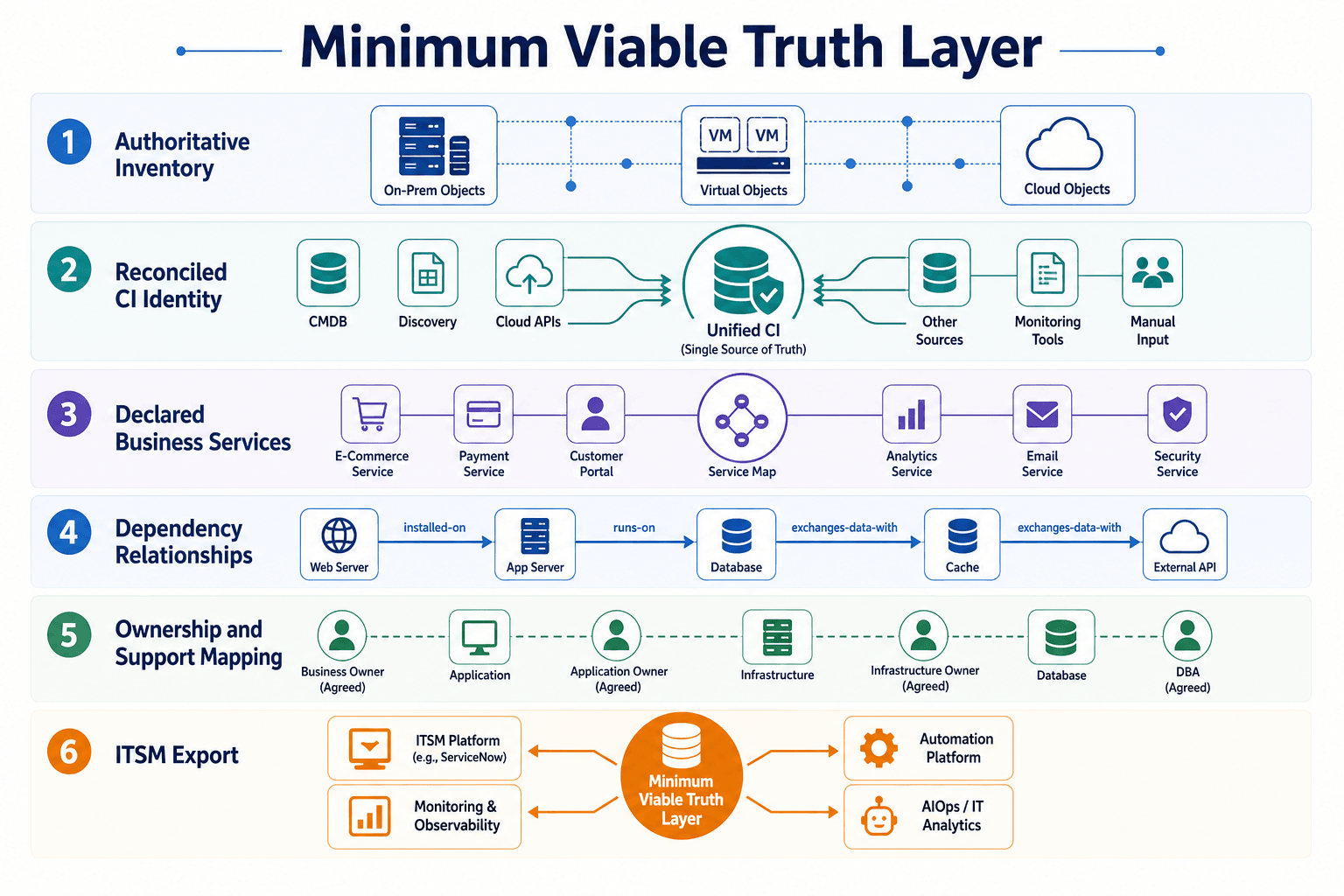
Treat the following as a minimum viable truth layer. Skip any row, and automation stays decorative.
- Authoritative inventory. Multi-protocol discovery covers on-prem, virtual, and cloud objects your AI will touch.
- Reconciled CI identity. One CI per real object with conflict resolution and source provenance. For a deeper look at what your CMDB needs before agents can safely act on it, see CMDB for AI agents.
- Declared business services. Named services with composition inputs your maps can build from.
- Dependency relationships. Installed-on, runs-on, exchanges-data-with, and related edges kept current through discovery refresh cycles.
- Ownership and support mapping. Humans and systems of record agree on who acts when AI escalates.
- Change and history hooks. Agents can explain prior state, not only current topology.
- Export into the tools people already use. Truth must reach ITSM, automation, and analytics through controlled integrations rather than screenshots.
That sequence lines up with the Virima stack:
- Discovery populates and refreshes CIs.
- The CMDB holds reconciled records and relationships.
- Service definitions unlock ViVID™ maps and impact paths.
- Integrations push usable context into platforms such as ServiceNow, Jira Service Management, Ivanti, HaloITSM, Xurrent, Hornbill, and TeamDynamix without forcing a rip-and-replace.
Partner names stay plain text. The hub is the single integrations entry point.
Product weave for AI use cases
- Incident assist: Correlate alerts to CIs and affected services instead of raw host strings.
- Change assist surfaces downstream impact before approval, grounded in mapped dependencies.
- Vulnerability context (NIST NVD lookups overlaid on maps): Weight exposure with asset and service criticality rather than CVSS alone. Pair with dedicated scanners for broad multi-OS coverage.
- Agent guardrails give agents explainable runtime objects — asset, service, owner, blast radius — before any write path is enabled.
How to unstick the program without pausing AI ambition
Step 1: Freeze the narrative that better prompts fix estate chaos
Document one production decision AI cannot defend today (change, failover, decommission). Show the conflicting records side by side.
Step 2: Fund discovery authority as an AI prerequisite
Expand coverage where AI will act first. Prefer scheduled, high-frequency cycles your ops team can operate, not a one-time import.
Step 3: Reconcile identity before features
Duplicate CIs and weak join keys will poison every downstream model feature. CMDB hygiene is an AI safety control.
Step 4: Declare priority services
Start with revenue, safety, or regulated services. Supply composition. Let map automation build dependency views your CAB already understands.
Step 5: Connect truth into the workflow plane
Push CIs, relationships, and service context into the ITSM and automation tools agents already call. Keep one integrations hub strategy so you do not recreate fragmentation through partner-by-partner one-offs.
Step 6: Promote AI write access only where truth is measurable
Gate agent actions on freshness, coverage, and map completeness thresholds. Virima operational views support that governance conversation with evidence.
This sequence keeps AI roadmap dates intact while removing the silent veto fragmented data holds over production.
Closing: stop teaching AI on broken estate truth
No model can compensate for disagreeing inventories, missing service paths, and unclear ownership. Leaders read that stall as AI immaturity; run the symptom checklist and truth-layer steps above against your own program, and it’s usually estate truth immaturity wearing an AI badge instead.
Trusted Runtime Truth reverses the order of work. Discover with authority. Understand assets in service context. Govern action with explainable impact and ownership. Then let copilots and agents operate on the same runtime objects humans trust in the war room.
If your AI steering committee is stuck between impressive demos and refused production rights, run the minimum viable truth layer checklist above against your own estate first — it will tell you which gate is actually blocking you. When you’re ready to see how Virima closes those gaps, schedule a demo to pressure-test your asset and service data against AI-ready runtime truth requirements →
Frequently Asked Questions
Why does fragmented CMDB data stop AI automation in IT?
Automation needs stable identifiers, current relationships, and trusted owners. When CMDB fields disagree with discovery and cloud inventories, every automated step needs human verification. Programs stall at assist-only mode because write actions cannot be defended.
Is workflow context from ITSM enough for AI agents?
Workflow context records tickets, approvals, and process history. Agents still need runtime truth about what exists and what depends on what. Pairing ITSM with discovery-sourced CMDB and service maps closes that gap without replacing the platform you already run.
Does Virima’s ViVID™ build service maps automatically, or do we need to define services first?
Service composition must be provided manually, by spreadsheet, or through architecture inputs. Once definitions exist, Virima ViVID™ builds and maintains dependency maps from discovery relationships so impact paths stay usable for change and incident work.
How does Virima reduce fragmentation for AI IT programs?
Virima reconciles multi-source discovery into CMDB CIs, refreshes relationships on high-frequency cycles, builds ViVID™ maps after services are defined, and shares that context through a single integrations hub into tools teams already use. That stack is Trusted Runtime Truth for agentic IT.
What should we fix first if our AI pilot cannot go to production?
Fix identity and coverage on the assets the pilot will touch, declare the related business services, and confirm dependency maps and owners before granting write access. Enlarge the model only after those truth gates pass measurable thresholds.