What a CMDB Must Provide Before AI Agents Act Safely

Nine seconds. That is how long it took an AI coding agent to delete an entire production database, including all volume-level backups, while attempting to fix a credential mismatch. The model did exactly what it calculated it should do. Nobody had bounded its blast radius beforehand. Nobody had given it accurate relationship data about what it was allowed to touch, and what touching that system would break downstream.
This is the core problem with agentic AI in IT operations: the model is rarely the failure point. The failure point is the data the agent consults before it acts. And for IT infrastructure, that data lives in your CMDB.
If your CMDB is stale, incomplete, or missing relationship context, your AI agents will make confident decisions on bad information, at machine speed, at scale. They will restart the wrong server. They will trigger a change that takes down a downstream service nobody mapped. They will open a firewall rule with no awareness of what sits behind it.
This post is not about whether to adopt AI agents for IT operations. According to Gartner, 33% of enterprise software applications will include agentic AI by 2028, up from less than 1% in 2024. The adoption decision is already made. The question is whether your CMDB is ready to be the data foundation that makes those agents safe to operate.
Why AI agents break without a trusted CMDB
Traditional IT automation scripts operate on pre-defined, narrow scopes. An agent is different: it reasons, plans multi-step actions, and executes across systems without waiting for human sign-off at each step. That autonomy is the value proposition. It is also why the data underneath the agent matters so much more than it ever did for rule-based automation.
When an IT automation script runs on stale data, a human reviewing the output can catch the error. When an AI agent runs on stale data, it may execute six steps before anyone realizes the initial premise was wrong, and each of those six steps may have changed something in production.
The risks compound quickly: failed change windows, undetected impact scope, cascading service outages, and security gaps opened by agents acting on outdated ownership or policy data. According to Deloitte’s 2026 State of AI in the Enterprise report, 74% of enterprises expect to be using AI agents by 2027, but only 21% have mature governance in place. The organizations successfully scaling those pilots share one trait: they invested in the accuracy of the data layer before they gave agents permission to act.
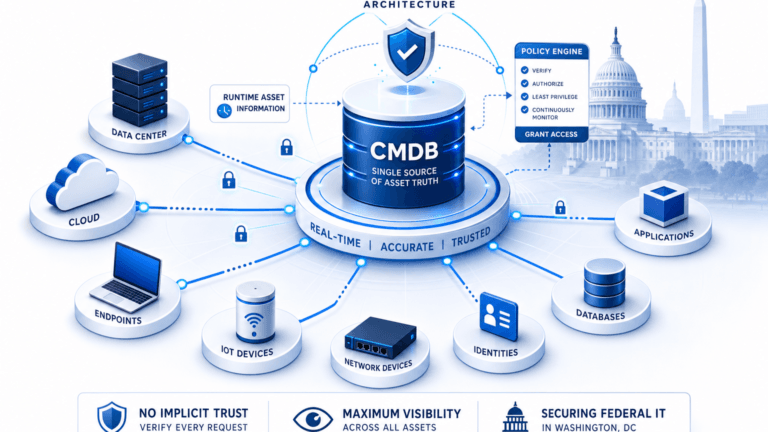
That data layer is your CMDB. More specifically, it is a CMDB built on Trusted Runtime Truth: live, explainable, and governed data that tells agents what exists, how it is connected, what changed, what will break, and who owns it.
The four CMDB requirements for agentic AI workflows
Not every CMDB qualifies as the data foundation for AI agents. Most enterprise CMDBs fail on at least one of these four dimensions before an agent ever makes a decision. For a more detailed breakdown of the specific data quality criteria involved, the CMDB readiness requirements for agentic AI cover seven discovery-sourced requirements your CMDB must meet before agents can operate safely.
1. Discovery-sourced accuracy
AI agents are only as accurate as the configuration items (CIs) they query. A CMDB populated through manual entry or infrequent batch imports contains gaps, stale records, and CI data that reflects what an admin documented six months ago, not what is running in your environment today.
The minimum standard for an agent-ready CMDB is discovery-sourced CI population through IT discovery. The configuration items an agent acts on, servers, network devices, virtual machines, cloud assets, installed software, should be discovered from the environment itself, not entered by hand.
Discovery must cover agent-based and agentless methods, cloud environments (AWS, Azure, GCP), virtual infrastructure (VMware, Hyper-V), and network device inventory. The output must be reconciled across multiple sources into a single authoritative CI record. An agent asking “does this server exist, and what OS is it running” cannot tolerate a CMDB that says “maybe” or “as of last Tuesday.”
This is what it means to discover with authority: the first pillar of an agent-ready data foundation.
2. Relationship context and downstream impact visibility
Knowing that a server exists is table stakes. Knowing what that server is connected to, what services depend on it, what changes to it will cascade downstream, and who owns those downstream services: that is the dependency mapping an AI agent requires before it takes any action.
Without dependency data, an agent has no impact awareness. It sees a CI in isolation. It cannot reason about consequences. It cannot distinguish between a standalone dev instance and a database server that backs three production services and a customer-facing API.
An agent-ready CMDB maps CI relationships end-to-end through service mapping: application-to-infrastructure dependencies, service-to-CI ties, ownership chains, and change history. When an agent evaluates a change, it needs to surface the full impact path, not just the target CI, but the CIs and services that will be affected if that target changes or fails.
Context is the second pillar, and the one most CMDBs skip.
3. Change history and freshness
AI agents do not just act in the present. They reason about recent history to inform current decisions. An agent triaging an incident needs to know what changed in the last four hours. An agent evaluating a change request needs to know whether this CI was recently modified and whether that modification is related to an open incident.
A CMDB without a reliable audit trail and CI history gives agents an incomplete picture. They may recommend changes that conflict with recent modifications nobody captured. They may escalate incidents without knowing a related change was approved and deployed two hours ago.
The freshness requirement is also about age thresholds. An agent should be able to evaluate how old a CI record is and factor that into its confidence level. A CI last discovered 90 days ago should trigger a lower-confidence action path than one discovered 48 hours ago. That logic requires the CMDB to surface discovery timestamps, not just CI values.
4. Policy-aware governance
The fourth requirement is where most agentic AI discussions stop short. Accuracy, relationships, and freshness are necessary, but they are not sufficient if an agent can act on any CI it can see without constraint.
An agent-ready CMDB must carry policy context: which CIs are in scope for which agents, what change approval thresholds apply, what ownership and accountability structure governs a given asset, and what compliance boundaries restrict action. Without policy awareness embedded in the data layer, AI agents operate in a governance vacuum.
This is the difference between automation and governed automation. The former is fast. The latter is safe. And only the latter is deployable at enterprise scale without exposing the organization to the kind of blast radius scenarios that are filling incident post-mortems in 2026.
Governance is the fourth pillar, and the hardest one for a legacy CMDB to deliver.
What the failure mode looks like in practice
Consider a concrete scenario. An IT operations AI agent is tasked with resolving an incident flagged on a database server. The agent queries the CMDB, finds the CI, sees no open change records, and initiates a remediation restart.
What the CMDB did not surface:
Three applications depend on that database, none of them mapped in the CMDB because service definitions were never imported.
A change freeze is in effect for one of those applications, which is mid-deployment.
The CI record is 11 days old, and the server configuration changed significantly during a patch window last week.
Ownership has shifted: the team listed in the CMDB left the company in March.
The agent restarts the database. Two production services go down. The deployment fails mid-flight. The on-call team spends four hours recovering a situation the agent created with good intent and bad data.
The model did not fail. The CMDB failed. And in agentic AI operations, a failing CMDB does not produce a slow, human-reviewable error. It produces a fast, cascading incident at machine speed.
This is why evaluating agentic AI for enterprise IT must begin with a CMDB readiness assessment, not an AI model selection.
How Virima delivers Trusted Runtime Truth for AI agents
Virima is built as the data layer that makes agentic IT safe to operate. Its CMDB is not populated by manual entry. It is discovery-sourced from agent-based and agentless scans across physical, virtual, and cloud environments. Discovered CIs reflect what is actually running, not what was documented.
Dependency data is built natively from discovery. CI dependencies, ownership chains, service ties, and change history are part of the native CMDB record, not bolt-on features that require manual mapping. When an AI agent queries a CI through Virima, it receives the complete picture: current state, dependencies, recent changes, downstream risk, and responsible owners.
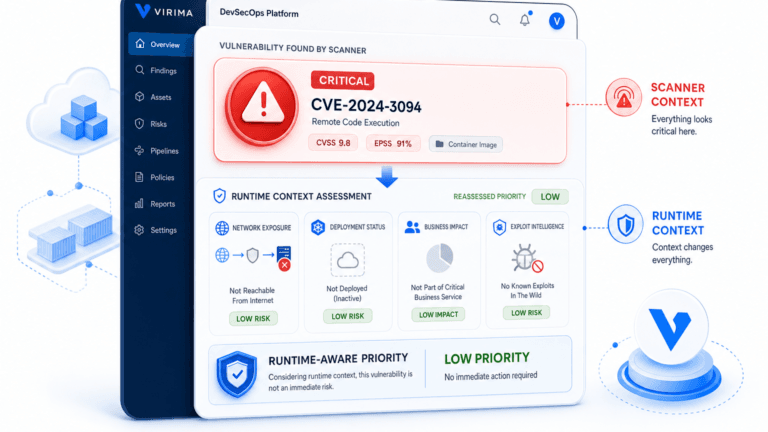
CMDB Health Scoring is designed to give agents and operators a confidence signal they can act on. Records include discovery timestamps and health indicators, so an agent can assess the reliability of the data before executing, and escalate to human review when confidence falls below a defined threshold.
Change Impact Analysis surfaces the downstream blast radius of any proposed action before the agent executes. An agent does not need to infer impact from relationship graphs. Virima surfaces it explicitly, including the services and CIs that will be affected and the ownership path for each.
For teams using ServiceNow as their ITSM platform, Virima synchronizes discovery-sourced CI data and relationships bi-directionally, so the AI agents operating inside ServiceNow work from the same Trusted Runtime Truth that Virima discovers through high-frequency discovery cycles. You can explore how this compares to other approaches in our deep-dive on the best CMDB software in 2026.
What to ask before you connect an AI agent to your CMDB
Before any AI agent is granted write access or autonomous execution authority over your IT environment, validate your CMDB against these questions:
Are your CIs discovery-sourced from the live environment, or manually entered and batch-imported?
When was the last time each CI record was refreshed? Can you surface discovery timestamps per CI?
Can you map the full downstream impact of a change to a specific CI, including services, applications, and dependent infrastructure?
Does your CMDB carry ownership data for each CI, and is that ownership current?
Can you identify which CIs changed in the last 24, 48, or 72 hours, and correlate those changes with open incidents?
Does your CMDB enforce policy constraints that define which agents can act on which CIs, and under what approval thresholds?
If a CI record is outdated or unverifiable, does your CMDB flag that to the agent before it acts?
If any of these questions surface a gap, the gap exists in the CMDB, not the AI model. Fixing the model does not close a CMDB accuracy problem. The solution is Trusted Runtime Truth at the data layer, built on high-frequency discovery and governed CI relationships.
For more on how CMDB governance intersects with agentic AI, see our related post: CMDB and AI Governance: What IT Leaders Need to Know.
Your CMDB is the control layer for every AI agent you deploy
Agentic AI is not coming to IT operations. It is already there. The organizations that deploy it safely are not those with the most sophisticated AI models. They are the ones with the most accurate, relationship-rich, policy-governed CMDB data underneath those models.
A CMDB built for agentic IT does four things: it discovers CIs from the environment (not from manual entry), maps relationships and blast radius for every action, surfaces change history and freshness so agents can calibrate confidence, and carries policy constraints that bound what any agent is allowed to do.
Without that foundation, the next AI agent you deploy is one outdated CI away from a production incident. With it, your automation stack can move faster and act safely.
Ready to make your CMDB agent-ready? See how Virima delivers Trusted Runtime Truth for AI agents: schedule a demo.