What K26 Told Us About the Future of Agentic IT (And What It Didn’t Say)

Every year, ServiceNow’s Knowledge conference functions less as a product launch and more as a directional signal for enterprise IT. K26 2026 in Las Vegas was no exception. Across three days of sessions, demos, and keynote presentations, one message came through with unusual clarity: agentic IT is no longer a roadmap concept. It is the immediate future of how enterprise IT operates, and ServiceNow has made clear it intends to be the platform that delivers it.
That is the headline. The more important story is the space between what K26 announced and what the industry actually needs to make agentic IT work safely at scale. Both sides of that gap matter for IT leaders building an H2 strategy off K26 signals.
The headline announcement from ServiceNow’s Day 1 keynote, “Welcome to Agentic Business,” delivered by CEO Bill McDermott to 25,000 attendees at the Venetian in Las Vegas, was the launch of ServiceNow Otto — a unified AI agent that combines the Moveworks acquisition with Now Assist into a single AI front door for enterprise work. Otto reaches across hundreds of systems, activates AI specialists, and executes tasks end to end, governed by policy and grounded in enterprise data. McDermott’s framing was unambiguous: the goal is not AI that recommends actions but AI that takes them. “The world of work is being remade,” he said.
What “Agentic IT” Actually Means Beyond the Stage Lights
The phrase “agentic AI” has circulated in enterprise technology circles since late 2024. K26 2026 is where it graduated from whitepaper concept to product roadmap reality. Across the session floor, the message was consistent: AI agents in IT operations are no longer experimental. They live in the platform, in the workflows, and are approaching production deployment in enterprise IT environments.
In practice, AI agents take actions rather than just make recommendations. An agent might triage and route an incident, execute a change request, update a CI record, or scale down a cloud workload without a human approving each step. The efficiency gain is real. So is the risk if the data those agents query is wrong.
Agentic IT works on a simple premise: the AI agent receives a task, queries what it knows about the environment, and acts on that knowledge. The query step is the critical one. What the agent knows about the environment determines whether the action is safe, accurate, and useful: which CIs exist, how they are connected, what changed recently, who owns what, and what would break if it acted. For a closer look at the governance and data readiness decisions that shape whether AI agents in IT operations succeed or compound existing problems, the strategic considerations IT leaders face are worth examining before any deployment begins.
The most direct K26 treatment of data dependencies in agentic AI came from a practitioner keynote featuring Phil Priest, Head of Global Business Services at Rolls-Royce, in a session with ServiceNow Chief Customer Officer Chris Bedi. Priest described deploying Now Assist across 12,000 employees and quoted Bill Gates directly: “Automation applied to an efficient operation magnifies the efficiency. Automation applied to an inefficient operation magnifies the inefficiency.” His point was explicit: the same rule applies to AI agents, and magnification happens in seconds. The data foundation comes first.
The Dependency Every Agentic IT Demo Glossed Over
Here is what K26 demos tend to skip: the data environment. Every AI agent demo on the conference floor showed a polished resolution sequence. The agent detects an anomaly, identifies the affected service, routes to the right team, and closes the ticket in minutes. What the demo never showed is the state of the CMDB that made that resolution possible.
Those demos run on clean, structured, current CMDB data. Every CI has a verified owner. Every service has a mapped dependency chain. Every change has a recorded blast radius. That is not the state of most production CMDBs, and K26 had very little to say about the gap between demo environments and real production environments.
Agentic IT systems act through their knowledge of the environment. They ask: “What is affected?” and “Who owns it?” and “What changed?” If those answers are stale, incomplete, or conflicting, the agent’s autonomous actions compound the error at machine speed. A human operator in the same situation would pause, cross-check, and verify. An AI agent doesn’t pause; it acts.
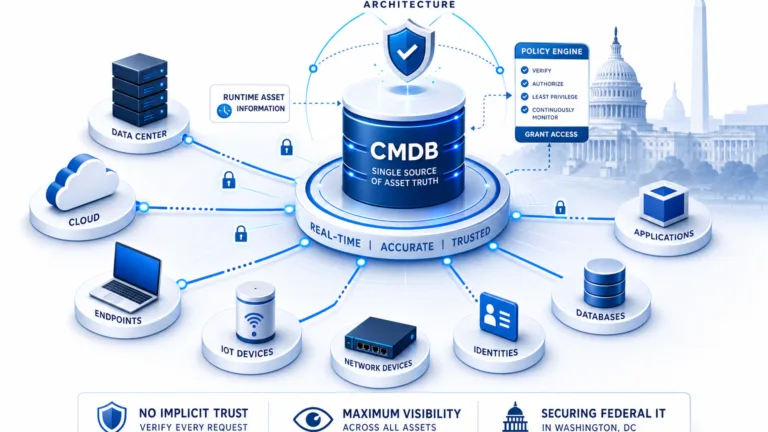
The foundational layer of agentic IT isn’t the AI model or the automation platform. It is the trusted runtime truth the AI queries before every action: live, explainable, policy-aware context about what exists, how it’s connected, what changed, and what will break.
What K26 Got Right About the Direction
ServiceNow’s framing for K26 2026 reflected genuine maturity in how enterprise IT vendors think about AI. Moving from AI as a recommendation engine to AI as an action-taking agent is the right direction. IT operations scaled beyond what human operators alone can manage years ago. The volume of alerts, changes, incidents, and lifecycle events in a mid-to-large enterprise environment exceeds human processing capacity at any meaningful speed.
K26 also got the organizational framing right. The sessions that positioned AI agents as force multipliers for IT teams, taking on high-volume rule-based decisions so human operators can focus on judgment-intensive work, were the most credible conversations at the conference. The goal is amplification, not replacement.
NVIDIA CEO Jensen Huang, joining McDermott on the Day 1 keynote stage, offered the clearest amplifier framing at K26 2026. “Think bigger than productivity gains,” Huang said. “Consider how AI will free your people to take on bigger challenges.” Earlier in the same session, Holly Briedis, ServiceNow SVP for Global Industries and Solutions, described new AI specialists as designed to slot into existing teams “just like a new team member would.” The amplifier argument, not the replacement argument, was the one K26 chose to put center stage.
What K26 Didn’t Say
The most important signals at any technology conference are often in the silences. Here is what K26 2026 didn’t say clearly enough.
It didn’t say how organizations are supposed to trust the data that AI agents act on. It didn’t address the structural problem of CMDB staleness at scale: the reality that most enterprise CMDBs drift from accuracy within weeks of a major infrastructure change. It didn’t provide a concrete framework for what “AI-ready data” actually requires in operational terms.
“You need good data for AI” is table stakes at this point. The real problem is a runtime truth problem: do your AI agents have access to live, explainable, policy-aware context about what exists, how it’s connected, what changed, and what will break? That question demands a different answer than improved data hygiene practices.
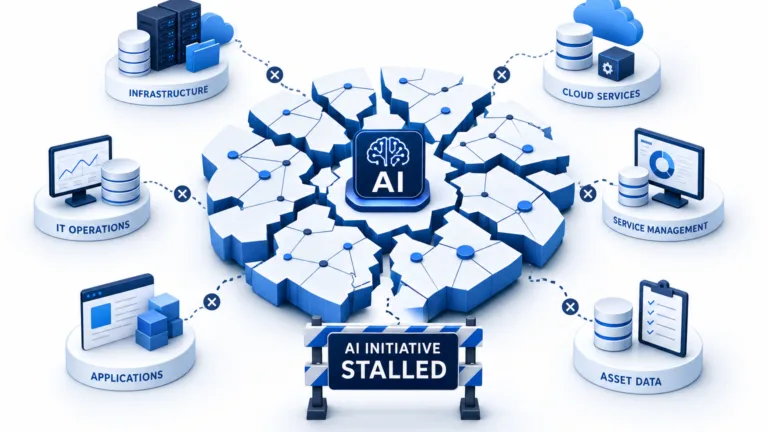
K26 2026 did not address CMDB data quality as a precondition for agentic AI deployment. The Armis integration was announced as a way to feed live asset intelligence into the CMDB going forward — a meaningful step. But ServiceNow’s architecture briefings for Workflow Data Fabric and AI Control Tower both assumed the underlying CMDB was already structured, owned, and current. No K26 session offered a framework for evaluating whether an organization’s CMDB is agent-ready before deploying AI specialists. The gap between a governed demo environment and a production CMDB carrying years of configuration drift went unaddressed.
The Layer K26 Couldn’t Name
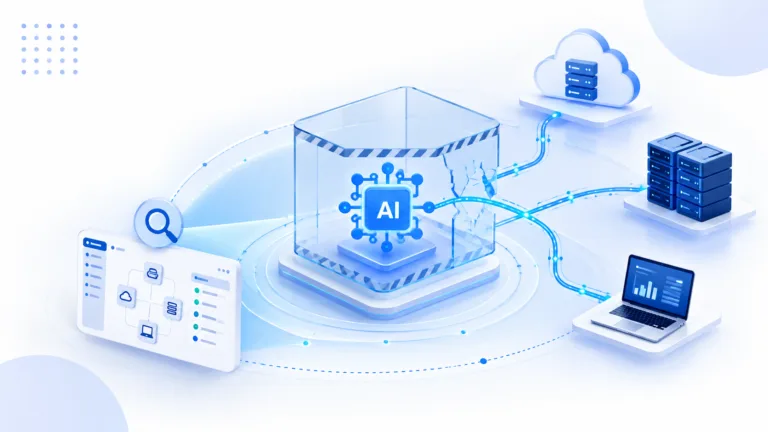
Agentic IT needs a Trusted Runtime Truth layer: live, explainable, policy-aware context about the infrastructure AI agents operate in. IT Discovery-sourced, multi-source reconciled, and blast-radius-aware. Not static records or manual data. Trusted runtime truth that an AI agent can query and act on without compounding the errors already present in the environment.
K26 2026 confirmed the direction the industry is heading. What the conference couldn’t name is the infrastructure underneath agentic AI that makes that direction safe to travel: the trusted runtime truth layer that sits between the AI model and the production environment.
If you’re building an agentic IT strategy off the signals from K26 2026, the first question to answer isn’t which AI agents to deploy. It’s whether the runtime truth they will query is trustworthy enough to let them act safely. Schedule a Demo.