What Is Agentic IT? A Plain-English Guide for IT Leaders

TLDR: Agentic IT is the discipline of deploying AI agents that can perceive, reason, and act across enterprise IT environments without a human initiating every step. It is the next phase of IT automation: one where agents handle incident triage, change risk assessment, and configuration governance on their own. But agents are only as reliable as the data they act on. Trusted runtime truth, a live, discovery-sourced, policy-aware operational record, is the foundation that makes agentic IT safe and effective.
Nearly every major technology vendor is using the word “agentic” right now. Vendors are shipping “agentic” platforms. Analysts are writing about the “agentic enterprise.” But what does it actually mean for the people responsible for keeping enterprise systems running, changes safe, and IT teams productive?
This guide defines agentic IT in clear, practical terms: what it is, how it differs from past automation waves, why it matters in 2026, and what the AI agents in your environment actually need to work safely. Whether you are planning an AI roadmap for the next two quarters or evaluating your first autonomous workflow tool, Trusted Runtime Truth is the concept that determines whether your agentic IT investments succeed or fail.
Virima defined the operational framework for agentic IT. This guide lays it out on Virima’s terms.
What “agentic” actually means
The word “agentic” means having agency: the capacity to perceive a situation, reason about it, decide on a course of action, and execute that action independently. An agentic AI system does not answer questions. It takes actions on its own, with minimal human instruction, to complete a defined goal.
MIT Sloan Management Review describes agentic AI as systems that are “semi- or fully autonomous and able to perceive, reason, and act on their own,” distinct from generative AI tools that respond to prompts but do not initiate or execute complex, multi-step workflows.
Applied to enterprise IT, an agentic system can perform IT tasks: incident triage, configuration updates, change risk assessments, patch orchestration, without requiring a human to initiate and supervise each step. The human defines the goal. The agent determines and executes the path.
Agentic IT: a working definition
Agentic IT is the discipline of deploying, governing, and operating AI agents across enterprise IT environments. It covers how agents are provisioned, what data they can access, how their actions are bounded by policy, and what happens when they take a decision that affects a production environment.
In 2026, agentic IT is the framework CIOs, CTOs, IT Directors, and compliance leaders use to answer a specific question: how do we give AI agents enough access to be useful, while maintaining the governance, visibility, and control that enterprise operations require?
The answer to that question depends on the data layer beneath the agents, not only on the agents themselves.
What is agentic IT management?
Agentic IT management is the discipline of deploying, governing, and operating AI agents across enterprise IT environments. Agents handle incident triage, change risk assessment, and configuration governance autonomously, but only produce reliable outcomes when they act on live, discovery-sourced, policy-aware operational data.
How agentic IT differs from traditional IT automation
Traditional IT automation: scripts, runbooks, robotic process automation: executes pre-defined instructions on a fixed schedule or trigger. It does exactly what you tell it, every time. That predictability is its strength. It is also its ceiling.
Agentic IT systems can reason about novel situations. An AI agent tasked with reducing mean time to resolution (MTTR) for P2 incidents does not wait for a human to map out every step. It queries the asset inventory, checks recent changes, identifies the likely blast radius, and proposes or executes a remediation depending on its permission scope.
| Capability | Traditional IT Automation | Agentic IT |
| Trigger | Predefined rule or schedule | Goal-based, event-driven reasoning |
| Decision-making | Fixed logic tree | Adaptive, context-aware |
| Action scope | Single predefined task | Multi-step, cross-tool workflows |
| Human involvement | Required for exceptions | Escalation-only for bounded decisions |
| Data dependency | Script parameters | Live Trusted Runtime Truth |
| Governance model | Manual approval chains | Policy-aware agent guardrails |
This shift from rule-execution to goal-pursuit defines agentic IT. The agents are not more powerful scripts. They are systems that can reason across context, adapt to conditions they were not explicitly programmed for, and take actions with real consequences in production environments.
How does agentic IT management differ from traditional IT automation?
Traditional IT automation executes fixed rules on a schedule. Agentic IT management uses AI agents that reason across context, adapt to novel conditions, and execute multi-step workflows without human initiation at each step. The key distinction: agents pursue goals; scripts follow instructions.
Why agentic IT matters more in 2026
Several converging forces make agentic IT an immediate concern, not a future planning horizon.
AI agent capabilities have matured. Foundation models now support multi-step reasoning chains, tool-use APIs, and persistent memory: the core building blocks of autonomous action. The gap between “agentic AI as concept” and “agentic AI as deployed software in your ServiceNow instance” has closed substantially in the last 18 months.
Enterprise tooling has followed. Platforms like ServiceNow and Microsoft Copilot for IT have shipped agent-layer products that give IT organizations concrete deployment targets. Agentic IT is a product category you can buy and configure today, not a research project.
CIO.com noted in December 2025 that organizations which lag on foundational readiness will fall behind on every automation initiative that follows the agentic wave. IDC forecasts that by 2030, 45% of organizations will orchestrate AI agents at scale across business functions. For IT teams, the preparation window is open now.
The three capabilities that define agentic IT in practice
For IT leaders, “agentic IT” resolves into three specific operational capabilities.
1. Autonomous triage and remediation
AI agents detect anomalies, correlate signals across monitoring tools, determine the likely root cause, and initiate remediation before a human touches a ticket. For well-scoped incident classes, this compresses MTTR from hours to minutes and reduces alert fatigue across the operations team.
2. Policy-aware change management
Rather than routing every change through a human approval chain, agentic IT systems evaluate a proposed change against policy rules, service dependencies, and the current environment state. Low-risk changes proceed. High-risk changes are flagged with a pre-scored rationale for human review. Effective change management in agentic environments requires this kind of policy-aware automation.
3. Continuous asset and configuration governance
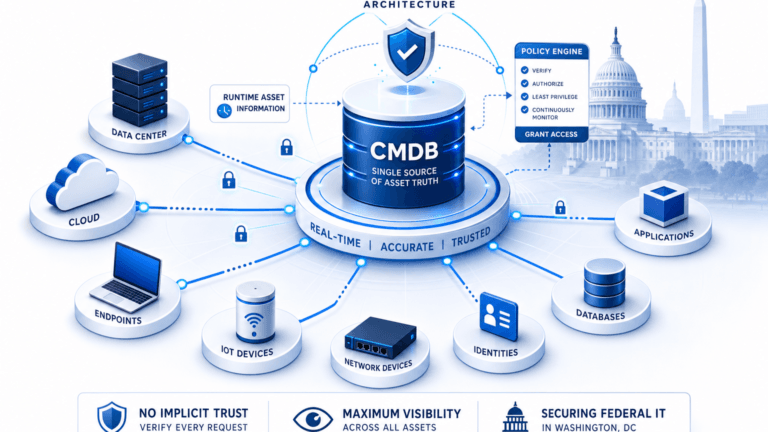
Rather than quarterly discovery runs, agentic IT systems maintain a live operational picture of the environment: assets, services, dependencies, ownership, and flag deviations from the desired state automatically. This keeps the CMDB accurate between scheduled audits and removes the manual reconciliation burden from your configuration management team.
Each of these capabilities depends on the same precondition: the AI agent must know what actually exists in the environment, how it is connected, and what the policy limits are. That precondition is a data architecture requirement, not a feature selection.
What AI agents actually need to act in IT environments
Most vendor narratives describe what agentic IT agents can do. Fewer describe what they need. The gap between those two conversations is where most enterprise agentic IT initiatives encounter failure.
An AI agent operating in an enterprise IT environment needs four things:
Accurate, live inventory. The agent must know what assets exist right now, not what was in the CMDB six months ago. Stale asset data causes agents to make decisions based on an environment picture that no longer reflects reality. IT discovery that reconciles across multiple sources is the starting point for any trustworthy agentic deployment.
Service context. Assets exist in relationship to services. An agent patching a server needs to know which services the server supports, which downstream systems depend on it, and what the blast radius of a configuration change would be. ViVID service maps provide exactly this relationship layer.
Change history. What changed recently, on what asset, by whom, and when? Without changing context, an agent performing incident triage cannot distinguish a problem caused by a recent change from a pre-existing condition.
Policy boundaries. What the agent is permitted to do: which assets it can modify, under what conditions, and within what approval workflows. An agent with broad access and no policy guardrails is an availability risk and a compliance liability.
These four requirements: live inventory, service context, change history, and policy boundaries, are the precondition for safe agentic action.
Why agentic IT fails without Trusted Runtime Truth
The failure mode most enterprises will encounter in 2026 is predictable: agentic AI deployed on top of fragmented, stale, or siloed IT data. The agents are capable. The data foundation is not trustworthy. The result is automation that operates on an inaccurate picture of the environment.
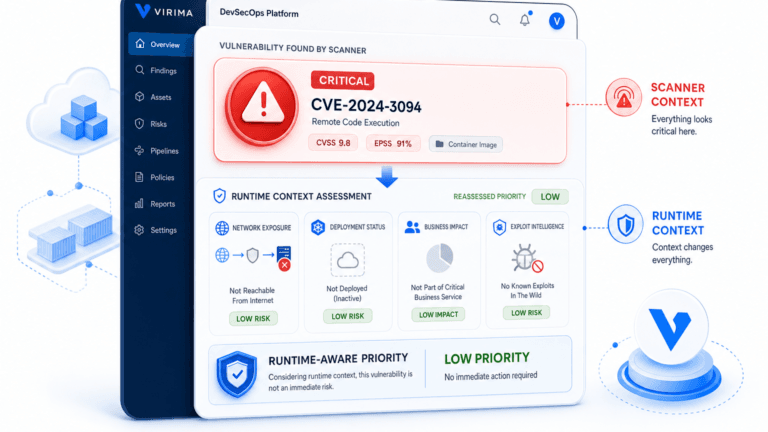
An agent that resolves an incident by restarting a service, without knowing that the service has three undocumented dependencies, can trigger a cascade outage. An agent that approves a change, without knowing the target asset carries an unpatched vulnerability, can widen an attack surface. Decommission an asset that is still referenced in an active service map? That causes an unexpected disruption, and nobody saw it coming.
This is the known failure pattern of previous IT automation initiatives that ran ahead of their data quality. Agentic AI raises the stakes because decisions are faster, scope is broader, and execution is autonomous.
That authoritative data foundation addresses this failure pattern directly. It is the live, explainable operational record, built from discovery data across every source, that tells AI agents, and the humans governing them, what exists, how it is connected, what changed, what will break, and who owns it. Without it, agentic IT is automation built on assumptions.
How Virima delivers Trusted Runtime Truth for agentic IT
Virima delivers the foundational components of Trusted Runtime Truth today: multi-source IT discovery, ViVID service mapping, and IT asset lifecycle management, and is extending this foundation to serve as the authoritative data layer for AI agents across assets, services, dependencies, ownership, change history, vulnerabilities, and blast radius.
Virima’s IT discovery reconciles data across multiple sources and protocols into a single, authoritative record. When the data source and the live environment conflict, Virima surfaces the conflict with full source attribution: not only the answer, but the authority behind it.
ViVID, Virima’s service mapping capability, builds live dependency maps from authoritative discovery data. It shows which assets underpin which services, which teams own what, and what the blast radius of any proposed change would be.
Virima’s IT asset management module brings asset lifecycle context into the same operational record: purchase history, ownership, compliance status, depreciation, giving AI agents the full asset picture, not only the configuration snapshot.
For AI agents working inside ServiceNow, Jira, or Ivanti, Virima delivers the live operational context they need to reason accurately. The agentic platform provides the workflow. Virima provides the authoritative operational context. Neither is complete without the other.
What IT leaders should prepare for in 2026
The move to agentic IT is a readiness program, not a single project decision. For IT leaders planning their AI roadmap in 2026, from CIOs setting strategy to IT Directors running evaluations, three priorities stand out.
Audit your current operational data quality. Before deploying any AI agent with write access to production environments, baseline your CMDB accuracy, discovery freshness, and service dependency coverage. Gaps here surface as agent failures later, at a speed and scale you cannot manually contain.
Define your agent policy architecture. Each AI agent in your environment needs a defined permission scope: what it can read, what it can modify, under what conditions it can act autonomously, and when it must escalate. Policy design is as important as agent capability selection.
Invest in Trusted Runtime Truth, not just discovery. Discovery tools give you inventory. That authoritative layer gives you inventory, service context, change history, blast radius, and policy-aware governance, all live and explainable. If you are building a CMDB or modernizing an existing one, design for Trusted Runtime Truth from the start. That foundation is what agentic IT runs on. And evaluate whether your current approach requires expensive platform-native licensing or whether a dedicated runtime truth layer can deliver the same foundation at significantly lower TCO and faster time to value.
How to evaluate an agentic IT management platform
The agentic IT platform market is growing fast. Most IT vendors now claim some form of agentic capability. The evaluation question is not whether a platform has agents. It is whether those agents can act reliably on your environment.
Five criteria separate platforms that support safe agentic action from those that create confident-sounding but unreliable automation.
Discovery depth and coverage. Agents need a complete, current picture of the environment. Evaluate whether the platform discovers on-premise, cloud, and hybrid assets, including assets added or changed since the last scan. Gaps in discovery produce gaps in agent decision-making.
CMDB accuracy and governance. A populated CMDB is not the same as an accurate one. Ask how the platform handles duplicate CIs, stale records, and relationship gaps, and whether reconciliation is automated or manual.
Service dependency coverage. Agents making change or incident decisions need to know which services depend on the CI they are acting on. Platforms without live, maintained service maps cannot provide the blast radius context agents need to bound their actions safely.
Policy-aware guardrails. Agents operating in production environments must know what they are and are not allowed to do. Evaluate whether the platform supports action policies, approval thresholds, and escalation paths, not just autonomous execution.
Integration with your existing ITSM stack. Agentic IT management does not replace your ITSM platform. It enriches it. Evaluate whether the platform integrates with ServiceNow, Jira Service Management, Ivanti, Halo, Xurrent, or Hornbill, and whether it feeds agent-ready data into those workflows or requires you to replicate data manually.
What data foundation does agentic IT management require?
Agentic IT management requires live, discovery-sourced operational data covering assets, service dependencies, ownership, change history, and configuration state. Without this foundation, AI agents act on incomplete or outdated information, producing automation that looks confident in testing and fails in production.
Frequently asked questions about agentic IT management
What does agentic IT management require to work safely in production?
Why do agentic AI automation initiatives fail in enterprise IT?
How is agentic IT management different from traditional ITOM?
What does Virima provide that makes agentic IT management possible?
How does Virima’s discovery data support AI agents making change decisions?
Agentic IT runs on Trusted Runtime Truth, not just better agents
Agentic IT is the shift from reactive, human-executed operations to AI-powered systems that can perceive, reason, and act autonomously inside enterprise environments. It is the current planning horizon for major IT platform vendors, and it is arriving in enterprise IT organizations in 2026.
For IT leaders, the question is not whether to prepare for agentic IT. The question is whether the data foundation beneath your AI agents is trustworthy enough to support autonomous action safely.
Virima delivers the foundation your AI agents need: live discovery, explainable service mapping, and governed asset intelligence across services, dependencies, and change history. The agentic era demands more than good data: it requires an authoritative operational record you can trust.
See how Virima delivers Trusted Runtime Truth for your AI agents: Schedule a Demo.