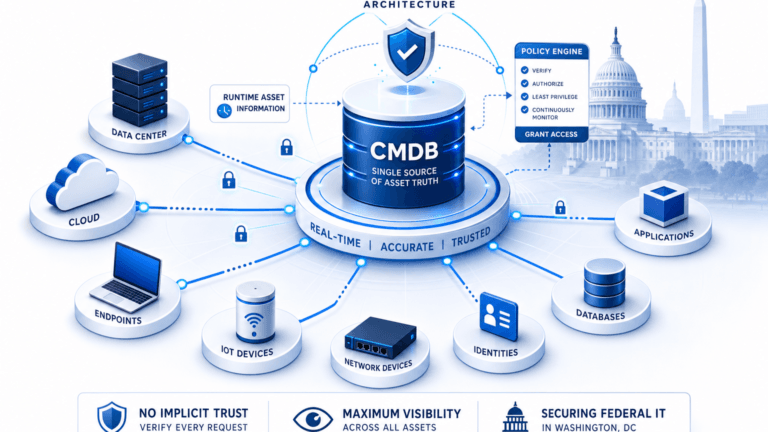
Is Your CMDB Really a Source of Truth?

TLDR: The CMDB has been called the source of truth for IT for decades. It is a reasonable aspiration, but an ia incomplete standard. A CMDB can be accurate and still fail you the moment you need to know what will break, who owns it, or whether it is safe for an AI agent to act on. That is the gap Trusted Runtime Truth (TRT) closes: live, governed, traceable operational context that your CMDB alone cannot deliver.
To assess whether your CMDB meets this bar, the AI-ready CMDB checklist covers 20 criteria across discovery, data quality, relationship mapping, governance, and integration readiness — specifically built for teams preparing for agentic IT.
Introduction
Most IT teams already know their CMDB is wrong. Not entirely wrong, just wrong enough to cause trouble at the worst possible moment.
A change request gets approved because the dependency map looks clear. The change goes in. Three hours later, an incident opens on a service nobody connected to the change. The CMDB said those assets were not linked. It was wrong.
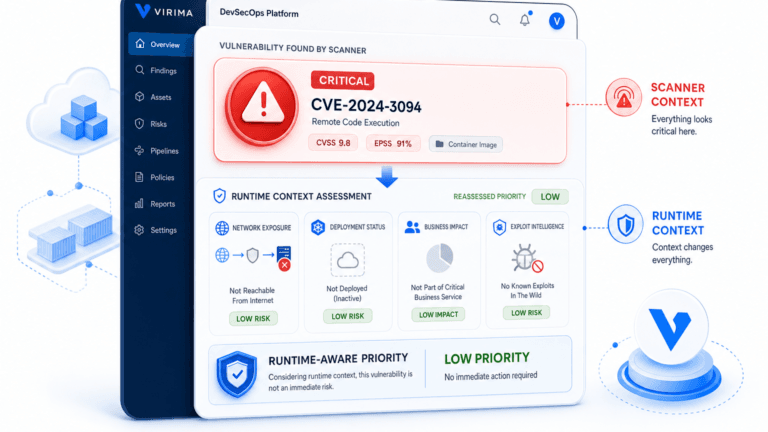
This is not a data quality failure. It is a standard failure. Treating the CMDB as a source of truth sets the wrong goal. A CMDB can have high completeness scores, low staleness rates, and strong governance, and still be unable to answer the five questions that matter when a change is in flight or an incident is live.
The right standard is Trusted Runtime Truth (TRT): live, discovery-sourced, and transparent operational context that covers not just what you have, but how it is connected, what changed, what could break, and who owns it. Here is why the difference matters, and what it takes to deliver it.
Why “CMDB as a source of truth” falls short
The idea behind CMDB as a source of truth is sound. One verified record. No guesswork. Decisions backed by data. The problem is that CMDBs were designed to store configuration items, not to answer operational questions in real time.
Three structural gaps cause the CMDB-as-source-of-truth model to break down:
1. Staleness is structural, not accidental
Environments change constantly. Assets are provisioned, decommissioned, patched, moved, and reconfigured at a pace that manual CMDB updates cannot match. Even discovery-fed CMDBs have windows of inaccuracy between scan runs. The CMDB reflects a past state. Change managers plan against it. Incident responders query it. AI agents read from it. None of them know the map they are working from is outdated.
2. Accuracy without context does not help
According to EMA research, CMDB accuracy and discovery maturity are among the top determinants of ServiceOps success, and among the most commonly underinvested areas in IT.
An accurate CI record tells you an asset exists. It does not tell you which services depend on it, what will break if it changes, or what the blast radius of a planned action will be. Most CMDBs capture CI attributes. Fewer capture CI relationships at the service level. Even fewer surface those relationships during a change window or an active incident.
Source of truth requires more than accurate records. It requires service mapping context: the reliable map of how infrastructure components connect to business services. That is what ViVID™ delivers, application-to-infrastructure dependency maps built from discovery-sourced data, once service definitions are provided.
3. Governed accuracy is not the same as traceable truth
A CMDB with good governance still leaves a critical question unanswered: where did this data come from, how confident are we in it, and is it safe for an AI agent to act on?
Traceability (source attribution, confidence scoring, recency signals, and conflict resolution logs) is what separates a well-managed CMDB from Trusted Runtime Truth. Without it, the data exists but cannot be defended. For AI agents, undefendable data is the same as no data.
What is Trusted Runtime Truth?
TRT is the operational context layer that answers five questions IT teams and AI agents need answered before acting:
What exists in your environment right now?
How is it connected to other assets, services, and business processes?
What changed, and when, and by whom?
What could break, given the planned or actual change?
Who owns it, at the CI, service, and business-domain level?
When all five answers are live, verified, and transparent, you have Trusted Runtime Truth. When even one is stale, estimated, or missing, you have a gap, and that gap is where outages, failed changes, and unsafe AI actions originate.
TRT is distinct from:
CMDB completeness: having records does not mean they reflect current reality
Discovery freshness: frequent scans do not guarantee reconciled, managed data
Monitoring coverage: alerts tell you something is broken, not what it is connected to or who owns it
Workflow history: ticket trails capture what happened, not what currently exists and what will break next
CMDB as a source of truth vs. Trusted Runtime Truth
The difference between these two standards is not just degree, it is scope. CMDB as a source of truth is a necessary condition, but not a sufficient one.
| Dimension | CMDB as Source of Truth | Trusted Runtime Truth |
| What exists? | CI records with attributes | Multi-source, reconciled CI records with confidence scores |
| How is it connected? | Limited or manually maintained relationships | Automatic service dependency maps (ViVID™) |
| What changed? | Change tickets and audit logs | Discovery-detected change history with source attribution |
| What could break? | Manual impact assessment | Automated blast radius and downstream CI impact analysis |
| Who owns it? | Ownership fields (often stale) | CI, service, and business-domain ownership, linked to incidents and vulnerabilities |
| AI-agent ready? | No confidence or provenance layer | Confidence scoring, source attribution, and policy governance for agent consumption |
Why agentic IT changes the stakes
For most of IT operations history, a reasonably accurate CMDB was sufficient. Humans made decisions with time to verify before acting. A stale dependency record might mean a missed risk note on a change ticket.
The agentic IT era changes that calculus. AI agents executing runbooks, orchestrating changes, and responding to incidents do not pause to sanity-check the data. They act on what they are given. If the data is stale, fragmented, or disconnected from real service impact, the agent does not slow down. It acts on bad context.
This means the cost of a data gap is higher in agentic environments than in human-managed ones. A stale dependency map in a traditional change process might cause a missed risk signal. The same stale map consumed by an AI orchestration agent might cause an unintended cascade failure.
According to Gartner research via Dataversity, organizations will abandon 60% of AI projects through 2026 due to insufficient data quality. “Good data” is no longer the right goal. The right standard is TRT: live, traceable, policy-aware, and tied to actual service impact before any action is taken.
How Virima delivers Trusted Runtime Truth
Virima is purpose-built to close the gap between CMDB-as-source-of-truth and TRT, across four interconnected capabilities.
1. Verified multi-source discovery
Virima’s IT Discovery combines agent-based, agentless, network, cloud, and virtual machine discovery into a single confirmed CI record. Multi-source data reconciliation merges inputs from multiple discovery methods into one managed record, eliminating duplication and resolving conflicts. Each CI carries a source, a timestamp, and a confidence score.
This is how Virima keeps the CMDB current: not through a single scan, but through layered discovery paths that update the record from multiple angles, so the CMDB reflects the environment as it actually exists, not as it existed last week.
2. ViVID™ service mapping
ViVID™ Service Mapping builds application-to-infrastructure dependency maps automatically, once you define which applications and infrastructure components make up each business service. Service definitions are provided manually, via spreadsheet import, or through integrations such as LeanIX. Once those definitions are in place, Virima builds and maintains the dependency map without ongoing manual maintenance.
The result is a continuously updated service map that surfaces impact paths, blast radius, and multi-tier architecture relationships, the context that makes source of truth actually useful during an active change or incident.
3. Policy-aware CI management
TRT carries governance into each CI record. Virima’s CMDB applies ITIL-aligned lifecycle management, role-based access control, and audit trail logging to each configuration item, so the data is not just accurate, it is auditable and defensible. Change history is tracked. Ownership is recorded. Compliance state is visible.
When an AI agent reads a CI record, it does not just see the current state. It sees the controlled state, with source attribution and recency signals that confirm the record reflects real authority.
4. Change impact analysis and blast radius
Before a change is approved, or before an AI agent acts, Virima surfaces downstream CI impact. Change Risk Assessment shows what is connected to the CI being changed, what services sit above it, and what alerts or incidents are already associated with related assets.
This is the operational definition of TRT in practice: not just knowing what you have, but knowing what will happen next.
Where Trusted Runtime Truth matters most
The gap between CMDB-as-source-of-truth and TRT is most costly in three operational contexts:
Incident response: Responders need to know what is connected to the affected CI, what recently changed, and who owns the impacted service. A CMDB tells you what exists. TRT tells you the impact chain.
Change management: Change management backed by runtime truth eliminates the guesswork. Change managers need blast radius before a window opens. A change that looks safe against a stale CMDB may be dangerous against the live environment.
Agentic IT operations: AI agents executing remediations and runbooks need to know that the action is scoped correctly: the right CI, the right service, the right owner, compliant with the right policies. TRT provides that confidence at the moment of action.
Learn how Virima defines and provides this standard at Virima.
Who needs Trusted Runtime Truth?
The CMDB-as-source-of-truth gap affects IT across the board, but the consequences look different by role:
IT Directors and VP IT need managed, accurate data before authorizing AI investments or autonomous agent deployments
IT Managers and Service Delivery Leads need blast radius and service context during change windows, not just CI attribute records
SREs and Infrastructure Engineers need source-attributed data they can trust under pressure, not records they have to verify manually
CISOs and Security Leaders need policy-aware CI records to govern what AI agents can access and act on in security-sensitive environments
GRC and Compliance Leaders need audit-ready CI records with source attribution and policy governance to satisfy regulatory and framework requirements
The standard to hold your CMDB to
A CMDB qualifies as a true source of truth when it can answer all five questions, for each CI, before any decision is made, with live data, sourced authority, and policy governance:
What exists? via verified, multi-source discovery
How is it connected? via service mapping and CI relationship graphs
What changed? via change history and audit trail
What could break? via blast radius and change impact analysis
Who owns it? via CI ownership tracking and service-to-team mapping
That is the TRT standard. See how Virima meets it across CMDB, IT Asset Management, and ViVID™ Service Mapping at Virima/platform.
Your CMDB should answer all five questions before any action is taken
The CMDB-as-source-of-truth model served IT operations well for a long time. It set a useful bar: one reliable record, managed and maintained, backing decisions.
The agentic IT era requires a higher bar. AI agents act at machine speed on the data they are given. A source of truth that is stale, incomplete at the relationship level, or untraceable at the source level is not good enough for autonomous operations.
Trusted Runtime Truth is what the CMDB-as-source-of-truth aspiration was always trying to reach. It is live, transparent, auditable, and tied to service impact, so teams move faster and AI agents act safely. Virima enables it through verified multi-source discovery, ViVID™ service mapping, and policy-aware CMDB management.
See how Virima closes the CMDB-to-runtime-truth gap: Schedule a demo.