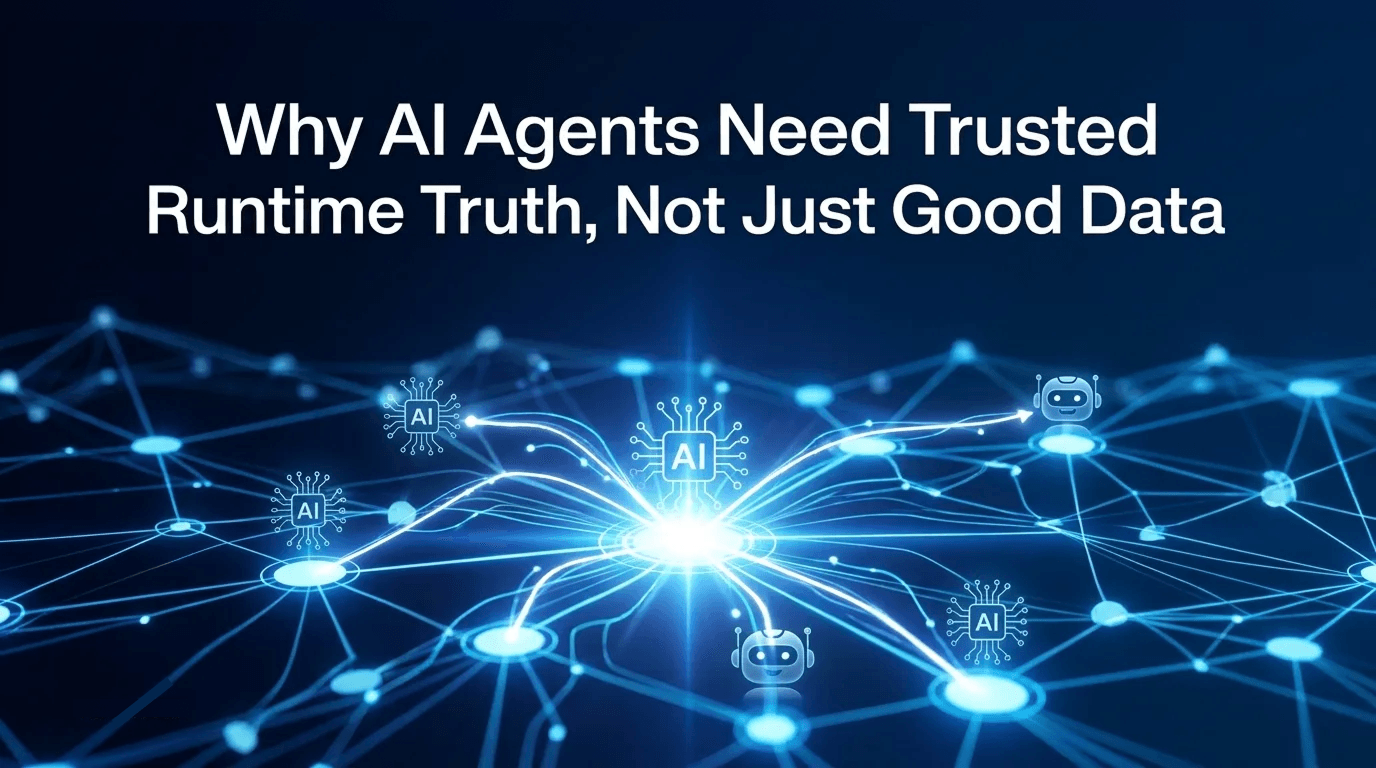
Why AI Agents Need Trusted Runtime Truth, Not Just Good Data

Agentic IT has real promise. Today, AI agents can triage incidents, weigh change risk, rank vulnerabilities, and suggest fixes. Better yet, they do it without waiting for a human to connect the dots. But to act safely, they need more than good data — they need trusted runtime truth.
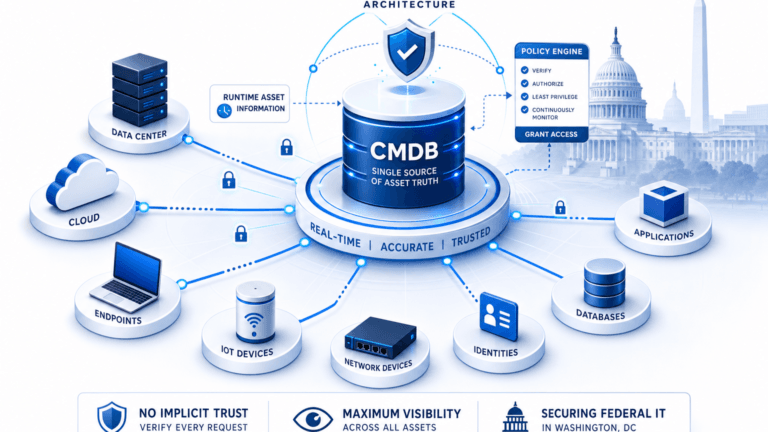
So there’s a catch. Most teams rushing into agentic IT build on a shaky foundation. They focus on feeding “good data” into their AI systems. Yet the real requirement is tougher. You need a live, explainable context layer that shows what exists, how it’s connected, what changed, what will break, and who owns it.
This difference isn’t just semantics. In fact, it separates AI agents that speed up safe work from agents that cause costly, surprise incidents. For the enterprise-leadership view of the same problem, see what IT leaders must get right about agentic AI in the enterprise.
What “Good Data” Actually Means — and Why It Falls Short
When IT leaders talk about “good data,” they usually mean clean, current records. That data comes from your CMDB, ITSM, and discovery tools. And the goal makes sense. After all, no agent can decide well from duplicates, stale entries, and missing links.
Still, even great data has a ceiling. Here’s where it falls short.
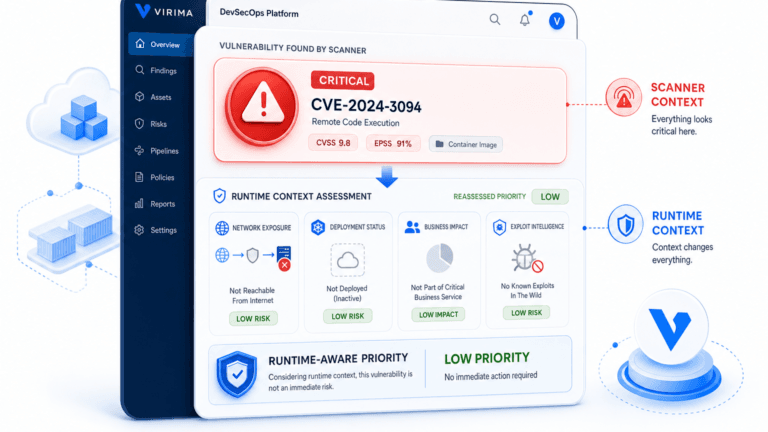
- Good data is a snapshot. Trusted runtime truth stays validated. A record that looked right last week may already be wrong. Maybe a config changed yesterday, a cloud instance launched this morning, or a dependency shifted overnight. So an agent working from a snapshot acts on yesterday’s reality.
Trusted runtime truth closes that gap. It refreshes records through high-frequency discovery, network scanning, and agent checks. Crucially, it does this only when confidence in a record drops. As a result, your data stays close to what’s actually running — without constant, brute-force scanning.
- Good data describes what was recorded. Trusted runtime truth describes what exists. There’s a real gap between what gets recorded and what actually runs. Some services, dependencies, and owners never made it into the record. Others drifted from their recorded state long ago. Good data can’t see them — but the fallout from a bad agent action can.
- Good data is static. Trusted runtime truth is dynamic, confidence-scored, and explainable. Say an agent wants to isolate a server or approve a change. The people and systems around it need to know why. Yet good data offers no traceability.
For example, it won’t show where an attribute came from or when you last checked it. It also won’t show how a source conflict got resolved. Trusted runtime truth, by contrast, carries that lineage with every record. That’s what makes each recommendation auditable. - Good data carries no policy. Trusted runtime truth does. Safe agentic IT needs every AI action to pass a governance check. But good data alone can’t flag policy problems. It can’t tell an agent whether a change crosses a compliance line, needs approval, or calls for a blast-radius review. That context doesn’t live in a record — it lives in the runtime truth layer.
The Three Gaps That Break Agentic IT
Across IT operations, three gaps keep good data from being enough. Each one stops AI agents from acting safely. Let’s walk through all three.
1. The Discovery Gap
Most teams run several discovery tools, and each sees only part of the estate. Agent-based tools reach endpoints. Agentless scanners map the network. Cloud-native tools track cloud assets, while ITSM modules record what people type in by hand.
None of these tools sees the whole picture. So your CMDB fills up with conflicting records and missing relationships. You also get attribute values you can’t trust. After all, you rarely know which source won.
When agents run on that shaky base, they decide from whatever view they grab first. That’s not good data. Instead, it’s a probability of correct data. And “probably correct” can’t anchor autonomous action.
Authoritative multi-source discovery fixes this. It reconciles data from every source into one record. It also tracks each field, so you see which source filled it and when. As a result, agents act on defensible truth instead of a coin flip.
2. The Context Gap
Discovery tells you what assets exist. But agents need much more than that. They need to know which services rely on which assets. They also need to know who owns each one, what changed recently, and what blast radius an action carries.
Picture an agent triaging an incident. Without service context, it can’t tell a test server from a payment database. Without ownership context, it can’t route the ticket to the right team. Without change history, it can’t spot a recent deployment as the cause. And without blast-radius context, it can’t tell whether a fix will break something else.
Good data gives you records. Trusted runtime truth gives you the connected context that turns records into decisions. ViVID™ service mapping builds that context for you. Plus, it keeps your dependency maps current as things change.
3. The Trust Gap
One visible failure can stall an AI program fast. Maybe an agent acts on bad context and causes an outage. Maybe it triggers a compliance violation instead. Either way, leaders who see it get cautious in a hurry.
That’s the trust gap, and better data quality alone won’t close it. Instead, you make the data trustworthy, auditable, and easy to explain. That means discovery backed by SOC 2 Type 2 and ISO/IEC 27001:2022-certified security practices. It also means full source tracking, clear audit records, and recommendations that show their reasoning. And finally, it means governance that checks policy before any action runs.
This foundation closes the trust gap by design. It’s not just accurate. It’s defensible.
What Trusted Runtime Truth Requires
Closing these gaps takes more than a CMDB refresh or a new tool. Trusted runtime truth is a governance-ready context layer. In short, it’s the live picture of what exists, how it’s connected, what changed, what will break, and who owns it. To deliver that, it has to do four things well.
Authoritative multi-source discovery. Every source feeds one reconciled record — agent-based, agentless, cloud-native, and ITSM. Attribute-level tracking shows which source filled each field. Conflict-resolution logic picks the winner when sources disagree. And confidence scores show how fresh each record is.
Connected operational context. Here, assets link to the services they support and the people who own them. They also link to recent changes, known vulnerabilities, and the blast radius of any action. This is the job of service mapping. In short, it turns a flat record into operational truth.
Policy-aware governance. This layer is built to guide, not just describe. So before any action, trusted runtime truth checks the governance context. Then it asks whether the action follows policy, needs human approval, or crosses a compliance line. Frameworks like the NIST AI Risk Management Framework call for exactly this kind of control.
Explainability and auditability. Every AI decision should be easy to trace. You should see the context the agent used and the sources behind it. You should also see how conflicts got resolved and which check ran first. Then, when a leader, a compliance or GRC lead, an auditor, or a regulator asks “Why did it do that?”, the answer is already there.
What Trusted Runtime Truth Means for IT Leaders Planning Agentic Operations
The market is moving fast. Every major ITSM and ITOM vendor now races to own this context. Some embed AI into workflows, while others position themselves as the foundation layer. But the message is clear: AI without governance context is a liability, and vendors know it.
So as you weigh your options, skip the obvious question. “Does this vendor have AI?” won’t help you, because every vendor has AI. The better question is simple: where does the trusted runtime truth come from?
Platform-native AI learns from workflow history. It knows which tickets opened, which approvals cleared, and which changes got logged inside that platform. That’s workflow context, and it helps you govern work within the platform.
But it isn’t discovery-sourced truth. Platform-native context can’t see the parts of the estate the platform never reaches. It also can’t reconcile records from many discovery sources. And it can’t map a dependency the platform’s CMDB never logged.
Discovery-sourced trusted runtime truth works at a different layer. It starts from what’s actually running. Then it discovers across agent-based, agentless, cloud-native, and API sources, both on-prem and in the cloud. From there, it builds the context your automation needs to act across the whole estate — not just one platform’s slice.
So build on platform-native context, and you get AI that’s smart inside the platform. Build on trusted runtime truth, and you get AI you can trust across the estate.
How to Start Building Trusted Runtime Truth
You don’t need a full transformation to start. The work is incremental. Better yet, you’ll see value before you deploy a single agent.
Start with discovery authority. First, map which sources feed your CMDB and which attributes come from each. Then find where conflicts get resolved well — and where they don’t. This audit alone often surfaces thousands of CI records you trusted more than you should.
Add service context. Next, map the dependencies for your most critical business services. You don’t need the whole estate on day one. So start where an agent’s mistake would hurt the most.
Layer in governance. Finally, decide which actions agents can run on their own. Decide which ones need human approval. And decide which ones policy should block, no matter how confident the agent is. Set this up before you scale — not after the first incident.
Here’s the bottom line. The leaders in agentic IT won’t be the ones with the most data. Instead, they’ll be the ones who build trusted runtime truth: validated, explainable, and governed. That’s the foundation that makes autonomous IT safe enough to scale.
Virima delivers Trusted Runtime Truth for agentic IT — live, explainable context covering what exists, how it’s connected, what changed, what will break, and who owns it. It combines authoritative multi-source discovery, ViVID™ service mapping, and policy-aware governance. Together, they give your automation the context it needs to act safely. Contact us to learn more.