Open context layer vs. standardizing on one ITSM for data quality

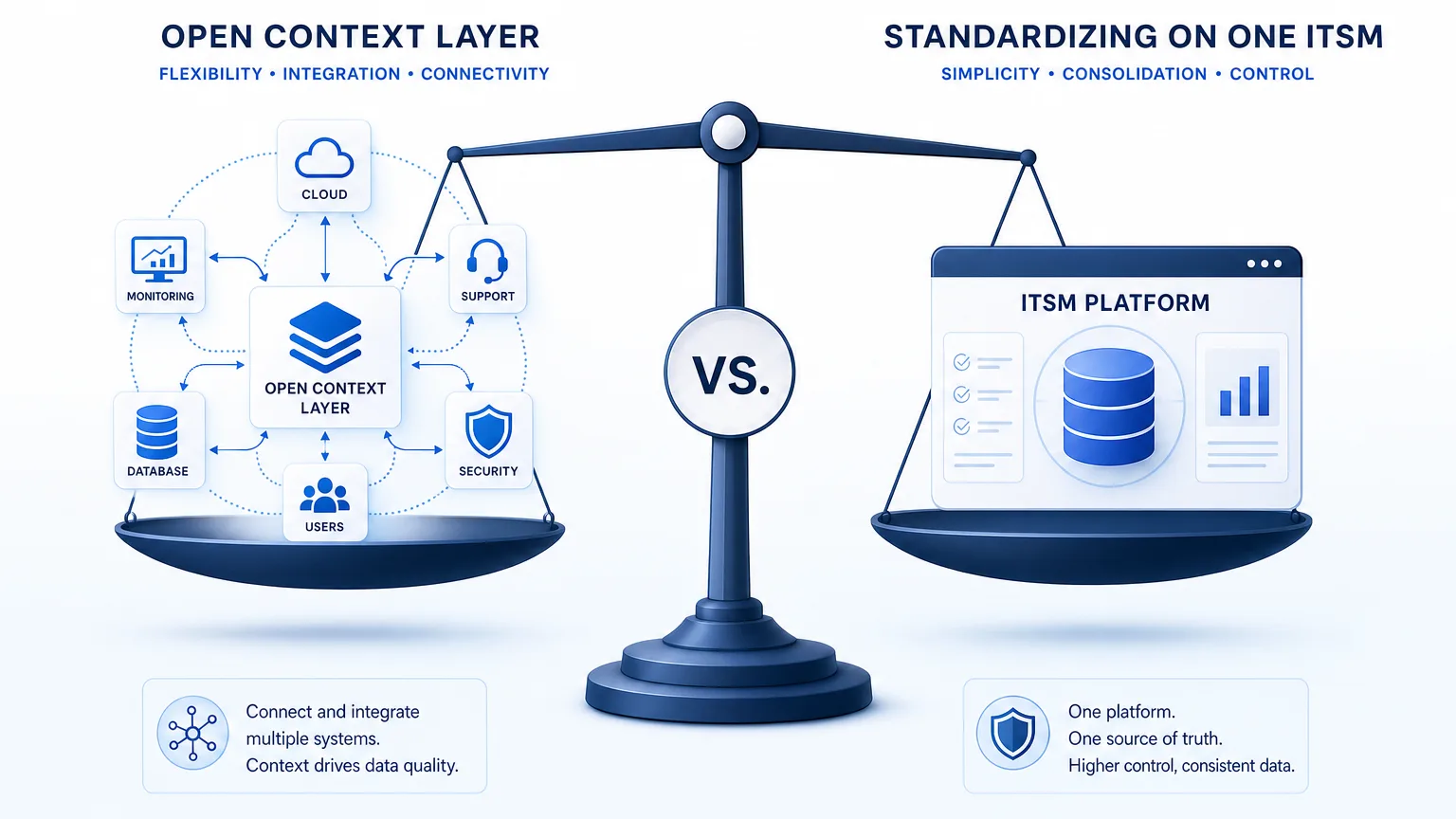
The architecture review board wants a clean answer: put every CI into one ITSM CMDB, or keep an open context layer that feeds several desks. Both camps claim better data quality. Neither claim holds until you name the trade-offs.
This page is a genuine architectural comparison of open context layer vs standardizing on one ITSM for data quality. It does not open with a conclusion that open layers always win. It maps cost, control, freshness, multi-desk access, and failure modes for each path, then shows how discovery authority sits under both.
For the category frame, start with Trusted Runtime Truth. For topology choices once you already accept multi-system truth, see CMDB models for agentic IT. This article stays on the open-layer versus single-ITSM decision for data quality.
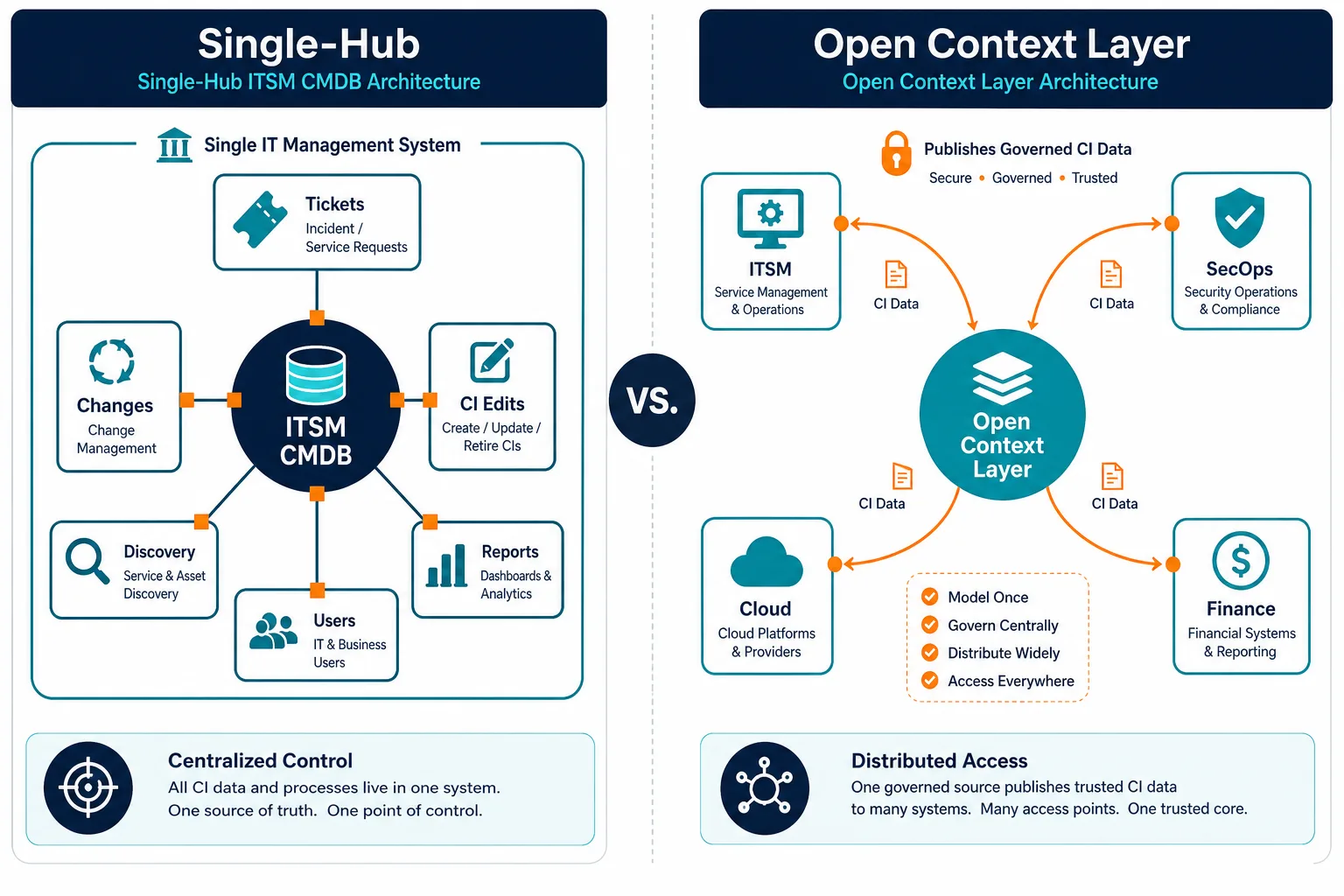
What each architecture means in practice
| Dimension | Standardize on one ITSM | Open context layer |
|---|---|---|
| System of engagement | One ITSM for tickets, changes, and CI edits | One or more ITSMs keep workflows; context layer holds estate truth |
| System of record for assets | ITSM CMDB is the intended record | Context layer is the intended record; ITSM holds working copies |
| Who writes CI facts | ITSM processes plus native or imported discovery | Discovery-led layer with governed publish into ITSM forms |
| Who consumes | Teams inside that ITSM | Any desk that can consume the feed (ITSM, SecOps, cloud, finance) |
| Primary quality lever | Process discipline and import jobs inside one platform | Identity, field authority, and freshness rules at the layer boundary |
Neither column is automatically higher quality. Quality is duplicate rate, owner currency, relationship honesty, and last-seen age under the workflows people already run.
CISA Binding Operational Directive 23-01 requires complete asset inventories for federal civilian agencies. Enterprise programs feel the same pressure without the directive on the ticket. Architecture choice does not invent inventory; it only decides where authoritative writes land.
Trade-off 1: Control concentration versus multi-desk access
One ITSM strength. A single CMDB gives one permission model, one audit trail for CI edits, and one place for CAB packets. Training, role design, and data stewardship sit in one product team.
One ITSM cost. Desks that do not live in that ITSM (cloud ops with its own inventory, security with a separate asset store, M&A estates on another ticket tool) keep parallel truths. Quality looks high inside the ITSM and weak outside it.
Open layer strength. Multiple systems of engagement can consume the same discovery-sourced picture. Jira Service Management and ServiceNow can both see the same host identity without forcing a single ticket product. This pattern is sometimes called a federated CMDB model.
Open layer cost. You now staff a boundary: publish contracts, field maps, and reject paths when consumers write back. Without that staff, the layer becomes another warehouse nobody trusts.
Platform bake-offs that stop at workflow fit still leave both tools needing estate truth; see Jira vs ServiceNow.
Trade-off 2: Process gravity versus discovery gravity
One ITSM strength. Change, incident, and request processes already touch the CMDB. Quality work rides existing process owners. Forms, required fields, and approval gates are native.
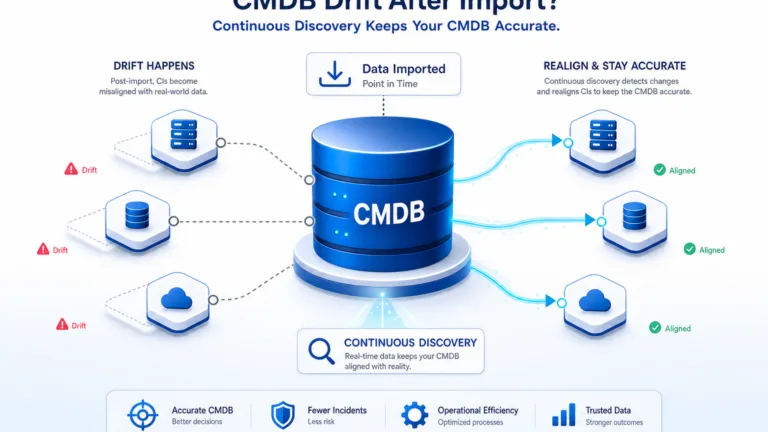
One ITSM cost. Process gravity can outrank probe gravity. Manual CI creates and bulk imports win the overnight job. Import projects go green while records age; see ServiceNow CMDB drift after import projects when that failure mode is the live issue.
Open layer strength. Discovery can own hardware, last-seen, and relationship edges before any ITSM form. Field-level authority becomes an explicit matrix instead of last-write-wins inside one platform.
Open layer cost. ITSM owners may treat the layer as optional context. If tickets never require a CI from the layer, quality metrics stay cosmetic.
Does standardizing on one ITSM automatically improve CMDB data quality?
No. One ITSM can improve quality when process owners, discovery feeds, and field rules stay aligned inside that platform. It can also concentrate stale imports and leave non-ITSM desks with separate inventories. Architecture alone does not set last-seen age or owner currency.
Trade-off 3: Integration surface and lock-in shape
One ITSM strength. Fewer bidirectional syncs. Fewer identity keys to map. Procurement and training consolidate.
One ITSM cost. Exit cost rises. Customizations, workflow history, and CI schema investments make later multi-desk reality expensive. Platform lock-in and agentic lock-in are different risks; governance still has to prove both, as framed in agentic lock-in versus platform lock-in.
Open layer strength. Consumers can change without re-discovering the estate. The layer can publish to ServiceNow, Jira, Ivanti, and other desks through one hub pattern.
Open layer cost. You own reconciliation and SLAs at the boundary forever. A thin layer with no identity match rules recreates multi-source chaos; companion patterns live in multi-source CI reconciliation for hybrid estates.
Trade-off 4: Freshness SLAs and stale-source behavior
One ITSM strength. Native Discovery (where licensed and scoped) and platform jobs can be scheduled next to change calendars. One ops team owns the schedule.
One ITSM cost. Coverage holes outside the MID or credential scope stay invisible until an incident. Global weekly dumps treat cloud churn and chassis the same.
Open layer strength. Class-based frequency policies and stale-source quarantine can sit once, then publish. High-frequency scheduled discovery cycles can protect last-seen without claiming passive continuous real-time event discovery when that is not product behavior.
Open layer cost. Consumers must honor freshness stamps. An ITSM that ignores last-seen and overwrites with a spreadsheet undoes the layer overnight.
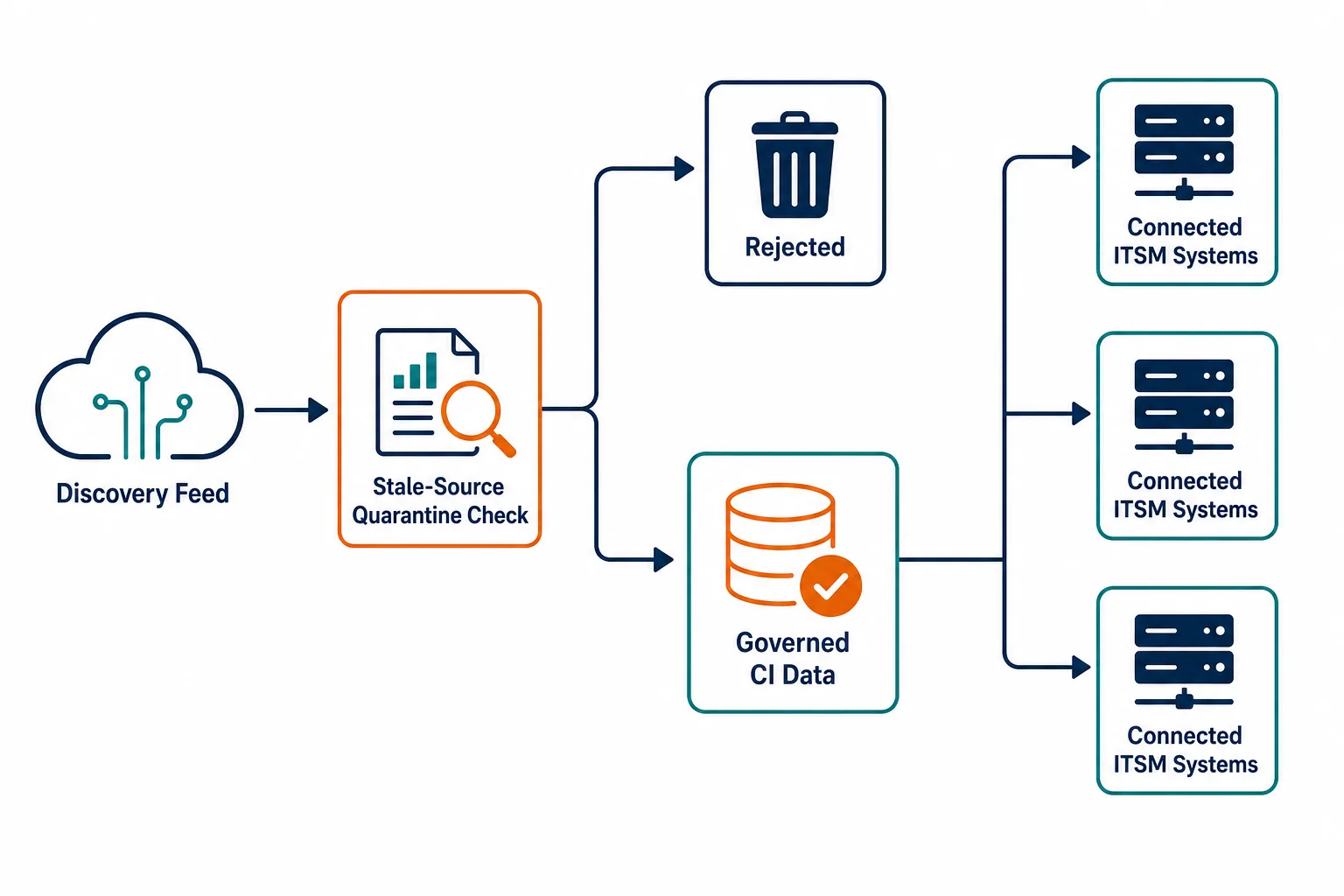
CMDB programs still decay when discovery authority is missing under either architecture; see CMDB projects decay without discovery authority.
Trade-off 5: Service context and agentic readiness
One ITSM strength. CSDM-style service models and platform AI features sit next to tickets. Operators stay in one UI.
One ITSM cost. Service definitions and dependency edges still need current infrastructure underneath. Context features without discovery-sourced joins amplify confident wrong actions.
Open layer strength. Service maps and dependency truth can be built once and offered to multiple tools. ViVID™ service maps still need service definitions first; they do not invent the business service list.
Open layer cost. Agentic consumers multiply. Without field authority and exception queues, agents inherit the same collisions humans already fight.
ServiceNow Context Engine augmentation is a related product conversation when ServiceNow is already the engagement plane; see how Virima augments the ServiceNow Context Engine with Trusted Runtime Truth. That post is not a substitute for the open-layer versus single-ITSM architecture choice.
What is an open context layer for IT data quality?
It is a discovery-sourced estate truth plane that publishes governed CI identity, attributes, and relationships into one or more systems of engagement. Workflows stay in ITSM tools. The layer owns freshness and field authority so each consumer does not run a separate inventory of record.
Decision table: when each path is the honest fit
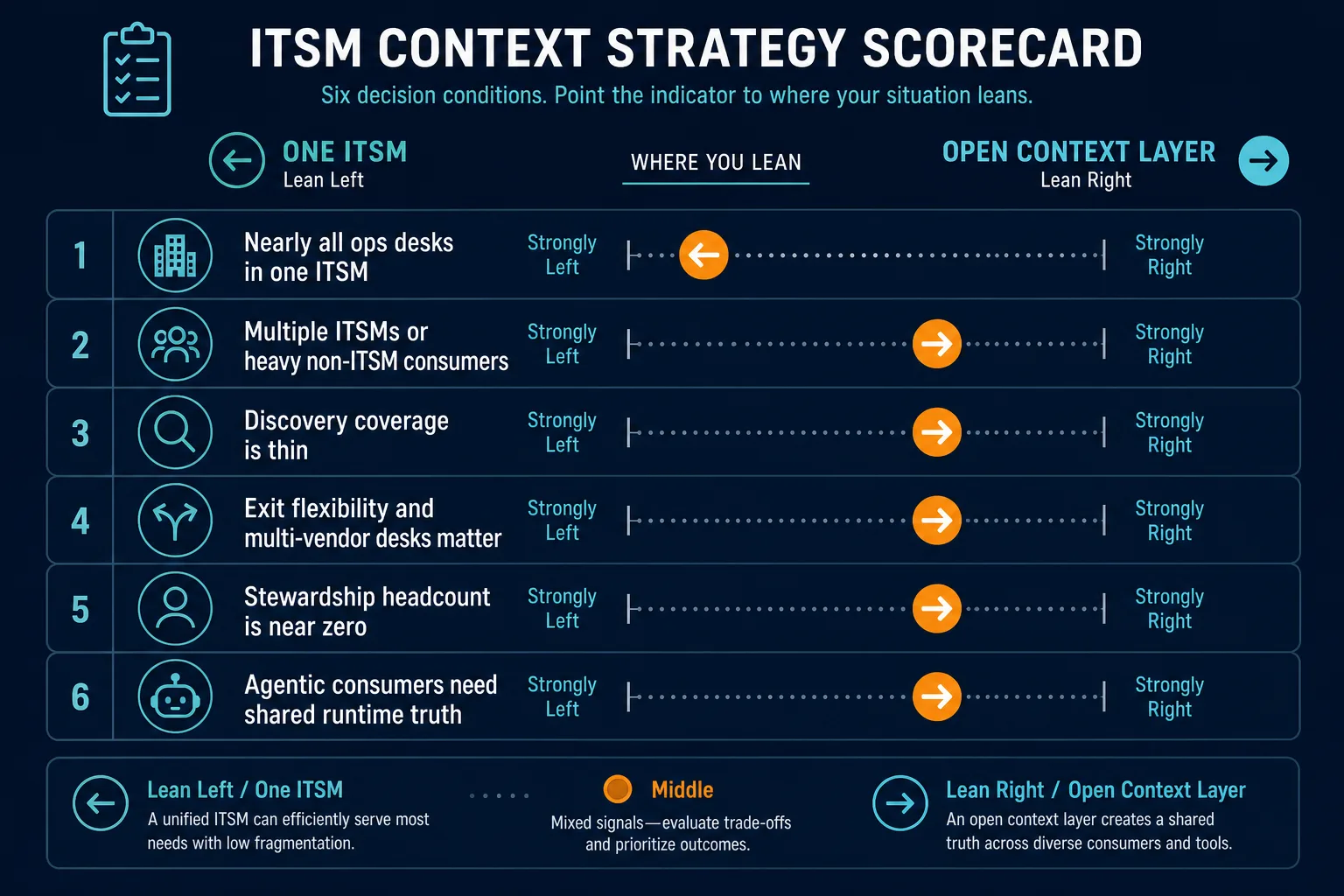
| Condition | Lean one ITSM | Lean open context layer |
|---|---|---|
| Nearly all ops desks already live in one ITSM | Strong fit | Optional later |
| Multiple ITSMs or heavy non-ITSM consumers | Weak fit without shadow stores | Strong fit |
| Discovery coverage is thin | Fix coverage first either way | Fix coverage first either way |
| Exit flexibility and multi-vendor desks matter | Weaker | Stronger |
| Stewardship headcount is near zero | One ITSM may be simpler | Layer will fail without staff |
| Agentic consumers need shared runtime truth | Possible inside one platform | Often clearer as a shared layer |
DORA research keeps tying delivery performance to reliable change and recovery practices. Those practices still need honest CIs and owners under either architecture. Architecture does not replace the discovery job.
Where teams usually fail the comparison
- Picking open layer to avoid ITSM politics without funding identity match and field matrices.
- Picking one ITSM to avoid integration work while leaving cloud and security inventories outside the CMDB.
- Calling either path done after the first import or connector goes green.
- Skipping discovery authority and treating spreadsheets as temporary forever.
If the architecture debate is really about where estate truth lives before it hits ServiceNow, Jira, or Ivanti, talk through how a discovery-sourced layer would publish into the desks you already run — before you commit to either architecture.
Where Virima sits in the comparison
Virima is a discovery-sourced open context layer candidate. It can feed ITSM CMDBs under field and freshness rules. It does not replace ServiceNow, Jira, or Ivanti as systems of engagement.
What Virima contributes
- Automated discovery so identity keys and last-seen stay current across hybrid paths Virima covers
- Inventory and relationship truth that can publish into ITSM working copies
- ViVID™ service maps after service definitions exist
- Windows Server NIST NVD overlays on maps where that signal applies, without claiming full multi-OS vulnerability data collection
- Feed into ServiceNow, Jira, Ivanti, and many more through one hub: all integrations
What Virima does not claim
- Autonomic Social Discovery (ASD) as a go-forward capability
- Passive continuous real-time event discovery as current behavior
- That open layers always beat a well-run single ITSM CMDB
- Replacement of ITSM workflow, CAB, or ticket products
- Instant business-service invention without a definition input
- GCP discovery parity with AWS and Azure where product scope is cloud-limited
For capability depth, see features/cmdb.
How should leaders choose between an open context layer and one ITSM for data quality?
Score multi-desk consumers, discovery coverage, stewardship capacity, and exit needs before picking. Prefer one ITSM when almost all work already sits there and process owners can enforce field rules. Prefer an open layer when multiple engagement systems must share the same discovery-sourced identity and freshness stamps.
Close on trade-offs, not on a slogan
Open context layer vs standardizing on one ITSM for data quality is an architecture decision with real costs on both sides. One ITSM concentrates control and process gravity. An open layer concentrates multi-desk access and discovery gravity. Data quality follows whichever path still funds discovery coverage, identity match, field authority, and freshness SLAs.
When you want to walk those trade-offs against a live estate and the ITSM desks you already run — not after you’ve already committed to an architecture — schedule a demo.
Frequently Asked Questions
Is an open context layer the same as replacing the ITSM CMDB?
No. The ITSM usually stays the system of engagement for tickets and changes. The open layer holds discovery-sourced estate truth and publishes governed working copies. Teams still edit process fields in the ITSM under a field authority matrix.
When is standardizing on one ITSM the better data quality move?
When nearly all operational desks already work in that ITSM, discovery can cover the estate in scope, and stewardship capacity is too thin to run a separate boundary. Process gravity then helps enforce required fields and owners.
When does an open context layer beat a single ITSM CMDB?
When multiple ITSMs or non-ITSM consumers need the same host identity and freshness stamps, or when exit flexibility matters. The layer still needs staffed reconciliation rules or quality will fragment again.
Does Virima require you to abandon ServiceNow or Jira?
No. Virima is positioned as a discovery-sourced layer that can feed those platforms. It does not replace ITSM workflows. Integration paths use a shared hub rather than one-off partner deep links.
What fails first if you pick either architecture without discovery authority?
Last-seen age, relationship edges, and owners drift under both paths. Import jobs and connectors go green while change and incident work still hunt for live CIs. Discovery coverage is a prerequisite, not a later optimization — whichever side of the open context layer vs standardizing on one ITSM for data quality decision you land on.