Agentic Lock-In Is a Different, Worse Risk Than Platform Lock-In

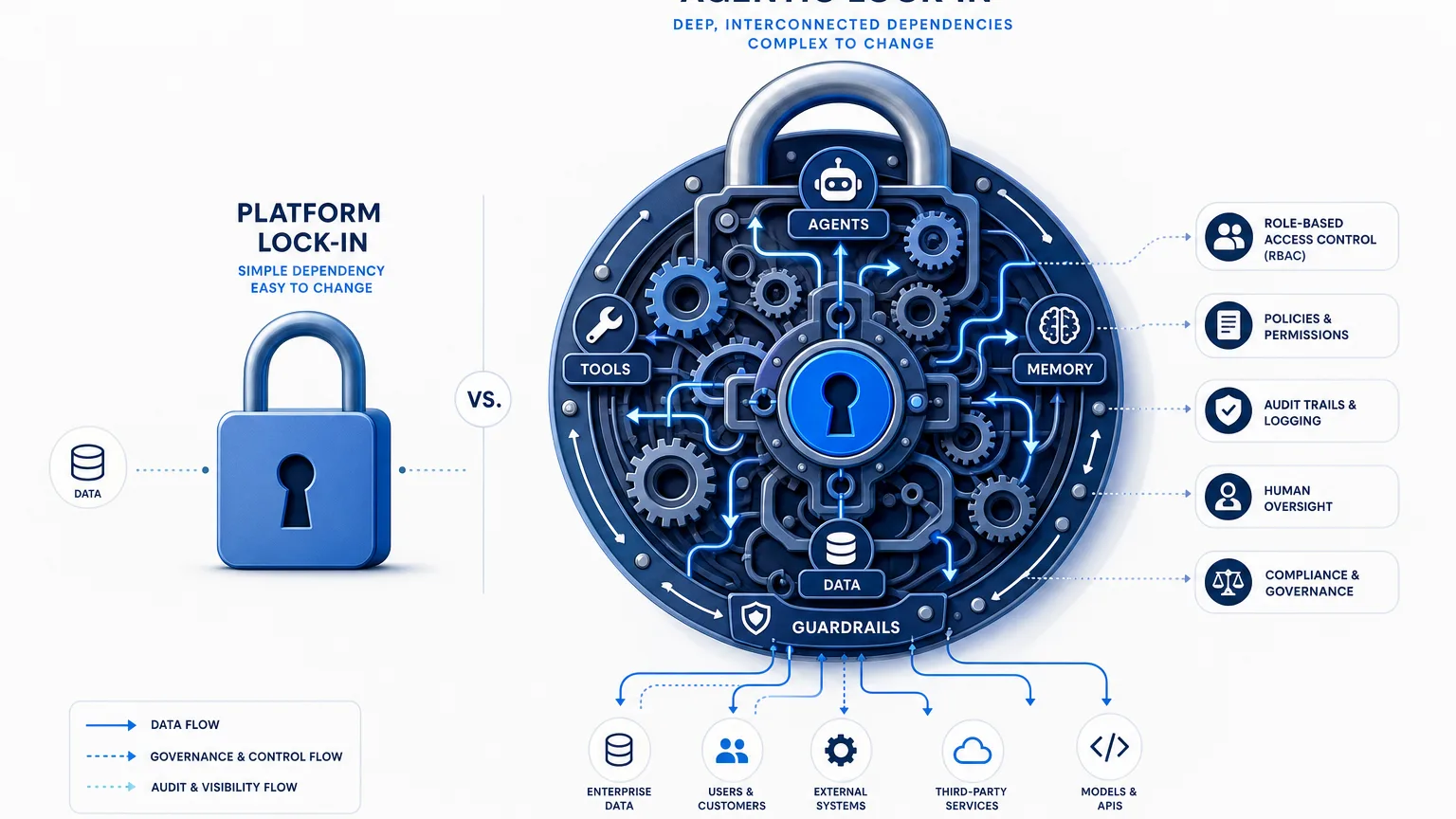
Most vendor lock-in talk still treats the problem as one general risk. Export the data, retrain the team, point the integrations somewhere else. That framing worked when humans were the only actors reading tickets and approving changes — a person was in the loop on every decision, ready to catch a bad one before it shipped.
AI agents change the cost of a bad exit. That shift is what makes agentic lock-in worse than the platform lock-in most IT teams already know how to handle. When access rules, blast-radius logic, and escalation thresholds live inside one vendor’s proprietary data model, leaving is no longer a migration project. You have to re-derive every governed decision the agent was trusted to make on its own.
Why agentic lock-in costs more than platform lock-in ever did
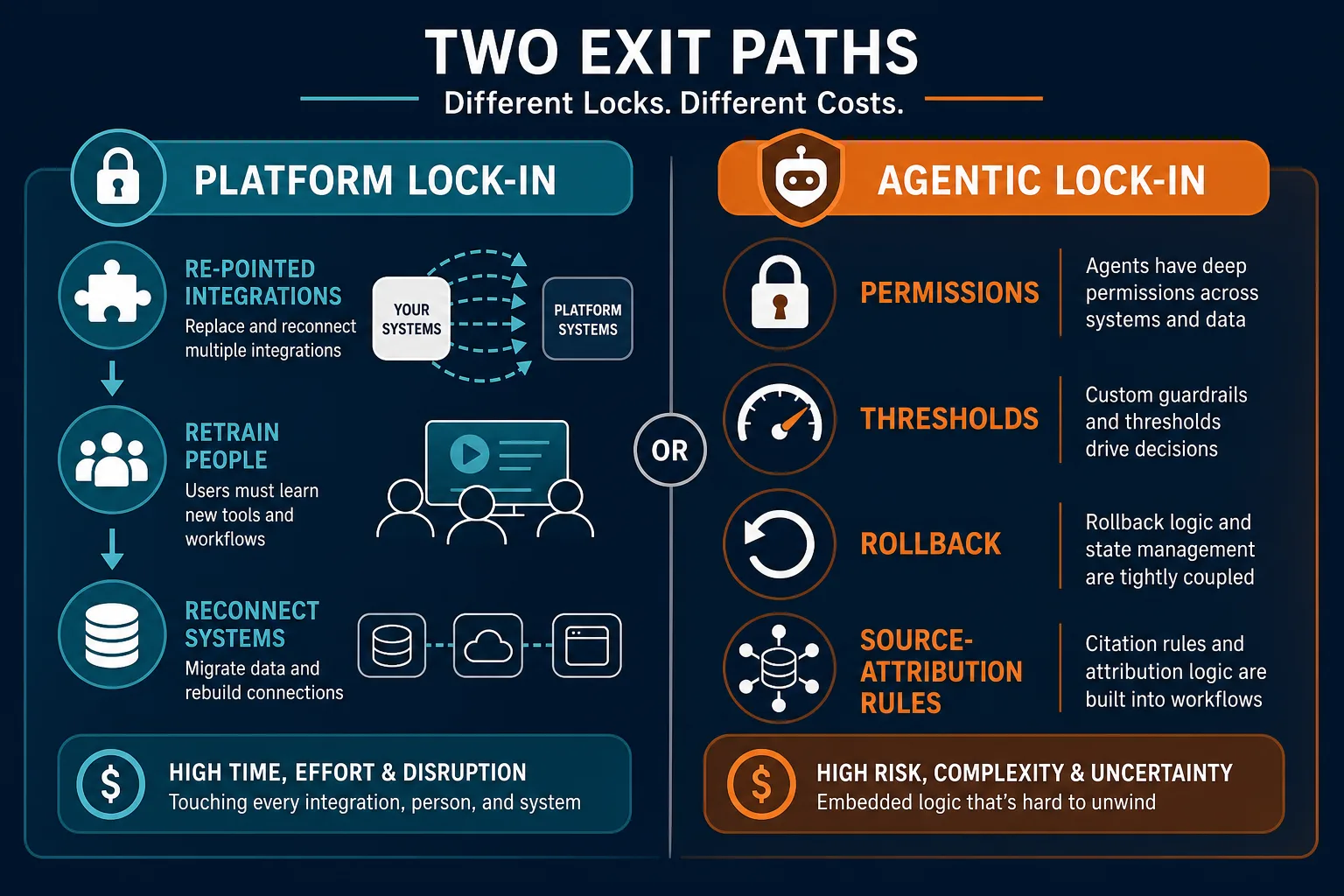
Platform lock-in has a known playbook. You leave a legacy IT service management (ITSM) tool, re-point connectors, retrain staff, and rebuild some workflows. Painful, expensive, and still mostly about systems of engagement and stored records. That worry is widespread and rising: 94% of IT leaders say they’re concerned about vendor lock-in, according to Parallels’ 2026 State of Cloud Computing Survey.
Agentic lock-in is a different failure mode. The agent does not only store configuration items (CIs). It acts. Permission boundaries, rollback conditions, and escalation thresholds are often encoded in the vendor’s schema and policy engine. Those rules are business decisions expressed as platform configuration. They rarely travel as portable business logic you can load into a peer tool on day one.
What you lose on exit is trust, not only rows. An agent that once opened low-risk changes under a known blast-radius limit must sit idle until someone rebuilds the same gates. Security and operations re-earn the right to autonomous action the hard way. A database re-sync does not restore that bar.
The financial shape of the risk also differs. Platform swaps burn integration hours and training budget. Agentic lock-in burns decision latency: every change that used to run under policy now waits in a human queue while governance is rewritten. Outage risk rises in the same window because the estate still moves while the agent stays grounded.
How does agentic lock-in differ from classic platform lock-in?
Platform lock-in mainly raises the cost of moving stored records, integrations, and human workflows. Agentic lock-in also traps the governance logic agents use to act: permissions, blast-radius thresholds, rollback rules, and provenance. After an exit, teams must rebuild those decisions before autonomous action is trusted again.
What governing agent actions actually requires to design, not just name
Naming RBAC, audit, and rollback on a product page is table stakes. Gartner projects that governance gaps, not model quality, will drive 40% of enterprises to demote or decommission their autonomous AI agents by 2027 (Gartner). Many teams are approving agentic AI deployments faster than their discovery and configuration management layer can support. Design means deciding how each control behaves when the actor is software that can change production state — this is what AI agent governance has to mean in practice, not a slide of feature names.
RBAC for agents, not only people. Read access and act access are different risk categories. An agent may need broad CI and dependency visibility to score impact, while write and execute rights stay narrow. Separate roles for “observe estate” and “execute change” so a compromised or mis-prompted agent cannot turn a research path into a mass update. Map those roles to services and CI classes, not only to human job titles.
Human-in-the-loop thresholds. Decide which blast-radius size, CI criticality, or environment tier requires a human sign-off before the agent proceeds. Encode the threshold as a measurable rule (for example, any change touching a revenue service CI class, or any dependency graph above a defined hop count). Document who can raise or lower the bar, and log every exception. Crossing a threshold should halt execution and hold the action in a pending-approval state — not just flag it in a log after the fact; anything less is a monitoring feature, not a governance gate. Without that, “human in the loop” becomes a vague culture claim.
Rollback mechanisms. When an agent action is wrong, operations need a defined reverse path. Prefer compensating changes tied to the same change record and CI set the agent touched. Confirm the audit trail can name the prior state, the action taken, and the data the agent trusted at decision time. A log that only says “updated” without the trusted inputs does not support a clean reverse.
Audit trail schema. Capture what changed, who or what initiated it, when it ran, and which sources and confidence signals the agent used. Source attribution belongs in the same trail: which discovery cycle, which CMDB fields, which relationship edges informed the blast-radius call. Auditors and incident commanders both need that chain. A black-box score with no exportable rationale fails the same test.
Treat these four as operational design work. They sit under the governance labels most runtime-truth pages only list.
What does governing AI agent actions require beyond naming RBAC and audit?
It requires designed controls: separate read versus act rights for agents, measurable human sign-off thresholds by blast radius or CI criticality, rollback paths tied to prior state, and an audit schema that records which data and source attribution the agent trusted when it decided. Labels alone do not make those controls portable or reversible.
Evaluation criteria a buyer can actually use
Bring a checklist into the vendor call. Ask for proof, not slogans.
- Sync direction. Is estate and governance data bi-directional with your ITSM and ops tools, or only a one-way export dump when you leave?
- Where rules live. Do RBAC definitions, escalation thresholds, and audit schema travel with exported data in a documented format, or stay trapped in the platform’s own configuration screens?
- Export shape for CIs and relationships. What format do you get for CIs and relationships? Do relationship edges survive, or do you receive flat records that force a rebuild of the graph?
- Verifiable source attribution. Can a third party inspect how confidence or source attribution is scored, or is scoring a vendor-only black box?
Score each answer as portable, partial, or trapped. Partial is common: raw CI export without relationship fidelity, or audit logs without the inputs the agent used. Trapped means the only way to keep agent behavior is to stay on that platform.
This checklist is vendor-neutral on purpose. Use it against any runtime, CMDB, or agent orchestration stack that claims governed autonomy.
The honest limits of standardization right now
Common Service Data Model (CSDM) is the closest large-scale example of structured service and CI relationships reducing messy inventory risk inside one major platform. ServiceNow documents CSDM as its framework for structuring those relationships for CMDB success. Structure helps. Portability across vendors is a different claim.
CSDM does not solve cross-platform lock-in. It standardizes how one platform wants services and CIs modeled. Another vendor’s agent governance schema will not ingest that model as a drop-in policy pack. Treating CSDM as a universal exit ramp overstates what it was built to do. Call these CSDM’s lock-in limits: it stops at the CI-and-relationship layer and never reaches agent RBAC, thresholds, or rollback rules. Virima integrates directly with ServiceNow to enrich CSDM-modeled CIs with discovery-sourced data, which helps CMDB accuracy on that platform, but it does not change the portability math for agent governance rules across vendors.
No true cross-vendor open standard for agent-governance data exists yet. There is no widely adopted, neutral format that carries RBAC for agents, human-in-the-loop thresholds, rollback contracts, and source-attribution scores between competing platforms. That gap is the harder edge of this argument. Buyers should plan for it instead of assuming a future standard will rescue a proprietary policy graph.
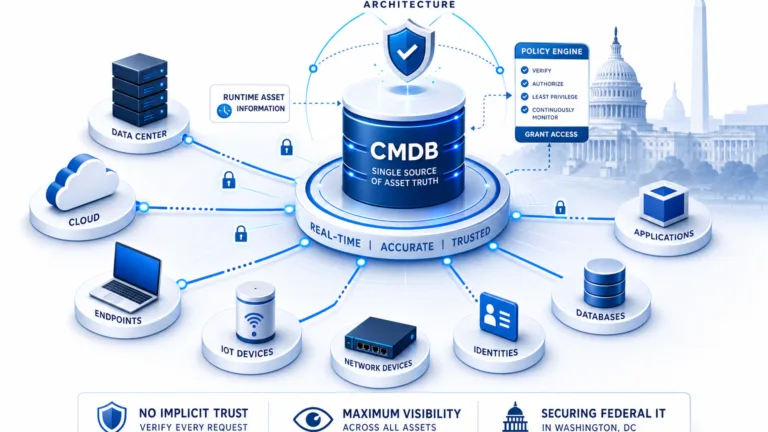
Federal inventory pressure still underlines why base estate data must stay trustworthy even when agent policy is not portable. CISA BOD 23-01 frames asset visibility as a prerequisite for vulnerability work. Agents that act on incomplete inventory inherit that same foundation risk, whether or not the governance layer is locked. The same principle plays out at the account level: CIO decisions on vendor scope, migration sequencing, and change windows shift once discovery-sourced data replaces a stale CMDB record, independent of whether agent governance itself is portable.
Does CSDM solve vendor lock-in for CMDB and agent governance data?
No. Common Service Data Model (CSDM) standardizes service and configuration item (CI) structure inside the ServiceNow platform. It improves modeling discipline on that platform. It does not provide a vendor-neutral, portable format for agent permissions, thresholds, rollback rules, or source-attribution scores across competing tools.
What this looks like when portability actually holds
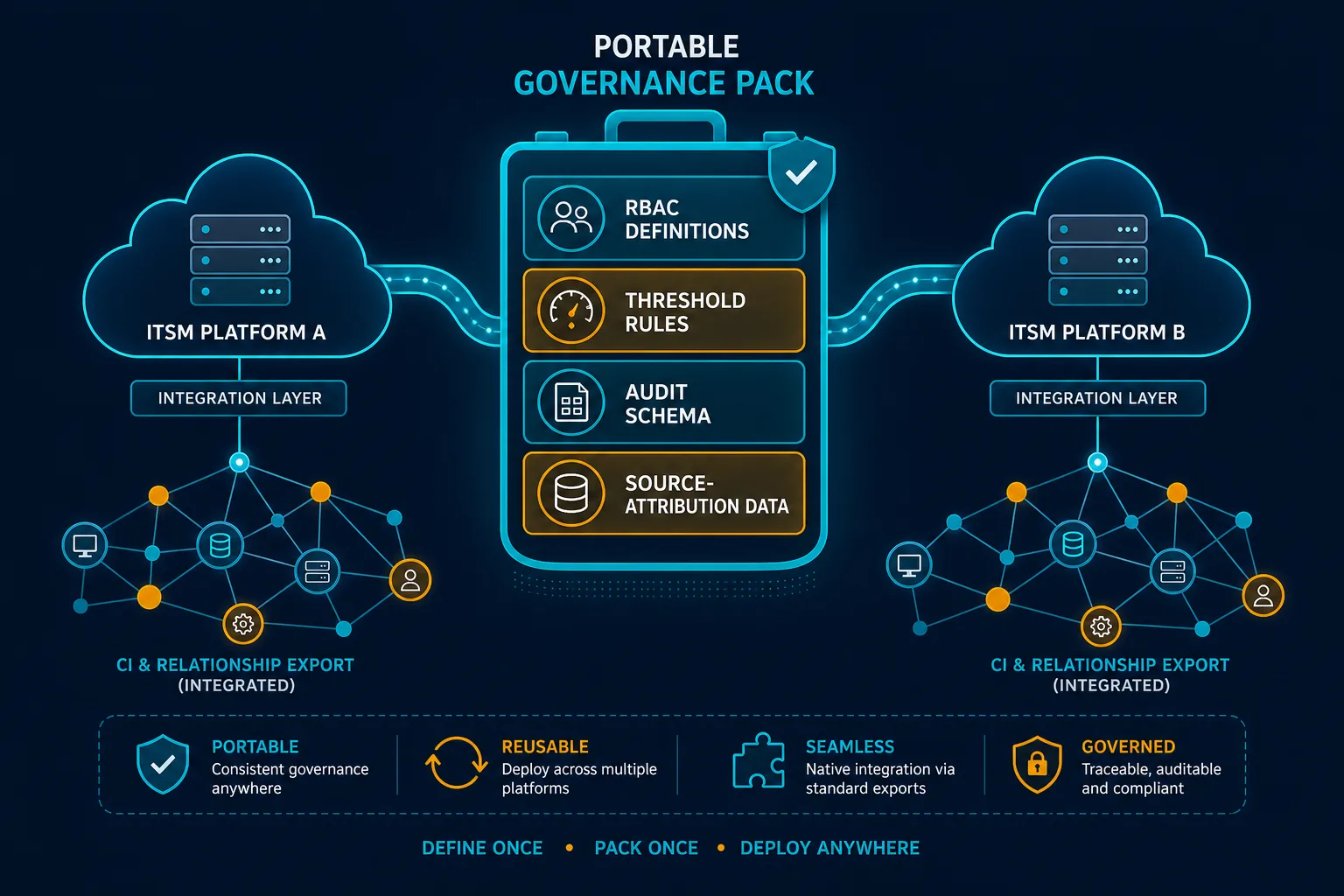
Portability that holds in practice shows up as a few concrete properties. Bi-directional sync keeps CMDB and ITSM views aligned without a one-shot exit dump. Governance artifacts (RBAC definitions, audit schema, confidence or source-attribution scores) remain available in a documented, usable format. Native integration paths reach more than one ITSM platform so the agent context layer is not married to a single ticket system.
Virima’s discovery-sourced CMDB and IT operations management path are built around multi-platform integration and discovery-sourced estate context that buyers can score against the checklist above: sync behavior, export fidelity for relationships, and governance artifacts that can be inspected rather than only marketed. That is an evaluation fit, not a claim that lock-in risk has vanished industry-wide.
Design governance so exit does not erase trust
Agentic lock-in is worse than classic platform lock-in because the valuable asset is governed decision logic, not only stored records. Design RBAC for agents, human thresholds, rollback, and audit schema on purpose. Evaluate vendors with portable sync, portable rules, relationship-preserving export, and verifiable source attribution. Treat CSDM as useful structure inside one platform, not as a finished cross-vendor standard.
Before the next agent gains write rights in production, run the buyer checklist on the stack that will hold those rights. If the answers are partial or trapped, fix portability while the blast radius is still small. To walk how discovery-sourced runtime truth and multi-platform ops context support that evaluation, schedule a demo.
Frequently Asked Questions
Why is vendor lock-in worse for AI agents than it was for traditional IT platforms?
Because governance logic embeds in proprietary schemas: permissions, blast-radius thresholds, rollback rules, and the source attribution an agent trusted when it acted. Leaving the vendor means rebuilding those decisions before autonomous action is safe again, not only exporting records and retraining people.
What should a buyer actually check to evaluate agentic lock-in risk?
Check bi-directional versus one-way sync, whether RBAC and audit schema travel with the data, whether CI and relationship exports preserve edges, and whether source-attribution or confidence scoring can be independently verified. Use those four checks as a call checklist rather than relying on marketing claims.
Does CSDM solve vendor lock-in for CMDB data?
No. Common Service Data Model (CSDM) standardizes structure within the ServiceNow platform. It does not make configuration data or agent governance rules portable across vendors as an open, cross-platform standard.
Is there an open, cross-vendor standard for agent governance data yet?
Not currently. No widely adopted neutral format carries agent RBAC, human-in-the-loop thresholds, rollback contracts, and source-attribution scores between competing platforms. Treat that gap as an unresolved industry edge in any architecture review.
How should RBAC differ for AI agents versus human operators?
Separate what an agent may read from what it may change. Broad observation of CIs and dependencies can support impact scoring, while execute rights stay narrow and tied to service class, environment, and blast-radius thresholds that force human sign-off when risk crosses the line.