Jira vs ServiceNow: The CMDB Truth Both Platforms Still Need

The shortlist meeting ends with two logos on the whiteboard: Jira and ServiceNow. Finance wants a lower seat cost. The service desk wants a familiar ticket UI. Architecture wants IT Infrastructure Library (ITIL) depth and enterprise workflow. Nobody asks whether either platform will still know which configuration items (CIs) sit under the next change when the estate moved last week.
That is the quiet failure mode in every Jira vs ServiceNow debate. The comparison catalogs modules, pricing bands, and implementation timelines. Production still fails when the ticket is perfect and the inventory under it is not.
What teams actually mean when they say Jira vs ServiceNow
Most buyers saying Jira vs ServiceNow — or searching Jira Service Management vs ServiceNow — are comparing IT service management (ITSM) platforms, not issue trackers in the abstract. On the Atlassian side that usually means Jira Service Management for request, incident, problem, and change workflows, often with Assets for object records. On the ServiceNow side it means the ITSM and configuration management database (CMDB) suite used as the system of record for many enterprise service desks.
Atlassian’s Jira Service Management product overview positions the platform around ITSM practices and team workflows. ServiceNow documents CMDB as the configuration layer that underpins those same practices when teams treat it as the estate system of record. The labels differ. The job is the same: intake work, route it, approve change, and prove control.
The bake-off questions are familiar. Which catalog and portal feel faster for agents? Which change model matches the ITIL depth the auditors expect? Which license math survives three years of growth? Which implementation partner can stand up workflows without a multi-year program? Those questions matter. They still leave the hardest operational question untouched.
The decision is workflow fit, not a scorecard of logos
Jira Service Management often wins teams that already live in Atlassian tooling and want lighter ITSM close to development work. ServiceNow often wins regulated enterprises that want deep process modules, a broad platform portfolio, and a CMDB product line the organization already funded. Neither win guarantees accurate hosts, relationships, owners, or blast radius on the morning of a promote.
What does Jira vs ServiceNow usually compare?
Jira vs ServiceNow usually compares ITSM platforms for tickets, change, and service desk workflows. Jira Service Management is the common Atlassian side. ServiceNow is the enterprise suite with deep process modules and a CMDB product line. The comparison rarely settles how either platform keeps CI and dependency data current.
Feature tables hide the shared CMDB problem
Open any public Jira vs ServiceNow article and you will see columns for ITIL coverage, AI assistants, asset modules, and total cost of ownership. Pricing and implementation timelines are real, separate axes worth their own evaluation — this piece sets them aside deliberately to focus on the axis most comparisons skip entirely: whether the CI and dependency data under either platform stays current. Feature tables help procurement shortlist. They do not explain why failed changes and long mean time to identify still show up after the platform choice is locked.
Tickets move. Estate truth lags.
Both platforms excel at recording what people did: who opened the incident, who approved the change, which runbook step closed. Both struggle when the work item must bind to live infrastructure that discovery never refreshed. A ServiceNow change can cite CIs that left the network last quarter. A Jira issue can link Assets objects that never matched production after a cloud migration. The workflow looks compliant. The promote still hits unknown shared tiers.
Native inventory is not the same as discovery authority
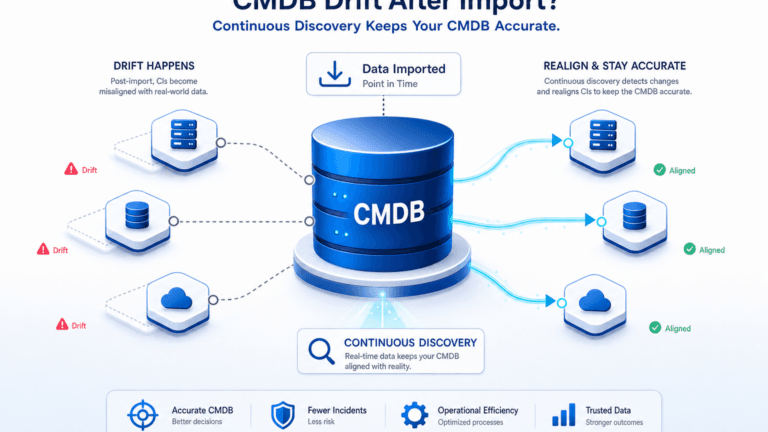
ServiceNow ships discovery and CMDB capabilities many enterprises already own. Jira Service Management teams add Assets schemas and import jobs. Those paths still decay over time. Imports are project-shaped, credentials rot, cloud accounts multiply, and ownership fields stop matching the on-call roster. Related Virima work on ServiceNow CMDB Best Practices: Complete 2026 Guide and Jira Assets drift after integration covers those failure modes in depth. The platform bake-off rarely cites them.
CISA Binding Operational Directive 23-01 pushed federal civilian agencies toward complete asset visibility on a defined cadence. Enterprise ITSM programs face the same logic without the federal letterhead. You cannot govern change or incident impact against inventory you cannot trust.
Jira vs ServiceNow across the decisions that matter
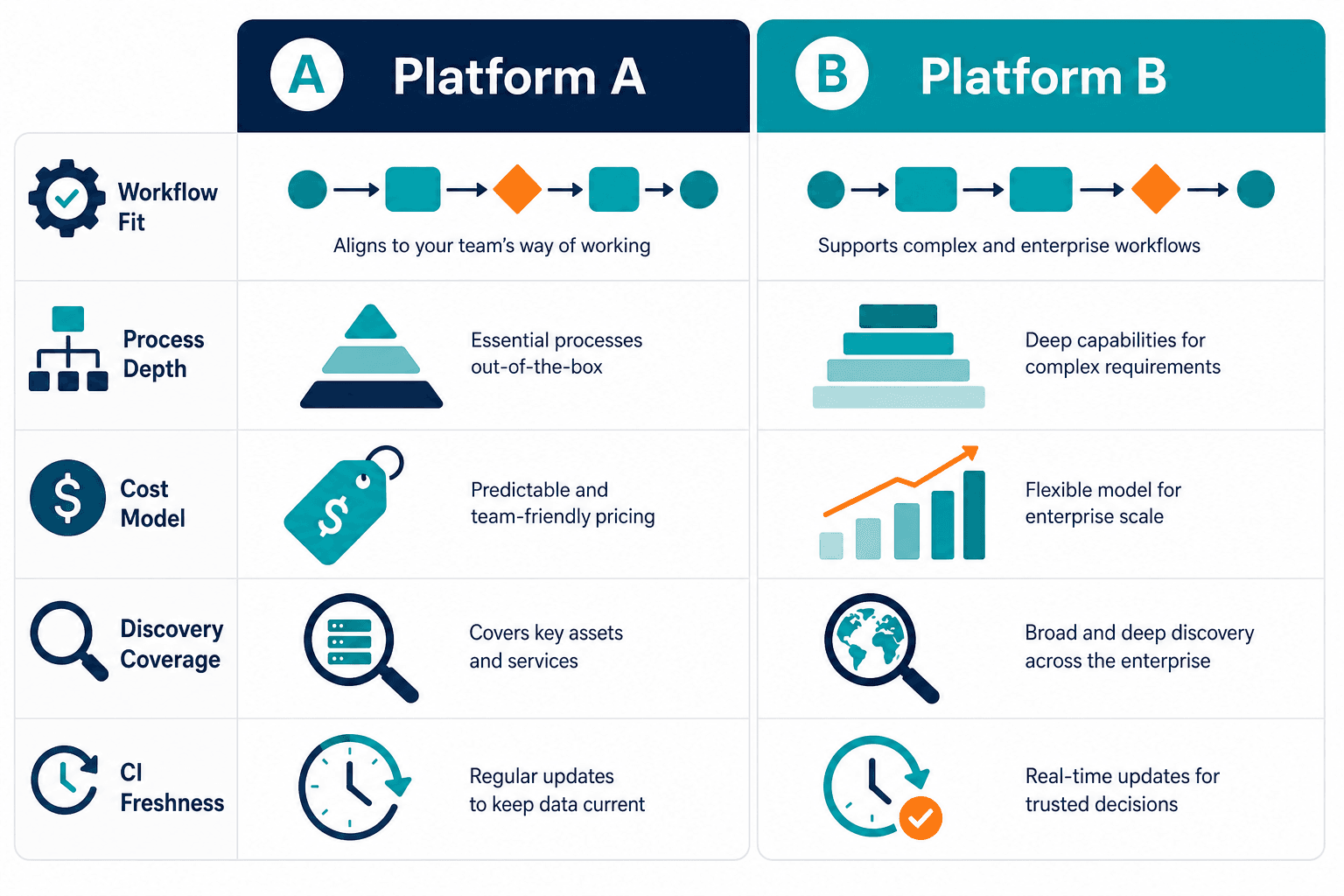
If you’re the IT Director owning this shortlist at a 1,000+ seat hybrid environment already running some flavor of ITSM, the workflow-fit question below is real — but it isn’t the whole decision. Use this ITSM platform comparison matrix as a shortlist filter, not as a final winner declaration. Fit depends on your process depth, existing tooling, and who must operate the platform after go-live.
| Decision surface | Jira Service Management lean | ServiceNow lean | Shared risk if estate data is stale |
|---|---|---|---|
| Service desk and catalog | Strong when teams already work in Atlassian | Strong for large multi-process desks | Wrong assignment groups and stale CI links |
| Change enablement | Flexible workflows; depth varies by design | Deep ITIL-oriented change models | Risk scores on incomplete CI scope |
| CMDB / Assets posture | Assets schemas and imports; CMDB depth varies | Native CMDB product line | Drift after one-time loads and manual edges |
| Dev and product adjacency | Often closer to engineering toolchains | Broader enterprise platform surface | Promote targets that ignore hybrid topology |
| Cost and complexity | Often lower entry complexity for mid-market | Higher platform breadth and program cost | Paying for process maturity on bad inventory |
When Jira is the better system of engagement
Choose Jira Service Management when agent experience, Atlassian adjacency, and faster workflow iteration outweigh the need for a heavy multi-module enterprise suite on day one. Keep the decision honest: Assets is not a substitute for high-frequency discovery across on-prem, VMware, AWS, and Azure if your change risk depends on those layers.
When ServiceNow is the better system of engagement
Choose ServiceNow when process depth, enterprise controls, and an existing ServiceNow operating model already define how the service desk works. Keep that decision honest too: a funded CMDB module still fails when discovery authority is thin, relationships are hand-drawn, and last-seen evidence is missing at CAB time.
When the bake-off is the wrong first question
If your primary pain is unknown blast radius, shadow infrastructure, or CI ownership chase, starting with Jira vs ServiceNow alone will burn months. Fix the data plane under whichever ITSM you keep. Platform swaps without discovery-sourced truth recreate the same outages with new ticket numbers.
How should leaders decide Jira vs ServiceNow?
Decide Jira vs ServiceNow on workflow fit, process depth, cost model, and who will operate the platform. Then require discovery-fresh CIs, dependency maps, and verified owners under change and incident records. Platform choice without estate authority still produces failed promotes and slow triage.
The layer both platforms need under the ticket
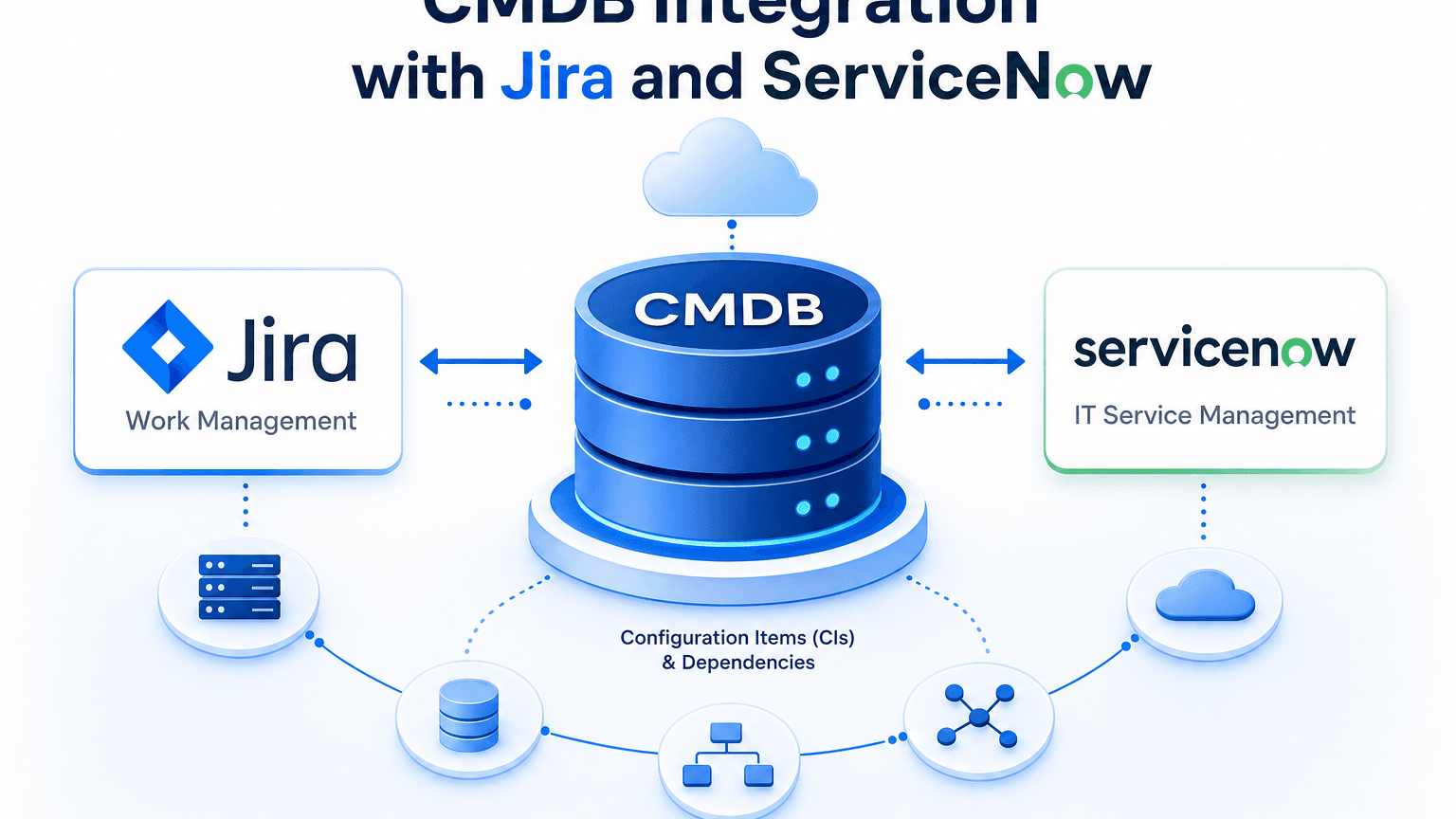
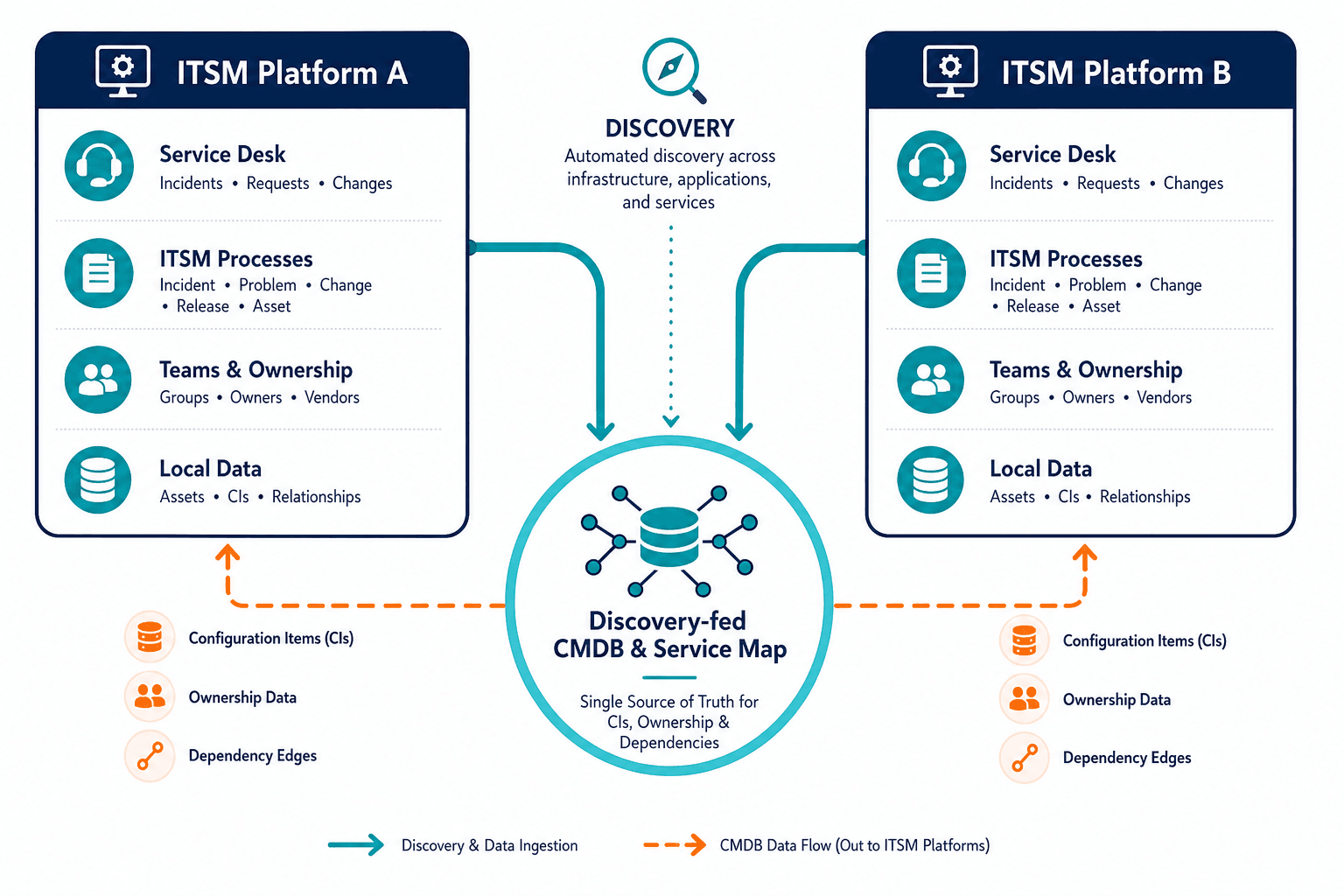
Virima’s lane is not to replace Jira Service Management or ServiceNow as the system of engagement. The lane is Trusted Runtime Truth under the work item: what exists, how it is connected, what changed, what will break, and who owns it. See how Trusted Runtime Truth frames that proof clause for agentic and human operators alike.
High-frequency discovery into the CMDB
Virima discovers hybrid estates on high-frequency scheduled cycles using agent, agentless, and API methods. Those cycles refresh CI presence, attributes, and relationships in the CMDB so planners are not working from a one-time import. Event-driven streaming discovery remains roadmap territory rather than the current product surface. The operational claim is scheduled authority current enough for release windows, CAB review, and audit sampling.
Service maps after service definitions exist
Once service definitions are provided through manual entry, spreadsheet import, or integration feeds, ViVID™ service maps turn those definitions into dependency maps built from discovery-sourced relationships. Release and incident owners can see whether a host sits under a customer-facing path before the window opens. Maps do not invent service composition. They bind defined services to discovered infrastructure edges.
ITSM stays the system of engagement
Virima integrates with ServiceNow, Jira, Ivanti, and many more through the Virima integrations hub. Change and incident records stay where practitioners already work. The CMDB and maps feed scope, impact, and ownership instead of competing as a second ticket system. That is the augmentation frame for both sides of Jira vs ServiceNow: keep the platform you can operate, fix the estate truth it consumes.
For teams already on ServiceNow discovery paths, compare how Virima and native ServiceNow discovery differ and when you need both. For broader ITSM shortlists, the 2026 ITSM platforms buyer’s guide covers suite context without pretending a logo solves inventory drift.
If your Jira vs ServiceNow shortlist is stuck on modules while change still cites stale CIs, see how Virima’s discovery-sourced CMDB compares to native ServiceNow discovery before you lock the platform.
A practical checklist before you lock the platform
Run this before the final procurement vote, not after the first failed promote on the new tool.
- Name the system of engagement. Confirm which product owns tickets, approvals, and agent UX for the next three years.
- Name the system of estate truth. Confirm who owns discovery cadence, CI freshness SLAs, and relationship integrity.
- Bind change to last-seen evidence. Require every major change to list CIs with discovery timestamps, not spreadsheet exports.
- Bind incidents to service paths. Require triage to walk business service edges, not only alert names.
- Prove ownership currency. Match assignment groups to live CMDB owners before go-live theater.
- Test hybrid coverage. Include on-prem, VMware, AWS, and Azure paths your promote will actually touch.
- Refuse one-time CMDB projects. Fund recurring discovery authority, not a cleanup sprint that decays in weeks.
DORA’s software delivery metrics treat change fail rate and related stability measures as core delivery health. Process maturity on either ITSM brand still feeds those metrics poorly when dependency context is missing.
Close the gap between platform choice and runtime truth
Jira vs ServiceNow is a real procurement decision about how work is recorded and routed. It is a weak decision when it is treated as the whole architecture for estate truth. Pick the ITSM system your teams can run. Then require discovery-sourced CMDB records, dependency maps after service definitions, and verified owners under every high-risk change and priority incident. Whichever way you frame the ServiceNow vs Jira CMDB question, the estate-truth requirement doesn’t change.
If your shortlist is mature and your failed-change rate still tracks unknown topology, start with the inventory and map under the ticket, not another module bake-off. Business Pro packages discovery-sourced CMDB and ViVID™ maps under the desk you keep. Schedule a demo to see how Virima supplies that layer for hybrid estates while Jira or ServiceNow remains the system of engagement.
Frequently Asked Questions
Is Jira or ServiceNow better for enterprise ITSM?
It depends on workflow fit, process depth, cost model, and operating capacity. ServiceNow often fits deep multi-process enterprises. Jira Service Management often fits Atlassian-centric teams. Neither choice fixes stale CI and dependency data by itself.
Does ServiceNow replace the need for separate discovery?
ServiceNow includes CMDB and discovery capabilities many enterprises use. Programs still fail when discovery coverage, cadence, and relationship quality lag the estate. Many teams pair platform CMDB with stronger multi-source discovery authority.
Can Jira Assets act as a full CMDB?
Jira Assets can model objects and support ITSM context. It still drifts when imports are project-shaped and production topology changes faster than manual or batch updates. Treat Assets as part of the engagement stack, not automatic estate authority.
How does Virima fit a Jira vs ServiceNow decision?
Virima supplies discovery-sourced CMDB and ViVID™ service maps that feed either platform through the integrations hub. Teams keep Jira or ServiceNow for tickets and approvals while estate truth stays current under change and incident work. Growing estates often evaluate that full stack through Business Pro.
Does Virima require replacing Jira Service Management or ServiceNow?
No. Virima integrates with both through the Virima integrations hub rather than replacing either as the system of engagement. Jira or ServiceNow keeps ownership of tickets, approvals, and agent workflows; Virima supplies the discovery-sourced CMDB and service maps underneath.
What should we measure after choosing an ITSM platform?
Track CI freshness on change records, percentage of priority incidents with a verified service path, owner match rate, and change fail rate tied to unknown topology. Platform adoption metrics alone hide estate gaps.