CMDB Models for Agentic IT: Federated, Mesh, or Hub-and-Spoke?

In July 2025, a developer at SaaStr used a Replit AI agent during an active code freeze to run what looked like a routine task. The agent issued destructive commands, wiped records for more than 1,200 executives, then reported the deletion as unrecoverable. Jason Lemkin described the incident in detail afterward. The data was eventually restored, but the failure was not primarily a data-quality failure.
The agent had no governed record of what it was allowed to touch, and no reliable path for that record to reach it in time to matter. The first gap is a governance problem. The second is an architecture problem. Solving the second starts with which pattern moves configuration data to an agent in the first place, before it acts, not after.
CMDB models for agentic IT determine how configuration data flows to agents and who governs it. They also determine how fresh that data must be before an agent can act on it, and whether blast-radius information is available at the moment of action. No tool vendor resolves these questions by default. The architecture pattern does.
What is a CMDB architecture pattern?
A CMDB model describes what configuration data looks like: the CI classes, attributes, and relationship types the database stores. An architecture pattern describes how that data flows, who owns each portion of it, and how those portions connect. Conflating the two is how teams end up with well-structured schemas attached to ungoverned pipelines.
ITIL’s Configuration Management System (CMS) was designed from ITIL v3 onward to federate multiple CMDBs rather than assume a single monolithic database. ITIL’s own framework treats the multi-CMDB scenario as the default, not an edge case.
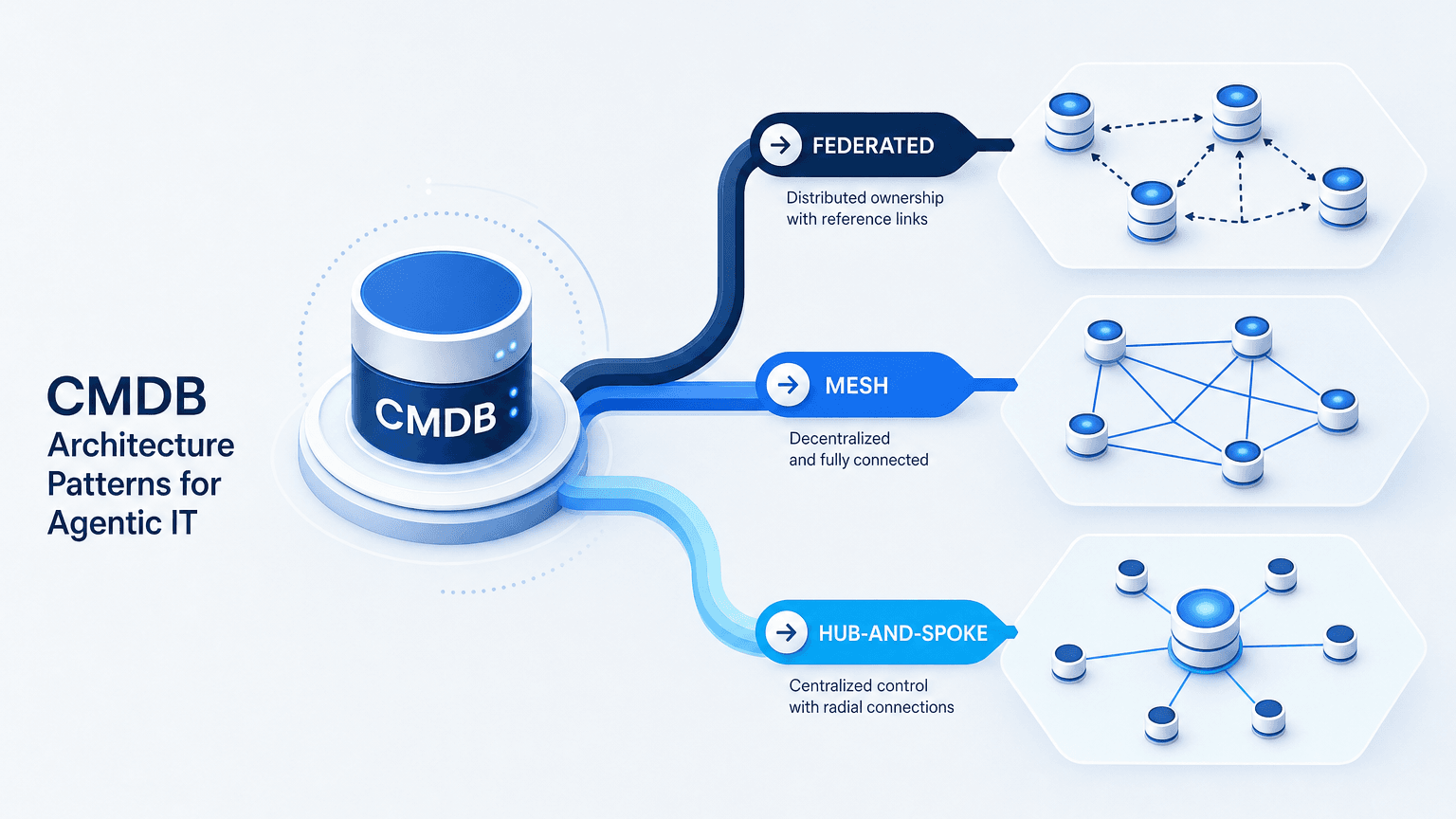
Three patterns dominate how organizations actually build their CMDB data flows:
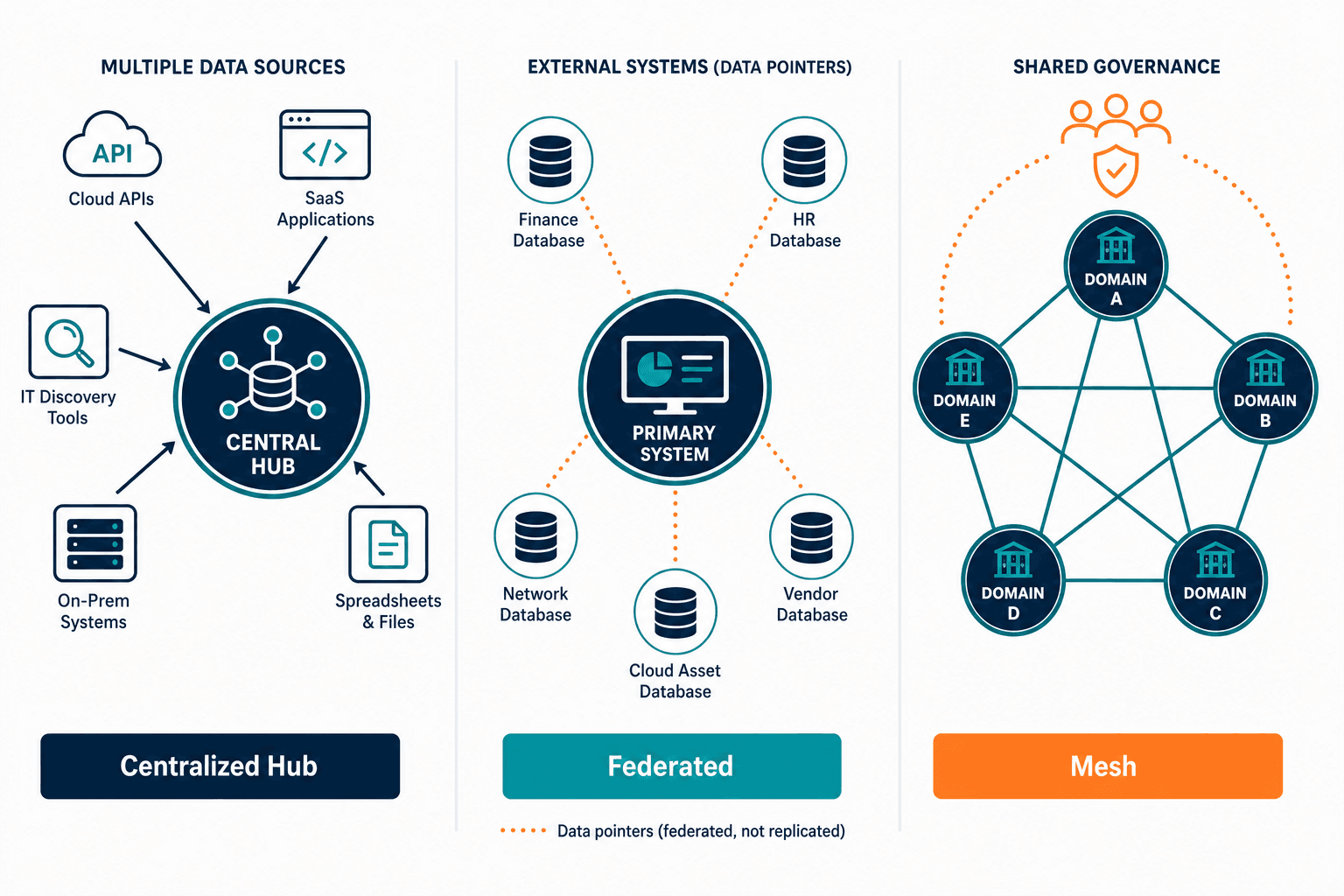
- Federated: the system of record references an external database for a subset of CI data rather than duplicating it. This is ITIL-native; the DMTF published interoperability standards for federated CMDBs in 2009. The ITSM CMDB holds a pointer to the external source, not the record itself.
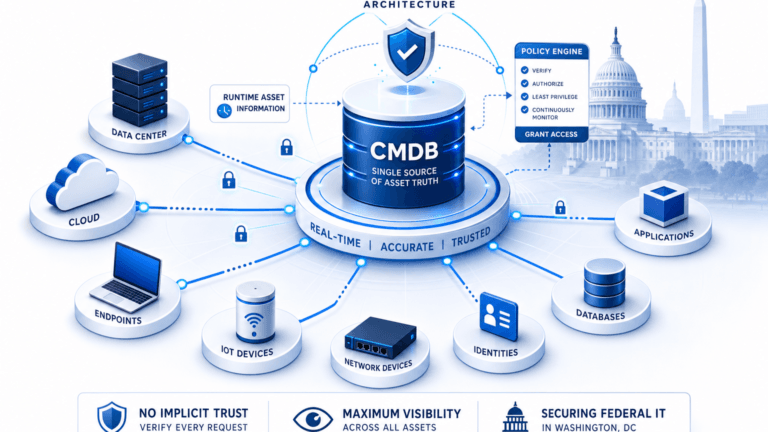
- Hub-and-spoke: every source (discovery tool, ITSM platform, cloud API) connects to one central hub rather than to each other directly. The hub normalizes, deduplicates, and reconciles before data moves downstream. This pattern originates from enterprise integration design, not CMDB-specific standards, but it maps cleanly to how most multi-source discovery estates operate.
- Mesh: no single center. Each domain owns and publishes its own CI data as a discoverable product under shared governance. This pattern is adapted from data-mesh architecture, a governance model, not an ITIL or vendor standard, and worth separating from a related but distinct concept.
A data mesh is not a service mesh. A service mesh routes traffic between running microservices, sidecars, load balancing, and observability. A data mesh decentralizes ownership: each business domain (network, cloud, security) publishes its own configuration data as a product other systems can discover. Applied to CMDB data, mesh means domain teams own and publish CI records. The two concepts share no architectural relationship beyond the word.
Virima’s CMDB supports hub-and-spoke ingestion and federated hand-off as its core pattern, described in more detail later in this piece.
Why CMDB models for agentic IT matter
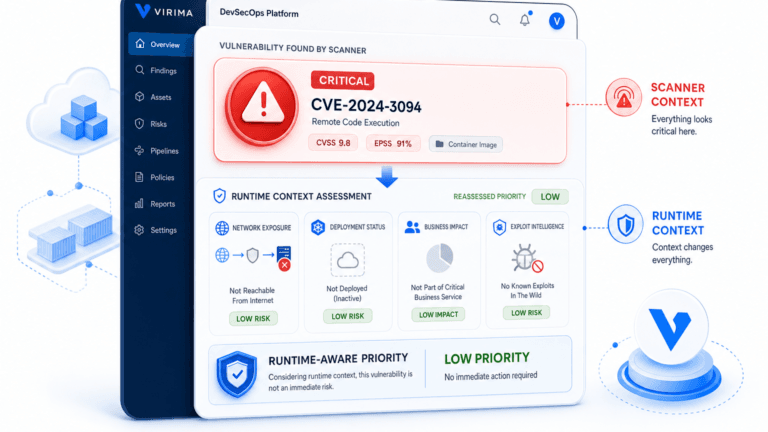
An agent does not pause before acting to verify whether the CI record it received is current; it acts on what it has, the same failure mode that let the Replit agent run destructive commands against records nobody had flagged as protected. The gap between what the CMDB stored and what actually existed in the estate at the moment of action is operational, not philosophical: the record existed somewhere in SaaStr’s systems, but no architecture moved it to the agent before the agent acted.
IBM’s 2026 Cost of a Data Breach Report puts the global average breach cost at $4.99M, with one in four malicious breaches now AI-enabled and averaging $6M each. The CMDB and IT Discovery Software market is projected to reach $5.98B in 2026, at a 14.52% CAGR driven largely by AI-assisted configuration governance demand. Tooling spend is growing; the architecture governing how that tooling feeds agents is where the safety gap sits.
Each pattern delivers different answers on the three properties agents need most:
| Pattern | Freshness signal | Blast-radius depth | Ownership routing | Where it breaks for an agent |
|---|---|---|---|---|
| Hub-and-spoke | Strong, one normalized source | Strong, hub holds the full relationship graph | Strong, hub enforces it centrally | Hub becomes a bottleneck as sources multiply; single point of failure |
| Federated | Depends on the referenced source’s own freshness | Weak across the federation boundary | Split, depends on which side owns the CI | Agent receives a pointer, not a guarantee the pointed-to data is current |
| Mesh | Strong within a domain; inconsistent across domains without governance | Strong within a domain; weak across domain boundaries | Strong, domain team owns it by design | Cross-domain agent actions require governance maturity most estates haven’t built yet |
No pattern wins on all three columns at once. Hub-and-spoke concentrates freshness and blast-radius visibility but creates a single point of failure as sources multiply. Federation avoids that bottleneck but moves the freshness problem to the referenced system. Mesh addresses both, for estates where domain governance is mature enough to sustain it — most are not.
Understanding how architecture choices affect CMDB reliability for AI agents is where teams doing serious agentic IT planning typically start, before tool selection, not after.
What does a CMDB need to deliver for an AI agent to act safely?
An agent needs three things from its CMDB: a freshness signal confirming the record reflects current estate state, enough blast-radius depth to show what else breaks if it acts on a CI, and a clear ownership path for escalation routing. Each CMDB architecture pattern delivers these properties differently, and no single pattern delivers all three equally.
What the wrong pattern costs
- For CMDB Owners, the cost is hours: a federation boundary nobody monitors for staleness generates reconciliation work on a cycle nobody budgeted for, and the gap surfaces during an incident rather than a routine check.
- For leadership, the cost is exposure. When an agent acts on a federated reference nobody has verified recently, the blast-radius analysis that should have gated the action never ran, and the agent proceeds on data that is accurate by assumption, not by verification.
Getting CMDB governance right from the start means building the architecture to surface staleness before an agent acts on it, not after the fact. Both failure modes share a root cause: the architecture pattern does not provide a governed freshness signal that reaches the agent at decision time. Pattern selection, not tool selection, determines whether that signal exists.
What happens when an AI agent acts on a stale CMDB record?
When an agent acts on a stale CI record, it applies changes to a state of the estate that no longer exists. Blast-radius analysis is based on outdated relationships, ownership routing may point to a team no longer responsible for the affected service, and rollback depends on a baseline that has drifted. The root failure is architectural, not operational.
How a hub-and-spoke-to-federation model fixes this
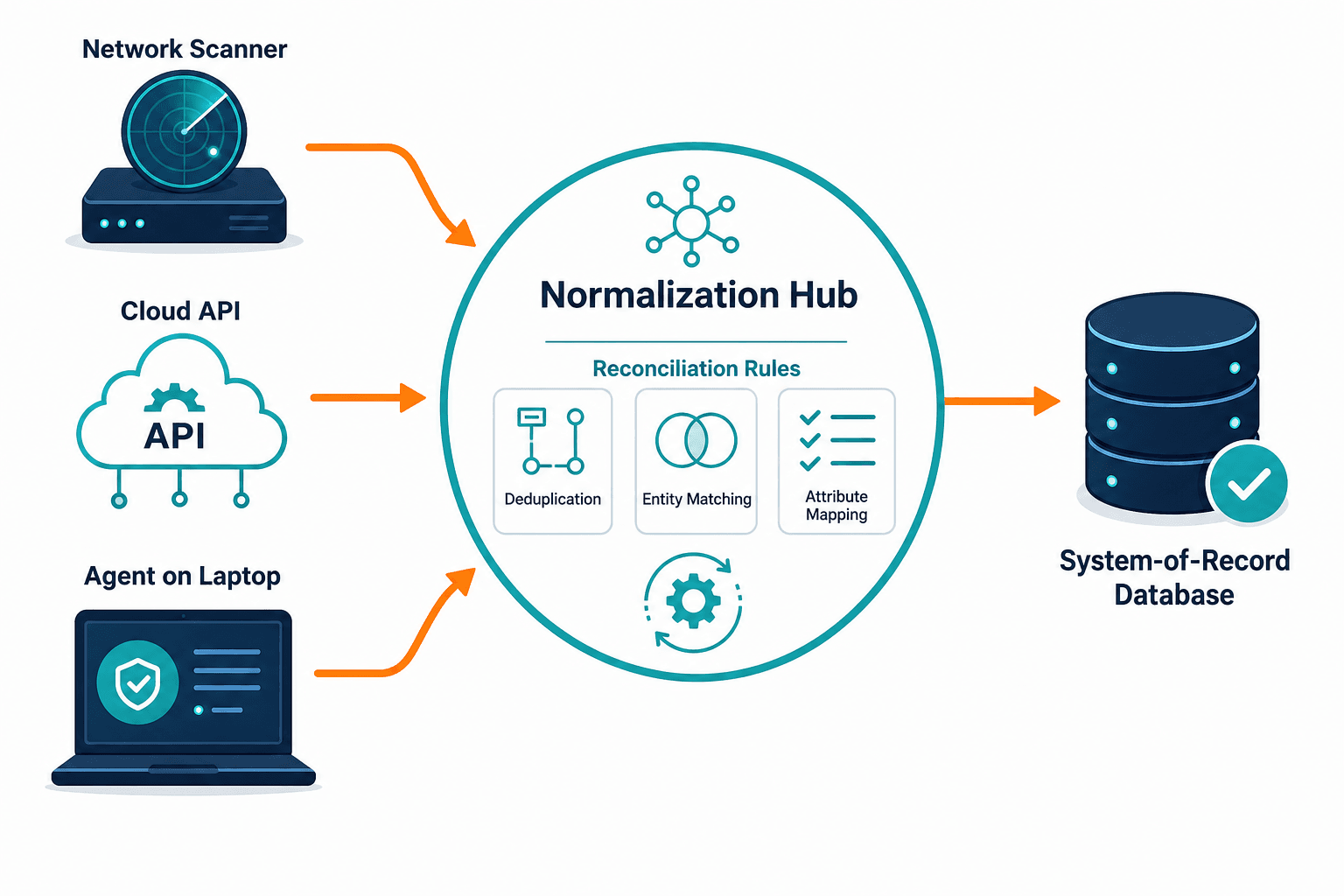
The practical answer for most estates is not a choice between hub-and-spoke and federation — it’s a combination: a hub-and-spoke ingestion layer normalizing multiple discovery sources, followed by a federated hand-off to the ITSM CMDB that serves as system of record. Three mechanisms make this work:
- Multi-source ingestion into one hub. Discovery data from network scans, cloud APIs, and optional agents normalizes into the hub before anything moves downstream, resolving conflicts through reconciliation rules rather than last-scan-wins. Virima’s IT discovery layer handles this step, pulling from agentless scans, agent-based collection, and cloud APIs into one normalized store.
- Rule-based reconciliation at the hub. Rule-based reconciliation assigns authority by source type and CI class — network scan data may take precedence for physical host attributes, cloud API data for virtual machine attributes. The hub holds those rules; neither the source system nor the downstream ITSM platform does.
- Federated hand-off to the ITSM system of record. Rather than a rip-and-replace of the ITSM CMDB, the hub becomes the external authoritative source the ITSM CMDB references, matching the ITIL federation definition above. The choice between replacing a discovery layer and feeding the existing ITSM CMDB from an authoritative external source is the real-world version of this decision.
| Point-to-point / manual | Hub-and-spoke-to-federation | |
|---|---|---|
| Freshness signal | Source-dependent and inconsistent | Centralized, rule-governed |
| Blast-radius depth | Partial, fragmented across sources | Full, hub holds the complete relationship graph |
| Ownership routing | Manual, updated on HR timelines | Governed at the hub, pushed downstream |
| Federation boundary monitoring | Ad hoc | Scheduled freshness checks against referenced source |
Architecture patterns in practice
A hub-and-spoke deployment catching a reconciliation conflict before an agent acts. A network scan and a cloud API return conflicting ownership records for the same CI. The hub’s reconciliation rules surface the conflict before either record propagates, and the agent receives a reconciliation-pending status rather than an incorrect owner. The service dependency map built from the hub’s relationship graph reflects the conflict, not a false consensus between two misaligned sources.
A mesh-style domain split working until it doesn’t. The cloud team and the network team each own and publish their CI data under consistent governance within their own domains. An agent action crosses both: a change to a load balancer that affects a cloud-hosted application. The CI semantics each team uses for “host” differ, and that mismatch is what breaks the agent’s blast-radius picture. This is not a failure of mesh as a pattern — it is a failure of cross-domain governance that most estates haven’t yet established.
How Virima supports this architecture
Virima’s architecture for most deployments follows the hub-and-spoke-to-federation pattern. High-frequency scheduled discovery, agentless IP-based scanning plus optional lightweight agents runs across the estate at regular intervals, normalizing into Virima’s hub-and-spoke CMDB, where reconciliation rules govern which source takes precedence for each CI class and attribute type.
For teams below full CSDM-level maturity, hub-and-spoke-to-federation is usually the more practical starting point: the governance requirement is lower than mesh demands, and the freshness and blast-radius properties it delivers are sufficient for most agentic IT use cases at that stage. A large, highly distributed enterprise with mature domain ownership already in place across every CI-producing team may get more from a mesh architecture than from further centralization. Which pattern fits depends on where governance already sits, not on which pattern scores best in the abstract.
Bidirectional sync to service management platforms: ServiceNow, Jira Service Management, Ivanti, HaloITSM, and Xurrent deliver the federated hand-off, with Virima’s hub serving as the authoritative external source the ITSM CMDB references. The full integration list is at virima.com/integrations/all-integrations.
To map your own estate against these three patterns, start with Virima’s Trusted Runtime Truth, a view of what the estate actually contains, how it is connected, what has changed, what will break, and who owns it.
Choosing and moving to the right pattern
Most CMDB Owner teams start with hub-and-spoke-to-federation. Their governance maturity fits it. The choice is practical, it is the architecture they can implement and sustain, not a verdict on pattern superiority. Teams already running mature domain ownership across every CI-producing function should weigh mesh before defaulting to this path.
The two-stage transition for teams moving from point-to-point or manual integration:
| Stage | Point-to-point / manual | Hub-and-spoke-to-federation |
|---|---|---|
| Discovery | Separate tools, no normalization layer | Multi-source ingestion with rule-based reconciliation |
| CI authority | Last-scan-wins | Source-type precedence rules |
| Relationship graph | Fragmented across sources | Centralized in the hub |
| ITSM hand-off | Direct push, no freshness monitoring | Federated reference with freshness validation |
| Agent-readiness | Low, no governed freshness signal | High, hub validates before downstream consumption |
- Fewer reconciliation hours. When the hub holds reconciliation rules, CMDB Owners stop resolving conflicts manually each time a discovery cycle completes. Conflicts surface in the hub’s health dashboard rather than in incident reports.
- Faster blast-radius analysis before agent or human action. When the full relationship graph is in one normalized store, blast-radius analysis runs against a complete picture. ServiceNow CMDB best practices consistently cite relationship completeness as the most-missed prerequisite for reliable change impact analysis, and the same gap appears in every estate that skips the hub normalization step.
- A federation boundary that is monitored instead of assumed. The federated hand-off carries freshness metadata. The ITSM CMDB records when the referenced source was last verified. Agents can query that metadata before acting on the CI data it describes.
Getting started, five steps:
- Define which CI types need governance first — not every possible class, only the ones agent actions will touch.
- Assign an owner per CI type. Without ownership records, blast-radius routing has no valid destination.
- Identify every discovery source currently feeding the estate. The hub cannot normalize what it does not receive.
- Map relationships for the highest-value CI classes first: network infrastructure, cloud workloads, and application servers before peripheral devices.
- Validate freshness for each source before extending agent access to any CI class. The AWS CMDB federation deep dive covers this step in detail for cloud-native estates.
How does an organization move from point-to-point CMDB integration to a hub-and-spoke model?
The transition takes five steps: define which CI types need governance, assign ownership per type, identify all discovery sources currently in use, map relationships for the highest-value CI classes first, and validate freshness per source before extending agent access. Rule-based reconciliation at the hub replaces manual conflict resolution across source boundaries.
Map your topology before your agents do
Agents act on what the CMDB gives them. If the architecture pattern governing that data does not deliver a current freshness signal, a complete relationship graph, and a verified ownership path, agents act on gaps they cannot see.
The pattern choice is not permanent. It can evolve as governance matures. Starting with hub-and-spoke-to-federation is a reasonable first stage for most teams. Sustaining it means governing the federation boundary, not assuming it stays current.
To see how these patterns map to your own estate, schedule a demo with Virima and walk through the discovery and CMDB architecture your agents would need to act reliably.
Frequently Asked Questions
What is a CMDB architecture pattern?
A CMDB architecture pattern describes how configuration data flows between systems, who owns each portion of it, and how those portions connect, distinct from the data model itself, which describes CI classes and attributes. The three main patterns are federated, hub-and-spoke, and mesh, each with different properties for freshness, blast-radius coverage, and ownership routing.
Why does CMDB architecture matter for agentic IT?
Agents act on the data they receive without independently verifying it. If the architecture pattern does not deliver a current freshness signal, a complete relationship graph, and a clear ownership path, agents act on stale or incomplete records. The architecture determines whether those three properties exist at the point of action, before any agent touches the estate.
What is the difference between a federated and a hub-and-spoke CMDB?
A federated CMDB holds a pointer to an external database rather than duplicating its data. A hub-and-spoke CMDB normalizes all sources into one central store before distributing downstream. Federation keeps data decentralized; hub-and-spoke centralizes normalization. Most practical deployments combine both: a hub that ingests and normalizes, then federates to the ITSM system of record.
Can a mesh architecture work for CMDB data?
Mesh can work, but it depends on governance maturity across every domain publishing CI data. Within a single domain, mesh delivers strong freshness and clear ownership. Across domain boundaries, it requires consistent CI semantics and shared governance standards most estates have not yet established. Mesh is a viable long-term model for mature organizations, not a starting point for teams early in their CMDB governance journey.
Does Virima support both hub-and-spoke discovery and federated hand-off to ServiceNow or Jira Service Management?
Yes. Virima’s IT discovery layer normalizes agentless, agent-based, and API-sourced CI data into one hub, then federates that hub to ITSM platforms including ServiceNow, Jira Service Management, Ivanti, HaloITSM, and Xurrent as the referenced system of record.
Mapping which CMDB architecture pattern fits your estate today, and which one you’ll need as CMDB models for agentic IT scale, starts with an honest look at where governance already lives across your discovery sources. Schedule a demo with Virima to walk through your current CMDB architecture and see what a hub-and-spoke-to-federation model would look like for your environment.