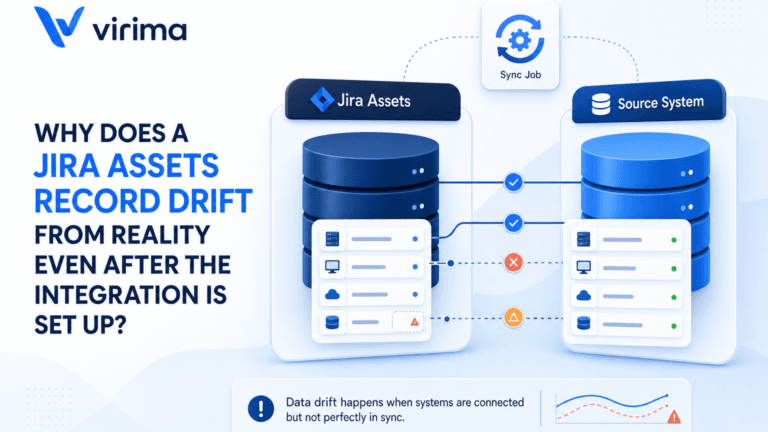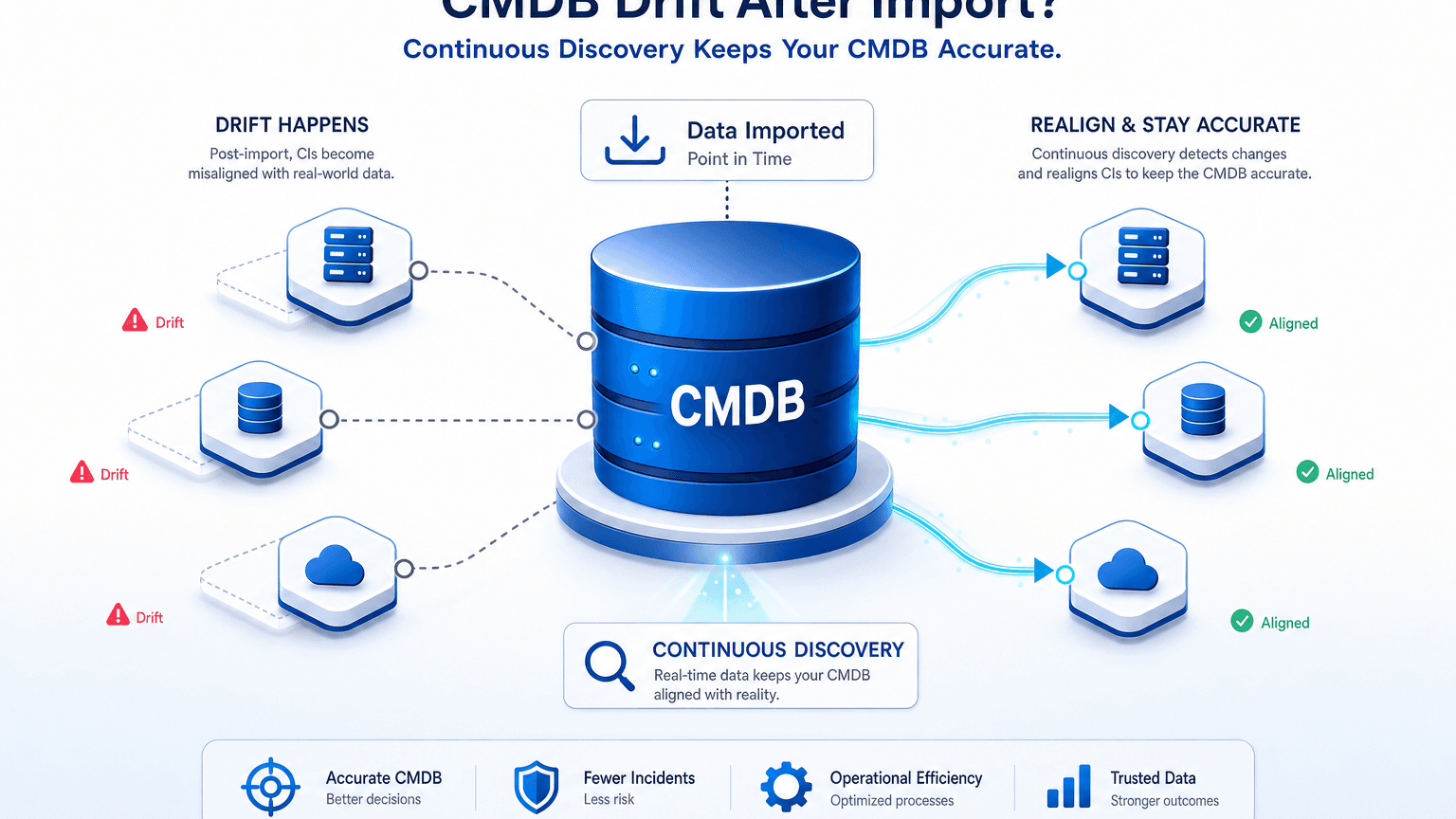
Why does ServiceNow CMDB drift after import projects?

The import cutover lands on Friday. CIs look clean on Monday. Change tickets start failing the second week because hosts that still answer discovery no longer match the classes the load project certified. That is why ServiceNow CMDB drift after import projects keeps surprising teams that treated the load as the finish line instead of the first honest snapshot.
This guide is for CMDB owners, ServiceNow platform leads, and IT operations managers who already run import and transformation projects. It is not a native discovery buyer guide. It is not a full CMDB governance handbook. It is not the general “why CMDBs go stale after cleanup” story alone.
The focus is why this drift pattern shows up when project authority ends and runtime discovery never becomes the durable source of CI existence and relationships.
Answer first: why ServiceNow CMDB drift after import projects starts with authority, not the load
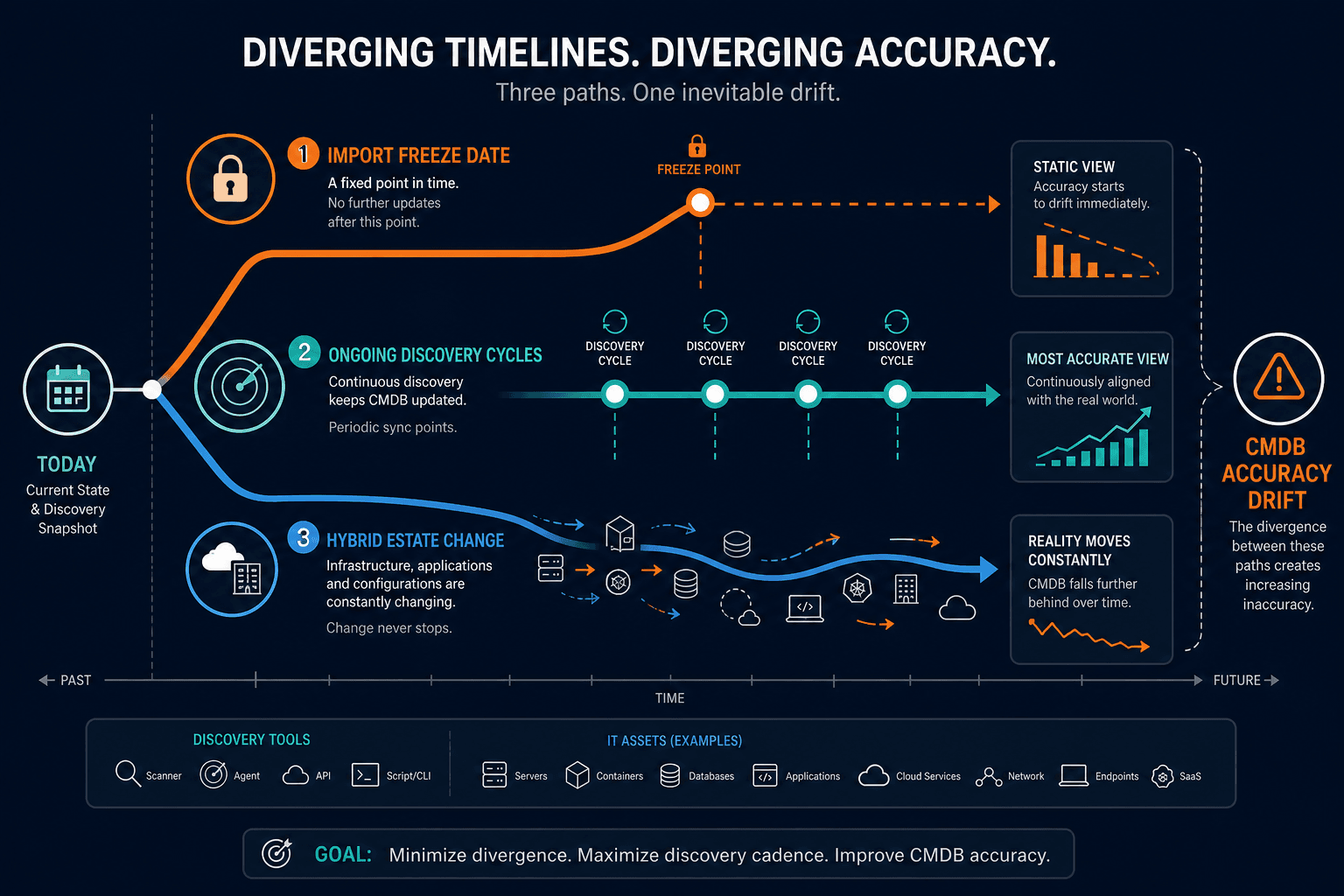
This drift starts when three clocks stop lining up. The import workbook freeze date, the last successful discovery cycle, and the rate hybrid estates change all move independently. Call this the three-clocks problem: the import project freezes a population while runtime keeps moving. If existence, last-seen, and relationship facts stay owned by the project team instead of discovery-sourced authority, the CMDB drifts even when the platform itself is healthy.
Operational risk shows up as wrong impact paths, duplicate CIs, and change failures. Audit risk shows up when control samples still pull from the post-import population while the estate has already moved. Both are authority problems, not only data-entry problems.
Flexera’s 2024 State of ITAM Report keeps pressure on incomplete technology intelligence as a cost and control problem. Import projects that cannot stay tied to live install truth inherit that same class of failure inside the ServiceNow CMDB.
When post-load CI truth still depends on the project spreadsheet, start with Trusted Runtime Truth. Pressure-test whether existence and last-seen facts still come from discovery after the import stewards hand the system to BAU.
Why does ServiceNow CMDB drift after import projects?
Drift starts when the import freezes a CI population while the estate keeps changing. If discovery does not remain the authority for existence and last-seen data, ServiceNow holds a certified snapshot that ages into conflict with runtime. Project success is not the same as durable CMDB authority.
What import projects fix, and what they cannot freeze
Import projects excel at bulk load, class mapping, and one-time cleanup. They do not freeze hybrid cloud change, VMware sprawl, or shadow hosts that appear between cycles. That gap between a successful load and a durable operating model is the pattern this article addresses.
The certified load is a point in time
Transform maps, identification rules, and reconciliation priorities can look perfect on go-live. Two weeks later, a new cluster, a renamed host, and a decommissioned appliance all land outside the project’s freeze. Without high-frequency discovery cycles on agreed scopes, BAU stewards inherit a museum exhibit. That gap compounds fast: CI drift between discovery scans grows every day a scope goes unscanned, and an import freeze is the longest unscanned window most CIs ever see.
Multi-source conflict without a prefer rule
Purchase systems, cloud exports, and scanner lists disagree with discovery on existence. If the import left no clear prefer-recent-discovery rule, operators re-open free-text edits, and the drift accelerates. Prefer recent discovery evidence for existence when sources conflict. ServiceNow’s own Identification and Reconciliation Engine (IRE) already supports a source-priority model for exactly this kind of conflict — the gap is usually that import projects never configure IRE’s reconciliation rules to prefer recent discovery evidence over older import data. A closer look at CMDB authoritative source models shows why a most-recent-wins default without a source hierarchy lets the wrong CI record survive reconciliation.
CISA BOD 23-01 keeps public pressure on accurate, timely asset visibility. Federal language is not every enterprise’s compliance frame. The operating lesson travels: incomplete or aged inventory is a control failure when change and risk programs still trust the post-import CMDB.
Put simply: an import project answers what did we find once. Discovery answers what is still true now. This failure mode is what happens when a system built to answer the first question is left to answer the second.
How drift shows up in day-two operations
This drift is visible in tickets before it is visible in dashboards.
Change and incident paths go soft
CAB still reads CI relationships from the post-import graph. On-call still finds hosts that discovery sees and the CMDB does not. MTTR rises because people stop trusting the record and rebuild tribal maps. This is the same pattern behind ServiceNow CMDB health score vs. discovery findings: a dashboard can show a clean completeness score while discovery already disagrees with what the CMDB holds.
Duplicate and orphan CIs return
Identification rules validated against the import’s clean sample data fail once real-world naming variance shows up in production. Orphans appear when decommissions never clear. Duplicates appear when cloud IDs and on-prem names never join. Import cleanup gains reverse without continuous discovery-backed reconciliation.
Service maps inherit stale infrastructure
Once service definitions exist, ViVID™ service maps can show installed-on and runs-on links. Virima ViVID™ builds those maps from defined services rather than inventing service composition automatically. Maps stay useful only while infrastructure CIs stay discovery-fresh. Stale post-import CIs poison blast-radius views even when the service list is correct.
Is ServiceNow CMDB drift after import projects a platform failure?
Usually no. The platform can hold accurate CIs when existence and relationships stay discovery-sourced. Drift is an authority and cadence failure after the project team leaves. Treating the import as the last bulk truth is the pattern that recreates inaccuracy.
Closing the gap: discovery authority after the load
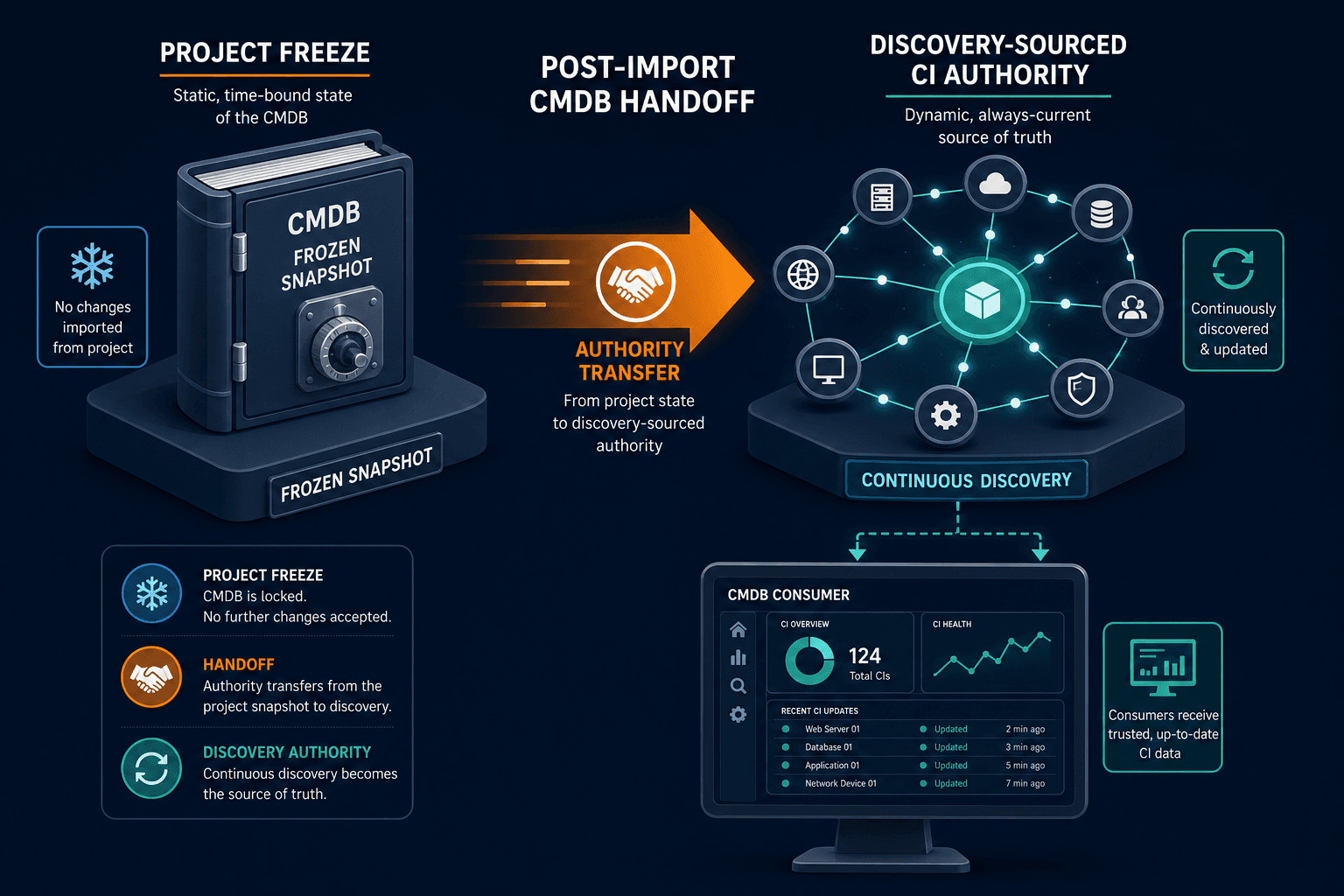
Closing this gap is not another one-time cleanup. It is a written handoff from project authority to discovery authority. That handoff needs an owner, a cadence, and a rule for which source wins when records disagree, not only a diagram in a project closeout deck.
Keep discovery on a written cadence
Agent-based discovery fits deep OS and software inventory where agents are allowed. Credentialed agentless discovery fits locked ranges. Cloud API pull covers images and instances that never sit on the corporate LAN. High-frequency discovery cycles on agreed scopes keep post-import populations honest between quarterly cleanups.
Virima’s discovery model runs on scheduled agent-based, agentless, and cloud API cycles against a written cadence policy, rather than passive, continuous, event-driven collection. That scheduled model still beats annual re-import projects that only run when trust collapses.
Prefer discovery for existence after go-live
Normalize identification keys so import classes and discovery records can join. Open ownership workflows when discovery finds assets the import never held. Prefer recent discovery evidence when purchase, CMDB, and scanner lists disagree on existence.
Internal teams evaluating platform fit should review how Virima IT discovery combines agent-based and agentless methods with software and hardware inventory on a shared schedule. A discovery-sourced CMDB stays useful when the ServiceNow side receives continuous truth instead of another freeze file.
Integrate without inventing a second source of truth
Integrations can push inventory truth into ServiceNow, Jira Service Management, Ivanti, HaloITSM, Xurrent, and Hornbill workflows. Tickets stop inventing parallel CI lists. Partner connections sit on the Virima integrations hub. ServiceNow remains the system of engagement. Discovery remains the system of runtime existence. That division of labor is what keeps the next import project from becoming the only moment CI truth gets refreshed.
Score readiness before the next import wave
Use a five-point scorecard for post-import CMDB accuracy before approving the next bulk load.
- Every scope that can change after go-live has a named discovery method and a last successful cycle newer than policy allows.
- Identification rules join import classes to discovery keys without free-text owner notes as the only bridge.
- Multi-source reconciliation prefers recent discovery evidence for existence.
- Decommission and rename paths clear CIs when discovery stops seeing them.
- High-impact services have dependency context on discovery-fresh infrastructure CIs so post-import maps stay trustworthy.
When those conditions hold, ServiceNow CMDB drift after import projects becomes a managed control instead of a seasonal surprise. Flexera’s ITAM research cited above keeps showing why incomplete technology intelligence still hurts cost and audit programs. Durable CMDB control needs durable install truth after the project team hands off.
Score your last import against these 5 criteria, then see how discovery-sourced CI authority keeps the next one from drifting the same way.
Frequently Asked Questions
Why does ServiceNow CMDB drift after import projects even when UAT passed?
UAT freezes a test population. Production estates keep changing after go-live. If discovery cadence and preferred rules never replace project authority, certified CIs age into conflict with runtime within weeks.
Does Virima replace ServiceNow’s CMDB, or work alongside it?
Virima works alongside ServiceNow, not in place of it. ServiceNow remains the system of engagement for tickets, changes, and workflows. Virima acts as the system of runtime existence, feeding discovery-sourced CI truth into the ServiceNow CMDB so the two data models stay in sync instead of drifting apart after an import project ends.
Does stopping drift require continuous passive scanning?
No. High-frequency scheduled discovery cycles on agreed scopes meet the need for many enterprises and keep ServiceNow CI drift in check between cleanup projects. Continuous passive collection on every segment is a different capability and may not sit in the stack today.
How does Virima keep post-import CI data current without another bulk load?
Virima schedules agent-based, agentless, and cloud API discovery cycles against a written cadence policy, so existence and relationship facts for every ServiceNow import project CMDB refresh on a known rhythm instead of waiting for the next bulk project. Prefer-recent-discovery reconciliation rules then resolve conflicts with purchase records and cloud exports automatically.
Where should teams start if the last import already drifted?
Restore discovery cadence on scopes that changed after go-live. Prefer recent discovery for existence. Clear orphans and duplicates with join keys. Rank relationship repair by service impact on discovery-fresh CIs next.