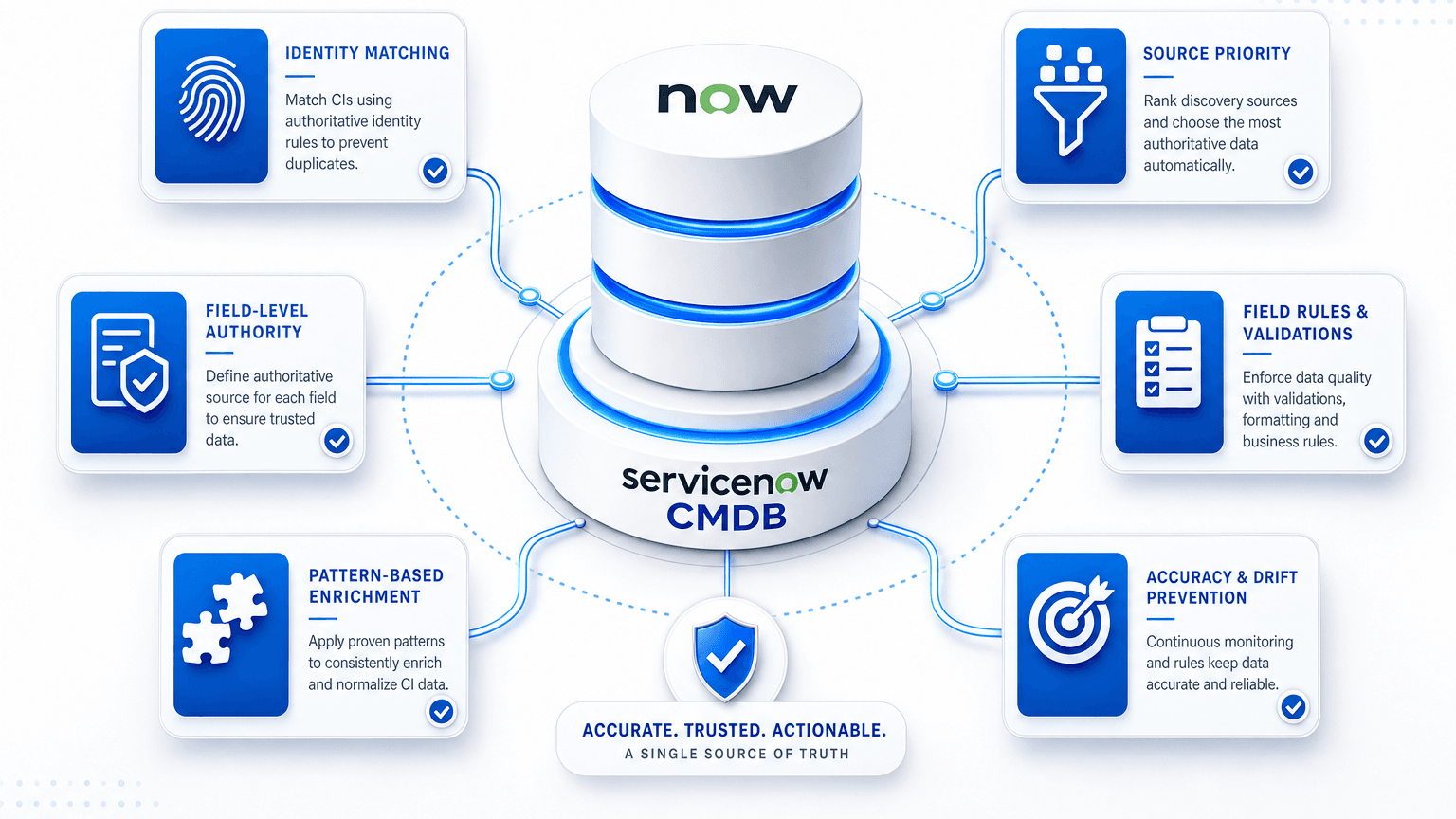
Best patterns to enrich ServiceNow CMDB from authoritative discovery still fail without field rules

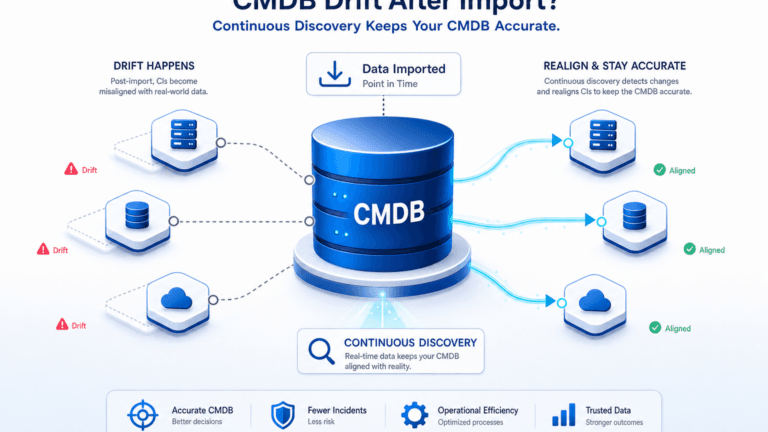
The import job finished green. ServiceNow still shows three serial numbers for one host, an owner who left last quarter, and a relationship edge that no longer exists on the wire. That is the usual failure of best patterns to enrich ServiceNow CMDB from authoritative discovery when teams treat enrichment as a bulk push instead of a set of named rules.
This page is not a critique of ServiceNow Discovery coverage. That comparison already has a home. The job here is different: reusable ServiceNow CMDB enrichment patterns you can staff against a CMDB that stays the system of engagement. Each pattern is a rule set for reconciliation, field-level authority, and update frequency. Skip the rules and discovery feeds become another source of quiet drift.
For the category frame, start with Trusted Runtime Truth. For estate-wide multi-source matching outside a single ITSM, see multi-source CI reconciliation for hybrid estates. This article stays on ServiceNow CMDB enrichment patterns fed by authoritative discovery.
How to read the enrichment pattern cards
| Field | Meaning |
|---|---|
| Intent | The CMDB decision the pattern protects |
| Rule core | Reconciliation, field authority, or frequency policy |
| Stay signal | Enrichment is working |
| Gap signal | Enrichment is theater |
| Failure mode | What ServiceNow users feel next |
CISA Binding Operational Directive 23-01 requires complete asset inventories for federal civilian agencies. Enterprise ServiceNow programs inherit the same pressure without the directive on the ticket: enrichment only works on hosts discovery can actually list.
ServiceNow documents Discovery as the product path that finds devices and applications and can populate the CMDB; see the public ServiceNow Discovery concept page. Enrichment patterns decide which external discovery values win, how often they write, and which attributes stay human-owned.
Pattern 1: Identity match before any attribute write
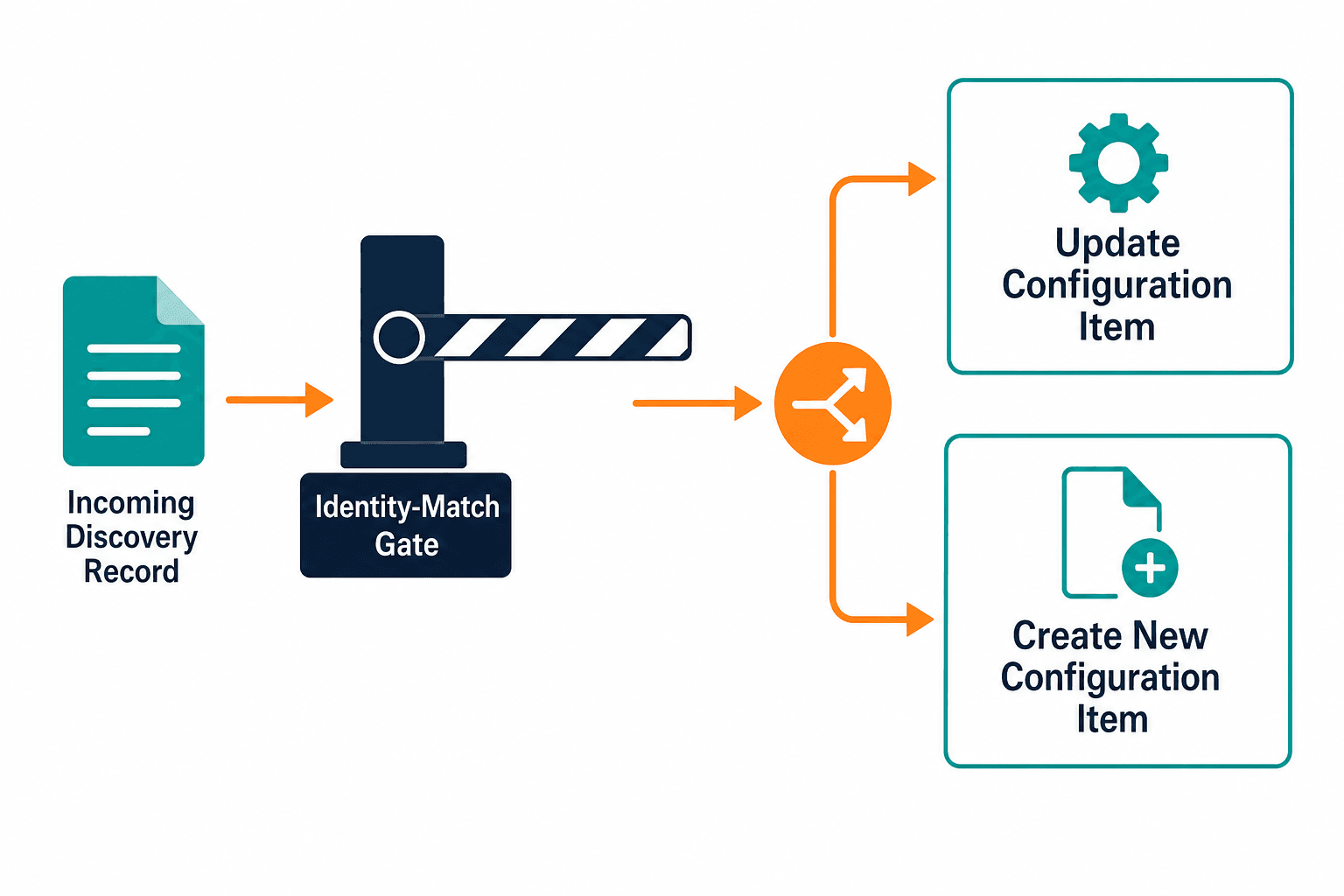
Intent. Never update a CI until the incoming record is joined to exactly one ServiceNow sys_id (or a controlled create path).
Rule core. ServiceNow CI reconciliation rules start with keys, not timestamps: reconciliation keys first (serial, FQDN, cloud instance ID, MAC set), then create-or-update. Ambiguous matches go to a queue, not a silent merge.
Stay signal. Duplicate CI rate falls and create volume is explained in a weekly report.
Gap signal. Operators still merge CIs by hand after every load.
Failure mode. Two CIs for one host, or one CI that absorbs the wrong neighbor. Import drift after projects is a related failure mode; see ServiceNow CMDB drift after import projects.
Pattern 2: Field-level authority matrix
Intent. Split attributes by who may write them, not by which tool ran last.
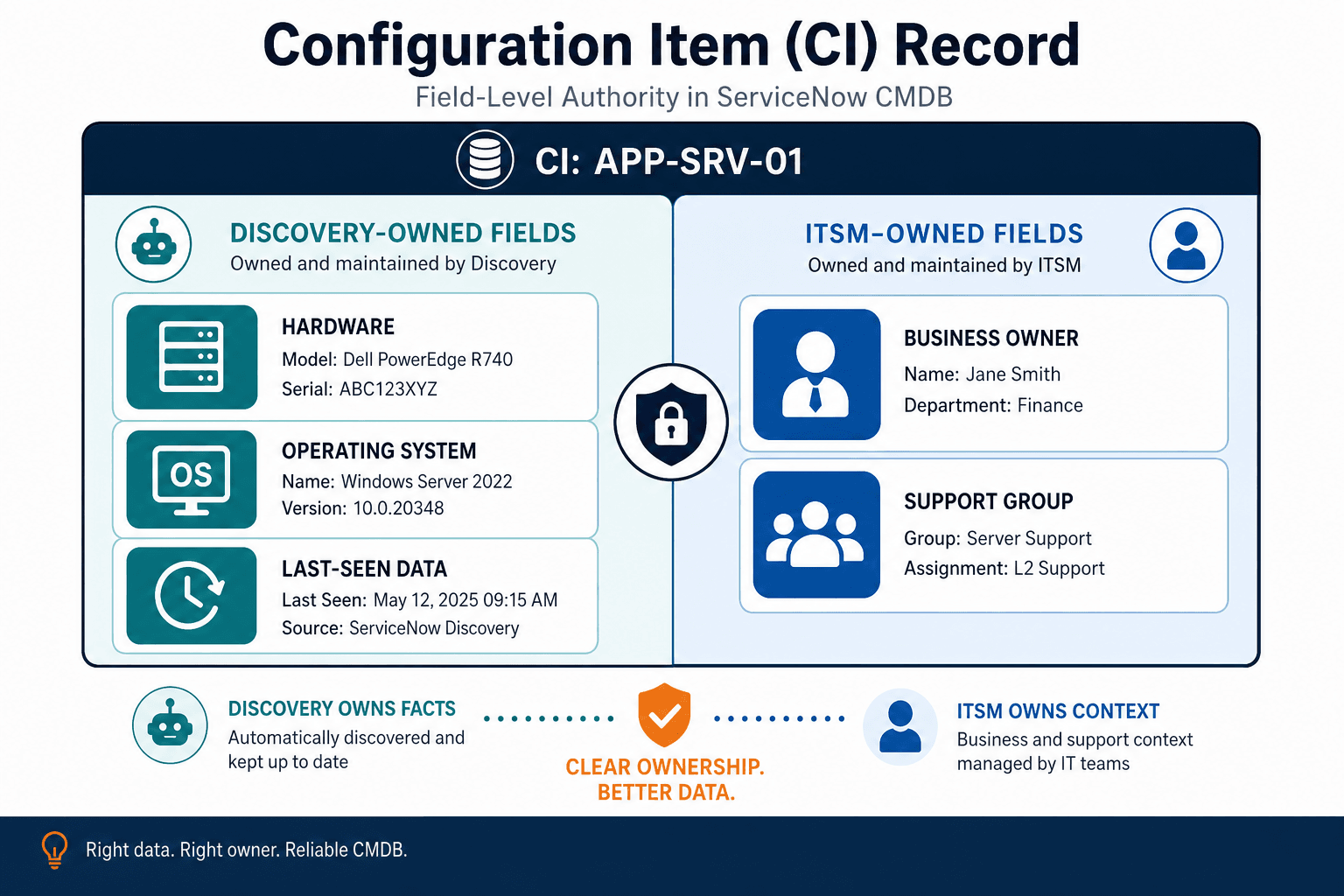
Rule core. Publish a matrix with three field classes. Discovery-authoritative fields cover hardware, OS, last-seen, and installed software where discovery owns installs. ITSM-authoritative fields cover assignment group, business owner, and support tier. Protected fields — cost center, contract tags — are ones discovery never overwrites.
Stay signal. Nightly jobs stop wiping owner and support group values entered in ServiceNow.
Gap signal. Every load is last-write-wins across the whole form.
Failure mode. Trust collapses because humans stop updating fields discovery will erase tonight.
What does field-level authority mean when enriching a ServiceNow CMDB?
It means each CI attribute has a named write owner. Discovery may own hardware and last-seen values while ServiceNow keeps owners and support groups. Without that split, bulk enrichment overwrites human data and operators stop trusting both systems.
Are reconciliation rules and field-level authority the same thing?
No. Reconciliation rules decide which discovery source may create or update a CI at all. Field-level authority decides which specific attributes that source is allowed to touch once matched. ServiceNow CMDB enrichment needs both — reconciliation alone still lets a trusted source overwrite an owner field it should never touch.
Pattern 3: Update frequency policies by CI class
Intent. Match scan and write cadence to how fast that class changes.
Rule core. High-churn classes (cloud compute, containers where in scope) get higher-frequency discovery cycles and tighter last-seen SLAs. Stable classes (network chassis, facility gear) use longer intervals and wider staleness windows. Document the SLA next to the class, not only in a runbook.
Stay signal. Stale-CI dashboards show class-specific age, not one global average.
Gap signal. One weekly full dump for every class, including objects that move hourly.
Failure mode. Either noise floods the CMDB or critical cloud CIs age out between jobs. Prefer high-frequency scheduled discovery cycles over claims of passive continuous real-time event discovery when that is not product behavior.
How often should ServiceNow CMDB enrichment update different CI classes?
ServiceNow CMDB enrichment should not run on one global schedule. High-churn CI classes like cloud compute need discovery cycles and last-seen SLAs tighter than stable classes like network chassis. A single weekly full dump for every class either floods the CMDB with noise or lets fast-moving cloud CIs age out between jobs.
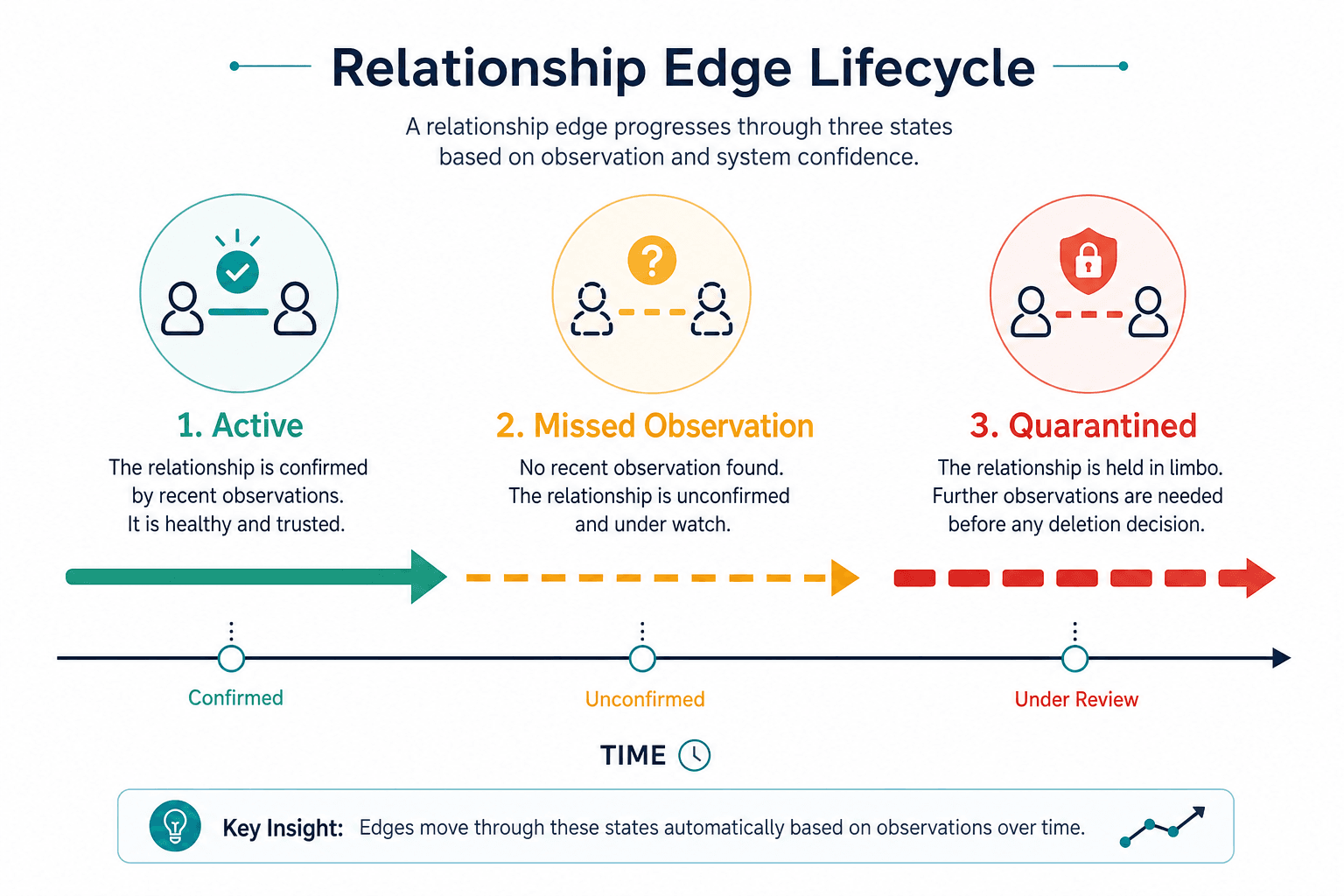
Pattern 4: Relationship edge rules with delete guards
Intent. Enrich dependency and containment edges without deleting edges that still matter for change impact.
Rule core. Add edges when discovery proves them. Soft-delete or quarantine edges only after N missed observations and a class-specific cool-down. Never hard-delete all relationships on every load.
Stay signal. Change packets still see shared hops after enrichment nights.
Gap signal. Relationship counts swing wildly every Monday morning.
Failure mode. CAB and incident paths lose blast radius. CMDB decay without discovery authority is the long form of this failure; see CMDB projects decay without discovery authority.
Should CMDB enrichment delete relationship edges automatically?
Enrichment should never hard-delete all CI relationships on every discovery load. The safer rule is to quarantine an edge after a set number of missed observations, then delete only after a class-specific cool-down. Immediate full deletes blind change and incident teams to real dependencies.
Pattern 5: Stale-source quarantine and last-seen gates
Intent. Block writes from discovery sources that missed their freshness SLA.
Rule core. If a source has not reported inside its policy window, pause attribute promotion, open a data-quality task, and keep prior good values. Log the quarantine so platform owners see coverage holes.
Stay signal. Empty scans do not blank serial numbers or OS builds.
Gap signal. A failed probe still posts nulls into production CIs.
Failure mode. One bad night undoes months of cleanup.
Pattern 6: Exception queue with time-boxed human override
Intent. Give humans a controlled path when rules disagree with reality.
Rule core. Ambiguous identity, conflicting serials, and protected-field conflicts land in a queue with owner, SLA, and expiry. Overrides expire so temporary fixes do not become permanent shadow policy.
Stay signal. Queue age is a managed KPI, not a forgotten backlog.
Gap signal. Email threads replace the queue and nobody can audit who forced a write.
Failure mode. Tribal exceptions become the real reconciliation engine.
Why do ServiceNow CMDB enrichment jobs fail without reconciliation rules?
Jobs can still load rows while identity keys collide, fields overwrite owners, and stale sources blank good values. Reconciliation rules, field authority, and freshness policies decide which discovery values may write. Without them, green import logs still produce untrusted CIs.
Pattern scorecard
| Pattern | Primary control | What it stops |
|---|---|---|
| Identity match first | Reconciliation keys | Silent merges and duplicate CIs |
| Field-level authority | Attribute write owners | Discovery wiping ITSM owners |
| Frequency by CI class | Update cadence policies | One-size dump for every class |
| Relationship delete guards | Edge cool-down rules | Weekly relationship wipeouts |
| Stale-source quarantine | Freshness gates | Null floods from failed probes |
| Exception queue + TTL | Human override policy | Permanent shadow rules |
Native discovery comparisons belong on their own page when the question is platform choice; see Virima vs native ServiceNow Discovery. Operational ServiceNow CMDB hygiene still sits under ServiceNow CMDB best practices and ServiceNow CMDB discovery. This pattern set is the enrichment rulebook between those posts.
Where the patterns break on hybrid estates
Hybrid paths (on-prem, VMware, AWS, Azure) multiply identity collisions. Cloud tags disagree with ServiceNow names. Agent-only views miss network gear. A field matrix that works for Windows servers still fails if cloud instance IDs never enter the key set. Authoritative discovery must cover the hop the CI represents before enrichment can claim authority.
ViVID™ service maps help after service definitions exist. They do not invent the business service list ServiceNow expects. High-frequency scheduled discovery keeps last-seen honest under Patterns 3 and 5. Passive continuous real-time event discovery is not current Virima product behavior, so do not write frequency policies that assume it.
If ServiceNow stays your system of engagement and discovery still fights the form overnight, see how Virima feeds the hub without replacing your ITSM workflows.
Where Virima fits under the patterns
Virima is the authoritative discovery and CMDB enrichment layer that can feed ServiceNow under these patterns. It does not replace ServiceNow as the ITSM system of engagement.
What Virima contributes
- Automated discovery so identity keys and last-seen stay current across hybrid paths Virima covers
- Inventory and relationship truth that enrichment jobs can map into ServiceNow CIs
- ViVID™ service maps after service definitions exist, useful when relationship edges need proof
- Windows Server NIST NVD overlays on maps where that signal applies, without claiming full multi-OS vulnerability scanning
- Feed into ServiceNow, Jira, Ivanti, and many more through one hub: all integrations
What Virima does not claim
- Autonomic Social Discovery (ASD) as a go-forward capability
- Passive continuous real-time event discovery as current behavior
- Replacement of ServiceNow ITSM, ITOM workflow products, or native Discovery licensing choices
- Instant business-service invention without a definition input
- GCP discovery parity with AWS and Azure where product scope is cloud-limited
For capability depth, see features/cmdb and features/it-discovery.
How should teams adopt ServiceNow CMDB enrichment patterns from discovery?
Start with identity match and a field authority matrix for one CI class, measure duplicate and wipe rates for thirty days, then add frequency policies and relationship guards. Do not enable every pattern on day one. Exception queues come after the rules have a baseline.
Adoption order that usually works
- Identity match first if duplicates dominate.
- Field-level authority if owners and groups keep vanishing.
- Stale-source quarantine if failed probes blank good data.
- Frequency by CI class once identity is stable.
- Relationship delete guards before you trust change impact again.
- Exception queue with TTL once volume justifies staffing.
Staff the pattern, not another one-time cleanup. CMDB programs without ongoing discovery authority still decay; enrichment rules are how you keep ServiceNow current without another spreadsheet load.
Close on rules, not on another import
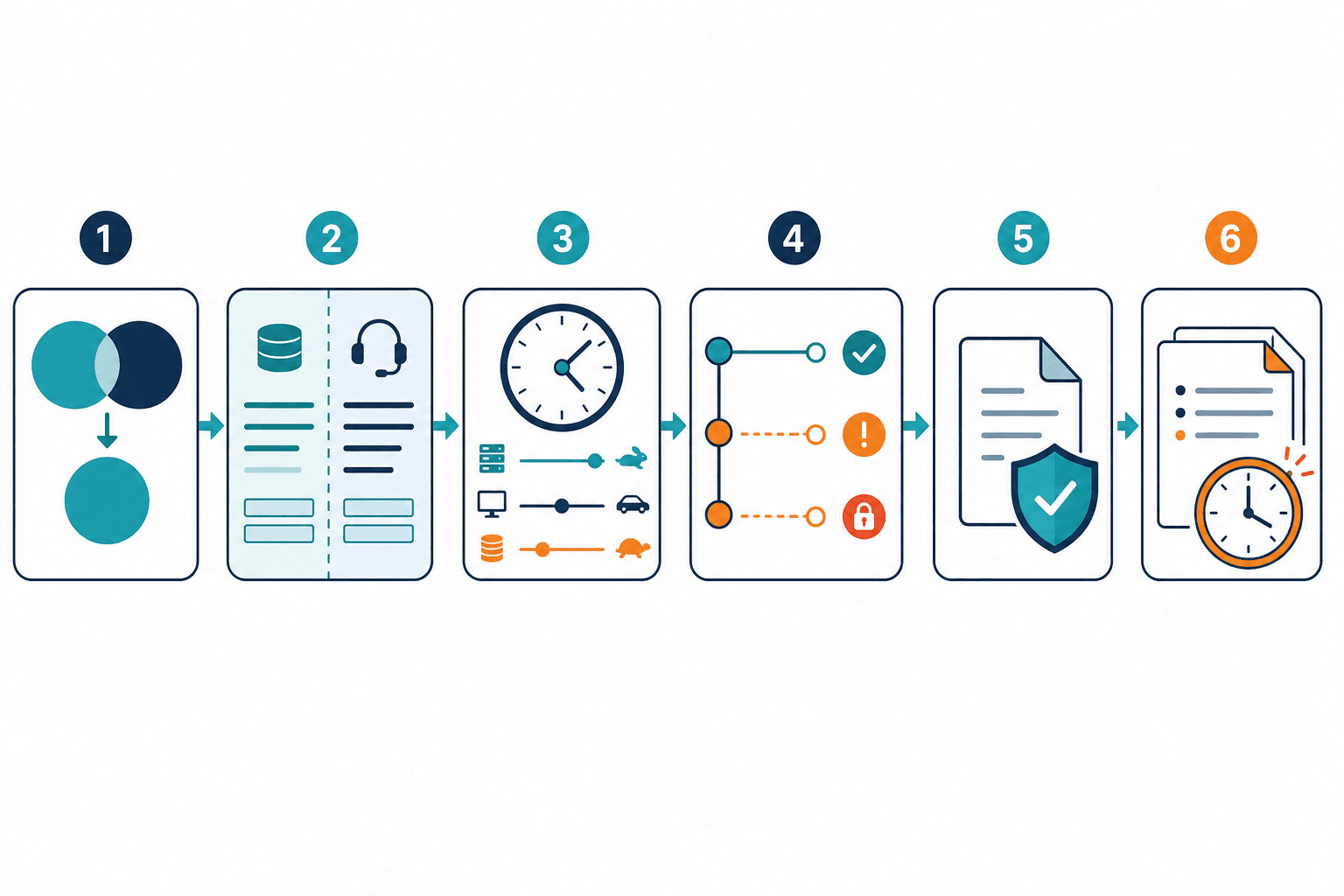
Best patterns to enrich ServiceNow CMDB from authoritative discovery are operational habits: identity-first reconciliation, field-level authority, class-based update frequency, guarded relationship deletes, stale-source quarantine, and time-boxed exceptions. Each pattern is reusable. Each one still needs discovery coverage under the ServiceNow workflows you already run.
When you want those patterns fed from production instead of last quarter’s export, schedule a demo and walk one CI class against a live ServiceNow instance.
Frequently Asked Questions
Does Virima replace ServiceNow Discovery, or work alongside it?
No. Enrichment patterns decide how authoritative discovery values write into ServiceNow CIs. Teams may still run native Discovery, third-party discovery, or both. The patterns govern identity, field authority, and frequency regardless of which probe collected the facts.
What should own the business owner field on a CI?
Usually ServiceNow or the ITSM process, not the discovery probe. Discovery should own hardware and last-seen style facts. A field-level authority matrix makes that split explicit so overnight jobs stop erasing human ownership data.
How often should discovery update cloud versus network CIs?
Cloud compute usually needs higher-frequency scheduled cycles than stable network chassis. Publish class-specific freshness SLAs and quarantine sources that miss them. One weekly dump for every class is the common failure mode.
Should enrichment delete old relationship edges automatically?
Not on first miss. Use observation counts and cool-down windows before hard delete. Immediate full relationship wipes make change and incident paths blind even when the import log is green.
How does Virima support ServiceNow CMDB enrichment patterns?
Virima supplies discovery-sourced inventory and relationship truth that can feed ServiceNow under identity, field, and freshness rules. It does not replace ServiceNow ITSM workflows. Integration paths sit on the shared hub rather than one-off partner deep links.