Why CMDB Projects Decay Without Discovery Authority

Six months after go-live, the configuration management database (CMDB) project still has a green status slide. The tool is live. The import jobs finished. A cleanup sprint closed thousands of stale configuration items (CIs). Change tickets still open against hosts the bridge cannot find. A weekend release still names a dependency that never entered the map. A security review still asks who owns a shadow cloud account nobody claims. The project did not fail at launch, CMDB projects decay without discovery authority when nobody names discovery as the lasting authority for what exists.
This guide explains why that decay happens, and what CMDB owners and IT leaders must change after the first cleanup. This isn’t a hygiene checklist or a stale-data cleanup story — the focus is authority: which system wins when spreadsheet, ITSM import, and live estate disagree.
Go-live freezes a picture the estate will not keep
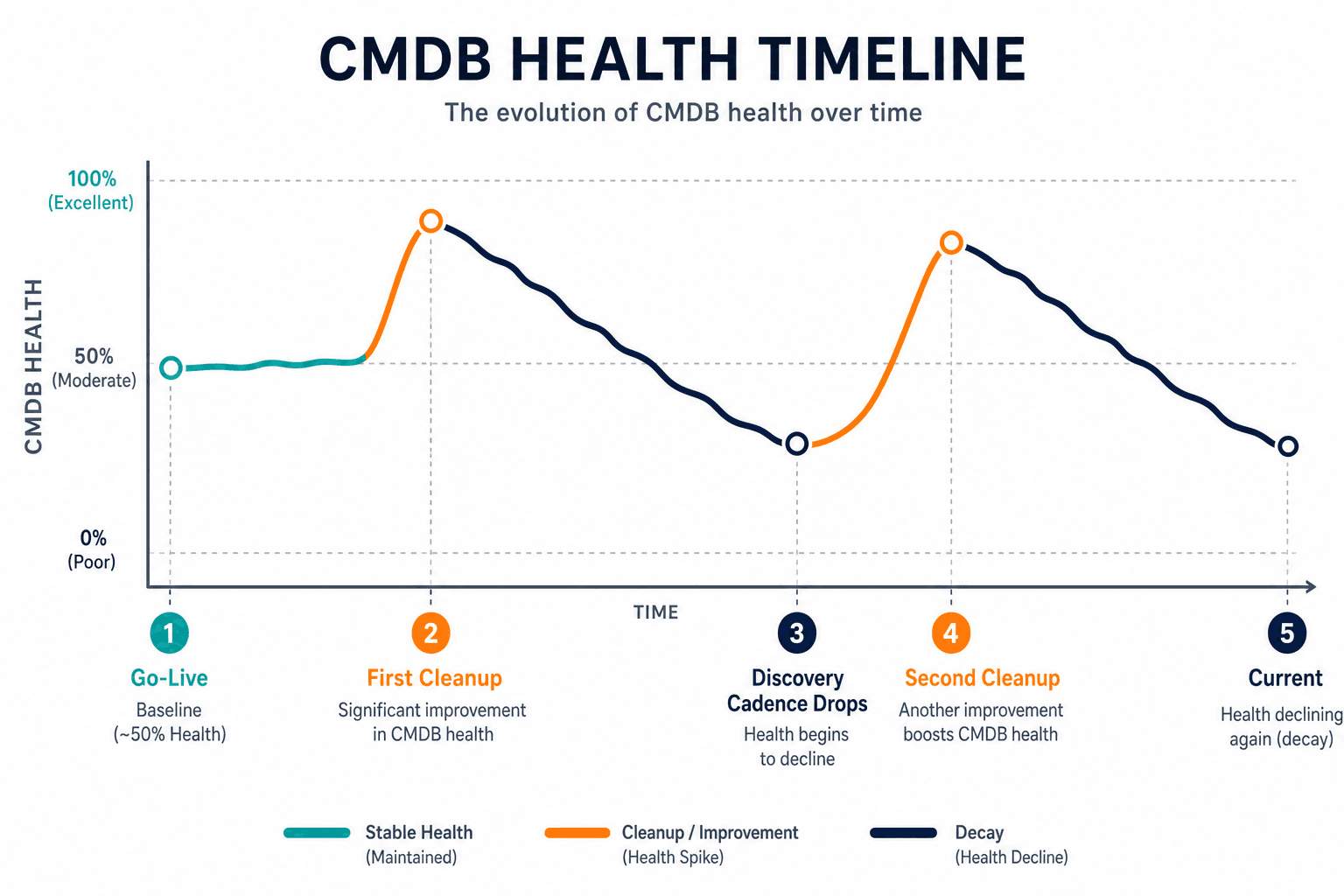
Most CMDB programs still treat discovery as a project phase. Scanners run hard for a few weeks. Consultants reconcile duplicates. Stewards label owners. Leadership signs off on a baseline. Then discovery cadence drops to whatever the operations calendar can spare.
Cloud accounts keep spinning. Contractors keep joining. Decommission tickets lag. The frozen baseline ages while the estate moves. That sequence feels responsible. It creates a defensible go-live date. It also creates a second, quieter failure mode. After go-live, the CMDB becomes a system of record for tickets and reports while the live estate remains the system of truth for risk. When those two diverge, every downstream process inherits the gap. Incident bridges invent host lists. Change boards approve paths nobody can prove. Automation scripts act on CIs that no longer match runtime.
Flexera’s 2024 State of ITAM Report keeps showing why incomplete technology intelligence, the same category of gap a decayed CMDB creates, still hurts cost and control programs. Teams that cannot trust what they hold pay again in audits, rework, and delayed decisions. A CMDB that only looked accurate on launch day becomes the same class of problem under a different label. CMDB data accuracy depends on which source wins when records disagree, not on how clean the launch-day baseline looked.
When partial inventories still drive change and incident decisions, start with Trusted Runtime Truth. Pressure-test whether discovery still owns CI existence after the project party ends.
Why do CMDB projects decay without discovery authority after a successful go-live?
Go-live freezes a baseline while cloud, contractors, and decommissions keep moving. Without discovery as the lasting authority for existence and last-seen data, imports and manual edits age. Ticket and report consumers then treat stale CIs as current until the next scrub or outage forces another cleanup.
Authority is the missing design decision
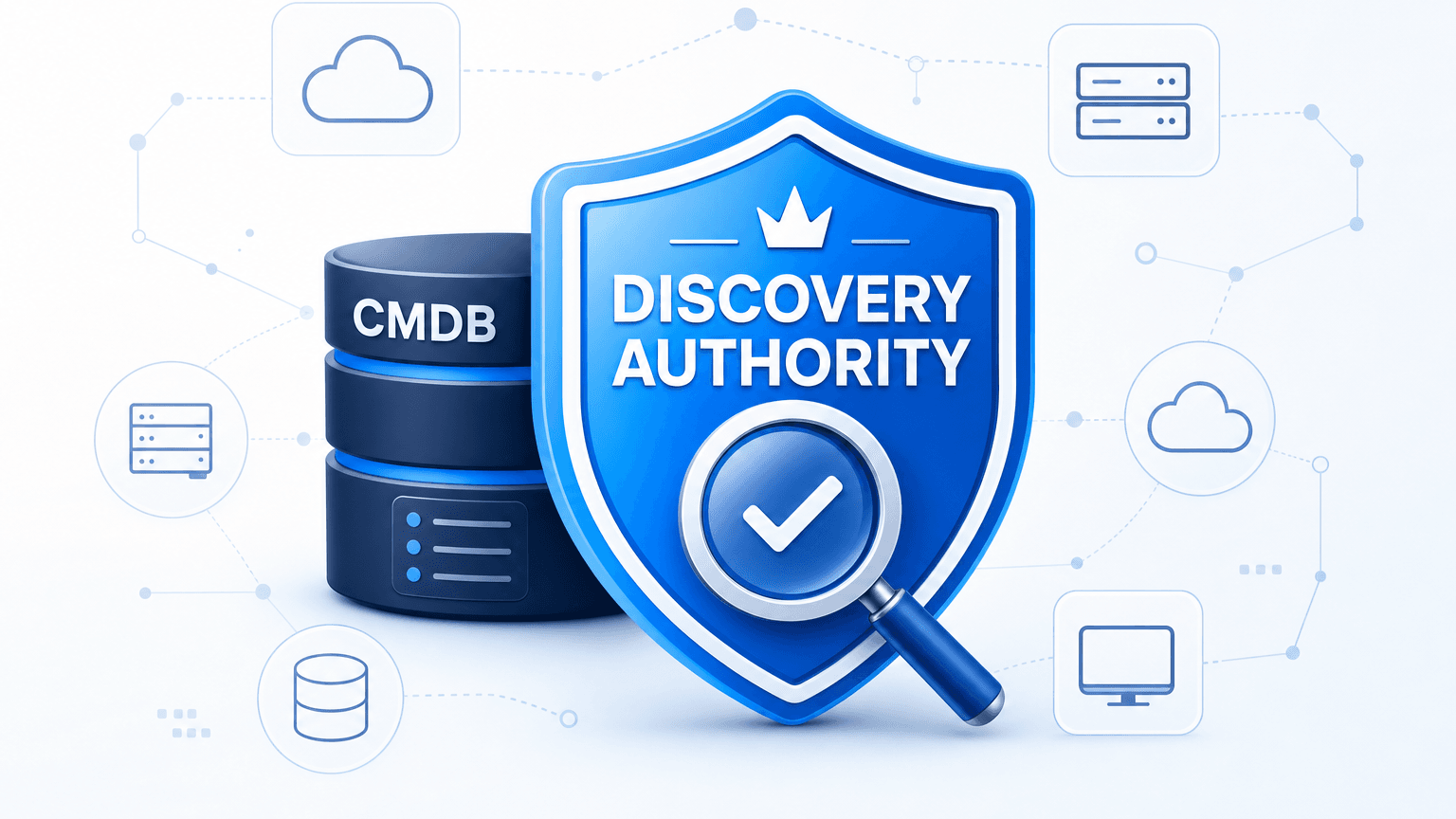
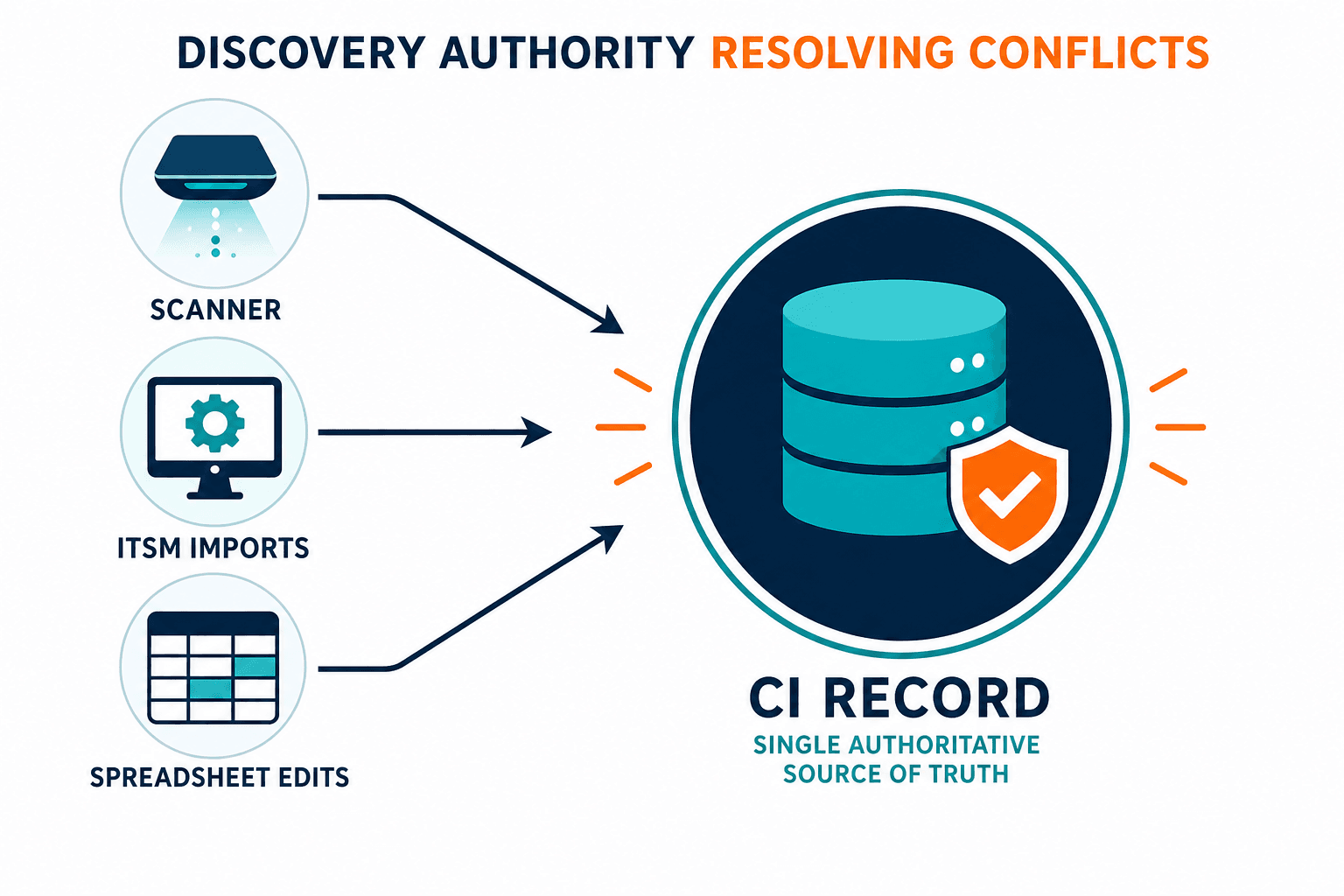
Teams often debate tools, data models, and steward headcount. They debate less who wins a conflict. This is the discovery authority for CMDB gap most programs never close: when a scanner reports a host and a spreadsheet denies it, which record stands? When AWS inventory shows an account and the CMDB lacks an owner, who opens the workflow? When two tools report different OS versions, which last-seen timestamp wins?
Without an explicit discovery authority rule, politics fills the gap. Security trusts its console. Cloud trusts its export. Enterprise IT trusts the last import. CMDB stewards become human merge engines. That model scales until volume exceeds attention. Then decay accelerates. Unknown devices stay unlabeled. Retired hosts stay active. Relationships rot because nobody refreshes the infrastructure CIs the maps sit on.
| Conflict scenario | Without a discovery authority rule | With discovery authority |
|---|---|---|
| Scanner reports a host, spreadsheet denies it | Whichever team argues loudest wins | Discovery evidence stands until the next scan |
| Cloud account has no listed owner | Account sits unclaimed indefinitely | An unknown-asset workflow opens automatically |
| Two tools report different OS versions | Stewards manually referee each conflict | The most recent discovery evidence wins by rule |
Ticket-and-import-driven CMDBs commonly run at 40 to 70 percent data accuracy, according to Oomnitza’s analysis of CMDB reconciliation practices. That range tracks with a CMDB that absorbs whichever source reported last instead of applying a fixed authority rule, so conflicts resolve by timing rather than by trust. Virima’s guide on multi-source CMDB reconciliation covers why “last scan wins” is not the same as an authority rule, even when it produces a similar-looking record. Some reconciliation approaches resolve conflicts per attribute rather than per source, trusting scanner evidence for OS version while trusting a manual field for cost center. That is a finer-grained version of the same authority principle, not an exception to it.
Discovery authority does not mean discovery replaces business metadata. Owners, cost centers, and service definitions still need human or system-of-record input. It means hardware and software existence, network identity, and last-seen facts come from scheduled discovery evidence first. Manual overrides stay allowed for business fields without freezing facts scanners still observe.
What is the difference between a CMDB and a discovery tool?
A CMDB and a discovery tool solve different problems. Discovery finds and confirms what exists in the live estate. The CMDB stores relationships, ownership, and history. When discovery cadence drops after go-live, the CMDB keeps its structure but loses its connection to what is actually running.
Operators who close that gap write the rule in operating procedures, not only in a slide. They name methods for each scope: agent where allowed, credentialed agentless where agents are blocked, API pull for AWS and Azure, network device collection for boundary gear. They name cadence short enough that a month-old blind spot counts as a defect. They name the owner who merges duplicates when serial or hostname collisions appear.
Cleanup without authority is a temporary score
Cleanup sprints create visible progress. Duplicate CIs drop. Completeness charts rise. Leadership celebrates. Weeks later the same charts soften because the estate never stopped changing. This is the same relapse pattern Virima’s research into why CMDB data goes stale again after cleanup documents: cleanup without discovery authority is a scoreboard event, not a control. The control is repeated discovery on a written scope, plus reconciliation that prefers recent evidence over static imports nobody revalidates.
IBM’s Cost of a Data Breach Report keeps financial and operational cost high when unmanaged edges and incomplete inventories sit in the path of an incident. Cascades often start on a host the CMDB never held or never retired. Discovery that only refreshes after major projects will miss the next contractor kit and the next temporary cloud resource. High-frequency discovery cycles across agreed scopes reduce that surprise before the change board or the incident bridge meets.
Relationship data fails next. A flat host list will not tell a change owner whether a logging collector still supports a crown-jewel path. Once service definitions exist, ViVID™ service maps can show installed-on and runs-on links. Virima ViVID™ builds those maps from defined services rather than inventing service composition automatically. Maps stay honest only while the infrastructure CIs underneath stay discovery-fresh. Authority for CIs is the foundation under service maps, not a separate project.
Internal teams evaluating platform fit should review how Virima IT discovery combines agent-based and agentless methods on a shared schedule. Pair discovery-sourced CMDB truth with dedicated EDR, SIEM, and vulnerability platforms. Do not force one tool to own every security job if the risk model says otherwise.
NIST NVD vulnerability overlays for Windows Server assets on service maps can help weight exposure by asset and business criticality where that product path applies. That overlay inherits the same authority problem as everything else on the map: it is only as trustworthy as the discovery-sourced CI data it is weighting, so it does not replace a full multi-OS vulnerability management program.
What does discovery authority mean for a CMDB program?
Discovery authority means existence, identity, and last-seen facts come from scheduled discovery evidence first when sources conflict. Business metadata can still come from owners and finance systems. The rule stops spreadsheets and stale imports from silently overwriting runtime truth after go-live.
How decay shows up before the board deck admits it
This is what CMDB project decay after go-live actually looks like day to day. Decay rarely announces itself as “the CMDB project failed.” It shows up as operational friction. Bridges spend the first twenty minutes hunting host names. Change windows expand because impact analysis cannot be trusted. Audit samples fail because ownership fields lag. Automation pauses because operators fear acting on bad CIs. Stewards burn cycles on the same classes of defects every quarter.
CMDB projects decay without discovery authority in a predictable pattern:
- Discovery becomes optional after go-live.
- Imports and tickets become the default write path.
- Unknown devices open no ownership workflow.
- Health metrics track ticket volume instead of staleness and coverage.
- Leadership funds another cleanup instead of funding cadence and conflict rules.
CISA cybersecurity best practices keep public attention on reducing cyber risk across high-value environments. That pressure does not automatically align asset systems of record. Security may run a separate inventory. Enterprise IT may run ServiceNow or another ITSM CMDB. Cloud teams may export account inventories into spreadsheets. Without a reconciliation owner and a discovery-first rule, every team can claim its list is complete while shared paths still host unknowns.
Leaders can treat Trusted Runtime Truth for the operational estate as the durable foundation, replacing temporary cleanup cycles with discovery-sourced authority. Leaders need what exists, how it is connected, what changed, and who owns it. That picture should be sourced from discovery rather than from the last spreadsheet edit. Automated discovery refreshes CIs while the CMDB holds relationships and health signals. Once services are defined, dependency maps give leaders a shared blast-radius view before weekend changes. Integrations can push that truth into ServiceNow, Jira Service Management, Ivanti, HaloITSM, Xurrent, and Hornbill workflows. Tickets stop inventing separate asset lists. Partner connections sit on the Virima integrations hub.
See how discovery authority keeps CMDB projects from decaying after go-live. Keep CI existence and last-seen data discovery-sourced so cleanup gains hold.
What good looks like when discovery stays the authority
Leaders can score readiness with a short operational checklist:
- Every range and cloud account in scope has a named discovery method and a last successful cycle newer than policy allows.
- Unknown devices open an ownership workflow instead of remaining unlabeled.
- Multi-source reconciliation prefers recent discovery evidence over static imports.
- CMDB health tracks completeness and staleness so executives see inventory debt as a metric, rather than relying on the completeness-only metric that trips up so many post-cleanup reviews.
- Service maps for key services stay tied to infrastructure CIs that discovery still confirms.
Teams that formalize this checklist can expect measurable movement away from the 40-70 percent accuracy range common in ticket-and-import-driven CMDBs, per Oomnitza’s reconciliation analysis cited above. The checklist is what turns a fixed authority rule into a measurable, repeatable score instead of a one-time cleanup claim, and it keeps CMDB data accuracy visible as an ongoing metric rather than a one-time launch claim.
How do teams know discovery authority is working inside the CMDB?
Scoped ranges show recent last-seen cycles. Conflicts resolve toward discovery evidence for existence fields. Unknown devices open named ownership workflows. Staleness appears on executive health views. Service maps stay attached to infrastructure CIs that discovery still confirms before change windows.
When those conditions hold, CMDB projects decay without discovery authority becomes a preventable failure mode instead of an annual surprise. Discovery-sourced CMDB records and dependency context give a shared runtime picture before the next patch window, merger cutover, or board risk review.
If your teams still fund cleanup sprints because discovery never became the authority after go-live, the checklist above is the place to start, validate whether your cadence and conflict rules can support the estate you already run.
Frequently Asked Questions
Why does CMDB accuracy collapse after a successful go-live?
Launch freezes a baseline while the estate keeps changing. If discovery cadence and conflict rules drop after go-live, imports and manual edits age. Consumers then treat stale CIs as current until the next scrub or outage forces another cleanup.
Is discovery authority the same as continuous passive scanning?
No. Discovery authority is a governance rule about which source wins for existence and last-seen facts. High-frequency discovery cycles on agreed ranges meet that rule for many enterprises. Continuous passive collection on every segment is a different capability and may not sit in the enterprise stack.
Does Virima replace ServiceNow or other ITSM CMDBs?
Virima supplies discovery-sourced CMDB authority and dependency context that can enrich ITSM workflows. Many teams keep ServiceNow, Jira Service Management, Ivanti, HaloITSM, Xurrent, or Hornbill as the workflow system while discovery evidence keeps the inventory honest.
How does Virima help stop CMDB project decay?
Virima runs agent-based and agentless discovery on agreed ranges. It populates a CMDB with multi-source reconciliation that prefers recent evidence. It builds ViVID™ dependency maps after services are defined. Teams use that discovery-sourced truth inside ITSM workflows instead of freezing a launch-day baseline.
Where should teams start if the last CMDB cleanup already faded?
Write the discovery authority rule and scope map first. Restore cadence on those ranges next. Open ownership workflows for unknowns. Then attach service definitions for the few crown-jewel services that create the most change and incident risk.