Best Approaches to Multi-Source CI Reconciliation for Hybrid Estates

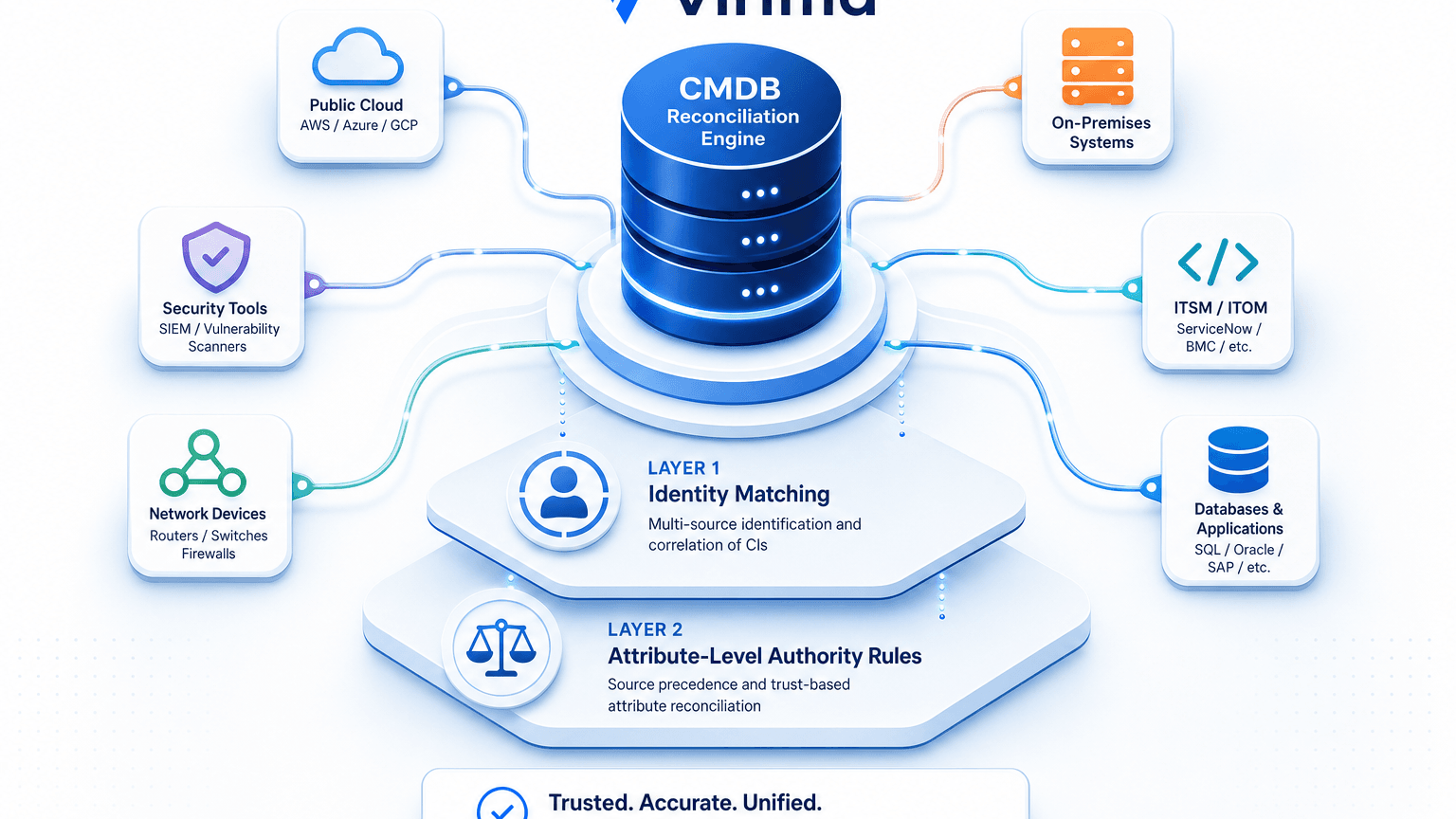
The best approach to multi-source CI reconciliation for hybrid estates is a two-layer model: identity matching first (deterministic keys where identifiers align, probabilistic matching where they partially align, human arbitration for irreducible ambiguity), then attribute-level authority rules once two records are confirmed as the same CI. Most guidance jumps straight to which source wins on a field value — but that step only works after you know the records describe the same asset.
A mid-size enterprise estate rarely has one system of record. It runs an agent-based scanner, an agentless network sweep, two or three cloud APIs, a security tool on its own schedule, and often an inherited platform from the last acquisition. Each source is right about what it sees. None of them agree with each other. The approach decision turns on estate heterogeneity: source count, identifier consistency, and edge conditions such as OT/IoT, shadow IT, and M&A-inherited tooling.
Why “which CMDB conflict-resolution method” is the wrong first question
The default framing in CMDB reconciliation treats the core decision as a binary: last-scan-wins (whichever source wrote to a CI record most recently sets the attribute value) versus attribute-level authority rules (each attribute has a designated primary source, regardless of timestamp).
The case against last-scan-wins is well-established, and Virima’s multi-source CMDB reconciliation guide covers it in detail. Attribute-level authority rules are the correct answer to attribute conflict. That framing, though, assumes two source records have already been confirmed to describe the same configuration item.
Authority rules only apply after identity is resolved. A well-configured authority-rule engine can operate on a false match — two records incorrectly merged as a single CI — and still produce confident-looking data. That data reflects the wrong asset. No conflict flag appears in the CMDB, because the engine performed exactly as designed: the error lives upstream, in the matching step, where most reconciliation documentation does not go.
The two layers hybrid estates force you to solve
Reconciliation in a hybrid estate operates across two distinct layers. They fail independently, and the diagnostic for each is different.
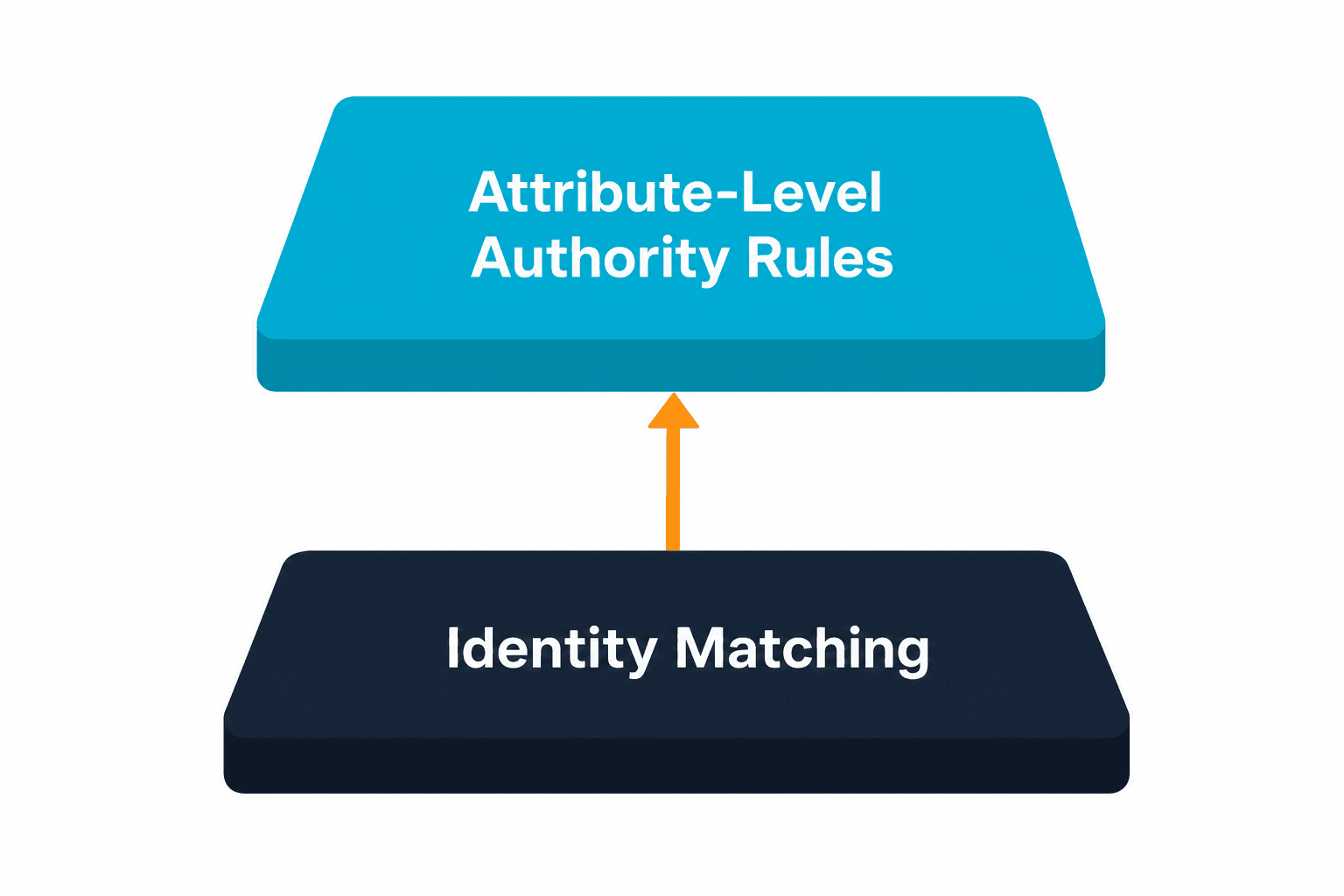
Layer 1: Identity matching. This is the process of determining whether two records from different sources describe the same physical or virtual asset. A Windows server discovered by an agent carries a hostname, an IP address, and a local hardware serial. The same server visible to a cloud API carries an instance ID and a resource ARN. That same asset gets logged by a security tool under a MAC address instead.
None of these identifiers are guaranteed to align across sources. Identity matching determines whether these three records merge into one CI or produce three separate ghost records in the CMDB.
Layer 2: Attribute-level authority rules. Once two records are confirmed to describe the same CI, authority rules determine which source populates each attribute. Operating system version from the agent. Cloud region from the cloud API. Patch status from the security tool. This is the layer addressed by most reconciliation documentation.
A hybrid estate diagnosis should start with one question: are CI counts wrong, or are CI values wrong? Ghost records and duplicate CIs point to Layer 1 failures. Attribute drift, stale values, and silent overwrites point to Layer 2. The two problems require different fixes.
Identity matching approaches, and where each breaks down
Three approaches cover the practical range of identity matching in hybrid estates.
| Approach | Best-fit scenario | Failure mode | Operational cost |
|---|---|---|---|
| Deterministic key matching | Environments where sources share a consistent identifier, BIOS UUID, cloud instance ID, or normalized hostname, across discovery methods | Breaks when the same identifier is absent from one or more sources, or when M&A-inherited tooling uses naming conventions that do not map to enterprise standards | Low once keys are mapped; high upfront effort to confirm which identifiers are actually consistent across sources |
| Probabilistic / fuzzy matching | Environments where sources share partial identifiers, similar hostnames, overlapping IP ranges, correlated discovery timestamps, that individually are unreliable but together produce a match score above a confidence threshold | Confidence thresholds are difficult to tune; a threshold that avoids false merges often produces false separations on OT devices with minimal metadata | Moderate to high; requires ongoing tuning and a mechanism for reviewing low-confidence matches before they commit to the CMDB |
| Human-in-the-loop arbitration | Assets where no reliable shared identifier exists and confidence scoring cannot resolve ambiguity, common in OT/ICS environments, M&A-inherited assets with custom naming, and IoT endpoints with inconsistent MAC assignments | Does not scale; review queues grow faster than teams can clear them if applied to a large asset population without scoping | High per record, but bounded if applied only to the genuinely ambiguous subset rather than the full estate |
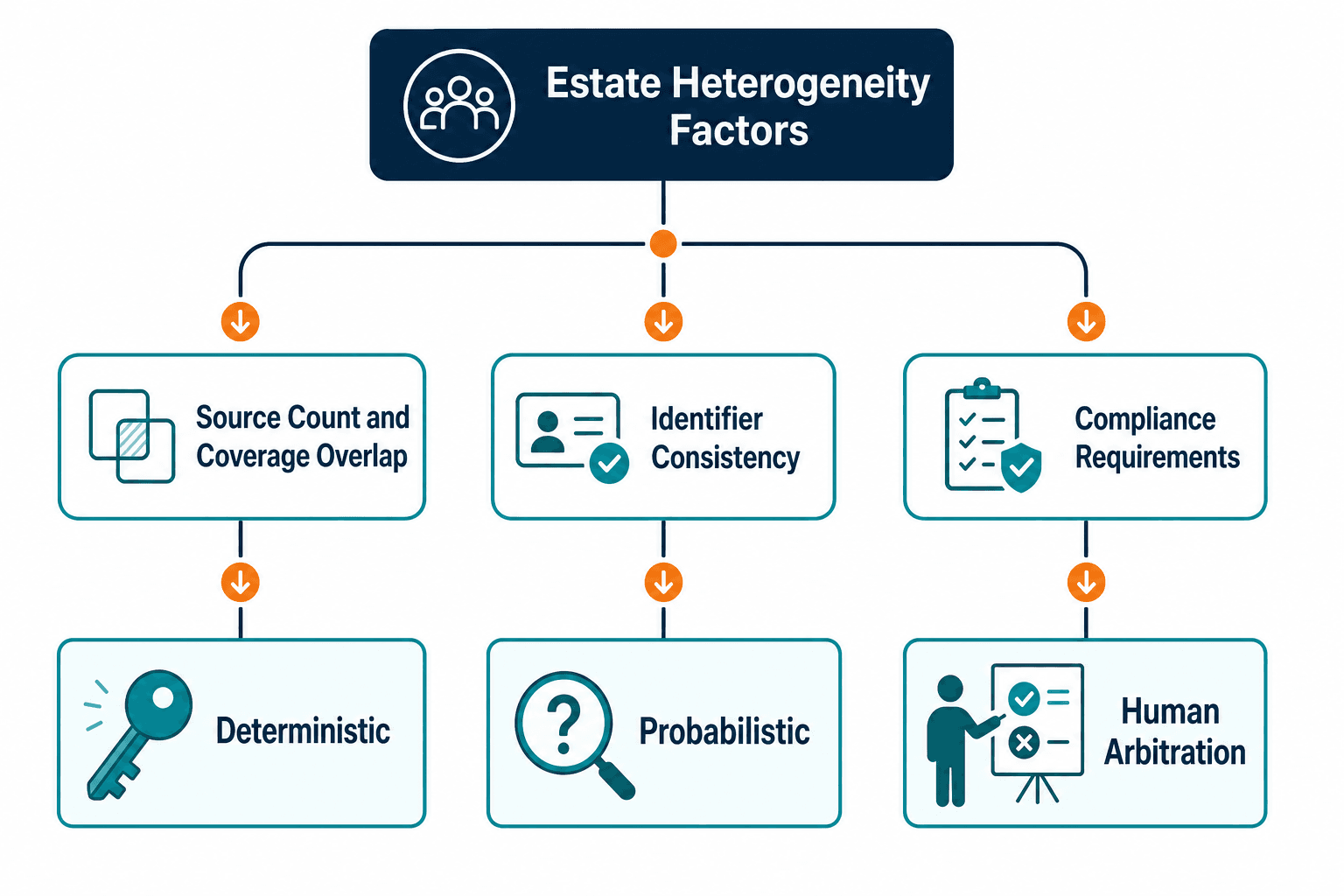
Most hybrid estates use all three in practice: deterministic matching where identifiers align, probabilistic matching where they partially align, and arbitration for the irreducible remainder. The proportion of each depends on how heterogeneous the sources are.
What is CI identity matching in multi-source CMDB reconciliation?
CI identity matching (configuration item identity matching) is the process of determining whether records from different discovery sources describe the same physical or virtual asset before attribute values are compared or merged. Without a reliable matching step, an authority-rule engine may reconcile records from two different machines into one CI, producing accurate-looking data that reflects the wrong asset. In hybrid IT estates, matching strategies range from deterministic key lookup to probabilistic confidence scoring to manual arbitration for assets with no shared identifier across sources.
Attribute-level authority rules: what good looks like once identity is resolved
With identity confirmed, authority rules govern which source’s values populate each CI attribute. The confirmed mechanism, covered in detail in Virima’s discovery and reconciliation automation post, is per-attribute source ownership. Three characteristics define a working version of it:
Per-attribute ownership
Operating system data traces to the agent. Cloud configuration traces to the cloud API. ITSM-managed fields, assigned user, cost center, lifecycle stage, trace to the service management platform. No single source owns all attributes.
Freshness as a signal, not a rule
A newer timestamp from a lower-priority source does not override an older timestamp from a higher-priority source. Recency informs confidence; it does not replace source assignment.
Conflict surfacing over silent resolution
When two sources assigned equal priority disagree on an attribute value, the conflict is logged and flagged for review. Reconciliation that silently resolves those conflicts conceals data quality problems rather than correcting them.
These three characteristics hold regardless of ITSM platform. The authority-rule layer is a configuration discipline, not a capability exclusive to any particular tool.
A decision framework: matching estate heterogeneity to an approach
Before configuring either layer, assess three dimensions of estate heterogeneity. Each drives a different approach decision.
Source count and coverage overlap
Environments with two or three discovery sources covering largely the same asset population can often rely on deterministic key matching paired with simple authority rules. Environments with five or more sources, each covering a different asset segment, typically require probabilistic matching for the segments where coverage overlaps but identifiers do not.
Identifier consistency
A cloud-native estate where every asset carries a cloud provider ID has a reliable deterministic key across API sources. A hybrid estate mixing team-named on-prem assets, vendor-assigned OT identifiers, and proprietary M&A numbering schemes has no single consistent identifier — probabilistic or hybrid matching applies instead.
Compliance and audit requirements
CISA Binding Operational Directive 23-01 and frameworks such as NIST SP 800-82 require defensible, documented asset inventory for covered asset types. Where audit-readiness is a driver, arbitration records and confidence scores need to be retained as evidence, not only the final merged CI record. See Before You Run AI Agents on ServiceNow, Answer These 5 Questions About Your CMDB for how to structure that evidence trail.
A practical starting point: identify the ten change-heavy CIs most likely to drift between discovery cycles. Run a manual comparison of their records across all active sources. The pattern of identifier alignment or misalignment in that sample reveals which matching approach the broader estate requires.
Mapping identity-matching gaps across your top change-heavy CIs is the fastest way to see whether the estate has a Layer 1 or Layer 2 problem. See how discovery-sourced Trusted Runtime Truth surfaces those gaps for configuration teams.
Where this breaks in practice: OT/IoT, shadow IT, and M&A-inherited tooling
Three estate conditions stress both layers in ways that standard CMDB guidance rarely addresses.
OT and IoT environments
Industrial control systems and IoT endpoints often carry minimal metadata, a vendor-assigned MAC, a firmware version string, and a network address. They frequently lack the hostnames, UUIDs, and cloud identifiers that deterministic matching relies on. Probabilistic matching on these assets requires a low confidence threshold, which raises false-merge rates. Human-in-the-loop arbitration for a large OT population is expensive at scale. The practical response is to scope OT/IoT assets into a separate reconciliation policy, manually maintained source assignments and a longer acceptable staleness window than enterprise IT assets carry.
Shadow IT
Unmanaged assets that appear in security or network scans but are absent from ITSM records create a specific identity problem: no existing CI record to match against. The first time a shadow asset appears in discovery, it generates a new CI. Subsequent scans may create duplicate records if the identifier changes, a new IP, a reassigned MAC. Shadow IT reconciliation requires a creation-gating policy: new CIs from unrecognized sources are held in a staging layer for review before they merge into the production CMDB.
M&A-inherited tooling
An acquired company’s asset management platform uses its own naming conventions, its own attribute schema, and its own source-priority logic. Merging those records into the acquiring company’s CMDB without a mapping layer first produces mass identity conflicts. The authority-rule layer cannot resolve these; the attribute names themselves may not correspond. An identifier normalization step, mapping the acquired tool’s identifiers to the enterprise standard before any reconciliation runs, is a prerequisite rather than an optional cleanup task.
Why is CI reconciliation harder for OT/IoT and M&A-inherited assets than for standard enterprise IT?
OT (operational technology) and IoT assets carry fewer consistent identifiers than enterprise IT equipment. Vendor-assigned MACs and firmware strings are often the only available metadata. That makes deterministic key matching unreliable and probabilistic matching prone to false merges at low confidence thresholds. M&A-inherited tooling compounds the problem: the acquired system’s attribute schema and naming conventions frequently do not correspond to the acquiring organization’s configuration data model, so an explicit identifier normalization pass has to run before any reconciliation logic can apply.
How Virima approaches both layers
Virima’s IT discovery capabilities span agent-based, agentless, and API-based methods across cloud, on-prem, and hybrid environments, with per-CI source tracking and freshness timestamps recorded at the attribute level. Each field in a CI record within Virima’s CMDB carries a traceable line back to its originating source and the time of last update.
At the authority-rule layer, Virima surfaces conflicts between sources rather than resolving them silently, consistent with the mechanism described above. Source lineage and freshness data are retained per attribute, supporting the audit-trail requirement that compliance frameworks such as CISA BOD 23-01 impose.
On the identity-matching layer, Virima’s confirmed capabilities center on source tracking and attribute-level reconciliation within the Virima CMDB. The specific identity-matching methodology for a given estate configuration, deterministic, probabilistic, or a combination, is best confirmed with Virima’s product team, particularly for environments where OT/IoT or M&A-inherited assets are in scope.
Start with the layer that is actually failing
Before adjusting reconciliation configuration, run the same diagnostic in any hybrid estate: determine whether CI counts are wrong (a Layer 1 failure, identity matching producing ghost records or false merges) or whether CI values are wrong (a Layer 2 failure, authority rules not holding against timestamp-based overwrites).
The two Virima posts linked in this piece cover each layer in depth. This framework is the starting point for deciding which layer to address first, and for building a reconciliation approach scaled to what the estate actually requires.
Frequently Asked Questions
What is multi-source CI reconciliation in a CMDB?
Multi-source CI (configuration item) reconciliation is the process of combining records from multiple discovery sources, agent-based scanners, agentless sweepers, cloud APIs, and ITSM platforms, into a single, consistent CMDB record per asset. It operates across two layers: identity matching, which determines that two records from different sources describe the same asset, and attribute-level authority rules, which determine which source’s values populate each field once identity is confirmed. Both layers must function correctly for the CMDB to reflect an accurate estate.
How do you match the same asset across different discovery sources?
Three approaches cover most hybrid estates. Deterministic key matching uses a shared identifier, a BIOS UUID, cloud instance ID, or normalized hostname, when sources consistently carry it. Probabilistic or fuzzy matching scores partial identifier overlaps to produce a confidence-weighted match decision when no single shared key exists. Human-in-the-loop arbitration handles assets where no reliable identifier is available, common in OT/ICS environments and M&A-inherited tooling. Most hybrid estates apply all three, with the proportion determined by how consistently sources agree on identifiers across asset types.
What is the difference between CI identification and CI reconciliation?
CI identification determines whether a record from a discovery source matches an existing CI in the configuration management database (CMDB) or represents a new asset requiring a new CI record. Reconciliation determines which source’s attribute values populate the merged CI once identification is complete. Identification is a prerequisite for reconciliation, authority rules cannot resolve attribute conflicts between records that have not yet been confirmed to describe the same asset. Errors in identification propagate through the reconciliation layer invisibly, because the engine treats the matched records as correct input.
What causes CMDB data conflicts across multiple discovery tools?
Conflicts arise from two sources. Identity conflicts occur when different tools generate separate records for the same asset because their identifiers do not align, a hostname from an agent, an instance ID from a cloud API, and a MAC address from a security scanner may all describe the same server without a common key to confirm it, producing duplicate CIs. Attribute conflicts occur when two sources that have correctly matched a CI disagree on a field value, patch status, assigned owner, or operating system version, because they run on different schedules or use different collection methods. Each type requires a different resolution approach.
How should teams handle CI reconciliation for OT, shadow IT, and M&A-inherited assets?
Each condition benefits from a separate reconciliation policy rather than uniform enterprise logic. OT and IoT assets should carry a longer acceptable staleness window and manually maintained source assignments, because their sparse metadata makes deterministic matching unreliable and probabilistic thresholds difficult to tune without false merges. Shadow IT assets should be held in a staging layer for identity review before merging into the production CMDB, to prevent duplicate CIs from accumulating across discovery cycles. M&A-inherited assets require an identifier normalization step, mapping the acquired tool’s naming scheme to the enterprise standard, before any reconciliation rules apply.
Does Virima support both identity matching and attribute-level reconciliation in its CMDB?
Virima’s CMDB records per-CI, per-attribute source lineage and freshness timestamps, and surfaces attribute conflicts between sources rather than resolving them silently. Its specific identity-matching methodology for a given estate, deterministic, probabilistic, or a hybrid, is configured with Virima’s product team based on estate heterogeneity, particularly for OT/IoT or M&A-inherited assets.