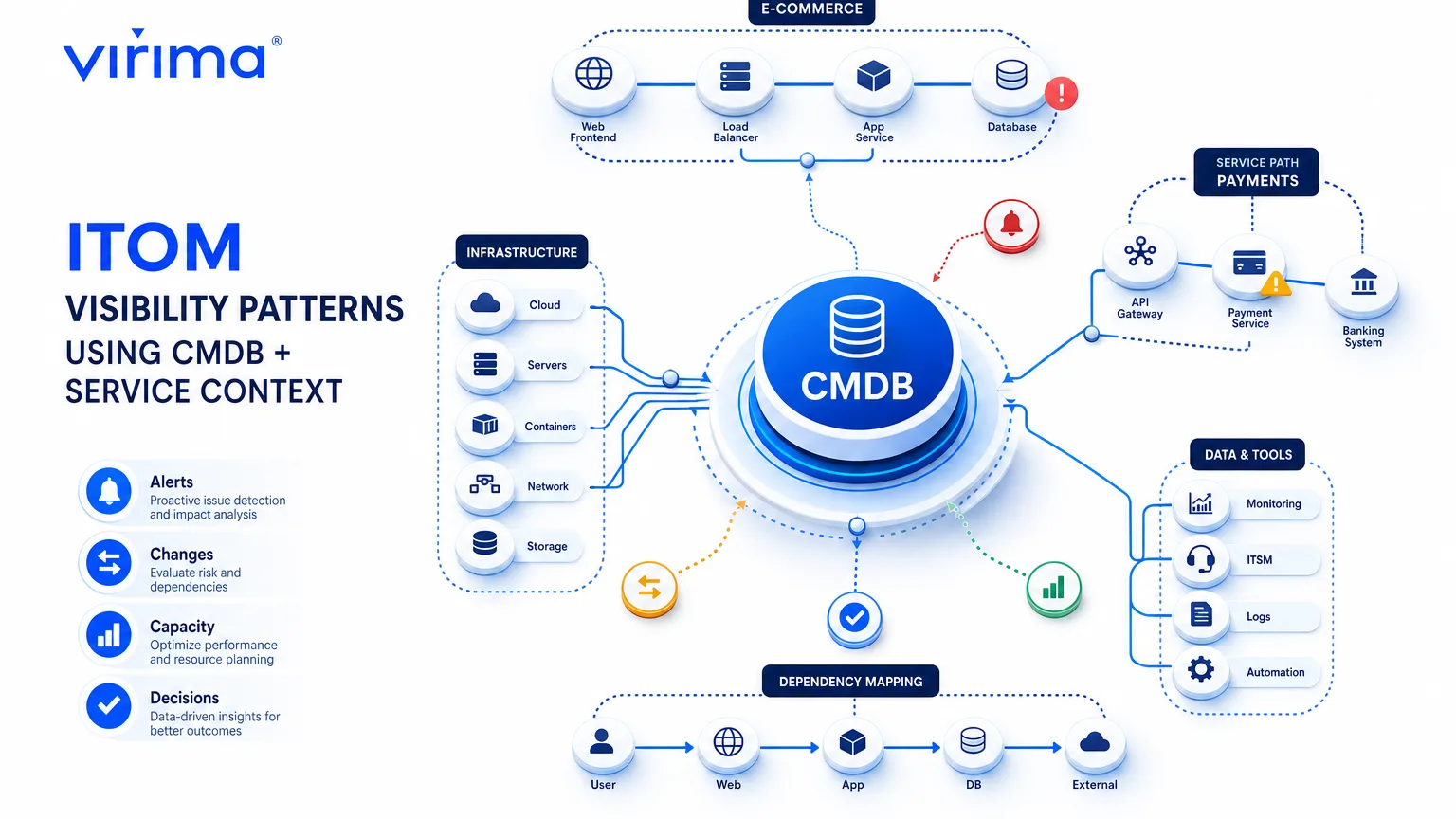
ITOM Visibility Patterns Using CMDB + Service Context | Virima

The NOC board is green until a change window opens. Then three tools disagree on which host owns the failing hop, and nobody can name the business service that will feel it first. That is where top ITOM visibility patterns that use CMDB + service context either earn their keep or collapse into chat threads. An ITOM visibility pattern is a repeatable workflow that joins live CMDB records to service dependency paths so alerts, changes, and capacity decisions act on the right CI and business service instead of a guess.
This is not another “what is ITOM” primer. ITOM already owns monitoring, event noise, capacity signals, and runbooks. The gap is reusable visibility patterns: named ways ops teams join configuration records to service paths so incident, change, and capacity work stop guessing. Each pattern below is something you can staff, measure, and repeat. Each one still fails when the CMDB or the service map lags the estate.
If you need the category frame first, start with Trusted Runtime Truth. For the broad ITOM versus ITSM split, see the live ITOM vs ITSM guide. This page stays on the six patterns.
How to read the pattern cards
Every pattern uses the same scorecard:
| Field | Meaning |
|---|---|
| Intent | The ops decision the pattern supports |
| Inputs | CMDB + service context minimums |
| Stay signal | You already run this well enough |
| Gap signal | The pattern is theater |
| Failure mode | What breaks when data is stale |
CISA Binding Operational Directive 23-01 pushes complete asset inventories for federal civilian agencies. Private ITOM stacks inherit the same pressure without the directive on the ticket: you cannot run a visibility pattern on hosts you cannot list.
Uptime Institute’s 2025 Annual Outage Analysis reports that nearly 40% of organizations saw a major outage tied to human error over three years. Most of those trace to process or procedure flaws, not a single root cause. Visibility patterns are procedures. Bad inventory makes a careful procedure still wrong.
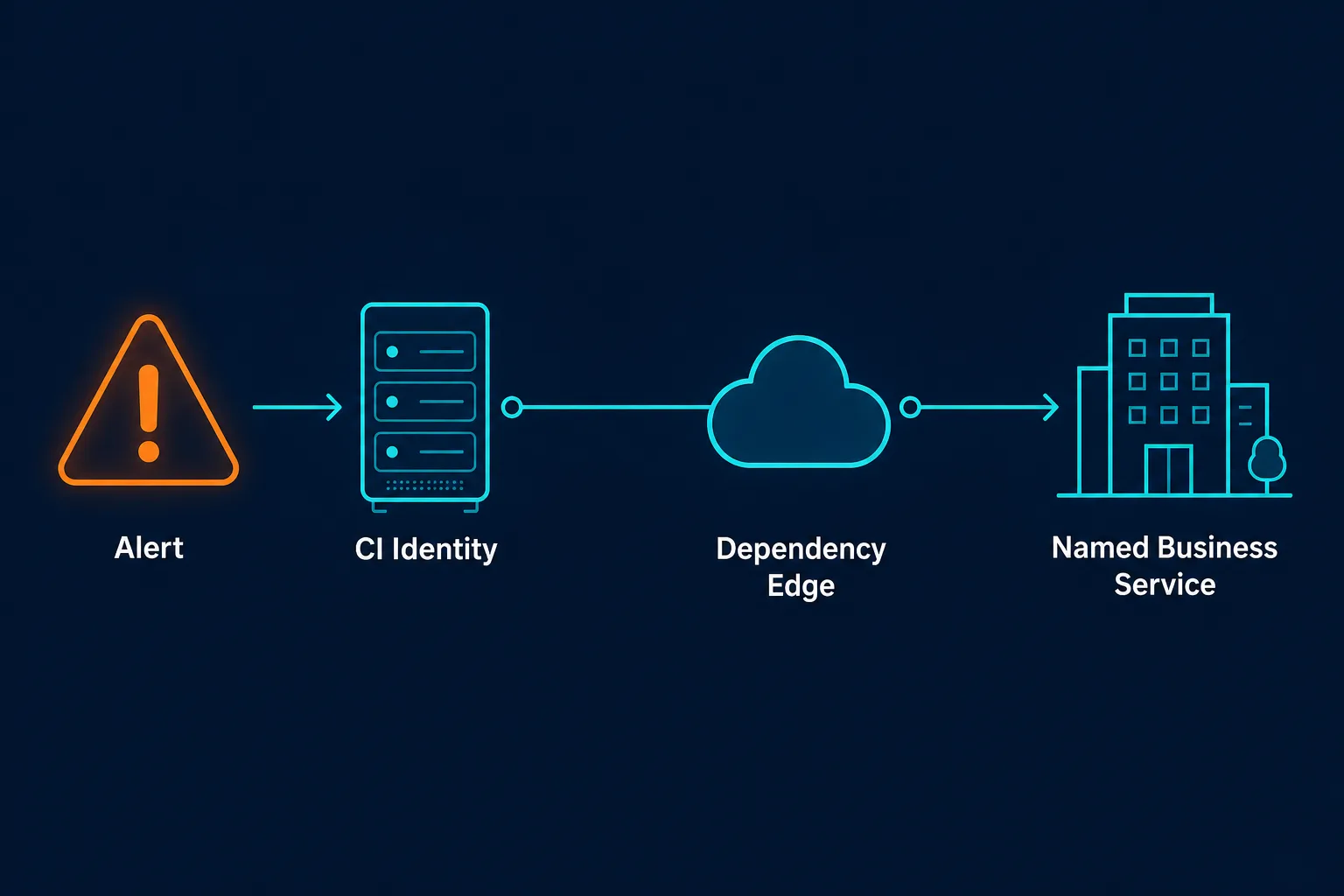
Pattern 1: Alert-to-CI join
Intent. Attach every actionable alert to a configuration item before the pager spiral starts.
Inputs. Stable CI identity, last-seen and environment tags, owner or support group, monitoring source ID that joins to the same CI key.
Stay signal. MTTA and MTTR clocks start on the right object more often than on a free-text host string.
Gap signal. On-call still renames the CI in the ticket after the bridge opens.
Failure mode. Green KPI boards, wrong clock start, duplicate bridges. Companion detail lives in correlate alerts to CI and business service and incident management KPI when the clock starts on the wrong CI.
Pattern 2: Alert-to-service path
Intent. Promote from CI to the named business or technical service the customer feels.
Inputs. Service definitions (manual, import, or ITSM), dependency edges from CI to service, criticality or tier labels the NOC already trusts.
Stay signal. First-response scripts name the service, not only the host.
Gap signal. Service field is free text or always “unknown.”
Failure mode. You fix a mid-tier box while the payment path stays dark. Service maps and observability traces answer different questions; see service maps vs observability traces when the team confuses APM hops with change-impact maps.
What is an ITOM visibility pattern that uses CMDB and service context?
It is a reusable ops workflow that joins live configuration records to service dependency paths so alerts, changes, and capacity work act on the right CI, owner, and business service. Monitoring alone is not the pattern. The pattern is the join, the decision table, and the freshness rule behind it.
Pattern 3: Change blast-radius packet
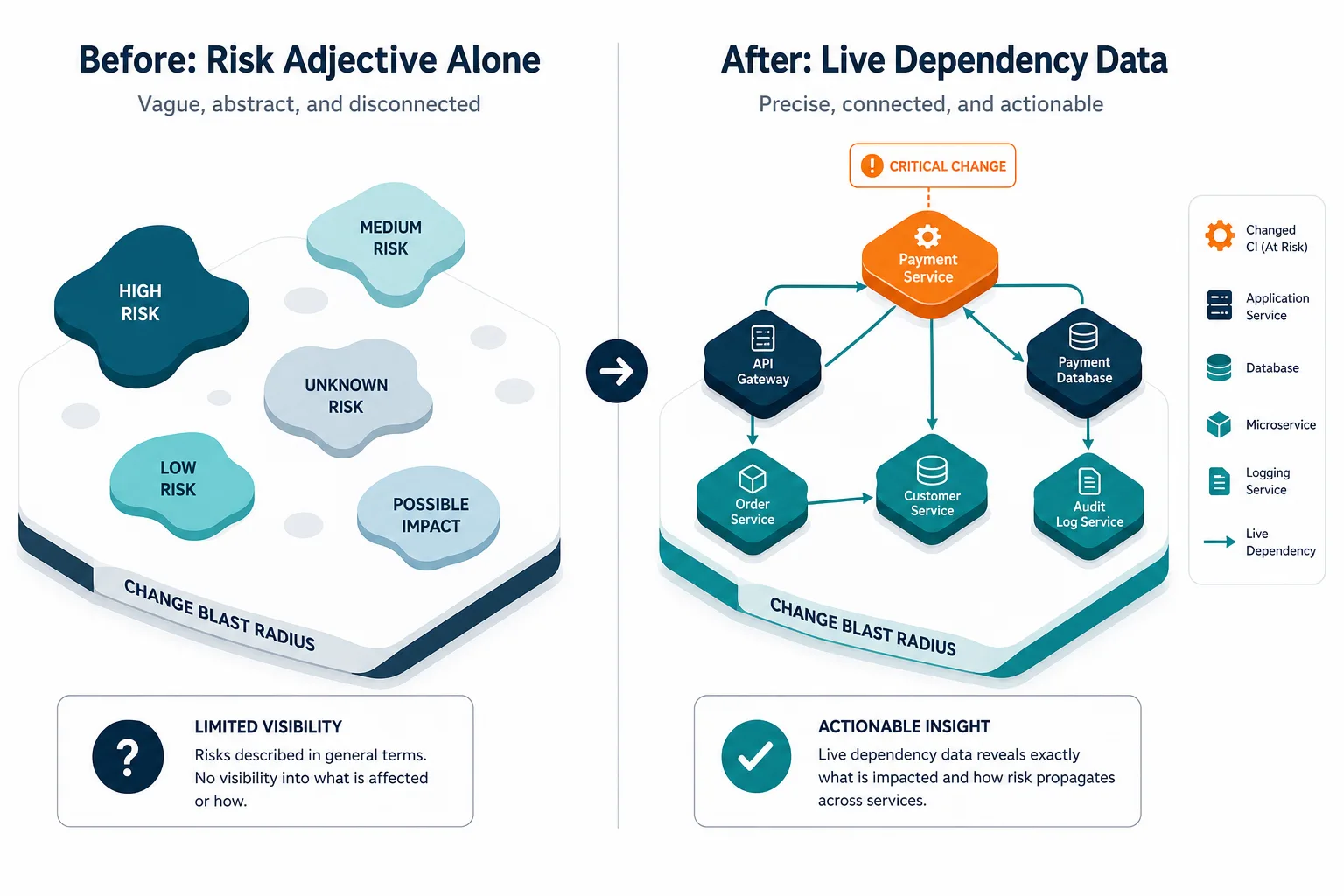
Intent. Score and authorize change with a written list of CIs and services that move if the change fails.
Inputs. CIs in scope, dependency map for cut candidates (upstream and downstream hop count from the changing CI), recent change history on the same objects, rollback path that matches topology.
Stay signal. CAB packets include a map or CI table — a risk adjective alone isn’t enough.
Gap signal. Standard change templates never re-check live deps.
Failure mode. Low-risk labels, high-blast outages. DORA’s research ties change failure rate directly to how well teams see dependencies before they approve, not after. ITOM practices for change risk assessment sit on this pattern; see ITOM practices for change risk assessment, what is blast radius in IT change management for the underlying definition, and ITIL 4’s guidance on change records for the process baseline a packet should meet.
Pattern 4: Post-change reconciliation
Intent. After the window, prove the estate matches the ticket before the next window opens.
Inputs. Pre/post discovery snapshots or high-frequency cycles, CI delta report, owner sign-off on unexpected nodes.
Stay signal. Drift tickets open automatically when the map moves without a change record.
Gap signal. Success is “change closed” with no inventory check.
Failure mode. CMDB quietly decays between cleanups — the same decay NIST’s configuration management baseline guidance warns against when baselines go unverified. Discovery authority is the feed; the pattern is the close-the-loop habit.
Pattern 5: Capacity and topology with owned services
Intent. Plan headroom and placement against services leadership recognizes, not against unnamed racks.
Inputs. Device and virtual inventory, relationship edges, service-to-infra join, utilization feeds that share CI keys.
Stay signal. Capacity reviews open on service risk, not only on CPU charts.
Gap signal. DCIM or cloud bills never meet the CMDB service list.
Failure mode. Capacity plans that skip inventory currency fund headroom for pools that no longer match the service they were sized for. Treating forecasting as a visibility problem, not a purchasing problem, is what keeps spend aligned to the service that leadership actually recognizes — otherwise you buy capacity for the wrong pool.
Pattern 6: Multi-tool correlation without a second CMDB
Intent. Let monitoring, ITSM, and automation share one identity layer instead of three host dictionaries.
Inputs. Single CI key strategy, hub integrations into the system of engagement, clear attribute authority per source.
Stay signal. A host rename in discovery shows up once, not three conflicting names in three consoles.
Gap signal. Each tool “discovers” and none reconciles.
Failure mode. Each tool maintaining its own host dictionary is how ITOM tool sprawl happens without a shared identity layer — and the Uptime Institute stat above is a process failure this pattern directly targets: mismatched identity across tools is exactly the kind of procedure gap that turns into a major outage. Mapping methods still matter under ITOM service mapping patterns like this one; the five approach frames live in top service mapping approaches for hybrid multi-tier apps.
Why do ITOM visibility patterns fail without a current CMDB?
Patterns assume stable CI identity, owners, and service edges. When discovery lags, alerts attach to stale names, change packets miss shared hops, and capacity plans fund the wrong pool. The workflow still runs. The decisions are wrong because the join keys are wrong.
ITOM visibility patterns scorecard (quick compare)
| Pattern | Primary consumer | CMDB load | Service-context load |
|---|---|---|---|
| Alert-to-CI join | NOC / on-call | Identity + owner | Low until escalate |
| Alert-to-service path | Incident command | Edges + criticality | High |
| Change blast-radius packet | CAB / change owners | Scope CIs + history | High |
| Post-change reconciliation | CMDB / discovery ops | Delta currency | Medium |
| Capacity + owned services | Capacity / infra leads | Inventory + relationships | High |
| Multi-tool correlation | Platform / ITOM architects | Key strategy + authority | Medium |
DORA research still treats change failure rate and recovery as elite signals. Those metrics move when blast-radius and alert-to-service patterns run on current data, not when dashboards only recolor.
Where the patterns break in hybrid estates
Hybrid paths (on-prem, VMware, AWS, Azure) multiply identity collisions. Agent-only views miss network gear. Cloud tags disagree with CMDB names. Service definitions lag container moves. A pattern card that works in one data center still fails if discovery never covers the hop the alert fires on.
ViVID™ service maps help after service definitions exist. They do not invent the business service list. High-frequency scheduled discovery keeps CI currency under all six patterns. Passive continuous real-time event discovery is not current Virima product behavior, so do not staff patterns that assume it.
If your ITOM stack still runs six tools and one stale host list, see how discovery-sourced CMDB and service maps feed the patterns without replacing your monitors overnight.
Where Virima fits under the patterns
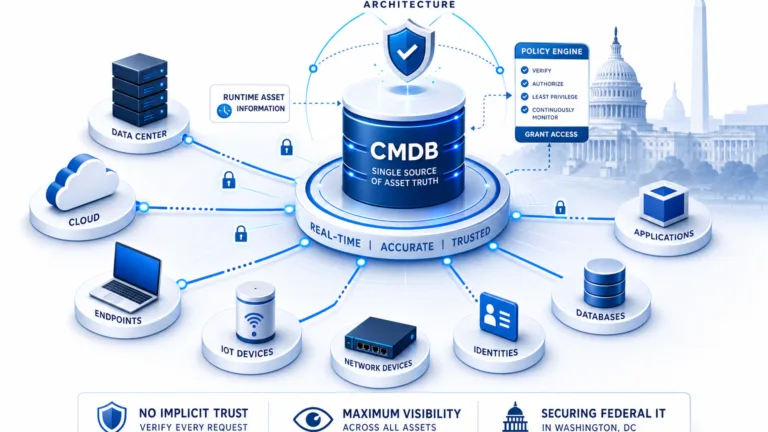
Virima is the discovery-sourced inventory, CMDB, and service-mapping layer under these ITOM visibility patterns. It does not replace your APM, SIEM, or ITSM workflow engine.
What Virima contributes
- Automated discovery so CI keys stay current across hybrid paths Virima covers
- CMDB identity and ownership under alert and change joins
- ViVID™ service maps after service definitions exist
- Windows Server NIST NVD overlays on maps where that signal applies, not multi-OS NVD lookup coverage
- Feed into ServiceNow, Jira, Ivanti, and many more through one hub: all integrations
What Virima does not claim
- Autonomic Social Discovery (ASD) as a go-forward capability
- Passive continuous real-time event discovery as current behavior
- Replacement of monitoring, paging, or full ITSM change products
- Instant business-service invention without a definition input
- GCP discovery parity with AWS and Azure where product scope is cloud-limited
For capability depth, see features/cmdb, features/service-mapping, and features/it-discovery.
How should teams adopt ITOM visibility patterns with CMDB and service maps?
Pick one pattern, name the CI and service inputs it needs, measure the stay and gap signals for thirty days, then add the next pattern. Do not launch all six on a project slide. Discovery currency and service definitions are prerequisites, not a later phase.
Adoption order that usually works
- Alert-to-CI join first if on-call pain is loudest.
- Post-change reconciliation next if CMDB trust is the political blocker.
- Change blast-radius packet when CAB still votes on adjectives.
- Alert-to-service path once service definitions exist for top services.
- Multi-tool correlation when three host dictionaries fight weekly.
- Capacity + owned services when finance asks which service burns the bill.
Staff the pattern, not a tool tour. Reuse the same CI key and freshness SLA across the set.
Close on patterns, not on a glossary
Top ITOM visibility patterns that use CMDB + service context are operational habits: alert-to-CI, alert-to-service, blast-radius packets, post-change reconciliation, capacity with owned services, and multi-tool correlation. Each pattern is reusable. Each one still needs discovery-sourced CMDB currency and service definitions under the monitors you already own.
When you want those patterns fed from production instead of last quarter’s export, schedule a demo and walk one pattern against a live service.
Frequently Asked Questions
Is ITOM visibility the same as monitoring coverage?
No. Monitoring shows symptoms. ITOM visibility patterns join those symptoms to CI identity, owners, and service paths so response and change work hit the right objects. Coverage without join keys still leaves bridges guessing.
Does Virima require a full CMDB migration before we can run these patterns?
No. You need authoritative inventory and stable keys for the services in scope, not a multi-year CMDB migration. Discovery currency on pattern one’s services still beats waiting on a full program to finish.
How do service maps differ from observability service maps?
Observability maps often show runtime call paths and latency. ITOM change and incident maps need CI ownership, install truth, and dependency edges that survive a change window. Teams need both lenses for different decisions.
Which pattern should we implement first?
Start with alert-to-CI join if on-call pain dominates, or post-change reconciliation if CMDB trust is the blocker. Add blast-radius packets before you scale CAB automation. Service-path patterns wait on service definitions.
How does Virima support ITOM visibility patterns?
Virima supplies discovery-sourced CMDB inventory and ViVID™ service maps after service definitions exist, so the six patterns can join alerts, changes, and capacity work to current CIs. It does not replace monitoring or ITSM workflow products.