How Virima’s change management tools can transform your change processes

Change management controls how IT changes move from proposal to production. Done well, it keeps services running and teams aligned. Done poorly, it causes outages, finger-pointing, and emergency rollbacks.
The challenge isn’t understanding why change management matters — most IT teams already know that. The real problem is having accurate, current data when you need to answer three questions: What depends on what? Who needs to know? What breaks if this goes wrong?
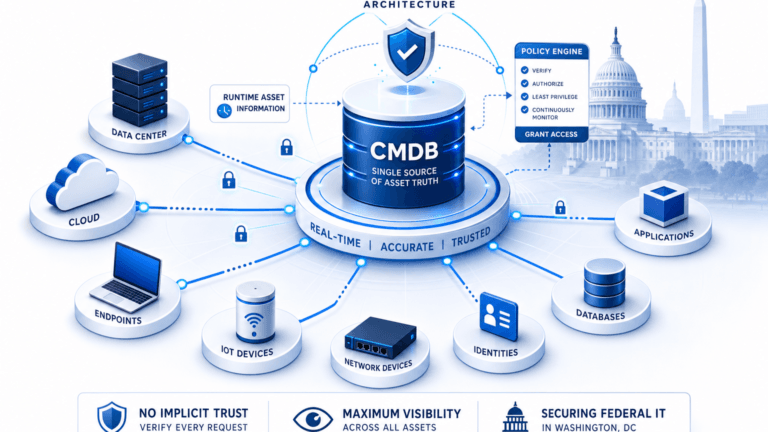
That’s where Virima’s CMDB and ViVID™ service maps come in. Together, they give change managers the dependency data and visual impact analysis they need to plan changes confidently, avoid surprises, and keep their change management process on track.
Why IT changes fail without accurate infrastructure data
Most failed changes share a root cause: incomplete information. The change advisory board (CAB) approves a server migration based on a CMDB that hasn’t been updated in three months. Nobody realizes that a critical application depends on that server. The migration goes ahead, the app breaks, and the incident response team spends hours tracing a dependency that should have been visible before the change was ever submitted.
This happens when CMDB data goes stale because teams rely on manual updates. It also happens when dependency maps don’t exist or only live in someone’s head. Virima solves both problems by feeding the CMDB with recurring scheduled discovery scans and by visualizing those dependencies through ViVID maps. Every stakeholder can then see the blast radius of a proposed change before it’s approved.
What are the biggest causes of failed IT changes?
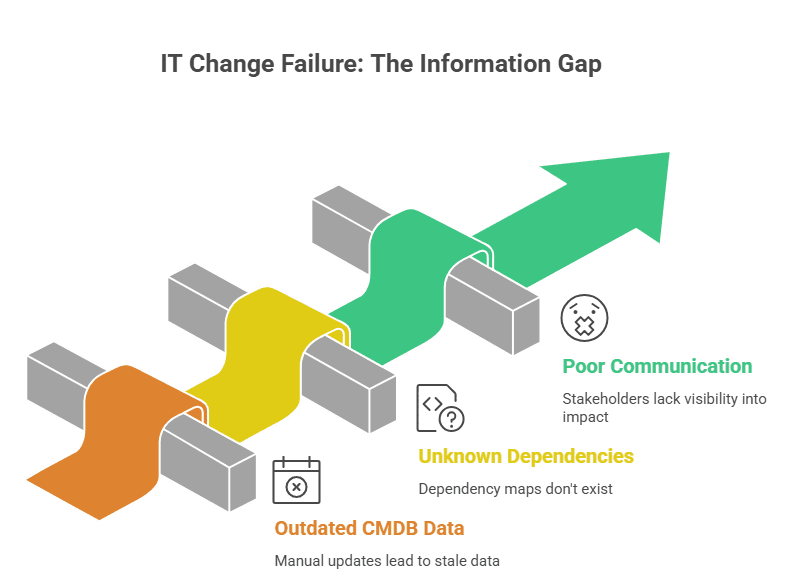
Failed IT changes usually come down to three gaps: outdated CMDB data, unknown dependencies, and poor stakeholder communication. When the CAB reviews a request, they’re only as effective as the data in front of them. If the CMDB hasn’t been refreshed since the last scan, the risk assessment is built on stale information. Missing dependency data means changes get approved without anyone understanding the downstream impact. That’s where outages start.
How Virima’s CMDB supports Virima’s change management tools
Virima’s CMDB is the data foundation that makes every other change management activity more reliable. Here’s how it works in practice.
Discovery-fed accuracy replaces manual updates
The biggest CMDB problem for change management is stale data. Virima’s IT discovery runs recurring scheduled scans across on-premises infrastructure, AWS, and Azure environments using agentless IP-based scanning with over a hundred extendable probes. Each scan updates CI attributes, relationships, and configuration states directly in the CMDB.
For change management, this means the data your CAB reviews is current. When someone proposes a change to a database server, the CMDB already shows which applications connect to it, which network segments it sits on, and when its configuration last changed. That’s the difference between a risk assessment based on facts and one built on assumptions.
This discovery-fed accuracy is core to Virima’s approach: every CI attribute in your CMDB comes from an authoritative discovery source, not a manual spreadsheet entry from three months ago. When the CMDB is continuously populated by automated discovery, the data your team relies on for change decisions reflects reality rather than a snapshot from last quarter.
Granular business rules simplify CMDB maintenance
Beyond discovery, Virima’s CMDB includes granular business rules that automate the promotion of CI updates and other CMDB maintenance tasks. These rules handle the tedious work that otherwise falls on your configuration management team, freeing them to focus on change planning and risk assessment instead of data hygiene.
Connecting ITAM and ITOM to change decisions
Virima’s CMDB ties IT Asset Management and IT Operations Management data into the change management workflow. Asset lifecycle data, including hardware configurations, software inventory, and contract details tracked in the CMDB, tells you whether a change target is approaching end-of-life or carries licensing constraints. Operations data, including alerts from event management tools like SolarWinds, Nagios, and LogicMonitor, shows whether a CI is already experiencing issues before a change is applied. Both sharpen the risk assessment that your CAB depends on.
| How do you assess risk before implementing IT changes? Risk assessment for IT changes depends on knowing what’s connected to the change target and understanding the current state of those connections. A CMDB provides the relationship map of every upstream and downstream dependency. ViVID makes that map visual so the CAB can see the blast radius at a glance. Together, they turn risk assessment from guesswork into a data-backed review where stakeholders, impacted services, and rollback paths are all visible before anyone signs off. |
How ViVID™ service maps strengthen Virima change management tools
Virima Visual Impact Display (ViVID™) is Virima’s visual layer on top of the CMDB. Built on Virima’s ML-powered discovery and service mapping engine, it turns raw CI data and dependency relationships into interactive service maps that change managers, operations teams, and leadership can all read and act on.
Studies show that organizations using visual service mapping can reduce mean time to resolution (MTTR) by up to 50%, making these insights especially valuable during change planning. Because the underlying relationships are machine-learned from actual network and application behavior, the maps reflect how your infrastructure actually works, not how someone documented it months ago.
Visual impact analysis for proposed changes
Through bi-directional integrations with ITSM platforms like ServiceNow, Jira Service Management, Ivanti, and HaloITSM, ViVID overlays planned changes and active incidents onto live service maps. When reviewing a planned change, ViVID shows which services sit downstream of the change target, which stakeholders should be engaged, and where other planned changes might collide. This is the core of proactive change management: seeing the impact before the change happens, not scrambling afterward.
For an operations manager reviewing a Friday night maintenance window, one glance at the ViVID map shows whether a database patch affects the customer-facing portal, whether the network team has its own change on the same switch, and which service desk team needs a heads-up.
Cross-team collaboration through shared visibility
ViVID breaks down communication silos between IT operations, cybersecurity, DevOps, and service desk teams. Instead of each team working from its own spreadsheet or monitoring dashboard, ViVID gives everyone the same dependency view. When a change is proposed, every affected team sees the same impact map. When an incident occurs during a change window, root cause analysis starts from the shared visual context. This speeds up both planning and resolution.
Faster incident response during change windows
Changes are one of the top triggers for incidents. When something breaks during or after a change, ViVID helps incident responders trace the impact chain immediately. ViVID’s business service maps and application dependency maps show the full picture from infrastructure and network dependencies to the applications and business services they support. These cuts mean time to recovery (MTTR) and accelerate the decision to roll back or fix forward.
Automated post-change validation closes the loop
Planning a change well is only half the job. You also need to confirm that the change did what it was supposed to do. Virima’s discovery scans run after changes are implemented to validate that configurations match the intended state. If something drifted, a setting reverted, a service didn’t restart, or an unintended configuration change slipped through the CMDB flags the discrepancy. This automated post-change validation replaces the manual spot-checks that most teams rely on and keeps the CMDB accurate as changes stack up over time.
Virima’s NVD-based vulnerability context for change prioritization
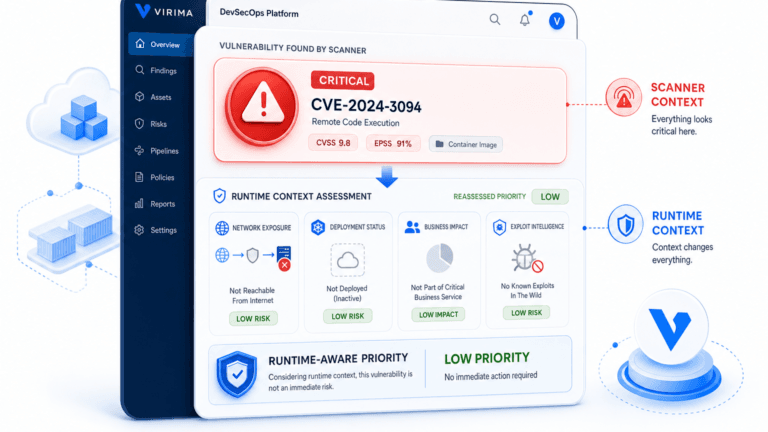
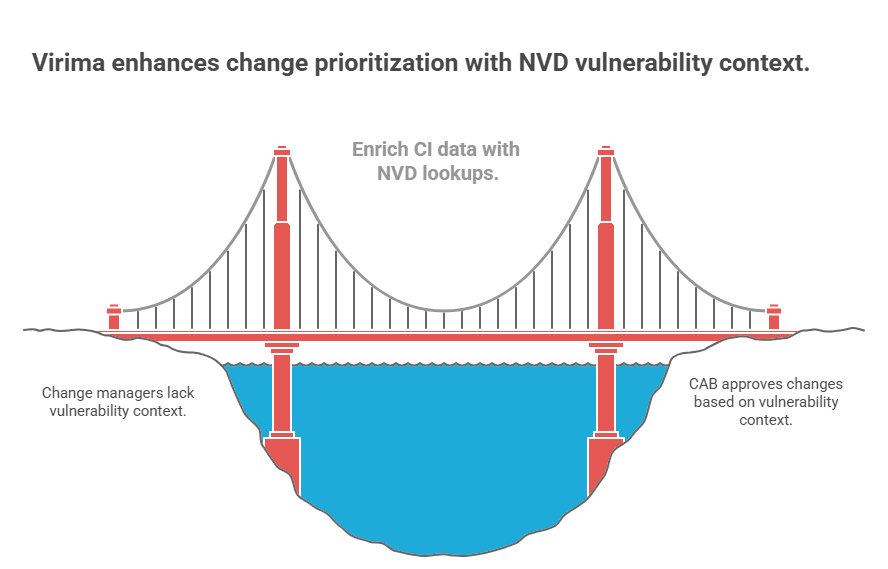
When planning changes, vulnerability context matters. Virima enriches CI data with NVD (National Vulnerability Database) lookups, flagging known vulnerabilities associated with discovered assets. This helps change managers prioritize which systems need patching first and understand whether a proposed change addresses or introduces known vulnerability exposure.
This isn’t vulnerability scanning — it’s enrichment. Virima matches discovered asset attributes against NVD records to surface relevant CVEs, adding deeper context to your management software and overall management solutions. That enriched data supports stronger risk assessment by highlighting potential impact and identifying high risks before any action is taken.
This context feeds directly into change prioritization and helps guide the approval process within your management process. It also strengthens impact analysis by using dependency maps to clearly show how changes may affect connected systems. As a result, the CAB can make a more informed decision with fewer uncertainties.
By improving visibility and aligning changes with business goals, this approach helps align with business priorities while also minimizing disruptions. It reduces risks during implementation and ensures smoother transitions, with better tracking through post-implementation reviews and audit trail visibility.
Accurate data and visual impact analysis drive confident change management
Change management works when the people approving changes can trust the data in front of them. Virima’s CMDB delivers that trust through a continuously validated configuration baseline; every CI reflects its actual state, not a stale manual entry. ViVID turns that data into a visual impact analysis that any stakeholder can read, from the configuration manager checking dependencies to the VP approving a major migration.
Together, Virima change management tools transform a process built on tribal knowledge into one built on current data, visible dependencies, and proactive risk assessment. If your CAB is still making decisions based on spreadsheets and memory, it’s time to give them better tools.
Schedule a demo to see how Virima’s CMDB and ViVID maps work for your change management process.
FAQ
How does a CMDB improve change management?
A CMDB improves change management by giving teams a single, accurate source of truth for every IT asset, its configuration, and its relationships. In fact, up to 80% of service outages are caused by poorly managed changes, which highlights why having reliable, real-time data is critical. When a change is proposed, the CMDB answers the questions that matter: Which CIs are affected? What depends on them? Who owns those services? Without this data, the CAB runs on tribal knowledge, and changes carry hidden risk. A discovery-fed CMDB like Virima’s ensures those answers reflect current scan data, not records that aged out weeks ago.
How does service mapping reduce change-related outages?
Service mapping reduces change-related outages by making hidden dependencies visible before a change is executed. Most change-related outages happen because a dependency wasn’t documented — an application depends on a middleware layer nobody knew about, or a load balancer routes to a server about to be decommissioned. Virima Discovery identifies these dependencies from scan data, and ViVID service maps visualize them in context, so the CAB sees the full picture rather than a partial one.
How do you prevent change collisions in IT?
Change collisions happen when two or more changes target overlapping infrastructure in the same window. Without visibility, teams schedule conflicting maintenance — an OS patch at the same time as a network switch upgrade affecting the same segment. ViVID’s overlay of planned changes maps every scheduled change against the live service topology, flagging where two windows overlap on shared dependencies. This lets the CAB reschedule or sequence changes before they conflict.