Change risk assessment in IT: How to know your blast radius before you approve

Over 80% of IT-related outages stem from planned changes, not cyberattacks, not hardware failures, but changes that someone on your team reviewed, discussed, and approved. That number means your change approval process is failing at its core job. The reason is almost always the same: changes are approved without a clear picture of their blast radius.
Virima delivers CMDB-grounded change risk assessment and IT change impact analysis built on live, discovery-sourced CI relationships. Before every change window, Change Advisory Board members see exactly which services, applications, and infrastructure components a proposed change will affect. This article explains how that works and directly answers the questions teams most commonly ask when evaluating Virima for change management.
Why IT Change Management Fails: The Visibility Gap Before Approval
Most IT change failures are not caused by poor execution. They are caused by incomplete information at the moment of approval. When a Change Advisory Board approves a change, the blast radius, the full set of services, applications, and infrastructure components affected, should be visible, understood, and evaluated. In most environments, it is not.
The root cause traces back to a single problem: CMDB relationships that do not reflect the actual state of infrastructure at the time of the change. CIs drift between IT discovery cycles. Relationships that were accurate six weeks ago no longer reflect the infrastructure as it exists today. When the CAB approves a change against an outdated relationship map, the blast radius they signed off on is not the blast radius that will materialize.
This is the visibility gap. Closing it requires discovery-sourced CI relationship data, current relationships, current service dependencies, current ownership tags, available before the change window opens.
Change Risk Assessment vs. IT Change Impact Analysis: Know the Difference
These two terms are often used interchangeably, but they answer different questions, and you need both for a sound approval decision.
- Change risk assessment asks: how likely is this change to fail, and how bad would that be? It evaluates probability and severity. A risk assessment might flag a database schema migration as high-risk because it cannot be partially rolled back and the team has limited experience with the specific version involved.
- IT change impact analysis asks: what else does this change touch? It maps the affected configuration items (CIs), services, users, and processes. Impact analysis is where blast radius lives. A change might carry low implementation risk but a wide blast radius: a simple configuration flag on a shared authentication service, for example, could ripple across hundreds of downstream applications.
A change with low risk and a wide blast radius still needs careful scheduling, stakeholder communication, and a tested rollback path. A change with high risk and a narrow blast radius might move quickly with the right safeguards in place. Conflating the two leads to over-approving dangerous changes or under-communicating safe ones.
What Blast Radius Means and Why It Starts with CI Relationship Accuracy
Blast radius is the full set of downstream configuration items, applications, services, and infrastructure components that a proposed change will affect. If you change the database server that three applications depend on, the blast radius includes everything that depends on those applications, all the way up to the named business services they support.
Calculating blast radius requires two things: an accurate map of CI relationships, and the ability to trace those relationships across every tier of the infrastructure stack. Asset inventory alone, a list of devices and software, is not sufficient. You need to know not just what exists, but how it connects, what depends on what, and which business services are exposed if a given CI changes.
This is where organizations relying on ITSM-native discovery often find gaps. ITSM platforms are built to govern workflows. Their native discovery captures CI inventory, but maintaining accurate multi-tier CI relationships typically requires additional tooling, specialist CMDB administration, or manual input. When those relationship maps fall out of sync with actual infrastructure, blast radius calculations fail at exactly the moment they are most needed. A CMDB without discovery is just a database of stale records. For a broader view of why CMDB relationship data degrades in ServiceNow environments specifically, the breakdown of structural gaps behind ServiceNow CMDB inaccuracy maps directly to the visibility problem described here.
How Virima Delivers Change Risk Assessment Before Every Change Window
Virima’s approach to change risk assessment and CMDB change impact analysis runs through four interconnected layers, each dependent on the accuracy of the layer before it.
Discovery-sourced CI relationships
Virima scans the full hybrid estate, on-premises, cloud, virtual machines, and network infrastructure, using agent-based, agentless credential-based, and API-based methods. Each discovery run surfaces configuration attributes and CI relationships, with every attribute traced to the discovery source that provided it. Multi-source reconciliation merges CI records from different probes into a single authoritative record, resolving conflicts at the attribute level rather than defaulting to last-write-wins. Organizations that have not yet deployed CMDB with automated discovery as their primary data source are operating every change window against an accuracy gap.
CMDB Change Impact Analysis
Before a change is approved, Virima’s Change Impact Analysis shows exactly which configuration items are downstream of the proposed change target. This analysis runs against the current state of the discovery-sourced CMDB from the most recent discovery cycle, not a cached snapshot. Change managers and CAB members see which CIs will be affected before the change window opens.
ViVID™ blast radius visualization
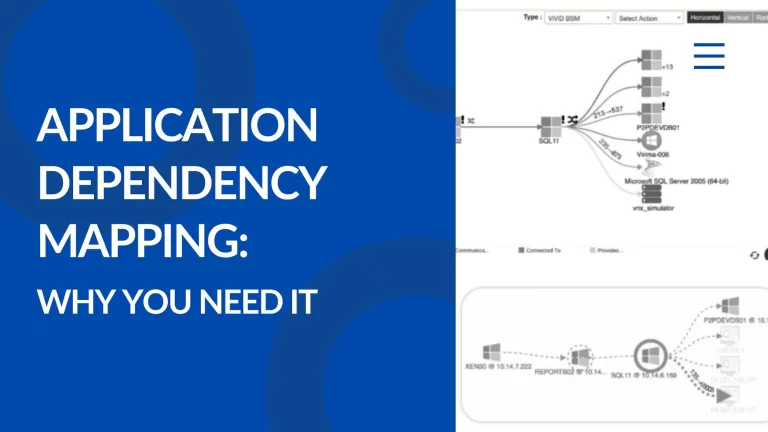
Virima’s service mapping layer renders affected service dependencies as a visual map. CAB members review this map before approving any change, seeing which services, applications, and infrastructure components fall within the blast radius, which open incidents are active against those services, and which other planned changes intersect the same service paths.
Change Risk Assessment signals
Virima surfaces risk signals associated with a proposed change: active incidents on dependent CIs, assets approaching end-of-support within the blast radius, recent configuration changes against related infrastructure, and ownership data that identifies the right teams to engage before the change is approved.
What Your Change Advisory Board Actually Sees
When a change request is raised against a production application server, the CAB member reviewing that request opens the ViVID™ service dependency map for the affected service. That map reflects the current infrastructure state from the most recent discovery cycle.
The map shows all CIs connected to that server: the applications it hosts, the services those applications support, the databases those services connect to, and the downstream business services that depend on the full chain. Open incidents are overlaid directly on the affected nodes. Planned changes for the same service path are flagged, so the CAB can see whether multiple simultaneous changes are creating compounding blast radius risk.
Change managers reviewing this view can reject a change based on active risk signals, an open severity-1 incident on a dependent service, a recently failed change against a related CI, or a compliance flag tied to an asset within the blast radius, before a single maintenance window is scheduled.
When Virima is integrated with ServiceNow or Jira Service Management, blast radius context flows directly into the change ticket. CAB members do not need to leave their ITSM platform to access ViVID™ maps: a link to the full service map is available from within any CI record, so change risk context lives inside the existing change workflow.
Does Virima Handle Change Alerts?
This is one of the questions teams ask most often when evaluating Virima’s change management capabilities. The direct answer is yes, through several distinct mechanisms.
- Before a change: ViVID™ blast radius maps, Change Impact Analysis, and change risk assessment signals give the CAB full context to evaluate risk before approval. This is proactive change risk intelligence: surfacing what will be affected before the change window opens, rather than alerting after something breaks.
- During and after a change: Alert and Incident Correlation links any alerts that fire to the affected CIs and services within the change blast radius. Operations teams see immediately whether an alert is change-related, which services are exposed, and which owner should be engaged first.
- Through ITSM integration: When integrated with ServiceNow, Jira, HaloITSM, or Ivanti, change impact context surfaces directly within the change ticket. Updates made inside the ITSM platform, ownership changes, change state transitions, enrichment notes, sync back into Virima, keeping both systems aligned through the full change lifecycle.
After the Change: Incident-to-CI Correlation for Faster Resolution
When a change produces unexpected results, Virima’s Alert and Incident Correlation layer links alerts to the CIs and services they affect. Instead of triaging a flood of undifferentiated alerts, the operations team sees which services are impacted, which CIs are involved, and what changes were recently completed against the affected service path.
This post-change context directly reduces mean time to resolution. The team knows whether an alert is related to the recent change, which service is exposed, which owner is responsible, and how far up the dependency chain the impact is spreading, all without leaving the ITSM tool or manually correlating alerts to a service map.
ITIL Framing: Which Change Types Need Blast Radius Analysis Most
Under ITIL 4, changes are classified as standard, normal, or emergency. Each has a different relationship to change risk assessment and blast radius analysis.
- Normal changes carry the highest blast radius risk and the highest requirement for full impact analysis. These are the changes that go through full CAB review. The blast radius should be documented and visible before any approval decision is made. Any normal change involving shared infrastructure, multi-tier service paths, or customer-facing services should be held until the blast radius map reflects the current discovery state.
- Emergency changes compress the timeline but do not eliminate the need for blast radius visibility. Teams are more likely to accept risk during emergency changes, which makes current dependency data even more important, not less. Virima’s Change Impact Analysis can be run within the same workflow as the emergency change record, giving even abbreviated CABs a clear impact view before execution begins.
- Standard changes are pre-approved and low-risk by definition. But that classification should be grounded in a verified blast radius. If a standard change template was approved based on a dependency map that has since changed, the pre-approval assumption is invalid. Virima’s discovery-sourced CMDB ensures standard change templates reflect the current infrastructure state, not a snapshot from when the template was first created. Following CMDB best practices around recurring discovery and governance is what keeps standard change templates trustworthy over time.
Change Risk Assessment and the Agentic IT Transition
As AI agents take on automated runbook execution, low-risk change approval, and incident triage, the accuracy of CMDB relationship data becomes a safety control, not just an operational convenience. An AI agent that approves a change against a stale blast radius will execute the change correctly and may trigger a cascading failure that no human predicted and no automated guardrail caught.
Trusted Runtime Truth, live, discovery-sourced, governed CI relationships, is the data layer that makes agentic IT operations safe. Virima provides that layer: current relationship data, blast radius visibility before every change, and ownership-tagged CIs so automated actions route to the right team. The combination of accurate change risk assessment and ViVID™ service maps gives both human change managers and AI agents the same grounding: a clear view of what will break if this change goes forward as planned. The CMDB requirements for safe AI agent operations cover all four pillars, source attribution, policy, ownership, and freshness, that determine whether a CMDB is ready to support agentic change decisions.
The EMA ServiceOps report documents the growing gap between change approval confidence and actual CMDB accuracy in enterprise environments: read the full findings.
Start Approving Changes with the Full Picture in Front of You
IT change management fails when blast radius is invisible. It succeeds when teams have current, accurate, discovery-sourced CI relationship data and the visualization layer to interpret it before every change window opens.
Virima delivers that visibility: change risk assessment grounded in live CI relationships, ViVID™ blast radius maps that every CAB member can read, risk signals that surface active exposure before approval, and post-change alert correlation that accelerates remediation when it is needed. For teams evaluating CMDB platforms to support this capability, the best CMDB software comparison for 2026 includes agentic IT readiness scoring across all major platforms.
Keith Lee, VP Disaster Recovery and IT Risk at The Bancorp, described the outcome directly: “Virima’s integration with ServiceNow has allowed us to enhance and fully integrate our CMDB into all of our ITIL processes. The seamless integration gives us the ability to leverage the best of both Virima and ServiceNow.”
See how Virima surfaces blast radius before your next change window. Schedule a demo today!
FAQs
What is the difference between blast radius and impact analysis in IT change management?
Blast radius is a specific output of IT change impact analysis. Impact analysis is the process: tracing which CIs, services, and systems a proposed change will affect. Blast radius is the result: the total footprint of potential impact, expressed as the set of downstream systems that could fail or degrade if the change behaves unexpectedly. A complete impact analysis produces the blast radius. Blast radius without documented impact analysis is guesswork.
How often should dependency data be refreshed for change risk assessment?
Dependency data needs to reflect the current state of infrastructure at the time the change is being assessed, not six weeks prior. The right frequency depends on how quickly your environment changes. For dynamic hybrid environments, this typically means running discovery often enough that no significant infrastructure change, new deployments, decommissions, network reconfigurations, goes unrecorded between cycles. Virima’s discovery-sourced CMDB ensures that the CI relationships used for blast radius analysis reflect the most recent discovery cycle, not a stale snapshot.
Can change risk assessment work without a CMDB?
In practice, no. You can perform a rudimentary risk assessment without a CMDB, experienced engineers can sometimes reconstruct key dependencies from memory or documentation, but this approach does not scale and fails when the change involves infrastructure components outside the engineer’s direct knowledge. A governed CMDB with accurate CI relationships is the only reliable foundation for repeatable, auditable change risk assessment. Without it, blast radius is always an estimate, and estimates are what make post-mortems inevitable. The determination of CMDB accuracy framework explains how to measure whether your CMDB data is trustworthy enough to support change decisions.
What role does service mapping play in blast radius analysis?
Service mapping translates CI relationships into business service terms. Without service mapping, you know which infrastructure components are downstream of a change, but you may not know which business services those components support. With service mapping, the blast radius map shows not just “these 14 servers and 3 databases” but “these 14 servers and 3 databases support the Claims Processing service and the Customer Portal, both of which carry P1 SLA commitments.” That business context is what enables the CAB to make a genuine risk decision rather than just approving a technical change record.
How do you handle blast radius for changes that span multiple environments?
Changes that touch both on-premises and cloud infrastructure, or span multiple network segments, are where blast radius analysis most commonly fails in organizations with partial or siloed discovery. The solution is a unified CI relationship model that covers the full hybrid estate, not separate CMDBs for on-premises and cloud that have to be manually cross-referenced. Virima’s agent-based, agentless, and API-based discovery spans the full hybrid estate and feeds a single reconciled CMDB, so blast radius analysis for cross-environment changes runs against a unified relationship map, not a patchwork of partial ones.