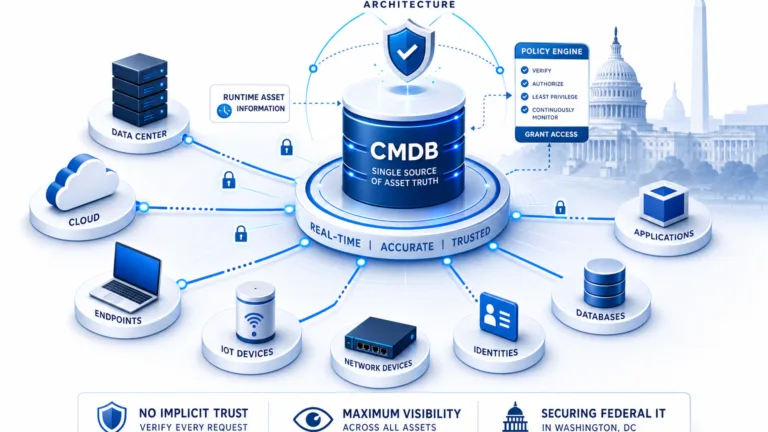
Why do Common Service Data Models (CSDM) matter for CMDB success?

A Configuration Management Database (CMDB) often fails because teams categorize servers, databases, and applications using inconsistent custom tables. The Common Service Data Model (CSDM) resolves this by prescribing standard definitions and relationships across the entire service lifecycle. Aligning to CSDM allows IT teams to trace operational incidents directly to affected business capabilities.
What is a Common Service Data Model?
The Common Service Data Model is a helpful framework for setting up a well-structured CMDB. It standardizes terms as well as definitions, further, guiding businesses in data modeling and management best practices. CSDM also includes out-of-the-box CMDB core tables. It offers clear guidance on service modeling, including recommended mappings.
The Common Service Data Model (CSDM) is not a standalone product or SKU offered by ServiceNow configuration management. Rather, it does not function as an implementation guide, a suite of reports, or any software code for installation. Instead, it’s a valuable framework to support CMDB structure and consistency.
CMDB vs. CSDM: Key Differences
Confusing the database with the data model is a common reason configuration projects lose organizational trust. The table below outlines how they interact:
| Dimension | Configuration Management Database (CMDB) | Common Service Data Model (CSDM) |
|---|---|---|
| Primary Role | The operational system of record storing CI data. | The governance framework prescribing table structure. |
| What It Contains | Servers, databases, software instances, IP addresses, relationships. | Taxonomies, domain boundaries, lifecycle stages, service definitions. |
| Installation Method | Software application or platform repository. | Conceptual model built into base platform table schemas. |
| Operational Outcome | Provides asset and dependency visibility. | Enables shared reporting, service mapping, and cross-team context. |
Phases of CSDM implementation
Implementing the Common Service Data Model in the ServiceNow platform involves several phases. Organizations should avoid implementing the entire model simultaneously. Adopting a staged crawl-walk-run-fly approach allows teams to stabilize foundational records before linking complex business capabilities:
| Phase | Primary Focus Area | Minimum Data Required | Operational Value |
|---|---|---|---|
| Foundation | Core organizational reference data | Users, groups, business units, physical locations, contracts | Clean ownership assignment and governance baselines |
| Crawl | Basic application mapping and ITSM tables | Business applications, application services, essential servers | Incident and change tickets linked to specific application services |
| Walk | Technical service infrastructure support | Technical services, hosting, network infrastructure, databases | Root cause identification during IT outages and change impact modeling |
| Run | Business service portfolios and consumption | Business services, customer-facing offerings, SLA commitments | Transparent service cost reporting and customer impact tracking |
| Fly | Strategic enterprise alignment | Business capabilities, information objects, digital product lines | Investment decisions aligned with actual technical runtime dependencies |
Here are the details for each implementation stage:
- Foundation phase
This phase builds a reliable data structure in the CMDB by defining terms and categorizing data. Then, it creates a base for reporting and data management. - Crawl phase
Here, essential data structures are set up for incident, change, and problem management. Altogether, it enables efficient IT issue tracking. - Walk phase
Organizations focus on managing and supporting infrastructure, strengthening operational efficiency as well as reliability. - Run phase
This phase integrates business processes into the CMDB and CSDM, connecting technology with business functions for further deeper insights. - Fly phase
IT and business services achieve full alignment, thus, completing CSDM elements to enhance quality and reduce costs.
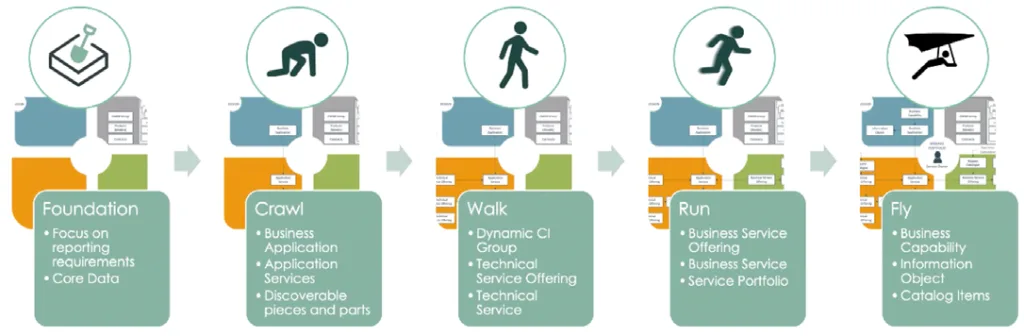
Regardless of where you are in the CSDM process, there are strategic and impactful next steps to follow.
Why follow the CSDM?
Following the Common Services Data Model helps you get the most out of ServiceNow products. By using it, you’ll enjoy:
- Better utilization of ServiceNow’s full capabilities.
- Streamlined and efficient upgrade processes.
- Improved compatibility with shared definitions across ServiceNow’s product portfolio.
Using CSDM also leads to transparent reporting, better service level costing, and lower maintenance overhead.
Core Service Classifications Defined in CSDM
One of the primary advantages of CSDM is establishing precise boundaries between operational infrastructure and customer-facing services. The framework organizes services into distinct tiers:
| Service Class | Primary Audience | Practical Example | Role in Incident Management |
|---|---|---|---|
| Business Service | Business users and external customers | Employee Payroll Processing, Online Storefront | Communicates business downtime and SLA impacts. |
| Technical Service | Internal IT engineering and operations | Enterprise DNS, Database Hosting, SAN Storage | Identifies which support tier handles component failures. |
| Application Service | Application owners and DevOps teams | SAP Production US-East, Workday Dev Instance | Pinpoints exact deployed stacks experiencing degradations. |
| Service Offering | End users and procurement teams | Tier-1 Critical Hosting (24/7), Standard Email | Determines response urgency and contract commitments. |
What are the benefits of the Common Services Data Model?
The Common Services Data Model offers several key benefits, particularly in improving IT service management. Here are the main advantages:
- Better data organization and mapping
CSDM offers a structured framework for mapping IT services in ServiceNow, improving data organization in the CMDB. By aligning data with CMDB tables, it also reduces duplicate or outdated entries, increasing data quality and reliability.
- Standardized data management
Further, CSDM creates a standard across ServiceNow products using CMDB functionalities. This consistency also minimizes data inconsistencies and integrity issues, thus, leading to more reliable and efficient operations.
- Optimized CMDB and CSDM
With CSDM, organizations simplify the CMDB, connecting business elements like the applications services directly to core tables. This further reduces the need for custom tables, hence ensuring easier maintenance and upgrade compatibility.
- Unified data model for better connections
CSDM’s unified model connects business capability and service data, creating a central source of truth. Moreover, service teams gain a holistic view, improving decision-making and speeding up issue resolution.
- Enhanced service quality and cost reduction
CSDM framework boosts service quality and transparency. As a result, it strengthens IT-business partnerships and identifies cost-saving opportunities that enhance ROI.
- More innovation and agility
Adopting CSDM’s best practices fosters enterprise-wide improvements. Altogether, it enables quick decision-making, operational agility, and sustainable innovation.
Challenges in maintaining a successful CMDB and CSDM
Maintaining a strong CMDB is crucial for a successful CSDM implementation, but it can be difficult at times. Many businesses face common problems that reduce their effectiveness.
1. Typical CSDM and CMDB challenges
- Lack of reliable or complete data
CSDM depends on accurate, consistent data for mapping services and assets. If the data is incomplete or inaccurate, it undermines the value of CSDM. Consequently, it makes it harder to create reliable service maps and dependency relationships.
- High reliance on manual updates
Manual updates can lead to errors and delays, resulting in outdated data within the CMDB. Further, CSDM requires up-to-date information to function optimally, and manual processes hinder its effectiveness by introducing inconsistencies.
- Not enough resources for CMDB maintenance
CSDM needs continuous upkeep to ensure its accuracy. Without dedicated resources to maintain the CMDB, it becomes outdated, weakening the value of CSDM.
- Lack of updates
Once data is entered into the CMDB, some businesses stop updating it regularly. The freshness of its data directly ties to CSDM’s effectiveness. A lack of regular updates creates gaps and inconsistencies, leading to poor decision-making and inefficiencies in IT operations.
- Weak governance processes
Without proper IT governance, CSDM cannot guarantee data quality and consistency. Weak governance leads to errors and missing information. Consequently, it compromises the reliability of the CMDB and the insights derived from it.
- Limited insight into inventory
A comprehensive CSDM requires visibility into all IT assets, including off-network and shadow IT. Lack of inventory insight leaves gaps in the CMDB. Further, this makes it harder to map services and manage resources efficiently.
- Lack of visibility into cloud resources
As more businesses move to the cloud, traditional CMDBs often struggle to track cloud-based assets. CSDM must be able to map both on-premises and cloud resources to provide a complete view of the IT infrastructure. Without this visibility, cloud resources become unmanaged, causing inefficiencies in service management.
2. IPC process optimization
Incident, Problem, and Change (IPC) processes are closely tied to the CMDB and CSDM. If we optimize these processes, the CMDB can maintain effectiveness. For example, if teams don’t resolve incidents quickly, they can lead to outdated data.
Also, poor tracking of changes means the CMDB might not reflect updates accurately. Improving IPC processes further ensures the CMDB remains up-to-date and useful.
3. Striking a balance with ITIL compliance
ITIL compliance is important but can be challenging. A strong data model can help businesses balance ITIL requirements with operational efficiency. With a well-organized CSDM, businesses can also follow ITIL CMDB best practices without slowing down productivity.
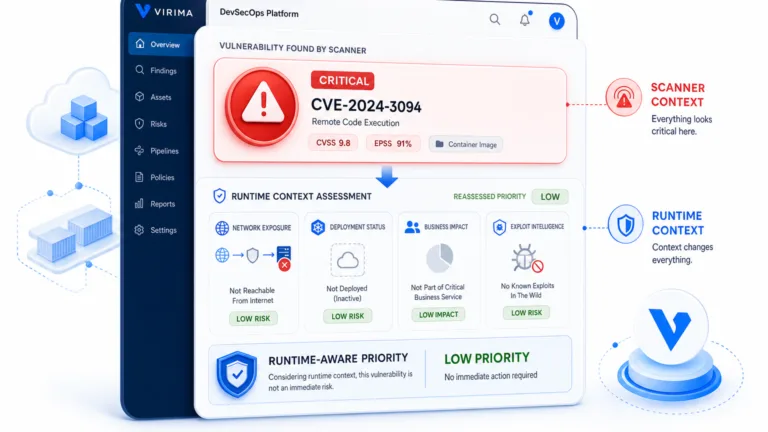
A structured data model cannot compensate for missing or inaccurate infrastructure data. For IT leaders working to align complex environments, establishing trusted runtime truth ensures that configuration records reflect actual deployed assets and dependencies before populating CSDM tiers.
How Virima boosts CMDB success
Virima addresses these CMDB challenges with solutions that boost data accuracy, automation, and efficiency. Many CMDBs struggle with data gaps and manual updates. Virima directly counters these issues, hence offering a more reliable and valuable CMDB.
Comprehensive IT discovery for reliable and complete data
Virima offers robust IT discovery tools that work in hybrid environments. This gives organizations a clear, current view of all assets across cloud, on-premises, and remote locations. Moreover, with this full visibility, Virima reduces the risk of missed assets and boosts data accuracy.
Automated CMDB management reduces reliance on manual updates
Manual CMDB management is labor-intensive and error-prone. Virima simplifies this with automation, thus, reducing the need for frequent manual updates. This not only saves time but also ensures data remains consistent, making Virima ideal for efficient CMDB upkeep.
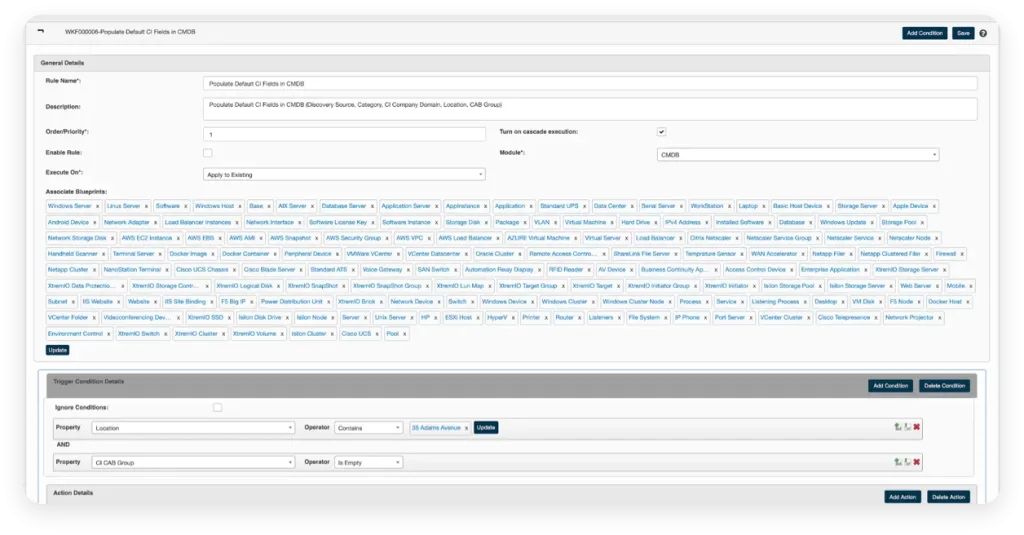
With a CMDB, you can establish detailed business rules to automate the updating of CIs and other maintenance tasks.
Advanced service mapping with ViVID™ for extended inventory visibility
Service mapping with ViVID™ connects known service definitions directly to underlying infrastructure components and vulnerability context. Visualizing these relationships dynamically provides configuration managers with the dependency clarity needed to validate CSDM application service models.

ViVID provides CSDM teams with visual tools to accelerate troubleshooting and incident resolution.
Improving cloud resource management
As businesses adopt cloud solutions, Virima ensures seamless integration of cloud-based assets into the CMDB. Further, its discovery capabilities extend to hybrid environments, providing a unified view of both on-premises and cloud resources. This enables better control and management of IT services.
Lower costs and faster value
Many enterprises maintain ServiceNow for service management while using independent, multi-source discovery to feed and validate configuration items. Virima integrates with platforms like ServiceNow, Jira, and Ivanti, providing the authoritative discovery data required to keep CSDM tables accurate without heavy administrative overhead.
Boosting CMDB success with CSDM: How Virima leads the way
By creating a consistent structure for data, CSDMs enhance accuracy and visibility, ensuring that organizations have reliable insights to support decision-making. When you organize your CMDB data, you make your entire infrastructure more effective, reduce risks, and drive value.
If you’re ready to see how a robust CMDB can transform your organization, explore Virima’s solutions. With cost-effective options, quick implementation, and a focus on data integrity, Virima empowers organizations to build a CMDB that’s accurate, resilient, and future-ready.
Start your journey with Virima today to discover the potential of your CMDB and elevate your IT operations.
Frequently Asked Questions About CSDM
What does CSDM stand for?
CSDM stands for Common Service Data Model. It is ServiceNow’s standard framework prescribing how tables, configuration item classes, and service relationships should be organized inside the CMDB.
Is CSDM an installable plugin or separate software product?
No. CSDM is not a separate software license, installable code, or report pack. It is an architectural framework and prescriptive data schema built directly into base system CMDB tables.
What is the difference between a CMDB and CSDM?
A CMDB is the database repository holding hardware, software, and relationship records. CSDM is the data modeling standard defining where each record belongs and how technical assets link to business services.
Can you use Virima discovery with ServiceNow CSDM?
Yes. Virima provides automated hybrid IT discovery and dynamic service mapping that feeds verified configuration items and dependencies directly into ServiceNow CMDB tables, supporting accurate CSDM tier alignment.