Why CMDBs Keep Failing (And What CMDB Governance Actually Fixes)

Most IT teams already know their CMDB isn’t fully accurate. The data drifts. Tickets get routed to the wrong teams. Change requests go through with incomplete dependency information. Audit cycles become fire drills.
CMDB drift is almost always a CMDB governance problem. The tool isn’t the limiting factor. The maintenance model is.
What CMDB governance actually means
CMDB governance is the set of processes, ownership structures, and data standards that keep a configuration management database accurate over time. It covers more than discovery scheduling. Strong CMDB governance defines:
Who owns each CI type and is accountable for its accuracy
How discovered data gets reconciled against existing CMDB records
What data quality standards apply to each CI class
How conflicting or stale records get resolved
According to Gartner research, organizations with successful AI initiatives invest up to four times more in foundational areas such as data quality and governance compared to those that experience poor outcomes. That principle applies directly to the CMDB: governance is the foundation, not an afterthought.
The root causes of CMDB drift
Discovery that doesn’t keep pace with change
Most organizations run CMDB discovery on a fixed schedule. In dynamic environments, cloud instances spin up and down, devices move, software gets installed without a ticket. By the time the next scheduled scan runs, the CMDB is already behind.
No reconciliation workflow
Discovery finds assets. Reconciliation is what happens next. Without a reconciliation workflow, those decisions don’t get made. Duplicate records accumulate. Stale CIs stay in the database long after the underlying asset is decommissioned.
Ownership without accountability
In most CMDBs, CI accuracy is everyone’s responsibility, which means, in practice, it belongs to no one.
What a working CMDB governance model looks like
Assign explicit ownership by CI type
Every CI class in the CMDB should have a named owner or owning team. Servers: infrastructure team. Applications: application owners. Network devices: network operations. Ownership carries specific responsibilities for reviewing changes, performing data quality reviews, and resolving reconciliation conflicts.
Build a discovery-to-reconciliation workflow
Automated discovery is a foundation, not a solution. A reconciliation process needs to sit on top of it. Define how long a discovered asset can remain unreconciled before it escalates, who reviews and approves changes to existing CI records, and what triggers automatic record updates versus manual approval.
For teams starting from scratch, building a CMDB use case is a practical starting point for establishing this workflow before CMDB drift sets in.
Define data quality standards per CI class
Not every CI attribute carries the same weight. A missing serial number on a production server is a higher-priority gap than a missing field on a retired device. Per CI class, define required fields, maximum acceptable record age, and conflict resolution rules.
As Dataversity reports, 61% of organizations list data quality as a top challenge, and 75% of leaders don’t trust their data for decision-making. In the CMDB context, that trust gap is what governance closes.
For a broader set of governance principles applied to CMDBs, see CMDB best practices: how companies can get it right.
Where automation fits in
CMDB governance sets the rules. Automation reduces the work required to follow them.
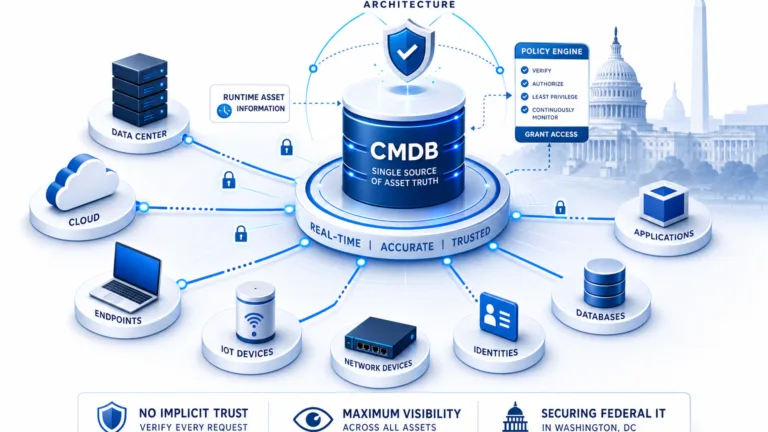
The most effective automation does three things: surfaces discovered data for review, maps relationships between CIs, and integrates with ITSM workflows.
Virima combines agent-based, agentless, and API-based discovery with ViVID™ Service Mapping and deep ITSM integrations with ServiceNow, Jira, Ivanti, and Halo. CMDB governance policies operate on top of accurate, automatically collected foundation data.
Build a CMDB that stays accurate
A CMDB that keeps failing is not a technology problem. It’s a governance gap.
Virima gives IT teams the discovery, service mapping, and ITSM integration foundation to build CMDB governance that holds over time.
Ready to see what a well-governed CMDB looks like in practice? Schedule a demo.
Frequently asked questions
What is CMDB governance?
The set of processes, ownership rules, and data quality standards that keep a configuration management database accurate over time.
Why does CMDB drift happen?
Discovery runs less frequently than the IT environment changes, discovered data has no reconciliation process, and no team member is explicitly accountable for CI accuracy.
Does switching CMDB tools fix accuracy problems?
No. A new tool inherits the same drift patterns unless governance also changes: how discovery is scheduled, who owns CI records, and how reconciliation decisions get made.
What role does service mapping play in CMDB governance?
Service mapping adds relationship context to individual CI records, showing how assets connect to applications and services they support. Without relationship data, a CMDB can have accurate individual records and still fail during incident response or change management.