CMDB Best Practices: The Complete 2026 Guide

CMDB best practices are the operational principles that determine whether a configuration management database becomes a live, governed source of IT truth or an expensive record-keeping system that teams stop trusting six months after launch. In 2026, those principles go beyond data hygiene. They define how discovery-driven population, formal CI governance, and agentic IT readiness work together to give both human teams and AI agents a reliable foundation for every decision they make.
8 CMDB Best Practices at a Glance
Short on time? Here is what separates CMDB projects that sustain value from those that stall:
Practice | What It Delivers |
1. Define business outcomes first | Pick 2–3 use cases before choosing CI classes — MTTR reduction, change success, compliance readiness |
2. Discovery-driven CI population | High-frequency discovery cycles as primary data source — not manual entry that starts decaying immediately |
3. Phased scope expansion | 8–12 CI classes in Phase 1; expand only when current classes hit quality targets |
4. Governance from day one | CI class owners assigned, quality standards defined, and change control processes active before the first CI record |
5. ITSM workflow integration | CMDB data must flow into incident, change, and problem management — or teams revert to spreadsheets |
6. Relationship and dependency mapping | Asset attributes without dependency context are an inventory list, not a configuration management database |
7. Agentic IT readiness | Source attribution, policy embedding, ownership, and freshness validation on every CI within automation scope |
8. Continuous data quality monitoring | Correctness, completeness, and compliance tracked in dashboards — not caught in audits after decay has happened |
Why Most CMDB Projects Stall Before They Deliver Value
The failure pattern is consistent across organizations of all sizes. A CMDB project launches with energy and executive sponsorship. Data is loaded, CI classes are defined, and the team celebrates launch day. Six months later, records are stale, relationships are broken, and teams have quietly reverted to spreadsheets and tribal knowledge.
Three root causes account for most failures. First, manual data entry as the primary population method. Configuration data changes constantly, and human updates cannot keep pace. Every manually entered CI record starts decaying the moment it is saved. Second, scope creep in the initial rollout. Organizations try to model every asset and attribute from day one instead of starting with the CI classes that directly support their most urgent use cases. Third, absent governance. Without clear ownership, defined update processes, and data quality standards, no one is accountable for keeping the CMDB accurate, and accuracy degrades invisibly until an incident exposes the gap.
The solution to all three follows the same logic: discovery-driven CI population as the foundation, phased implementation as the strategy, and formal governance as the operating model. Every CMDB best practice in this guide connects back to these three principles.
CMDB failures follow a predictable pattern: manual data entry that cannot keep pace with infrastructure change, over-scoped initial rollouts that teams abandon, and absent governance with no named accountability. Discovery-driven population, phased scope, and formal CI class ownership resolve all three. The failure is almost never the technology — it is the operating model. |
Start With Business Objectives, Not CI Classes
Before defining CI classes or selecting discovery methods, identify the specific business outcomes your CMDB needs to support. Are you trying to reduce mean time to resolution? Improve change success rates? Support compliance audits? Prepare your infrastructure data for AI agent operations? Each goal shapes which CI classes, attributes, and relationships matter most.
Start small and expand deliberately. Organizations that try to model everything from day one end up with sprawling data models that no one maintains. Pick two or three high-impact use cases — incident management and change impact analysis, for example — and build your CMDB to serve those first. A Phase 1 scope of 8 to 12 CI classes is workable for most enterprise environments. Once those CI classes are delivering measurable value, expand to the next tier.
Align to CSDM from the start. The Common Service Data Model (CSDM) provides the structural blueprint for how CI classes, services, and relationships should be organized. Organizations that align to CSDM during initial CMDB design report fewer structural rework cycles than those that model data ad hoc and try to align it later. Bring your service owners, configuration managers, and application owners into the design conversation early. Their input on which CI classes map to which business services is what keeps the CMDB useful rather than merely populated.
Implementation timeline. A focused CMDB rollout — single environment, well-defined scope — typically runs 12 to 18 weeks from planning through a working production CMDB. Multi-cloud environments with strict compliance requirements run 5 to 9 months. Scope and timeline set expectations with your executive sponsor. Without them, CMDB projects get abandoned the moment they hit inevitable complexity in month three.
This approach also makes executive sponsorship easier to maintain. When the CMDB demonstrably reduces MTTR or improves change success rates within the first quarter, the business case for continued investment rests on results, not promises.
For a detailed look at implementation sequencing, see how successful CMDB implementations are structured from the ground up.
Discovery-Driven Accuracy: The Non-Negotiable Foundation
A CMDB fed by manual entry becomes outdated the moment infrastructure changes. The only reliable way to maintain accuracy at scale is discovery-sourced CI population. That means using IT discovery tools that scan your environment through agent-based and agentless methods, across on-premises, AWS, and Azure environments, and reconcile the results into authoritative CI records. This is also the dividing line when you compare IT management software: platforms that source CI data from high-frequency discovery stay accurate, while those relying on manual imports drift quickly.
Recurring scheduled scans keep data current. Set your CI-data refresh cadence based on the rate of change in each environment. Production servers and network infrastructure may need scans every 24 to 48 hours. Cloud assets in dynamic environments need more frequent attention because resources spin up and decommission on short cycles. The goal is to ensure CI records reflect the actual state of your infrastructure, not a snapshot that starts decaying immediately.
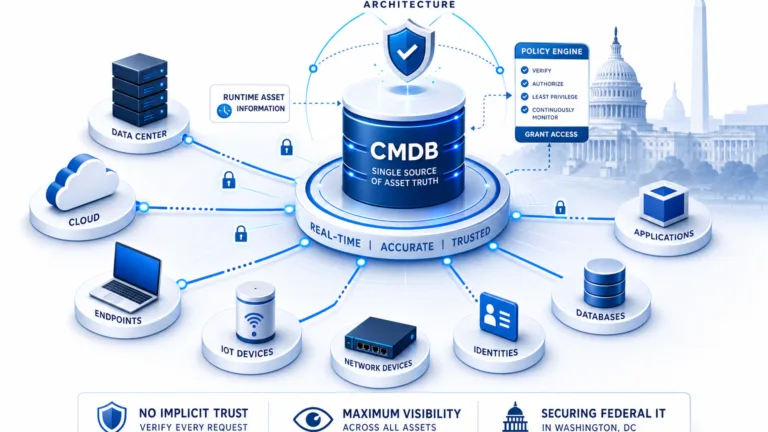
Discovery should also capture relationships and dependencies, not just asset attributes. Knowing that a server exists is necessary but not sufficient. Knowing that the server hosts a database that supports a business-critical application, which in turn depends on a specific network path and load balancer, is what makes the CMDB operationally useful for incident response, change management, and impact analysis.
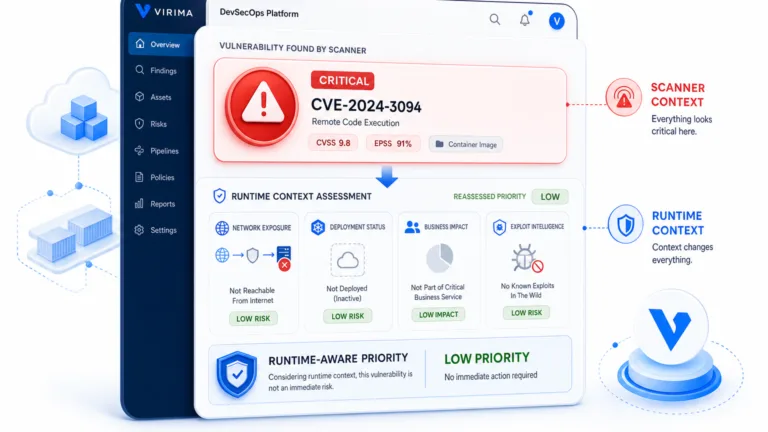
Virima runs agent-based and agentless multi-source discovery across on-premises, cloud, and hybrid environments. The discovered data populates the Virima CMDB with high-authority CI records, capturing hardware, software, operating systems, configurations, and every dependency and relationship. ViVID™ service maps then present those dependencies as interactive views that overlay ITSM incidents, changes, and NIST NVD vulnerability data for faster root-cause and impact analysis.
| Discovery Cadence Best Practice: Maintaining CMDB data quality requires recurring discovery scans calibrated to the rate of change in each environment: every 24 to 48 hours for production servers, more frequent for dynamic cloud assets. Relationship mapping that captures dependencies, not just asset attributes, is what makes the CMDB operationally useful. |
CMDB Governance: The Framework That Stops Data Decay
CMDB governance is the set of processes and policies that control how the database is managed, maintained, and used. Without governance, even discovery-driven data eventually drifts. Governance is what keeps CI records current, accurate, and consistent instead of slowly decaying into a data swamp that teams stop trusting.
Stale CI ownership records carry a cost that shows up outside the CMDB itself. Incorrect routing from outdated records is one of the most consistent root causes of SLA breaches across enterprise service desks. SLA monitoring and reporting cover exactly how that chain works and what accurate CI data does to the breach rate.
Assign Ownership at the CI Class Level
Designate CI class owners responsible for data accuracy within their domain. The network team owns network device CIs. The applications team owns application CIs. The database team owns database CIs. This distributed ownership model scales far better than one configuration manager trying to govern all data alone. When a CI goes stale, a named person must be responsible for resolving it. Without stewardship, abandoned records accumulate quietly until they surface during an incident.
Define Data Quality Standards
Set explicit standards for data entry, verification, and validation. Track data quality across three dimensions: correctness (do attribute values match the actual infrastructure state?), completeness (are required attributes populated?), and compliance (do records meet organizational standards and regulatory requirements?). Set tier-based targets. Business-critical CI classes should target 90% or higher data quality scores. Supporting CI classes can operate at 75% or higher while you focus governance resources on high-impact areas first.
Establish Change Control Processes
Define clear processes for reviewing and approving CMDB changes, including updates to CI attributes, relationships, additions, and decommissions. Every change to a CI record should be traceable: who made it, when, why, and through what authority. This audit trail becomes critical when AI agents begin acting on CMDB data, because every automated action must be explainable after the fact.
Schedule Regular Audits and Reconciliation
Run periodic audits to verify that the CMDB meets governance policies, industry regulations, and internal standards. Reconciliation compares discovered data against existing CI records to catch configuration drift, unauthorized changes, and records that no longer match the live environment. Virima’s CMDB health scoring surfaces records that are stale, unowned, or incomplete before they cause downstream problems.
| For ServiceNow CMDB Users: Governance That Scales Across Platforms If your organization runs ServiceNow for ITSM, CMDB governance needs to work across both platforms. Virima’s no-code bi-directional CMDB sync with ServiceNow includes pre-built blueprints that map to ServiceNow tables, including custom objects, so organizations reach accurate CMDB data faster than building custom integrations or relying on manual population. Business rules in Virima automate the promotion of CI updates and CMDB maintenance tasks, reducing the manual burden on data stewards. The bi-directional sync ensures that governance policies applied in either platform propagate across both. Governance embedded in the data pipeline is governance that actually scales. |
CMDB Data Quality: An Ongoing Practice, Not a Periodic Cleanup
Data quality is the single biggest determinant of whether a CMDB delivers value or becomes a liability. Inaccurate data is the leading cause of CMDB project failures, and reliance on manual processes is usually the culprit.
Treat data quality as an ongoing operational practice, not a periodic cleanup project. Build quality gates into your CI lifecycle: validate data at ingestion, flag anomalies during reconciliation, and surface quality scores in dashboards that governance teams review regularly. When a CI record falls below your quality threshold, the responsible owner should be notified with a defined timeframe to remediate.
Discovery-driven CI population addresses the correctness dimension at its source. Because data comes from the environment itself rather than human memory, attribute values reflect what is actually running. Completeness requires governance: defining which attributes are mandatory for each CI class and enforcing population through business rules and automated flagging. Compliance requires organizational alignment: ensuring CI records meet both internal standards and external regulatory requirements.
Virima’s CMDB health scoring monitors data quality across all three dimensions continuously. When the system detects missing attributes (lifecycle status, business criticality, or policy assignments), it flags the incomplete CI record and routes it to the responsible owner. This closes the gap between what discovery can populate automatically and what requires human knowledge.
See how Virima builds Trusted Runtime Truth into every CI record. Explore the Trusted Runtime Truth approach at Virima.
Preparing Your CMDB for Agentic IT Operations
AI agents operating inside IT environments need a CMDB that answers four questions before any action executes: What exists? How is it connected? What is governed? Who owns it? A CMDB that cannot answer those questions with live, explainable, policy-aware data creates automation risk. Agents acting on stale or unverified records can cause the exact failures they are designed to prevent.
This is the operational reality that makes agentic IT readiness the defining CMDB best practice of 2026. Traditional CMDB best practices focused on keeping data clean for human decision-makers. Agentic IT demands a higher bar because AI agents do not compensate for incomplete data with experience and judgment the way humans do. An agent acts on what the CMDB says, and only what the CMDB says.
Four requirements define a CMDB ready for agentic operations:
- CI source attribution. Every CI attribute must document where its data came from, when it was last discovered, and whether the discovery method is authoritative for that CI class. An agent acting on a CI record without source attribution is acting on unverified data.
- Policy attributes embedded at the CI level. Governance rules, including change approval tiers, blast radius classifications, and maintenance window constraints, must live at the CI record itself. Policy attributes give AI agents the guardrails to act within organizational boundaries.
- CI ownership attribution. Every CI that an AI agent might act on must have a named owner. Ownership is the accountability chain that makes automated action auditable. When an agent initiates a change and something breaks downstream, the question ‘who authorized this CI for automated action?’ must have a clear answer.
- Freshness validation thresholds. Standard CMDB health metrics track when a CI was last updated. Agentic IT requires a stricter measure: when was the CI last verified by an authoritative discovery source? For production servers, a discovery verification age of more than 30 days should trigger a hold on AI agent actions. For cloud assets, 7 days may be more appropriate.
Together, source attribution, policy, ownership, and freshness form the Trusted Runtime Truth requirements that separate a CMDB ready for agentic IT from one that creates risk at scale. For a deeper look at how these four properties apply in practice, see how Virima’s CMDB is purpose-built for AI agent operations.
| A CMDB ready for AI agent operations must carry four properties on every CI within automation scope: source attribution showing where data came from and when, policy attributes defining change windows and blast radius thresholds, named ownership attributing accountability, and freshness validation thresholds that trigger holds when data ages beyond acceptable limits. |
Relationship Mapping and Service Dependency Visibility
A CMDB that only tracks individual assets without mapping how they connect is an inventory list, not a configuration management database. Relationship mapping transforms asset data into operational intelligence by surfacing dependencies, communication paths, and impact chains.
When a network switch fails and several servers drop off, the operations team needs to know instantly which business services are affected, which applications depend on those servers, and which teams need to be notified. Without mapped dependencies, incident response is guesswork, and change management becomes a risk exercise based on assumptions rather than evidence.
ViVID™ service maps present dependency views that update as infrastructure changes. Communication views show flow and port numbers of host-to-host communications, including assets not yet formally in the CMDB. All views include overlays of ITSM incidents, changes, and NIST NVD vulnerability data. The same service map that helps an SRE troubleshoot an outage also helps a change manager assess blast radius and a security analyst prioritize remediation based on asset criticality to the business.
CMDB Governance as an AI Safety Requirement
The emergence of AI governance in IT changes what ‘good enough’ means for configuration management. When a human makes a change decision, they compensate for data gaps with experience and judgment. When an AI agent makes a change decision, it acts on what the record says. That difference in tolerance for ambiguity is what makes governance a safety requirement, not just an operational improvement.
Every CI within the scope of automated action needs three governance properties that traditional CMDB practices did not enforce. First, ownership attribution: a named human accountable for the CI’s accuracy and the decisions it drives. Second, source attribution: documented evidence of where each attribute value came from and when it was last verified. Third, policy embedding: governance rules attached to the CI record itself, defining change windows, approval requirements, and blast radius thresholds.
Without these properties, AI agents operate in a governance vacuum. They may execute actions on CIs with stale data, route incidents to the wrong teams based on outdated ownership records, or approve changes without understanding downstream impact. Each of these failures occurs at machine speed, which means the blast radius of a bad CI record scales directly with the level of automation applied to it.
For organizations building AI governance programs around their CMDB, see how CMDB and AI governance intersect in practice.
| CMDB governance becomes an AI safety requirement once agents act autonomously. Embedding ownership attribution, source traceability, and policy constraints at the CI record level gives AI agents governed context rather than a governance vacuum, where confident decisions on stale data compound at machine speed. |
CMDB Implementation Checklist for 2026
Before launching or modernizing a CMDB, work through these eight criteria:
- Define business objectives first. Identify the two or three operational outcomes your CMDB must support before selecting CI classes or discovery methods.
- Deploy discovery-driven CI population. Use agent-based and agentless discovery across on-premises and cloud environments. Make recurring scheduled scans the primary data source, not manual entry.
- Start small, expand deliberately. Begin with high-impact CI classes that serve your priority use cases. Add scope only after current CI classes meet data quality targets.
- Establish governance from day one. Assign CI class owners, define data quality standards, and build change control processes before the first CI record is created.
- Integrate with ITSM workflows. A CMDB that does not flow into incident, change, and problem management workflows will be ignored. Connect it to the tools your teams use daily.
- Map relationships and dependencies. Asset attributes alone are insufficient. Service dependency mapping is what makes the CMDB operationally valuable for impact analysis and change planning.
- Build for agentic readiness. Add source attribution, policy attributes, ownership attribution, and freshness validation to every CI class within the scope of automated operations.
- Monitor data quality continuously. Track correctness, completeness, and compliance scores. Surface quality dashboards to governance teams and hold CI owners accountable for remediation.
| The 2026 CMDB best practices checklist spans eight areas: business-first objectives, discovery-driven CI population, phased scope expansion, day-one governance with CI class ownership, ITSM workflow integration, relationship mapping, agentic IT readiness (source attribution, policy embedding, ownership, freshness validation), and continuous data quality monitoring with clear accountability. |
Turn Your CMDB Into the Trusted Runtime Truth Foundation Agentic IT Demands
CMDB best practices in 2026 are no longer about data hygiene alone. The organizations that get the most from their CMDB treat it as a governed, discovery-driven operational foundation, not a static inventory that teams update when they remember to.
The shift to agentic IT raises the stakes. When AI agents act on your CMDB data at machine speed, accuracy is no longer a quality-of-life improvement. It is a safety requirement. Source attribution, ownership, policy, and freshness are the four properties that separate a CMDB ready for agentic operations from one that creates risk.
Virima delivers Trusted Runtime Truth through discovery-driven CI population, ViVID™ service maps, CMDB health scoring, and governance capabilities built for the agentic era. Whether you are building a CMDB from scratch or modernizing an existing deployment, Virima provides the accuracy, visibility, and governance your IT operations demand.
Schedule a demo to see how Virima turns your CMDB into the Trusted Runtime Truth foundation for agentic IT.
Frequently Asked Questions: CMDB Best Practices
What are CMDB best practices in 2026?
CMDB best practices in 2026 go beyond data hygiene. They include discovery-driven CI population through recurring scheduled scans, formal governance with CI class ownership, data quality scoring across correctness, completeness, and compliance dimensions, and agentic IT readiness through source attribution, policy embedding, ownership attribution, and freshness validation. The new standard is Trusted Runtime Truth: live, governed data that supports both human decision-making and AI agent operations safely.
How do you maintain CMDB data quality over time?
Sustained CMDB data quality requires three elements working together. First, discovery-driven CI population that keeps attribute values aligned with the actual infrastructure state through recurring scans. Second, governance processes that assign CI class owners, define mandatory attributes, and enforce quality gates at ingestion and reconciliation. Third, continuous monitoring through data quality dashboards that track correctness, completeness, and compliance scores, flagging records below defined thresholds for owner remediation.
What is CMDB governance and why does it matter?
CMDB governance is the set of processes and policies that control how the database is managed, maintained, and used. It includes defining CI ownership, establishing data quality standards, building change control processes, scheduling regular audits, and enforcing compliance with organizational and regulatory requirements. Without governance, CMDB data decays silently. In the agentic IT era, poor governance means AI agents act on unreliable data at machine speed, compounding the impact of every inaccuracy.
How do you prepare a CMDB for AI agent operations?
An agent-ready CMDB must deliver four things: source attribution that documents where each attribute value came from and when it was last verified, policy attributes embedded at the CI record level defining change windows and blast radius thresholds, ownership attribution naming a human accountable for every CI within automation scope, and freshness validation that distinguishes a recently updated record from a recently verified one. These four properties form the Trusted Runtime Truth layer that gives AI agents governed context to operate safely.
Can a CMDB integrate with ServiceNow and other ITSM platforms?
Yes. A well-implemented CMDB should integrate with your ITSM platform so CI data flows directly into incident, change, and problem management workflows. Virima offers no-code bi-directional sync with ServiceNow, Jira Service Management, Ivanti, HaloITSM, Xurrent, Hornbill, and TeamDynamix. Pre-built blueprints map to ITSM tables, including custom objects, making integration fast to deploy and straightforward to maintain.