The Most Impactful Jira Service Manager Tool Examples: Virima

Jira Service Management (JSM) is a solid service management itsm platform for service delivery, supporting teams that manage customer requests, service requests, incidents, problems, and maintain a knowledge base within their Jira Service Management project, but it has a gap that catches teams off guard: no true CMDB.
Jira Assets tracks configuration items at a basic level, but it can’t run automated IT discovery, keep data updated in near-real-time, or map the complex service relationships that production environments depend on. For teams running large or hybrid infrastructure, that gap shows up fast.
Virima plugs it. It brings automated discovery and service mapping into your JSM environment through a direct Jira Service Management integration, syncing data bi-directionally so your ticketing platform and your CMDB stay consistent. In the same study, average resolution time dropped from 32.46 hours to 22.55 hours with modern ITSM capabilities, a 30.5% improvement. through stronger incident management, sharper change risk assessments, and fewer surprises when services go down.
A 2025 ITSM report found that teams using automation resolved incidents 17.8% faster, saving 4.87 hours per ticket on average, sharper change risk assessments, and fewer surprises when services go down.
This post breaks down where JSM falls short as a Jira Service Manager tool example, what to look for in a CMDB extension, and how Virima delivers on each front.
Why extend Jira Service Management with additional tools?
While Jira Service Management supports core ITSM needs, growing environments often demand deeper visibility and control.
Limitations of Jira Assets and discovery
Jira Assets gives you a structured way to track configuration items (CIS) and support asset and configuration management within Jira Service Desk environments. But teams relying on it as their CMDB regularly hit these walls:
- Performance degrades at scale. As data structures grow, Jira Assets slows down. In environments with thousands of CIs, that lag makes daily operations painful.
- Rigid data structures force compromises. The recommended schemas limit how you can model your IT ecosystem, and customizing them to match real-world infrastructure takes more effort than most teams budget for.
- There’s no pre-built CMDB schema. You build and configure every schema manually, which slows initial setup and opens the door to inconsistencies.
- Workaround-heavy workflows become the norm, especially when trying to handle service requests across multiple request types with limited flexibility. Teams create helper status fields and patches to bypass execution limits. The result is a fragile setup that nobody wants to maintain.
- Relationship mapping is weak. Complex CI dependencies and automation workflows are difficult to build, which limits how useful the CMDB is when things move fast.
- Scalability is a real concern. Many teams question whether Jira Assets can function as a production CMDB for large, complex environments.
On top of that, complex configuration processes, thin documentation, and integration friction make the case clear: teams need purpose-built solutions like Virima to extend their JSM platform.
Why advanced discovery matters for Jira Service Manager tool examples
To manage modern IT environments effectively, teams need deeper visibility than basic discovery can provide.
Full asset visibility across hybrid environments
A proper IT discovery tool detects physical and virtual assets, hardware configurations, and installed software across every operating system in your environment. Without that visibility, your CMDB is incomplete from day one, and every change request, incident ticket, and audit is working from stale or partial data.
Keeping your CMDB accurate without manual effort
Automated discovery keeps your CMDB current through recurring scheduled scans, improving request management and ensuring accurate data supports service level agreements. When new assets come online or existing configurations change, the next scan picks them up and updates the CMDB automatically. This matters most during change management planning, incident response, and compliance audits, where stale data directly causes bad decisions.
Security and compliance coverage
Discovery tools identify every network-connected device and analyze hardware and software configurations in depth. Virima integrates with the National Vulnerability Database (NVD) at no extra cost, automatically flagging known vulnerabilities so your team can focus remediation on the most critical exposures rather than manually cross-referencing CVE lists.
Managing hybrid and remote work environments
Agentless and agent-based discovery give you flexible options for different parts of your infrastructure. Virima’s Discovery Agent includes a Work from Anywhere (WFA) capability, helping teams manage distributed environments and even support operational needs like call scheduling tied to remote assets. that tracks daily configuration changes and software usage on remote PCs. When half your workforce is distributed, that visibility isn’t optional.
Why service mapping matters for Jira Service Manager tool examples
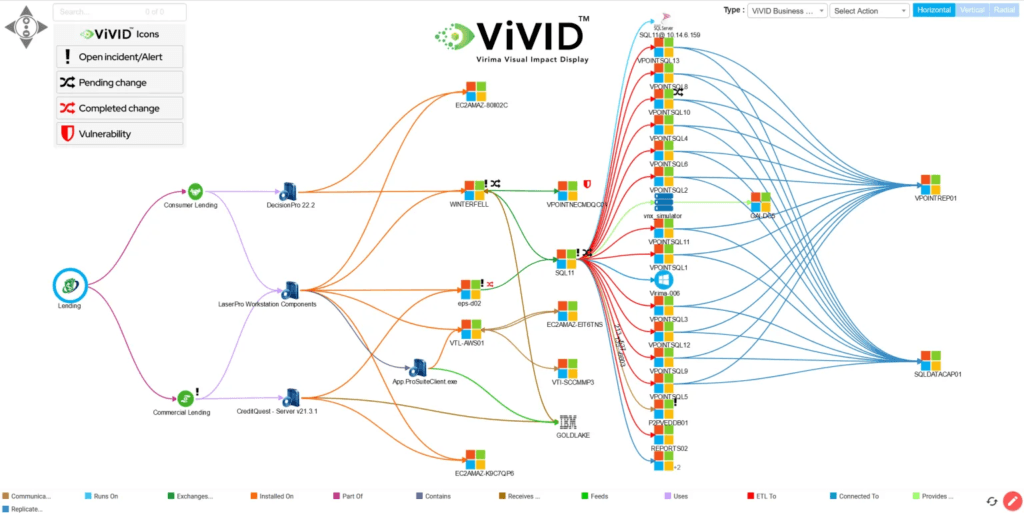
Service mapping shows you how your infrastructure actually connects, giving better visibility into systems that support both Jira software development workflows and IT operations. With Virima’s Virima Visual Impact Display (ViVID™), you can:
- Spot single points of failure by visualizing service dependencies before they cause outages.
- Reduce change failures by analyzing the downstream impact of planned changes before executing them.
- Speed up incident response with near-real-time visibility into which services are affected and where the root cause sits.
- Cut operational risk by maintaining accurate, current records of every dependency in your environment.
- Plan IT investments with a clear picture of asset ownership and service interdependencies.
Why Virima is one of the best Jira Service Management tool examples
Virima strengthens JSM in two areas that matter most: a production-grade CMDB backed by automated discovery, and service mapping that gives your ops team near-real-time infrastructure visibility.
Virima’s CMDB with automated discovery
Virima’s CMDB is purpose-built for the complexity that Jira Assets can’t handle.
Automated discovery across hybrid environments
Virima Discovery uses 140+ extendable probes to scan your full environment, identifying connected devices, applications, and dependencies across on-prem, cloud, and edge networks. Recurring scheduled scans keep the CMDB current as assets come online, go offline, or change configuration. Coverage spans physical servers, virtual machines, containers, IoT devices, and cloud services from AWS, Azure, and other providers.
Automatic CMDB population and maintenance
Virima keeps your CMDB accurate without manual data entry, ensuring reliable data for downstream processes like incident resolution, change planning, and fulfilling service requests efficiently. It tracks changes to configuration items automatically, feeding that data into change impact analysis. Data flows both ways between Virima and JSM through bi-directional sync, keeping both platforms consistent without manual reconciliation. Built-in data normalization eliminates duplicates and maintains a single source of truth for configuration data. Setting up the integration is straightforward. Virima and JSM connect through their standard interfaces in a few steps, with no complex coding or configuration required.
Flexible discovery methods
Virima supports multiple discovery approaches for different environments. You can run agent-based discovery for deep inspection or agentless scanning for a minimal footprint, depending on the asset and environment. The platform scans via SNMP and other standard network protocols, covering a wide range of device types and operating systems. Discovery tools are extensible, so you can customize them for unique assets or proprietary systems as your environment evolves. API integrations also pull data from AWS, Azure, SCCM, Intune, hypervisors, and other management consoles into a unified CMDB.
Enterprise scalability
Virima handles large-scale environments without performance degradation. The architecture scales as your organization grows, keeping pace with increasing CI counts and data volumes.
Virima also extends JSM’s usefulness for IT Asset Management teams. The same discovery data that feeds your CMDB powers hardware and software inventory tracking, license metering, and lifecycle management, giving IT asset managers the visibility they need for financial, licensing, and warranty audits without a separate tool.
Autonomic Social Discovery: Filling the gaps machines can’t
Virima’s Autonomic Social Discovery (ASD) automates the collection of human intelligence for attributes that discovery probes and agents can’t detect on their own. These include asset lifecycle status (requested, ordered, production, decommissioned), ownership information, business criticality ratings, and SLA assignments. ASD sends targeted queries to the people who know, then writes the answers back to the CMDB automatically. This closes the gap between what’s technically discoverable and what your team actually needs to manage assets properly.
ViVID™: Service mapping that changes how you manage JSM
ViVID™ is Virima’s service mapping engine. It turns a static CMDB into a live operational picture of your infrastructure.
Dynamic service maps
ViVID™ uses machine-learning-driven relationship data from Virima Discovery to map hardware connections, so you can identify and manage physical dependencies. It visualizes software-to-software interactions across your application stack and maps network relationships for faster troubleshooting. It also surfaces both expected and unauthorized communications, which helps identify gaps in CMDB completeness.
JSM overlay and impact analysis
ViVID™ integrates directly with JSM to overlay incidents and planned changes onto your service maps. You see active incidents mapped to affected services for immediate situational awareness. Before approving a change, you can visualize its downstream effects. And when something breaks, you trace the origin of service disruptions through the dependency chain for faster resolution.
Vulnerability context on your service maps
ViVID™ overlays vulnerability data from the NVD directly onto service maps. You see which vulnerabilities affect which services, and you can prioritize remediation based on both vulnerability severity and the business criticality of the impacted assets. Your most critical services get patched first.
Why your JSM environment needs Virima’s discovery and service mapping
Jira Assets has real limitations as a CMDB for complex IT environments. If your team is dealing with performance bottlenecks, incomplete asset data, or blind spots in your service dependency chain, those limitations are costing you time and increasing risk.
Virima extends JSM with automated discovery that keeps your CMDB accurate, service mapping through ViVID™ that visualizes every dependency, and integrations that sync data bi-directionally with your ITSM platform. The result: faster MTTR, fewer failed changes, and better visibility across your entire infrastructure.
Virima is also Pink VERIFY ITIL 4 certified across six processes (SACM, change, incident, problem, request, and knowledge management) and holds SOC 2 Type II compliance. For enterprise buyers evaluating Jira Service Manager tool examples, that’s the credibility check that separates a purpose-built solution from a point tool. If you are still weighing whether to stay on Jira at all, compare the best Jira alternatives for IT service management and agile teams.
If you’re evaluating CMDB and discovery solutions for your environment, now is the right time to request a demo and see how Virima performs in a real-world setup.
FAQ
Can Virima replace Jira Assets?
Virima doesn’t replace Jira Assets. It extends it. Jira Assets handles basic asset tracking within JSM and supports standard jira service management offers, but it lacks the discovery engine, service mapping, and relationship intelligence that a production CMDB requires., but it lacks the discovery engine, service mapping, and relationship intelligence that a production CMDB requires. Virima fills those gaps by discovering your assets automatically, mapping their dependencies, and syncing everything back into JSM. You keep using JSM for ticketing and workflows. Virima makes the data behind those workflows accurate.
What ITSM platforms does Virima integrate with beyond Jira?
Virima supports seven ITSM integrations: ServiceNow, Jira Service Management, Ivanti, HaloITSM, Cherwell, Xurrent, and Hornbill. If your organization runs multiple ITSM platforms or is weighing a migration, Virima’s CMDB and discovery layer works across all of them. That makes it a strategic investment, not just a JSM add-on.
What is the need for advanced discovery and service mapping?
JSM doesn’t ship with a discovery engine or a service mapping tool that can handle hybrid IT environments. If your infrastructure spans on-prem data centers, cloud instances, and edge devices, you need both.