ITOM Practices for Change Risk Assessment: The Blind Spot Before the Window

On October 29, 2025, an inadvertent configuration change on Azure Front Door bypassed Microsoft’s own validation safeguards and spread across the edge fabric before operators could fully read the blast radius. Microsoft’s engineering team later published a public review of the Azure Front Door outages, covering what failed in the control path and what they changed afterward. The outage was not a mystery failure of hardware. It was a change that moved faster than the checks meant to bound its risk.
That pattern is familiar inside enterprise IT, and it’s exactly where ITOM practices for change risk assessment either hold or fail: a change ticket gets scored, a change advisory board (CAB) reviews the form, the window opens, and then something outside the scored configuration items fails because the assessment never saw the current estate. CMDB-backed change management only helps when the configuration record going into the score is still true on the day the window opens.
IT operations management (ITOM) practices for change risk assessment are the work that happens before the window: inventory currency, dependency truth, and post-change reconciliation. Without them, risk scoring is a questionnaire on yesterday’s map. The blind spot is not missing ITIL language. The blind spot is missing operational truth at assessment time.
What is ITOM-driven change risk assessment?
ITIL 4 Change Enablement frames the practice purpose around assessing risk properly, authorizing changes, and managing the schedule. The practice does not invent the facts under the score. It consumes them. When those facts are incomplete, authorization still proceeds. The label on the ticket still looks precise. Production does not match the form.
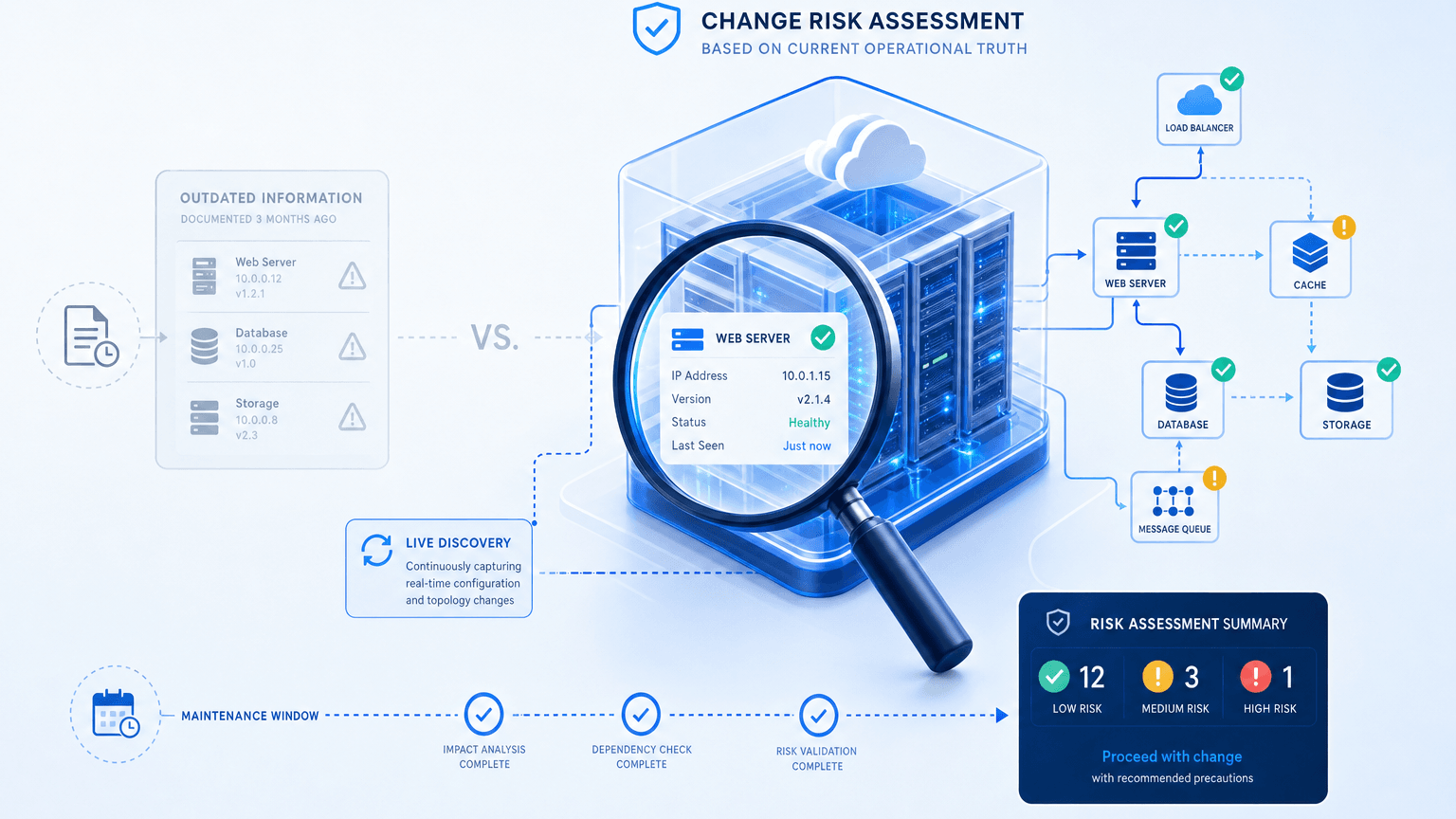
ITOM-driven change risk assessment means the score is fed by operational data, not only by what the change requester typed into fields. At minimum, a defensible assessment needs five inputs:
- Current configuration item (CI) state for every object in scope
- A dependency map that shows what else those CIs touch
- Recent change history on the same objects and services
- An affected-service list that leadership and support can recognize by name
- A rollback path that matches the real topology, not a generic playbook line copied from last quarter
Each input can be wrong in a quiet way. A CI can exist in the CMDB and still be wrong on owner, environment, or relationships. A dependency map can look complete while omitting a shared mid-tier path. Change history can list tickets without linking them to the CIs that actually moved. Affected services can be named by application code while the business service that leadership tracks sits one layer above. Rollback steps can assume a topology that no longer exists after the last cloud migration.
When those inputs are stale or incomplete, the CAB still meets. The authorization still happens, and the risk label still looks precise. The underlying estate does not match the form. For the category framing behind those inputs, see Trusted Runtime Truth: what exists, how it is connected, what changed, what will break, and who owns it.
Where the data gap hides
| Situation | What the CAB assumes | What’s actually true |
|---|---|---|
| CI last updated 45 days ago | Inventory matches production | Hosts, agents, and cloud tags moved; the record did not |
| Single-app change ticket | Blast radius stops at named app | Shared middleware and network path sit outside the ticket |
| “Standard” change template | Low risk by category | Category never checked against live dependencies |
| Rollback steps copied from last quarter | Failback still works | Topology and owners changed; the steps no longer fit |
This is why ITIL change management and CMDB accuracy sit on the same path. Process maturity without data currency produces confident wrong answers, and that’s CMDB change risk in its purest form: a defensible process running on an indefensible record. The CAB is not the problem when the packet was already wrong before the first vote.
What does ITOM-driven change risk assessment require before authorization?
It requires current CI state, dependency maps, recent change history, named affected services, and a rollback path that matches live topology. Without those inputs, CAB scoring authorizes work against a form that no longer matches production.
Why maintenance window risk assessment matters
Maintenance windows compress time. There is little room to discover missing dependencies once the change job has started. The cost of a weak assessment shows up as extended downtime, emergency follow-on changes, and lost trust in the change calendar. Teams that treat risk assessment as paperwork finish the form on time and still walk into the window blind.
Uptime Institute’s 2025 Annual Outage Analysis reports that nearly 40% of organizations suffered a major outage caused by human error over the past three years. Of those incidents, 85% stem from staff failing to follow procedures or from flaws in the processes and procedures themselves. Change risk assessment is one of those procedures. If the procedure is fed bad inventory, following it still fails. The procedure looks compliant. The outage still lands.
Windows also concentrate decision pressure. Approvers have minutes, not days, to challenge a packet. If dependency context is missing from the packet, nobody invents it in the meeting. The default becomes approve on category and hope. That is how standard changes become P1 bridges after midnight.
Where change risk assessments break down
- Stale CMDB at assessment time. Discovery last ran weeks ago. The form uses that snapshot as truth. Result: approved low risk on CIs that no longer exist in that shape.
- Dependency blind spots across hybrid estates. On-prem, VMware, and cloud objects sit in different tools. The ticket only lists the primary host. Result: shared services and cross-tier paths never enter the score.
- No reconciliation between planned and actual change. Implementation drifts from the approved package. Nobody closes the loop in the CMDB. Result: the next assessment inherits the same drift.
- CAB working from a spreadsheet export. A static file freezes ownership and relationships at export time. Result: the board-facing risk label outlives the data that justified it.
ITOM service mapping is how teams see the path from a CI under change to the business service that will absorb the failure. Without that path, risk scores stay technical and incomplete. A host reboot looks low risk until the map shows the payment path sitting on the same edge policy.
Why do change risk assessments fail before a maintenance window?
They fail when the CMDB is stale, hybrid dependencies are unmapped, planned and actual changes are never reconciled, or the CAB scores a spreadsheet snapshot. Compressed windows leave no time to discover those gaps after the job starts.
The real cost of skipping the ITOM layer
For ops and CMDB owners
The hidden cost is hours spent reconciling records before every CAB. Someone exports from discovery. Someone else cleans ownership fields. Someone else rebuilds a dependency slide for leadership. That work rarely appears as a line item. It appears as late packets, deferred changes, and CMDB owners who become the most-questioned people in the room when a low-risk change fails.
For leadership
Boards already track delivery health through frameworks such as DORA’s software delivery metrics, including change failure rate. When an assessed-as-low-risk change becomes a P1, leadership does not only see an outage. They see a governance story that said risk was controlled while the estate data underneath was not. One bad window can erase months of process theater.
For regulated environments
Regulated operators need an audit trail tying authorization to the configuration state assessed at the time. The IRS IRM 2.125.2 Change Management Process is one public example of a risk-based authorization model that expects controlled change evidence. If the CMDB used for the score does not match what was deployed, the trail fails even when the ticket workflow looked complete.
Trusted discovery data changes which decisions operators can defend. Risk assessment is one of those decisions. Without it, ops absorbs the overtime, leadership absorbs the board question, and regulated teams absorb the finding.
What does a stale CMDB cost operationally?
A stale CMDB shifts cost rather than removing it: ops teams spend hours reconciling exports before every CAB, leadership absorbs the governance risk when an assessed-as-low-risk change becomes a P1, and regulated teams risk an audit trail that can’t tie authorization to the configuration state actually deployed.
The ITOM practices that fix this
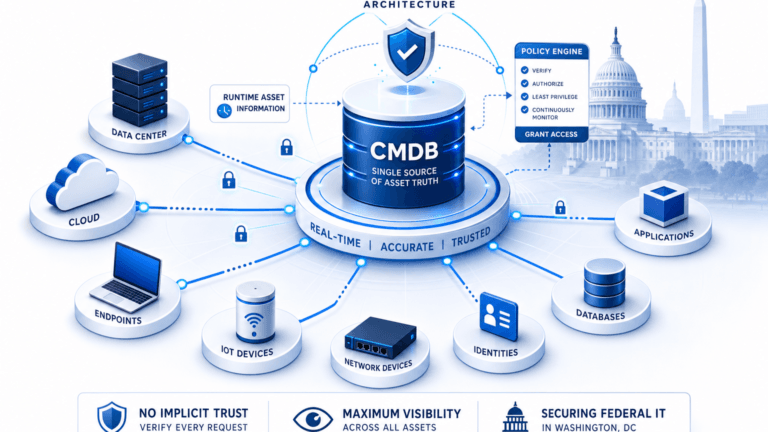
Three practices close the gap between form-based scoring and estate truth. None of them replace CAB judgment. They feed it with inputs the form cannot invent. Where these practices connect to Virima’s platform, ViVID™ service maps and the broader Trusted Runtime Truth layer are what keep CI state, dependency maps, and change history discovery-sourced rather than manually assembled, the distinction that separates a defensible packet from a plausible one.
1. High-frequency scheduled discovery
High-frequency scheduled discovery keeps CI inventory current going into the assessment window. Agent-based, agentless, and API sources refresh hosts, software, network devices, and cloud objects on a defined cadence. The score should use inventory from the latest completed cycle, not a cleanup project from last quarter.
Coverage matters as much as cadence. Segments that never enter discovery never enter the score with evidence. Shadow hosts, orphaned agents, and cloud objects created outside the approved pipeline stay invisible until they fail in the window. Discovery scope is a change-risk control, not just an inventory project. A CMDB without discovery remains a database of claims until those cycles run.
2. Dependency and service mapping
Once service definitions exist, dependency maps show what is connected to the CI under change. That is how shared databases, load balancers, and mid-tier paths enter the risk conversation. Service composition still has to be provided. The automation is in building and refreshing the map from infrastructure relationships, not in guessing which apps make up a named business service.
Native platform maps and third-party discovery maps both fail when relationships are manual and stale. Fit debates matter less than whether the map used at CAB time still matches production. A diagram from last release is still a blind spot if the estate moved. For platform-specific mapping tradeoffs, see ServiceNow ITOM service mapping fit questions.
3. CMDB reconciliation after the change
Authorization is incomplete until the CMDB is checked against what landed. Post-change reconciliation validates that approved scope and actual deployment still align. Drift left unreconciled becomes the next assessment’s blind spot. Teams that skip this step rebuild the same wrong packet for the next window and call it process maturity.
ITOM change management: manual vs. ITOM-driven risk assessment
| Dimension | Manual risk assessment | ITOM-driven risk assessment |
|---|---|---|
| Data source | Requester form and static exports | Discovery-fed CI and relationship records |
| Refresh cadence | Ad hoc, often pre-CAB only | High-frequency scheduled discovery cycles |
| Dependency visibility | Named apps and hosts on the ticket | Mapped paths across tiers and shared services |
| Audit trail | Ticket fields and attached spreadsheets | Ticket plus configuration history and map versions |
Which ITOM practices improve change risk assessment?
High-frequency scheduled discovery keeps CI inventory current. Dependency and service mapping show what the change touches. Post-change CMDB reconciliation confirms approved scope still matches what was deployed before the next assessment inherits drift.
ITOM practices for change risk assessment in practice
These are patterns teams recognize, not invented case-study scores.
- A routine storage migration. The ticket lists the array and two application hosts. A pre-change discovery refresh surfaces mounts and consumers the form never named. Without it, fourteen dependent teams learn about the window from an incident bridge instead of the change calendar.
- A hybrid-cloud patch window. On-prem CMDB rows and cloud inventory disagree on instance identity and ownership. Discovery closes the join before the patch starts, so the CAB scores every object that will reboot, not just the ones in the older spreadsheet.
- A network path change labeled standard. Category-based low risk looked correct until the service map showed a payment path on the same edge policy: the assessment moved from template to evidence, and the window was rescheduled with the right stakeholders.
- A mid-tier library upgrade. The requester scored the change against two application servers. Mapped dependencies showed a batch job and a reporting extract on the same library version; rollback planning expanded before the job ran, not after the extract failed at 05:00.
For the conceptual split between scoring risk and analyzing impact, see risk assessment versus impact analysis in IT change management. This article stays on the ITOM inputs both practices need before the window. Risk labels and impact paths both collapse when the inventory under them is wrong.
Where Virima fits in this process
Virima supports ITOM practices for change risk assessment as the discovery, CMDB, and service-mapping layer under existing change workflows. It does not replace the CAB, the ITSM ticket, or the authorization decision. The job is to make the inputs to that decision current and explainable.
Immediate operational impact
High-frequency scheduled discovery shortens the pre-CAB scramble. Configuration managers spend less time hand-merging exports and more time reviewing exceptions. Change packets arrive with current CI state instead of last month’s cleanup residue. Risk signals surface earlier because the inventory under the score is no longer a weekend spreadsheet project.
Longer-term accuracy
CMDB drift is treated as a structural problem, not a quarterly cleanup project. Multi-source reconciliation keeps records aligned across agent, agentless, and API inputs. ViVID™ service maps, once service definitions are provided, stay tied to infrastructure relationships that discovery continues to refresh. Accuracy compounds because each cycle feeds the next assessment instead of resetting the same gaps.
Integration with existing workflows
Virima sits alongside ServiceNow, Jira Service Management, Ivanti, and related platforms rather than replacing the change process itself. Partner names stay in the ITSM plane. Discovery-sourced truth feeds the CMDB and maps those tools already used. See the full list on the Virima integrations hub. The goal is better inputs into the ITSM you already run, not a new CAB product.
Moving from manual to ITOM-driven risk assessment
What changes in data and process
| Area | Before | After |
|---|---|---|
| Data | Static exports, requester claims, partial ownership | Discovery-fed CIs, reconciled multi-source records, mapped dependencies |
| Process | Score the form, authorize by category, hope the window holds | Refresh inventory, score with map context, reconcile after deploy |
The shift is not a new policy binder. It is a change in which system of record the CAB trusts when the form and the estate disagree. When they disagree, the estate wins, and the form is corrected before authorization.
Benefits cascade
- Fewer emergency changes. When more risk is visible before the window, fewer surprise follow-ons appear as emergency tickets the next morning.
- Faster CAB cycles. Packets that already carry current inventory and dependency context need less last-minute clarification. Approvers challenge exceptions instead of rebuilding the estate narrative live.
- Cleaner audit trail. Authorization, assessed configuration state, and post-change records line up. Auditors can follow the path without reconstructing it from chat logs.
Getting started
- Audit current discovery coverage. List which segments of the estate still rely on manual inventory for change scoring.
- Reconcile the CMDB against a live scan. Close the largest identity and ownership gaps before the next high-risk window.
- Map dependencies for top-tier services. Provide service definitions, then build maps for the services that own the highest blast radius.
- Pilot on one change category. Apply ITOM-fed scoring to a single normal-change class and compare failed-change and emergency follow-on rates.
- Expand to the full change calendar. Carry the same discovery cadence and reconciliation loop into standard and emergency paths with category-appropriate depth.
Track time spent assembling CAB packets, emergency changes after assessed windows, and audit exceptions tied to configuration mismatch. Those three numbers tell you whether ITOM practices for change risk assessment are working.
Close the blind spot before the next window
Change risk assessment fails in the hours before the window when inventory is stale, dependencies are unmapped, and post-change drift is left for the next ticket. ITOM practices fix that sequence with high-frequency scheduled discovery, service maps under defined services, and CMDB reconciliation after deploy. Virima ITOM delivers operational visibility, change risk signals, and the discovery-CMDB-map stack those practices require. Teams that want to audit their own assessment blind spots before the next CAB cycle can download the How Good is Your IT Change Management Process?.
Frequently Asked Questions
What is ITOM in change risk assessment?
ITOM in change risk assessment is the operational data layer under the score: discovery currency, CMDB accuracy, and dependency maps. It supplies current CI state and service paths so authorization uses estate truth, not only ticket text.
Why is ITOM important for change management?
Change management authorizes work against assumed risk. ITOM practices keep inventory and relationships current so that assumptions match production. Without them, CAB decisions inherit stale hosts, missing shared paths, and weak rollback plans.
What are examples of ITOM practices before a maintenance window?
Examples include a scheduled discovery refresh before scoring, a dependency review for every CI in scope, ownership validation on affected services, and a post-change CMDB reconciliation once the window closes.
How does a CMDB affect change risk scoring?
The CMDB holds the CI state, relationships, and ownership the score consumes. If records are stale or incomplete, risk labels look precise while missing the objects and paths that will fail first when the change runs.
How does Virima keep CMDB data current for change risk scoring?
Virima runs high-frequency scheduled discovery across agent-based, agentless, and API sources, so the CI state a CAB packet scores against reflects the latest completed cycle rather than a quarterly cleanup snapshot.
Does Virima replace my existing change management tool?
No. Virima feeds ServiceNow, Jira Service Management, Ivanti, and similar platforms with discovery-sourced CMDB and dependency-map data. The CAB, the ticket, and the authorization decision stay in the tool you already run.