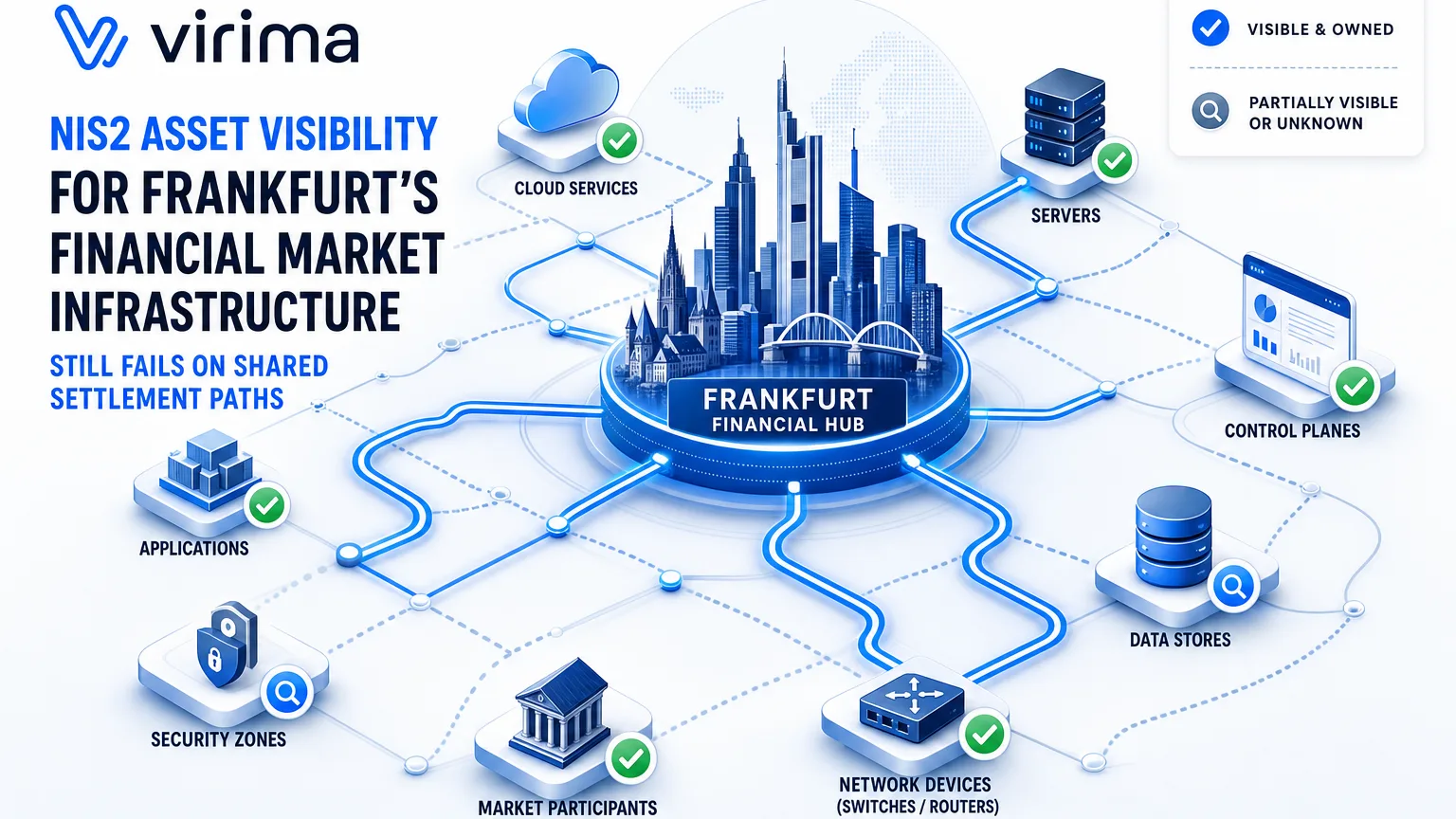
NIS2 Asset Visibility for Frankfurt’s Financial Market Infrastructure Still Fails on Shared Settlement Paths

The German competent authority sample did not start with a policy binder. It started with three hosts that sit on a payment or settlement path out of Frankfurt, plus the question every financial market operator dreads: who owns each host today, what depends on it, and when was that picture last refreshed from live discovery rather than a quarterly export?
That is the real test of NIS2 asset visibility for Frankfurt’s financial market infrastructure. Annex I essential-entity duties land on banking, financial market infrastructure, and digital infrastructure operators that keep euro clearing, settlement, and market data moving. Spreadsheet inventories that look complete in a workshop still fail when the sample hits a shared switch, a co-located rack, a vendor jump box, or a cloud control plane that never sat in the CMDB.
This page is not another generic NIS2 checklist. For the cross-sector audit-day list, use NIS2 compliance checklist: what audit day actually requires. Here the lens stays on Frankfurt-centered financial market infrastructure (FMI): trading venues, CSDs, CCPs, payment processors, and the IT estates that keep those services available under NIS2 risk measures.
For the category frame before you rewrite another inventory policy, start with Trusted Runtime Truth.
Why Frankfurt FMI is a harder visibility problem than a single bank branch estate
Frankfurt concentrates euro market plumbing: exchange and clearing networks, TARGET-related payment traffic, and dense colocation around major venues. The European Central Bank’s TARGET services overview is a reminder that settlement and payment rails are national and pan-European at once. Operators in and around Frankfurt rarely own every hop on a path that matters for continuity.
NIS2 still expects essential entities to manage risk, handle incidents, secure the supply chain, and keep business continuity evidence that assumes you know the systems in scope. The European Commission’s NIS2 Directive page lists financial market infrastructures among the critical sectors. Visibility work fails when the inventory stops at our laptops and our named servers and ignores shared infrastructure that still sits under your risk measures.

| Visibility failure | What the sample often finds | Why FMI estates hit it first |
|---|---|---|
| Shared fabric | Core switch or firewall with no CI owner | Multiple business services share the hop |
| Co-lo and vendor gear | Jump hosts and appliances outside the CMDB | Contractors refresh gear without ITAM tickets |
| Cloud and SaaS control planes | Subscriptions with no service map join | Market data and surveillance tooling expand fast |
| Cross-entity dependencies | Upstream CCP or network provider systems | Continuity plans assume partners stay up |
| Stale last-seen | Decommissioned hosts still production | Quarterly CMDB cleanups lag settlement calendars |
What does a NIS2-ready CMDB record need?
Five fields per configuration item: an accountable owner, a discovery source, a last-seen date, a criticality tag, and at least one dependency edge to the service it supports. A sampled record missing any one of the five is treated as unverified, regardless of how complete the surrounding policy documentation looks.
CISA Binding Operational Directive 23-01 is a U.S. federal inventory rule, not EU law. Enterprise programs still use the same operational lesson: incomplete asset inventories break every control that claims coverage.
What NIS2 asset visibility means for FMI operators (not a full legal memo)
NIS2 asset visibility for Frankfurt’s financial market infrastructure means a dated, owned overview of the IT assets and dependencies that support essential market and payment services in scope for your entity type, refreshed from discovery-sourced records rather than one-off workshops.
NIS2 also splits obligations between essential entities and important entities by size and sector criticality; most Frankfurt-area FMI operators — trading venues, CSDs, and CCPs — sit under Annex I essential-entity duties, which carry closer supervisory oversight and shorter reporting expectations than important-entity status. That classification is a starting scoping question, not a visibility answer by itself.
It is not:
- A substitute for German transposition advice or BaFin engagement
- A full Digital Operational Resilience Act (DORA) ICT-risk programme by itself
- A claim that Virima is a GRC, CSIRT portal, or regulatory filing tool
It is the infrastructure evidence layer that risk analysis, incident handling, supply chain security, and continuity testing all lean on. ENISA’s NIS2 Technical Implementation Guidance turns Article 21-style measures into technical expectations. None of that guidance treats an undated spreadsheet as proof that asset security holds under sampling.
In July 2026 the Commission referred several Member States to the Court of Justice for incomplete NIS2 transposition (Commission press release IP/26/1499). Operators still face national competent authorities and CSIRT reporting clocks. Inventory currency does not wait for every transposition lawsuit to finish.
What is NIS2 asset visibility for financial market infrastructure operators?
It is a discovery-sourced, owned inventory of systems and dependencies that support essential market and payment services in scope. Auditors and competent authorities sample hosts, owners, freshness dates, and service joins. Policy binders without that evidence fail the same controls they claim to meet.
The five inventory gaps that break Frankfurt FMI samples
1. Settlement-path hosts without a single accountable owner
A host can sit on a path that supports matching, clearing, or payment messaging and still have three owners in three tools. NIS2 accountability and access-control measures need one accountable role per relevant asset. Discovery that only populates hardware without owner fields leaves the governance gap open. A related pattern shows up across industries, not just FMI: discovery has found that 12% of devices had no owner assigned, and that gap reads very differently once an auditor asks who is responsible for a specific host on a payment path.
2. Shared network and security appliances treated as background noise
Core routing, load balancers, and perimeter devices rarely appear on the business-service spreadsheet. They appear first when an incident needs a blast-radius answer. Without configuration items and relationship edges, continuity plans describe org charts instead of failure paths. Finding shadow servers and unknown network devices before an auditor does is the same discipline applied earlier in the calendar.
3. Co-location and vendor-managed gear outside discovery scope
Frankfurt estates often mix owned racks, co-lo cages, and vendor-managed appliances. Credential and scope limits leave dark zones. ENISA’s NIS2 technical guidance treats third-party and supplier-managed infrastructure as part of the supply chain security measures operators must account for, not as an exception to them — so gear a vendor operates on your behalf still needs an owner and a last-verified date on your side of the boundary. Those zones still sit inside essential-entity risk measures when they carry market traffic.
4. Cloud control planes and market-data SaaS without CMDB joins
Surveillance, market data, and collaboration SaaS expand faster than import jobs. Subscriptions without join keys to business services break supply chain and access reviews. The same ENISA guidance extends risk-measure expectations to the services an entity depends on, not just the hardware it owns, which is why a subscription with no service join is a compliance gap and not only a data-hygiene one. High-frequency scheduled discovery cycles plus API inventory close more of that gap than annual cloud workshops.
5. Partner and upstream dependencies with no last-verified edge
FMI continuity depends on other entities. You cannot discover every partner’s private estate. You can still record the interfaces, circuits, and systems you own that connect to them, with last-verified dates. That is the evidence supply chain security reviews actually sample.
What inventory evidence should Frankfurt FMI teams prepare for NIS2 sampling?
Prepare scoped essential services, discovery-backed configuration items with owners and last-seen dates, service dependency joins, stale-record quarantine, and supplier touch points on production paths. Continuity and incident tests should name the same configuration items the inventory claims.
A practical visibility packet before the next competent-authority conversation
Build a packet your risk, IT, and compliance leads can defend without rewriting NIS2 law:
- Scope statement for essential services you operate from Frankfurt-linked estates (named services, not vague IT).
- Discovery-backed CI list with owner, status, source, and last-seen for sampled classes (servers, network, critical endpoints, cloud accounts in scope).
- Service joins from those CIs to the market or payment services they support (ViVID™ maps after service definitions exist; definitions are an input, not an automatic invention).
- Stale-source quarantine list: records past freshness SLA, blocked from silent overwrite by spreadsheets.
- Supplier touch map for direct ICT suppliers that reach production paths, scaled to actual risk.
- Incident and continuity test evidence that names the same CIs the inventory claims.
Use national transposition and legal counsel for final obligations. Use nis2directive.eu requirements as a plain-language orientation to the four pillars and minimum measures, then prove the asset lines with live data.
Why do Frankfurt financial market infrastructure teams fail NIS2 inventory samples?
Shared settlement paths, co-location gear, vendor appliances, and cloud control planes often sit outside a single CMDB owner model. Continuity and incident plans then reference services whose underlying hosts have no dated discovery source. Sampling finds the gap faster than policy workshops do.
How Virima supports NIS2 asset visibility without replacing your GRC stack
Virima is a discovery-sourced CMDB and visibility layer. It helps FMI and banking IT teams keep estate truth current so risk, incident, and continuity programmes can cite real configuration items.
What Virima contributes
- Automated discovery across hybrid paths Virima covers so identity keys and last-seen stay current
- CMDB records that carry source and freshness for audit sampling
- ViVID™ dependency maps after service definitions are provided
- Windows Server NIST NVD overlays on maps where that signal applies, without claiming full multi-OS vulnerability management
- Publish into ServiceNow, Jira, Ivanti, and many more through one hub: all integrations
What Virima does not claim
- Autonomic Social Discovery (ASD) as a go-forward capability
- Passive continuous real-time event discovery as current product behavior
- Replacement of BaFin filings, CSIRT portals, or GRC platforms
- Instant invention of business services without a definition input
- Full DORA ICT-risk management or third-party register product coverage
- GCP discovery parity with AWS and Azure where product scope is cloud-limited
- Legal advice on German NIS2 transposition
For capability depth, see IT discovery and CMDB.
Close the sample before you polish the binder
NIS2 asset visibility for Frankfurt’s financial market infrastructure is won or lost on shared paths, owner currency, and last-seen age, not on how thick the policy PDF is. Essential-entity duties still need risk measures, incident handling, supply chain security, and continuity plans. Those controls inherit whatever inventory quality you actually run.
If Frankfurt-linked settlement and market paths still sit on hosts your CMDB cannot own or date, walk a discovery-sourced inventory packet against the services you must keep available under NIS2.
Frequently Asked Questions
Is this the same as a full NIS2 compliance checklist?
No. A full checklist covers risk measures, accountability, reporting, and continuity across sectors. This article focuses on asset and dependency visibility for Frankfurt-centered financial market infrastructure estates that often fail the inventory sample first.
Does NIS2 asset visibility replace DORA work for financial entities?
No. DORA is a separate EU digital operational resilience framework for the financial sector. Inventory and dependency truth still feed both programmes. Treat them as related evidence needs, not as one product checkbox.
Can Virima discover every partner system on a settlement path?
No. Virima discovers and maps systems in your scope. Partner estates stay outside your credential boundary. Record the interfaces and owned systems that connect to partners, with last-verified dates, for supply chain and continuity evidence.
What should we bring to a competent authority or auditor sample?
Bring scoped service lists, discovery-backed CIs with owners and last-seen, service joins, stale-record quarantine, supplier touch points you can defend, and incident or continuity tests that name the same CIs. Confirm final legal obligations with counsel and national rules.
Does Virima’s discovery cover the co-location and vendor-managed gear that often sits outside the CMDB?
Coverage depends on credential and network access, not on the gear’s location. Co-located and vendor-managed appliances stay out of scope until your team can provide the access to reach them; Virima does not invent visibility into infrastructure it cannot reach. That access gap is itself the scoping decision gap #3 above describes.