Best SolarWinds Alternatives and Competitors in 2026

| What are the best SolarWinds alternatives in 2026? The best SolarWinds alternatives depend on which module you are replacing. For network monitoring, Datadog, PRTG, and Zabbix lead the field. For ITSM, Freshservice covers most mid-market needs. For CMDB and asset discovery, Virima provides discovery-sourced CI accuracy that SolarWinds’ native CMDB does not match. No single tool replaces all SolarWinds modules, so most teams replace by use case. |
Why IT Teams Are Moving Away from SolarWinds
SolarWinds covers a lot of ground. Its platform spans network monitoring, ITSM, log management, ITAM, and CMDB. But that breadth comes with real trade-offs. Licensing costs increase substantially as you activate additional modules, and the platform’s complexity slows down teams that need fast operational answers.
The 2020 Orion supply chain attack is still shaping procurement decisions. CISA confirmed the attack compromised thousands of organizations globally and reshaped how enterprise IT teams evaluate vendor trust and third-party software risk. Security teams that lived through Orion now treat vendor risk very differently.
Beyond security, many IT teams find that SolarWinds’ discovery engine does not keep pace with modern hybrid environments. The CMDB and ITAM modules surface network data, but they do not provide the CI relationship context, service dependency mapping, or asset lifecycle detail that today’s IT operations teams need for change management, incident response, or audit readiness.
What to Evaluate Before You Switch
Before picking a replacement, identify which SolarWinds module you are actually replacing. The answer changes which alternatives belong on your shortlist.
- Network monitoring (Orion/NPM): You need protocol depth, topology mapping, and reliable alerting.
- ITSM (Service Desk): You need ITIL-aligned workflows, a self-service portal, and CMDB integration.
- ITAM and CMDB: You need high-frequency discovery cycles, multi-source CI reconciliation, and service dependency mapping.
Most alternatives excel in one or two of these areas. Few cover all three at enterprise depth. Because of that, many teams replace SolarWinds module by module rather than all at once.
Also check your CMDB data quality before you switch. If your CMDB has been fed by SolarWinds discovery, you may be carrying stale or incomplete CI data into your next platform. That gap is worth addressing before, not after, the migration.
8 Best SolarWinds Alternatives and Competitors in 2026
1. Datadog
Datadog is a cloud monitoring and observability platform that covers infrastructure metrics, application traces, logs, and security signals in a single interface. It works well for cloud-native and hybrid environments where you need full-stack visibility beyond network monitoring.
Best for: Engineering and SRE teams managing cloud workloads who need correlated observability across infrastructure and application layers.
Key strength: A single pane for metrics, logs, and traces, with AI-assisted alerting and strong cloud provider integrations.
Where it falls short: Costs grow quickly as you instrument more hosts and services. Datadog does not address ITSM workflows or CMDB population natively. If you are replacing SolarWinds’ service management or asset modules, Datadog does not cover those use cases.
2. PRTG Network Monitor (Paessler)
PRTG monitors networks through SNMP, WMI, flow protocols, and packet analysis. It covers routers, switches, firewalls, servers, and applications from a single console. Most teams deploy it on-premises, which appeals to organizations with strict data residency requirements.
Best for: Network-centric IT teams that want a direct SolarWinds NPM equivalent without the vendor complexity or escalating licensing model.
Key strength: Deep protocol support, flexible sensor-based licensing, and a mature on-premises deployment model.
Where it falls short: PRTG is a monitoring tool, not an ITSM or CMDB platform. Teams that also need to replace SolarWinds Service Desk or ITAM modules will need additional tools alongside it.
3. Zabbix
Zabbix is an open-source monitoring platform that covers networks, servers, cloud services, and applications. Because it is free to use, it attracts teams with strong in-house technical capacity who want to eliminate per-device licensing costs entirely.
Best for: Teams comfortable managing infrastructure tools internally who want to cut SolarWinds licensing overhead.
Key strength: No licensing cost, highly flexible, and backed by a large community ecosystem with wide integration support.
Where it falls short: Implementation and ongoing maintenance require significant internal expertise. Native ITAM, CMDB, and ITSM capabilities are absent. Zabbix solves the monitoring problem, not the asset intelligence problem.
4. NinjaOne
NinjaOne combines remote monitoring, endpoint management, patch management, and basic ticketing in one platform. It is built for both internal IT teams and MSPs managing distributed endpoint environments.
Best for: Mid-market IT teams or MSPs that need RMM capabilities alongside lightweight ticketing and endpoint visibility.
Key strength: Fast deployment, strong patch management, and a clean interface that reduces technician ramp-up time considerably.
Where it falls short: NinjaOne’s CMDB and asset intelligence features are lightweight. It covers endpoints well but does not provide the CI relationship depth, service dependency context, or blast radius analysis that SolarWinds CMDB users may expect from a replacement.
5. ManageEngine OpManager
ManageEngine’s operations suite includes OpManager for network monitoring, ServiceDesk Plus for ITSM, and AssetExplorer for ITAM. As a suite, it is the most direct structural alternative to SolarWinds if you want to stay with a single-vendor approach.
Best for: Teams that want a single vendor covering monitoring, ITSM, and asset management under one contract.
Key strength: Broad functionality under one vendor, with native integrations between modules that reduce configuration overhead.
Where it falls short: The suite’s depth varies by module, and total cost of ownership climbs substantially at enterprise scale. Discovery capabilities inside AssetExplorer have similar limitations to SolarWinds’ ITAM module. For a deeper look, Virima’s guide to ManageEngine alternatives covers this in detail.
6. Freshservice
Freshservice is a cloud-native ITSM platform with modules for incident, problem, change, release, and asset management. Teams using SolarWinds Service Desk find it a clean, modern replacement. Gartner Peer Insights rates it as one of the leading platforms in the IT service management category, particularly for user experience and out-of-the-box ITIL alignment.
Best for: Replacing SolarWinds Service Desk with a modern, ITIL-aligned ITSM experience and stronger ticket automation.
Key strength: Intuitive interface, solid ticket automation, and a fast implementation timeline for mid-market teams.
Where it falls short: Freshservice’s discovery and CMDB depth are limited compared to dedicated platforms. G2 reviewers frequently note that discovery capabilities lag behind dedicated ITAM and CMDB tools. The asset management module handles the basics, but it does not provide CI relationship mapping, change impact analysis, or blast radius visibility that infrastructure-heavy teams need.
7. New Relic
New Relic is a full-stack observability platform covering application performance monitoring, infrastructure monitoring, log management, and synthetic testing. It targets engineering teams that need to correlate application behavior with infrastructure health in a single interface.
Best for: DevOps and SRE teams replacing SolarWinds for application performance and infrastructure observability.
Key strength: Traces, metrics, and logs in one platform, with AI-assisted anomaly detection and strong APM capabilities.
Where it falls short: New Relic does not address ITSM, CMDB, or ITAM use cases. It solves the observability problem, not the service management or asset intelligence problem. Teams replacing more than just SolarWinds NPM will need additional tools.
8. Virima: Discovery-Sourced CMDB and ITAM Complement
Virima does not replace SolarWinds’ network monitoring. Instead, it fills the CMDB and ITAM accuracy gap that monitoring tools leave behind.
SolarWinds can surface network data. But it cannot tell you which business service a failing server supports, which open change affects it, or who owns it. Virima’s IT discovery uses high-frequency discovery cycles across on-premises, AWS, and Azure environments to populate and maintain an accurate CMDB without manual effort. ViVID™ service mapping then builds dynamic dependency maps from that CI data, connecting assets to the business services they support so your team can assess blast radius before approving any change.
Virima also integrates directly with SolarWinds through the Virima SolarWinds integration. That means you can feed SolarWinds monitoring data into Virima’s CMDB layer for enriched CI records, rather than running two disconnected systems.
If you are replacing SolarWinds’ ITAM module specifically, see how the two compare on SolarWinds IT asset management features and limitations. For the CMDB comparison, read the breakdown of SolarWinds CMDB capabilities and alternatives.
| What does Virima do that SolarWinds CMDB cannot? Virima provides discovery-sourced CI accuracy, service dependency mapping through ViVID™ service maps, and asset lifecycle management that SolarWinds’ CMDB module does not support natively. It integrates with SolarWinds monitoring data and with ITSM platforms including ServiceNow, Ivanti, Halo, Jira Service Management, and Xurrent to provide a complete operational context layer. |
The CMDB Gap Monitoring Tools Leave Behind
Every monitoring tool on this list surfaces infrastructure data. None of them solve the CMDB accuracy problem on their own.
A network monitor tells you a device is unreachable. A CMDB tells you which business services depend on that device, who owns it, what changed in the past 72 hours, and what the downstream impact will be if you take it offline. That context is what separates fast incident resolution from prolonged outages and failed change windows.
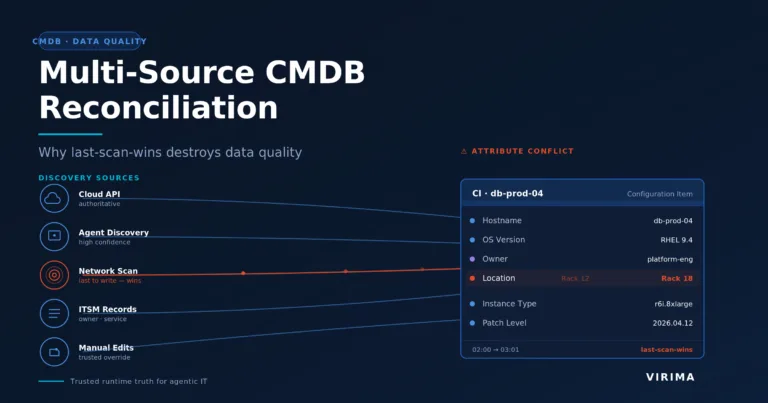
When you switch from SolarWinds, the risk is carrying forward stale CI data into your next platform. Discovery-driven CI population is what prevents that. Virima’s IT asset management tracks the full hardware and software lifecycle, including license compliance, contract dates, and end-of-life status. Its ViVID™ service mapping capability builds dynamic dependency maps from discovered CI data, so you can see blast radius before you approve a change.
Gartner’s coverage of infrastructure monitoring tools reflects this separation: monitoring platforms and CMDB platforms serve different primary use cases, and teams increasingly need both working together to achieve the operational context required for change governance and agentic IT operations.
See how Virima provides that context layer. Explore Trusted Runtime Truth
| What is the difference between a network monitoring tool and a CMDB? Network monitoring tracks device availability, performance metrics, and traffic flows. A CMDB tracks what every CI is, how it relates to other CIs, which service it supports, and who owns it. Monitoring tells you something is broken. A CMDB tells you what else breaks if you change or lose that asset. Most SolarWinds alternatives address monitoring well; few address CMDB accuracy. |
Matching the Right Tool to Each SolarWinds Module You Are Replacing
No single alternative covers everything SolarWinds does. The most effective approach is to replace module by module and choose the best tool for each job.
For network monitoring, Datadog, PRTG, or Zabbix give you the protocol depth and alerting that SolarWinds NPM provides. For ITSM, Freshservice covers the ITIL-aligned workflows that SolarWinds Service Desk handles. For CMDB and ITAM, Virima provides discovery-sourced CI accuracy, ViVID™ service maps, and asset lifecycle management that monitoring tools do not cover.
That combination gives you better performance in each layer and accurate CI data your teams can act on. When your CMDB reflects what actually exists in your infrastructure, change approvals get faster, incident resolution shortens, and audit preparation stops being a manual effort.
Frequently Asked Questions
Why do IT teams look for SolarWinds alternatives?
The most common reasons are licensing cost, platform complexity at scale, and CMDB data quality. Monitoring teams often outgrow SolarWinds’ asset and CMDB modules before they outgrow its network monitoring features. The 2020 Orion supply chain attack also reshaped how many security teams evaluate vendor risk and third-party software exposure.
Can I keep SolarWinds NPM and still replace my CMDB?
Yes. Many teams keep SolarWinds NPM for network visibility while replacing the CMDB and ITAM modules with a dedicated platform. Virima integrates with SolarWinds so you can feed monitoring data into a discovery-sourced CMDB without removing your existing network layer. The Virima SolarWinds integration page covers how this connectivity works in practice.
Is Zabbix a good long-term alternative to SolarWinds?
Zabbix works well for infrastructure monitoring, particularly for teams with strong internal technical expertise. However, it does not cover ITSM or CMDB use cases. If your SolarWinds footprint includes Service Desk or ITAM modules, you will need additional tools alongside Zabbix to cover those areas.
What should I look for in a SolarWinds CMDB replacement?
Look for a platform that uses high-frequency discovery cycles to populate CI data, supports multi-source reconciliation, maps CI relationships and service dependencies, and integrates with your existing ITSM tools. A platform that relies on manual imports or spreadsheet uploads will not solve the accuracy problem you are trying to move away from.
How does Virima complement a team that already uses SolarWinds?
Virima integrates with SolarWinds to enrich CI records with relationship data, service context, and asset lifecycle details. When a SolarWinds alert fires, Virima provides the dependency context to understand impact, ownership, and change history alongside the alert. Teams also use Virima to build a CMDB that SolarWinds monitoring data alone cannot support.