Inherited CMDB Data Quality: 63% Degraded on Day 1

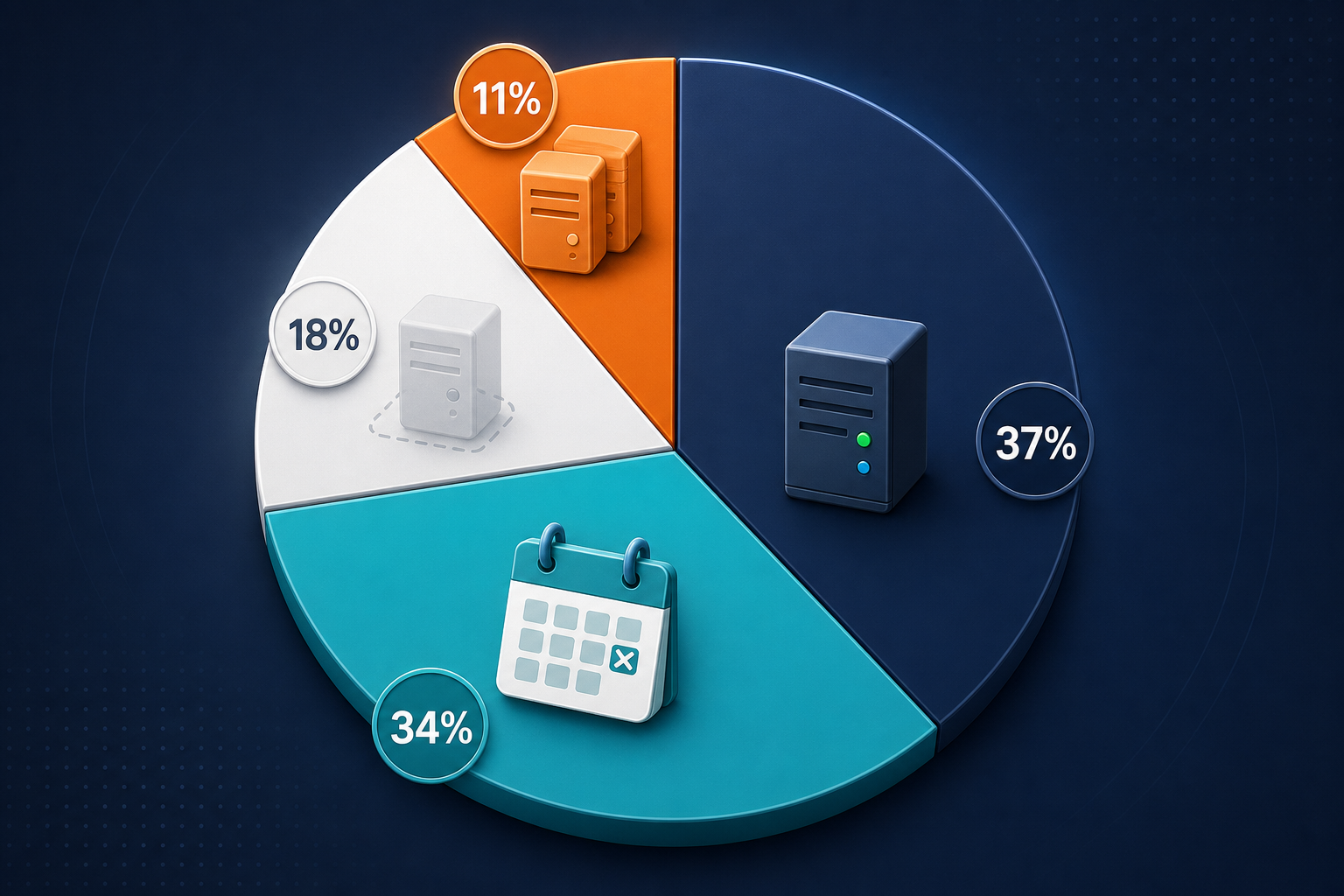
Inherited CMDB data quality degrades faster than manual teams can correct it. A discovery-sourced audit of a 14,000-CI CMDB found 63% of configuration items degraded on Day 1 — split across stale records (34%), ghost CIs (18%), and duplicates (11%). The root cause was structural: manual CMDB maintenance depends on notification triggers that infrastructure changes rarely generate reliably, at any team size or staffing ratio.
Inherited CMDB data quality: what 14,000 CIs revealed on day 1
Of 14,000 configuration items, 8,820 were degraded in some form — 63% of the total inventory, spread across three distinct failure categories. None of those numbers were visible in any dashboard before the audit ran.
What the Day 1 CMDB data audit found
The audit combined agentless network scanning across the on-premises environment, agent-based collection from managed endpoints, and API-based pulls from AWS and Azure. Against each discovered CI, four fields were validated: last confirmed active date, current network presence, hostname uniqueness, and owner assignment. Three degradation categories emerged immediately.
| Category | CI Count | % of Total | Operational Impact |
|---|---|---|---|
| Stale | 4,760 | 34% | Routes incident triage to wrong IP addresses or departed owners |
| Ghost | 2,520 | 18% | Dependency chains terminate in decommissioned assets |
| Duplicate | 1,540 | 11% | Neither record holds a complete picture of the asset |
| Clean | 5,180 | 37% | Accurate and current |
Stale CIs — 4,760 records (34%)
A stale CI is a configuration item record that has not been confirmed current within a defined threshold — in this case, 90 days. Several hadn’t been touched in over a year. Ownership fields pointed to team members who had left the organization months earlier. IP addresses reflected DHCP allocations from previous quarters, so incident triage would route to addresses that either no longer existed or had been reassigned to different devices entirely.
Ghost CIs — 2,520 records (18%)
A ghost configuration item is an active CMDB record for a device that no longer exists in the environment. Servers had been decommissioned. VMs had been deleted from the hypervisor. Physical removals happened when change requests closed — but CI record retirement depended on a separate notification step that frequently never arrived at the CMDB team.
Duplicate CI records — 1,540 records (11%)
A duplicate CI record is a single physical or virtual asset appearing under two separate CMDB entries. Both records accumulated tickets, open relationships, and linked vulnerability data independently, so neither held a complete picture of the asset. The most common trigger was a device rename combined with a new discovery run: the renamed device registered as a new CI rather than updating the existing one. Additional causes include manual imports run without deduplication checks and discovery tool migrations where assets re-register under new identifiers.
Relationship orphans — the hidden fourth failure mode
CI degradation creates a secondary problem that count-based audits miss: orphaned relationships. When a ghost CI is retired or a duplicate is merged, every relationship record pointing to it becomes a dangling reference — a connection to a CI that no longer exists or has changed identity. In this inherited environment, approximately 600 relationship records were orphaned: dependency links that showed a service connection but terminated in a retired or merged CI.
Orphaned relationships are why dependency-mapped incident triage fails silently. An engineer following a service chain doesn’t see an error — they follow a link that looks plausible but traces to nothing current. ViVID™ service maps surface orphaned relationship records as broken dependency chains, making this fourth failure mode visible before an incident forces discovery.
These three degradation categories — plus relationship orphans as their structural byproduct — are the pattern we see consistently in inherited CMDB data quality problems.
Why 22 months of manual maintenance produced this outcome
The team of four was not careless. Over 22 months, they processed change requests and kept pace with every infrastructure event they were directly notified about. The gap was structural, not behavioral.
Why the failure mode is structural, not behavioral
Manual CMDB maintenance depends on every infrastructure change generating an update trigger. That trigger has to reach the right person, at the right time, with bandwidth to act on it. Infrastructure changes don’t reliably generate those triggers. Servers get provisioned through channels that bypass CMDB notification. VMs get cloned for testing and are never cleaned up. Assets get physically relocated without a linked change request. Each individual gap is small. Over 22 months, those gaps compound into 8,820 degraded records.
Gartner research — consistently cited across CMDB industry analysis — puts this pattern in broader context: 75% of CMDB deployments fail to deliver on their intended goals, with data quality and completeness as the primary drivers. That figure isn’t a statement about careless teams — it reflects how inherently fragile trigger-dependent CMDB maintenance is at scale. Manual updates are reactive by design. They require someone to know a change happened, remember to update the CMDB, and complete the update before the next incident surfaces the gap.
A four-person team managing 14,000 CIs across on-premises and cloud infrastructure operates at roughly one administrator per 3,500 CIs. At that ratio, catching every change that doesn’t generate a formal notification isn’t a process problem — it’s a math problem.
What degraded inherited CMDB data quality costs in operations
During the first three weeks after inheriting this CMDB, two incidents made the operational cost tangible. In the first, an on-call engineer traced a dependency chain for a failing web service — terminating in a ghost CI for a load balancer decommissioned four months earlier. That dead-end cost 14 minutes of triage before the engineer abandoned the chain and started over. In the second, a stale IP address sent the response team to the wrong subnet, adding 20 minutes before the correct device was isolated.
Those 34 minutes of combined misdirection are not exceptional. They are the typical result of incident triage running against a degraded CI inventory. The pattern compounds at scale: more degraded CIs mean more dead-end dependency paths, more stale IP addresses, and more triage time consumed before engineers reach the actual affected system. Information Technology Intelligence Consulting (ITIC) research shows 98% of enterprises report that a single hour of unplanned downtime costs more than $100,000 — every misdirected triage minute carries a real cost.
If your inherited CMDB looks anything like this — or you suspect it might — Virima can run a discovery-sourced CI audit against your actual environment and categorize your inventory across the same four fields. Alternative to Cloudaware CMDB Explore Virima CMDB for multi-cloud environments
The downstream ITSM impact
Connecting a CMDB with 60%+ degradation to an ITSM platform before remediation sends inaccurate CI data into every downstream workflow. Change advisory board reviews rely on relationship maps that don’t reflect the actual environment. Vulnerability assessments link findings to ghost CIs that no longer exist. Compliance reports describe a configuration state from two years ago. For teams running ServiceNow, Jira Service Management, or Ivanti, that means every automated workflow touching CI data is operating on a foundation that cannot be trusted.
For a detailed look at how CI degradation creates compounding errors in ITSM workflows, see Virima’s guide to preventing duplicate CIs and sync errors in ServiceNow CMDB integration and the CMDB audit essentials overview.
How discovery-sourced population corrects the inherited baseline
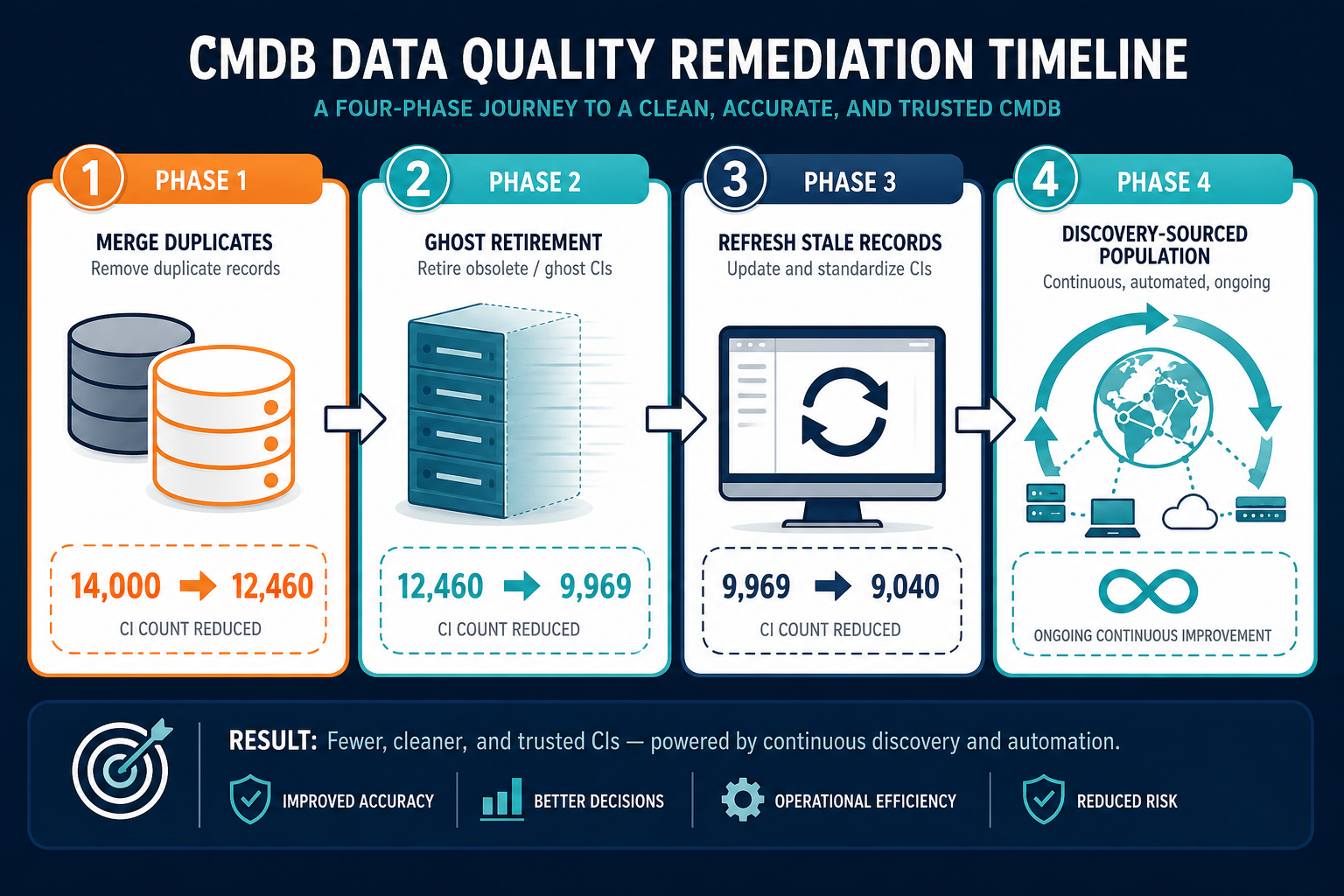
Remediating inherited CMDB data quality problems starts with replacing manual triggers with discovery as the update source. The remediation ran across four phases over eight weeks using discovery as the authoritative input rather than manual updates. Virima’s agentless and agent-based discovery — not additional manual update workflows — produced audit results that were authoritative from Day 1, independent of the same trigger-notification model that generated the degradation.
Phase 1: Merge duplicates (1,540 records)
Phase 1 merged all 1,540 duplicate CI records. The deduplication used hostname, MAC address, and serial number as matching keys — three independent identifiers that need to agree before records are merged. That brought the active CI count from 14,000 to 12,460.
Phase 2: Retire ghost CIs (2,520 records)
Phase 2 verified all 2,520 ghost CIs through active re-discovery. Of those, 2,491 were confirmed offline and retired. Twenty-nine were confirmed as relocated devices — assets that had moved without a linked change request — and their records were updated with current location and network data. Active CI count dropped to 9,969.
Phase 3: Refresh stale CIs (4,760 records)
Phase 3 refreshed all 4,760 stale CIs through combined agent-based and agentless scanning. Each CI was verified against its current network presence, ownership, and attribute state. Records that no longer matched any discovered asset were retired.
Phase 4: Establish continuous discovery-sourced population
Phase 4 established ongoing CMDB population rules so updates flow from discovery rather than manual triggers. Instead of relying on change requests to notify CMDB administrators, automated discovery runs on a schedule — agentless scans across on-premises networks, agent-based collection from managed endpoints, and API-based pulls from AWS and Azure — and pushes confirmed CI states back into the CMDB continuously. That shift is the one that makes the remediation durable.
At the end of eight weeks, verified CI count stood at 9,040 accurate, active records — a reduction from 14,000 inherited CIs that sounds like loss but represents a gain: every record in that 9,040 traces back to its discovery source.
Building from an accurate baseline
An inherited CMDB with 63% degradation is a diagnostic, not a dead end. But the remediation only holds if the structural problem — trigger-dependent updates — is replaced with continuous, discovery-sourced population.
With accurate CI records feeding Virima’s ViVID service maps, dependency chains reflect the environment as it actually exists. Change advisory boards review real blast-radius data rather than relationships mapped against decommissioned infrastructure. Incident engineers follow dependency paths that terminate at live systems. Software license counts run against assets confirmed active in the current quarter, not a list that includes VMs deleted six months ago.
Production CMDB health benchmarks typically target 95% CI coverage and 98% accuracy on critical attribute fields — the threshold below which CI data should be treated as untrustworthy for change advisory board reviews, vulnerability assessments, and compliance reporting. Virima recommends a monthly discovery scan cadence at minimum, with automated alerts when CI attribute staleness crosses a configurable threshold. Getting to 95%+ CI coverage from a 63% degradation baseline takes a structured remediation — but staying there only works with automated discovery as the update engine, not manual triggers as the fallback.
The automated discovery capabilities that rebuilt this CMDB baseline don’t require manual triggers to stay current. They run on a schedule — agentless scans, agent-based collection, and API-based pulls from AWS and Azure. The gap between what’s in the CMDB and what’s actually in the environment stays narrow: hours, not months.
For teams connecting their remediated CMDB to an ITSM platform, Virima integrates directly with ServiceNow, Jira Service Management, Ivanti, HaloITSM, Xurrent, Hornbill, TeamDynamix, and Cherwell to enrich those platforms with discovery-sourced ground truth — without replacing the tools your IT team already uses. For more on establishing and maintaining a healthy CMDB baseline, see why a CMDB baseline matters for IT infrastructure.
If your inherited CMDB looks anything like this — or you suspect it might — Virima can run a discovery audit against your actual environment and show you what your CI health looks like in hours, not weeks. Alternative to Cloudaware CMDB Explore Virima CMDB for multi-cloud environments