The Unowned-Asset Gap: An IT Asset Management Failure, Not a Data Problem

Managing IT assets across a sprawling estate quickly spirals into mismanagement without a proper IT asset management process. Especially in the face of security vulnerabilities.
A critical security vulnerability hit our client’s infrastructure. The security team identified which assets were exposed, but could not pinpoint who owned them. Across dozens of devices in their configuration management database (CMDB), the owner field was blank or listed someone who had left months earlier. With no one accountable, patch deployment stalled.
When IT operations ran a discovery scan to find every exposed asset, the problem turned out to be structural. Much of their live infrastructure had no assigned owner. Not unauthorized machines, but active systems handling real workloads, with no one responsible for their operation, patching, or downstream lifecycle decisions.
The team first approached it as a data problem. Assign owners, deploy patches, move on. But filling an owner field does not make someone accountable for an asset. When they conducted an asset management gap analysis, they found two distinct sources.
Some assets had never been assigned an owner when they entered the system. No one was responsible at the start, so no one was responsible now. That broke the accountability chain at the first link. Others had started with an owner, then lost one. A team member left without handing off responsibility. A project closed and its assets drifted. The chain broke somewhere along the process.
Both problems produced the same outcome: live systems, consuming resources and carrying risk, with no one answerable for their health and upkeep. The real question was not how to fill owner fields. It was how to restore accountability and keep the asset gap from returning.
What the Client Discovered: Ownership Gaps Across Four Stages
When the client investigated their unowned assets, they discovered accountability had to flow through four distinct stages, not sit with one person. Each stage required different decisions made at different times, and each needed its own accountable owner. A budget holder approved the purchase and justified its cost. An infrastructure engineer managed patching, configuration, and change approvals. A software license administrator tracked renewals and compliance.
A service desk lead decided when to retire the asset and dispose of it. When any of these four owners went missing, the decisions belonging to that stage stopped happening and the asset drifted.
Their asset management gap analysis revealed the gap ran across all four stages. Some devices had no operational owner. Others listed someone who had left the organization months earlier. A few had never been assigned an owner when they entered the IT asset management (ITAM) system.
The Acquisition Stage: No Budget Owner
Spend happened with no business case or cost center attached. Assets were bought, and no one could later say why. Accountability broke at the first link.
The Operations Stage: No Infrastructure Owner
Patches stalled and change approvals slipped through unsigned. The engineer who should have managed configuration either did not know the asset existed or had left without handing off the responsibility.
The License and Compliance Stage: No Administrator
Renewals were missed and licenses ran unwatched. Some products were over-licensed, others under-licensed, because no one was assigned to track them.
The Retirement Stage: No Disposal Owner
Assets ran years past their useful life, still consuming resources and still sitting on audit records, because no one was accountable for deciding when to retire them.
Where the Gap Was Widest
The asset management gap analysis revealed that cloud instances and contractor devices were the most exposed. A cloud instance spun up for a short project had no natural owner at any stage. A contractor’s laptop stayed on the network after the engagement closed, with no one assigned to manage it. Neither fit the normal path from acquisition to retirement, so neither picked up an owner along the way. Both needed the IT asset management process to assign one deliberately. Without that, they drifted.
How Our Client Fixed the Gap: Four Steps in Order
Finding the unowned assets was the straightforward part. Restoring stage-specific accountability without disrupting operations was the real work. The client worked through four steps in sequence, and the order mattered as much as the actions.
Step 1: Reconcile Discovery Against the Asset Register
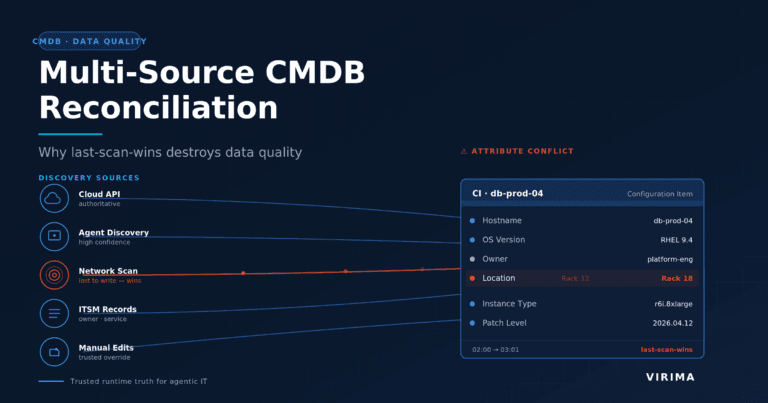
The team ran Virima’s IT discovery to find unknown assets and compare what was actually running against what the CMDB recorded. Discovery pulled live data from their network, servers, and cloud environments. The CMDB held the official record, and discovery showed what that record had missed, including assets with stale or departed owners. The comparison exposed every asset the register had lost track of.
Step 2: Classify Each Asset by Its Current Lifecycle Stage
The team sorted each unowned asset by where it actually sat in its life:
- In active use, needing an operational owner
- At or past renewal, needing a license administrator to renew or retire it
- Beyond useful life, needing a disposal decision
The stage set both the fix and the type of owner to assign. Sorting first stopped the team from assigning owners to assets that should simply be retired.
Step 3: Assign a Stage-Specific Owner
Each live asset received a named owner for its current stage. Where the right permanent owner was not yet confirmed, an interim owner took responsibility first. Change approvals, license renewals, and disposal decisions all waited on a named person, so this step had to come before the rest could work.
Step 4: Govern Ownership Through the ITSM Workflow
The team used Virima’s ITSM integrations to route each ownership assignment into their IT service management (ITSM) platform automatically. When discovery found a new asset, it opened an ownership task through Virima’s native connector without manual intervention. Each assignment became a tracked, auditable action, with a record of who assigned ownership, when, and why.
Within a couple of months, nearly every asset had a named owner at its current stage. A handful remained, each awaiting disposal sign-off rather than an owner. More important, the process that restored ownership became the process that sustained it.
Why the Gap Stayed Closed: The Governance Process
A one-time cleanup buys a few clean weeks. New devices connect, cloud resources spin up, and licenses lapse. Staff leave without handing off their stage responsibilities. The client needed a process that kept ownership assigned as the environment changed.
Scheduled Discovery That Triggers Ownership Assignment
Instead of running discovery once, the client set Virima’s discovery platform to run on a fixed, high-frequency schedule to find unknown assets. Every new asset it found opened a stage-specific ownership task in the ITSM system through Virima’s native connector. Because discovery ran on a regular schedule rather than once a year, no asset sat unmanaged for long. Each run caught new devices, departed staff, and changed circumstances. By the next audit window, ownership was current across the estate.
Ownership Rules Applied at Each Discovery Run
The client set ownership rules in Virima’s ITAM system based on asset type, location, and business unit. When discovery found a new asset, those rules decided which stage owner it should go to, applied at the point of entry rather than after the fact. The exposed asset types described earlier now picked up an owner on the next run. Mid-lifecycle orphaning, where an owner left without a handover, surfaced within one run instead of waiting for the next audit.
License and Compliance Visibility Built In
Every asset now carried its stage owner and lifecycle status, so over-licensing and under-licensing surfaced early rather than as audit surprises. The license administrator saw renewals coming and could plan ahead. License spend became a number the team controlled, not one that surfaced during negotiations.
Security Tied to Ownership
The cybersecurity asset management layer linked each owned asset to its known vulnerabilities. When a device showed a real Common Vulnerabilities and Exposures (CVE) entry, it surfaced with its stage owner already attached, and the fix went straight to the person responsible instead of through manual routing.
That was what finally closed the incident the team had started with. The exposed devices from the original vulnerability were traced to named owners and patched. The same scan that once returned assets with no one to call now returned every asset with an accountable owner attached.
| The Outcome Twelve months after the initial audit, the client ran reconciliation again. The gap between unowned assets and total inventory was negligible, and nothing had to be rebuilt from scratch. Every new installation, license renewal, and asset change moved through the same governed process. The gap did not return, because ownership had stopped being a cleanup project and become a standing discipline. |
What Other Teams Can Learn From Our Client’s Fix
The client’s experience reveals three foundational practices for governing ownership continuously, not just before audits.
Reconcile Discovery Against Your Register First
Our client’s owner fields looked populated until Virima’s IT discovery checked them against the CMDB and the running reality. That comparison showed which fields were truly empty and which listed owners had gone stale. Run a scan even when the register looks complete that’s often how you find unknown assets. The mismatch between what the record claims and what is actually running is usually where the asset gap hides.
Separate Entry-Time From Mid-Lifecycle Orphaning
Our client had two distinct problems that needed different fixes:
- Entry-time orphaning: an asset enters with no owner assigned, breaking the chain at the first link. Fix it with enforcement at the point of discovery or procurement entry.
- Mid-lifecycle orphaning: the asset starts with an owner who later leaves or changes roles, so the chain breaks along the process. Fix it with scheduled checks that confirm the listed owner is still there.
Treating them as one problem delays both fixes.
Restore Ownership First, Then Govern It on a Schedule
Cost, license, change, and disposal decisions all wait on a named person at the right stage. Assigning any owner is faster than holding out for the perfect one. An interim owner unblocks work immediately, and the permanent assignment follows.
More importantly, one-time cleanups fail. Enforcement at the point of discovery entry, on a recurring schedule, is what keeps the gap from returning. That takes a discovery platform feeding ITAM on a schedule, with ITSM governance routing every assignment through an auditable trail. Virima connects those three layers in one system, which is what held the fix in place for our client.
| Schedule a Virima demo to see how scheduled discovery feeds ITAM and routes ownership through your ITSM platform, so the scan that finds the gap becomes the process that keeps it closed. |
Frequently Asked Questions
Is an unowned asset a CMDB problem or an IT asset management problem?
The CMDB shows it, but the failure sits in asset management. The database records that an owner is missing. The reason no one is accountable, and no process assigns one, is a management gap. Correcting the record without fixing the process only lets the gap return.
Does one person own an asset for its entire lifecycle?
No. Ownership is stage-specific. The person accountable at acquisition is rarely the one who manages patching, renews licenses, or approves disposal. When a handover between stage owners breaks down, the asset goes ownerless mid-lifecycle even though the record can still look correct.
Why does a missing owner create license risk?
When no one owns the license stage, software keeps running against paid entitlements with no one renewing or reconciling them. That produces silent over- or under-licensing, a common audit finding that ISO/IEC 19770-1, the international standard for IT asset management, is built to prevent.
What keeps the gap from returning after a cleanup?
Ownership governed through scheduled discovery rather than a one-time fix. Each new asset triggers a stage-specific assignment as it is found, so a departed owner surfaces on the next run instead of sitting undetected until the next audit.