MSP IT Asset Management: Managing Multiple Client Environments at Scale

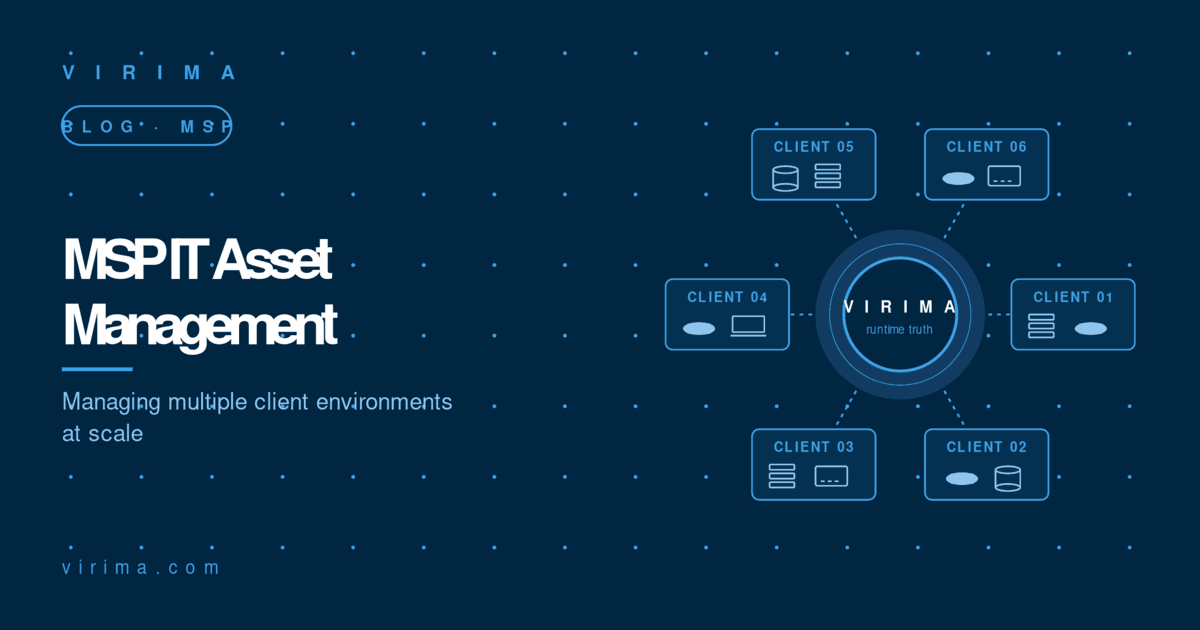
MSP IT asset management is one of the harder operational challenges in the managed services business. Running asset tracking for a single organization is hard enough. Running it across 20, 50, or 100 client environments at the same time is a different challenge entirely. For MSPs, this is not just IT operations — it is the foundation of every client outcome you deliver. Virima for Managed Services Providers is built for exactly this kind of multi-tenant reality.
The stakes keep rising. In 2024, IBM’s Cost of a Data Breach Report found the global average cost of a breach climbed to $4.88 million — the highest figure on record (IBM Cost of a Data Breach Report 2025). So for MSPs, even one incident at a client site, drawn out by stale asset data, can erase a quarter of margin.
Most MSPs start with the same setup. A mix of spreadsheets, RMM tools, and whatever discovery capability their PSA platform offers. It works at first. Then a client adds a cloud workload nobody tracked. A software audit surfaces unexpected gaps. An incident drags on because nobody can confirm which assets are in scope. The cracks show.
So the core problem is not a tool shortage. Instead, most IT Asset Management tools were built for single-tenant IT teams, not for service providers running many client environments. Forcing those tools into a multi-client context creates exactly the kind of stale data that slows incident response and complicates audits.
This article covers what MSP IT asset management needs to look like in 2026, the capabilities that determine IT asset management platform scalability, and how to build a foundation of trusted runtime truth that works across the client environments you manage.
The Multi-Client Problem Nobody Talks About Enough
Every MSP knows the moment. A client calls in with a P1 incident. Your engineer pulls up the client’s record. The CMDB shows three application servers. But the client mentions a fourth that was spun up two weeks ago. Now the engineer is working blind.
Multi-client environments multiply this problem. One outdated record in one client’s CMDB is a problem. Outdated records across dozens of multi-client environments become a systemic risk to your MSP’s service quality. MSPs need a different operating model — one built for multi-tenancy from the ground up.
Why Standard Tools Fall Short for MSP IT Asset Management
The Stale Data Trap
The biggest operational risk in MSP IT asset management is not a security breach or a failed change. Instead, it is stale data that nobody questions until something breaks.
When your team responds to an incident at a client site, they need to know what assets are involved, what those assets connect to, and what the blast radius looks like right now. Not as of the last manual scan three weeks ago. If your MSP CMDB is populated through periodic manual updates or infrequent discovery runs, the data is already out of date by the time you need it. This problem compounds at the hardware level — devices get deployed, moved, or retired without any corresponding CMDB update. A structured approach to computer lifecycle management at the client level closes that gap, keeping asset records accurate from first deployment through secure disposal.
For a single IT team, stale data is a problem. For an MSP managing dozens of environments, it becomes a portfolio-wide risk. So one outdated record in a client’s CMDB can turn a quick fix into hours of investigation.
The Tooling Sprawl Problem
Most MSPs accumulate tools over time. One RMM platform. A PSA for ticketing. A separate discovery tool. Maybe a spreadsheet-based license tracker. And whatever each client already had in place before you onboarded them.
Each tool solves part of the problem. But none of them share a common data layer. So your engineers spend time reconciling data across systems instead of resolving issues. Service delivery managers cannot get a consistent view of asset health across clients. And when a client asks for an audit report, someone has to pull data from multiple sources manually and hope it is accurate.
This is not a process failure. It is an architecture failure. Therefore, MSPs need a unified asset intelligence layer that spans client environments and feeds into whatever ITSM tools each client uses.
Understanding how RMM, PSA, ITSM, and CMDB layers fit together is the foundation for choosing the best managed IT services software for MSPs that work as a cohesive stack.
What Modern MSP IT Asset Management Requires in 2026
Effective MSP IT asset management in 2026 needs to do four things well:
- Discover continuously across on-premises, cloud, and hybrid environments for each client — without manual scans or agent deployment on every device.
- Maintain accurate, relationship-aware CMDBs for each client that stay current as environments change.
- Map service dependencies so your team understands how assets connect to services, and what breaks when something goes wrong.
- Integrate with whatever ITSM platform each client uses — ServiceNow, Jira Service Management, Ivanti, Halo, Xurrent, TeamDynamix, or something else.
These are not nice-to-have features. They are operational requirements for running a profitable MSP in an environment where clients expect faster resolution, tighter compliance, and more transparency than ever.
Discovery-Driven Ground Truth for Every Client Environment
Agentless, Agent-Based, and API Discovery Working Together
Reliable MSP IT asset management starts with reliable discovery. Not periodic scans. Not manual inventory collection. Instead, high-frequency discovery cycles that give you live asset data across the client environments you manage.
However, no single discovery method covers everything. Each method has its sweet spot:
- Agentless — best for network devices, infrastructure, and environments where agents are not practical; common gaps are endpoint software detail and cloud workloads.
- Agent-based — best for endpoints, software inventory, and configuration data; common gaps are network infrastructure and headless devices.
- API-based — best for cloud platforms (AWS, Azure) and SaaS; common gaps are on-premises assets that are not cloud-managed.
So you need all three working together. Virima’s IT discovery combines agentless, agent-based, and API-based MSP discovery to give an accurate, current picture of assets across hybrid environments. Your team gets live, explainable asset data rather than a snapshot that ages the moment the scan completes.
Hybrid Environment Coverage at the Client Level
Every client looks different. Some are mostly on-premises. Others have moved heavily to AWS or Azure. Most sit somewhere in between — a mix of physical servers, virtual machines, cloud instances, and SaaS applications.
Your MSP discovery capability has to handle the full range. When a client migrates a workload to the cloud, that change should appear in their CMDB as part of the next discovery cycle. Not after someone notices the discrepancy during a quarterly review. When a client adds a new application server, it should be discovered and related to the services it supports without anyone filing a ticket.
That is what discovery-driven asset data looks like in practice. Your CMDB reflects what is running right now, not what someone thought was running last month.
Multi-Tenant Data Separation Without Manual Overhead
A common question from MSPs evaluating ITAM tools: how do you keep one client’s data separate from another’s, while still giving engineers a unified workspace?
Virima handles this through tenant isolation at the data layer combined with role-based access at the user layer. Each client’s discovery data, MSP CMDB records, and service maps stay logically separate. Engineers scoped to a specific client see only the assets and dependencies for that client. Meanwhile, service delivery managers can roll up health and inventory views across the clients they oversee.
This matters operationally. MSPs cannot afford the risk of an engineer accidentally seeing — or worse, changing — another client’s environment. And it matters commercially. Clients increasingly ask about data isolation as part of their own compliance reviews.
Keeping Client CMDBs Current Without Manual Work
An MSP CMDB is only useful if it is accurate. That sounds obvious. But most MSPs are running on CMDBs that are partially accurate at best and actively misleading at worst.
The problem with manual CMDB maintenance is not careless engineers. Environments change faster than any team can track manually. A client spins up a new VM. Decommissions an old server. Updates a software version. Adds a cloud storage bucket. Each change should update the CMDB as discovery picks it up. Instead, they pile up as undocumented drift until something breaks.
Continuous CMDB maintenance fixes this by connecting high-frequency discovery cycles directly to CMDB build and ongoing population. When Virima discovers a new asset or detects a change, the CMDB updates as part of the next discovery cycle. Engineers do not need to file update requests or run reconciliation scripts. For MSPs managing white-labeled or isolated client environments, managing IT assets across multiple clients becomes simpler when each client’s CMDB is maintained in isolation yet visible from a unified MSP portal.
For MSPs, this matters at the client level and at the portfolio level. You need accurate data for each client. But you also need confidence that your team is not spending hours every week on data hygiene across many accounts.
Service Dependency Mapping Across Client Environments
Knowing what assets exist is necessary but not sufficient. You also need to understand how those assets relate to each other and to the services your clients depend on. That is where MSP service mapping changes the picture.
When an incident occurs at a client site, your team’s first question is usually “what is affected?” Without dependency maps, answering means tracing relationships through documentation that may or may not be current. With live service dependency maps, the blast radius surfaces in seconds.
Virima’s ViVID™ service mapping builds these maps from live discovery data. Each map shows asset relationships, application dependencies, active incidents, pending changes, and known vulnerabilities in a single view. So when a client’s database server goes down, your team sees immediately which applications depend on it, which services are at risk, and what the downstream impact looks like.
For MSPs managing many client environments, this MSP service mapping capability is especially valuable during incident response. Engineers do not need to remember the topology of every client environment from memory. Instead, the maps surface the context they need, drawn from live discovery data.
Incident Response and Change Management at MSP Scale
Cutting MTTR When You Manage Dozens of Clients
Mean time to resolution (MTTR) is one of the most visible metrics for any MSP. When clients measure your performance, MTTR usually sits near the top. Cutting MTTR at scale requires more than faster engineers. It requires better context at the moment of triage.
In practice, the biggest driver of slow incident resolution is not technical complexity. It is the time spent figuring out what is connected to what, what changed recently, and who owns the affected assets. When that context is not immediately available, your engineers spend the early minutes of an incident gathering information that should already be in front of them.
Trusted runtime truth changes this. When your CMDB is continuously populated from live discovery data and your service maps reflect current dependencies, your engineers can start resolving the incident instead of researching the environment. Root cause context surfaces immediately. Ownership is clear. The blast radius is visible.
Blast Radius Visibility Before Every Change
Change management is where MSPs most often introduce risk. A change that looks straightforward in isolation can have unexpected downstream effects if you do not know what depends on the asset being changed. The ITIL 4 framework calls this dependency awareness a precondition for safe change — and at MSP scale, it is non-negotiable.
Showing blast radius before approving a change is the difference between a planned maintenance window and an unplanned outage. Virima surfaces dependency context at the change approval stage, so your team can see what is at risk before any change is approved.
This matters especially for MSPs. A change at one client site can sometimes have implications that are not obvious without a complete dependency picture. As a result, having that picture available at approval time means your change advisory process is based on facts, not assumptions.
Audit Readiness Across Multiple Client Accounts
Audit preparation is one of the most time-consuming activities for MSP teams. When a client faces a compliance audit — SOC 2, ISO 27001, HIPAA, or another framework — they need accurate records of what assets exist, what software is installed, what licenses are in use, and how long assets have been in service. For MSPs whose clients include GRC leaders and compliance owners, this kind of audit support is now part of the service contract.
If your asset data lives in spreadsheets or is maintained manually, pulling together an audit package means hours of data collection, reconciliation, and verification. And if the data turns out to be inaccurate, you have a bigger problem than the audit itself. Strong IT audits depend on a current asset record — not a snapshot assembled the week before.
Continuous asset tracking changes audit preparation substantially. When your CMDB is maintained from live discovery data, audit-ready reports are available on demand. Hardware lifecycles, software license counts, contract details, and ownership records are current because they update continuously — not assembled before each audit.
For MSPs managing clients in regulated industries like financial services or healthcare, this is not optional. Your clients need to demonstrate compliance. And your ability to provide accurate, timely asset data is part of your service delivery.
ITSM Integration Without Forcing Clients to Switch Platforms
One reality of running an MSP: your clients use different ITSM platforms. Some use ServiceNow. Others use Jira Service Management, Ivanti, Halo, Xurrent, or TeamDynamix. Asking every client to migrate to a single platform is not a realistic option.
So a vendor-neutral CMDB foundation matters for MSPs. You need an asset intelligence layer that integrates with whatever ITSM platform each client is already using, rather than one that requires platform migration as a prerequisite.
Virima provides bidirectional sync with popular ITSM platforms including ServiceNow, Ivanti, Halo, Xurrent, Jira Service Management, and TeamDynamix. Your discovery data and CMDB records flow into each client’s existing ITSM workflows without requiring anyone to change platforms. Your team gets a consistent asset intelligence layer. And each client keeps the ITSM tools they already know.
For MSPs whose clients run SolarWinds Service Desk, the question of whether it can serve as both the help desk and the CMDB layer matters operationally — the Virima vs SolarWinds Service Desk comparison explains exactly where the asset and discovery layer needs to be supplemented.
This approach also means your asset management foundation does not depend on any single client’s ITSM choice. If a client switches platforms, your discovery, CMDB records, and service maps keep working.
Agentic ITAM: Where MSP Asset Management Is Heading
MSP IT asset management is moving toward a model where AI agents handle more of the routine operational work. Incident triage. Ticket routing. Anomaly detection. Remediation suggestions. This is the direction the industry is heading, and it changes what your asset data needs to look like.
However, AI agents can only act safely when they have access to live, explainable operational context with clear source attribution. An agent that routes an incident based on stale CMDB data will route it incorrectly. An agent that approves a change without understanding the blast radius will introduce risk. So the quality of any agent-driven action depends entirely on the quality of the underlying asset data.
Virima already builds toward this today through service map rescan, confidence-scored asset data, and source attribution at the asset level. Extending the same foundation to AI agents is the next step, not a rebuild. For MSPs, your asset intelligence layer is ready when AI agents start handling routine work — because the underlying data is live, traceable to source, and current enough to act on.
Next Steps
Managing IT assets across many client environments is one of the harder operational challenges in the MSP business. The tools that work for single-tenant IT teams rarely scale to multi-client reality.
So the answer is not more tools. It is a better foundation. High-frequency discovery that gives you live, discovery-driven asset data. CMDB maintenance that keeps pace with how fast environments actually change. Service dependency maps that surface blast radius and root cause context when you need them. And ITSM integrations that work with whatever platforms your clients already use.
That foundation makes your incident response faster, your change approvals safer, your audits less painful, and your team more efficient across the clients you manage. Done right, MSP IT asset management stops being a recurring fire and starts being a competitive moat.
See how Virima delivers live, discovery-driven runtime truth across MSP client environments — explore Virima for MSPs.
FAQs
What is MSP IT asset management and why is it different from standard ITAM? MSP IT asset management refers to the processes and tools a managed service provider uses to track, manage, and report on IT assets across multiple client environments at the same time. It differs from standard ITAM because it requires multi-tenant data separation, integration with multiple ITSM platforms, and the ability to scale discovery and CMDB maintenance across many different client configurations.
How can MSPs keep client CMDBs current without manual updates? The most reliable approach is continuous discovery connected directly to CMDB population. When discovery runs at high frequency across a client’s environment, any new asset, changed configuration, or decommissioned device updates the CMDB as part of the next discovery cycle. So this eliminates the manual update cycle that causes CMDB drift.
What discovery methods work best for MSP environments? MSPs need a combination of agentless, agent-based, and API-based discovery to cover all asset types across hybrid environments. Agentless discovery handles network infrastructure. Agent-based discovery provides deeper endpoint and software visibility. API-based discovery connects to cloud platforms like AWS and Azure. Relying on any single method leaves gaps.
How does service dependency mapping help MSPs during incident response? Service dependency maps show how assets relate to each other and to the services clients depend on. During an incident, your team can see the blast radius, which assets are affected, what services are at risk, and what changed recently. As a result, this context cuts the time spent on triage and investigation.
Can MSPs use a single asset management platform when clients have different ITSM tools? Yes, if the platform integrates with multiple ITSM systems. A vendor-neutral CMDB foundation that connects to ServiceNow, Jira Service Management, Ivanti, Halo, Xurrent, and TeamDynamix lets MSPs maintain consistent asset intelligence while each client keeps their existing ITSM workflows.
What does audit readiness look like for MSPs managing regulated clients? Audit readiness for MSPs means having continuously maintained asset records that can generate accurate reports on demand. When asset data is populated from live discovery rather than assembled before each audit, the preparation process is faster and more reliable.
What is the difference between RMM and ITAM for MSPs? RMM (remote monitoring and management) tools watch endpoints in real time and push updates, patches, and scripts. ITAM (IT asset management) tracks what assets exist, who owns them, what they depend on, and how they relate to services. So RMM is about operating endpoints across clients. ITAM is about understanding the full asset estate — including network gear, cloud workloads, and on-premises infrastructure that RMM does not see. For MSPs, the two are complementary. RMM keeps endpoints healthy. ITAM gives you the multi-tenant CMDB, dependency maps, and audit-ready records that incident response and change management depend on.
What is agentic ITAM and why should MSPs care about it now? Agentic ITAM refers to IT asset management that supports AI-driven actions — incident triage, change routing, anomaly detection. For MSPs, it matters now because the quality of your asset data today determines whether AI-assisted service delivery will work reliably tomorrow.