What Is SACM? A Practical Guide for IT Teams

TLDR: SACM (Service Asset and Configuration Management) is the ITIL 4 practice that governs how configuration items (CIs) are identified, controlled, verified, and managed across their lifecycle. This guide covers what SACM is, why it matters, how it fits within ITIL 4, and what practical implementation looks like for IT teams, from defining CI scope to running configuration audits. Virima supports the full SACM lifecycle through discovery, business rules governance, CI lifecycle tracking, configuration baselines, audit history, and ITSM platform integration.
Service Asset and Configuration Management is one of the most foundational and most frequently underimplemented practices in ITIL 4. Organizations often have a CMDB but lack the governance discipline to keep it trustworthy.
This guide explains what SACM is, why it matters, how it connects to the rest of ITIL 4, and what practical implementation looks like for IT teams. It also covers how Virima supports each stage of the SACM lifecycle.
ITIL 4, as maintained by PeopleCert, defines SACM’s purpose as ensuring that accurate and reliable information about the configuration of services and the CIs that support them is available when and where it is needed across the entire service lifecycle, making it the foundational practice that Change Enablement, Incident Management, and Problem Management all depend on.
What is SACM in ITIL 4?
Service Asset and Configuration Management (SACM) is one of the 34 management practices defined in the ITIL 4 framework. Its purpose is to ensure that accurate and reliable information about the configuration of services and the configuration items (CIs) that support them is available when and where it is needed.
SACM covers the full lifecycle of service assets and CIs: their identification, control (ensuring changes happen through authorized processes), status tracking, verification against the actual environment, and audit. SACM governs the CMDB, the database where CI records and relationships live, but SACM is the practice, not the tool.
Why SACM matters: the cost of getting it wrong
Most IT teams have experienced some version of this: an outage is escalating, nobody knows which services depend on the failing server, the CMDB has not been updated in months, and responders are running manual discovery in the middle of a P1 incident. That scenario is what happens when SACM is absent or nominal.
The business case for a properly governed SACM practice is direct:
Change decisions rely on accurate CI data. Change Enablement uses CMDB relationships to assess impact. If those relationships are wrong, impact assessments are wrong, and change failures follow.
Incident resolution relies on accurate service maps. Without an SACM-governed CMDB, responders have no structured way to identify affected services or reach the right resolver group during an outage.
Compliance depends on configuration evidence. Auditors need to see not just the current state of critical systems but the history of how configurations changed. SACM’s audit trail provides that evidence.
AI-driven IT operations require trusted data. As organizations begin deploying AI agents and automation across ITSM workflows, those systems act on CMDB data. Inaccurate data produces inaccurate actions, at machine speed and at scale.
How SACM fits within the ITIL 4 framework
ITIL 4 organizes its 34 management practices across three categories: General Management, Service Management, and Technical Management. SACM sits in the Service Management category, alongside Change Enablement, Incident Management, Problem Management, and Service Desk.
What makes SACM distinct is its role as a data foundation rather than a response practice. SACM does not handle incidents or changes directly. It provides the accurate, governed CI data that those practices depend on.
Key practice relationships within ITIL 4:
SACM and Change Enablement: SACM data powers impact assessment. Change Enablement uses CI relationships from the CMDB to determine what is downstream of a proposed change. Without SACM governance, impact analysis is speculative.
SACM and Incident Management: During an incident, SACM-governed service maps identify which services are affected by a failing CI and route the incident to the right resolver group.
SACM and Problem Management: SACM’s audit history, the record of what changed and when, is the primary structured data source for root cause analysis, replacing unreliable human recollection with timestamped configuration evidence.
SACM and IT Asset Management: SACM and IT Asset Management: SACM and IT Asset Management:ITAM tracks the financial and contractual lifecycle of assets. SACM governs their technical configuration. Both practices operate on the same objects from different angles, and tools like Virima handle both on a single platform — including financial workstreams like software license optimization, which rely on SACM-governed deployment data to right-size entitlements against actual usage.
For a deep comparison of SACM and ITAM, see CMDB vs SACM.
SACM vs. CMDB: two different things
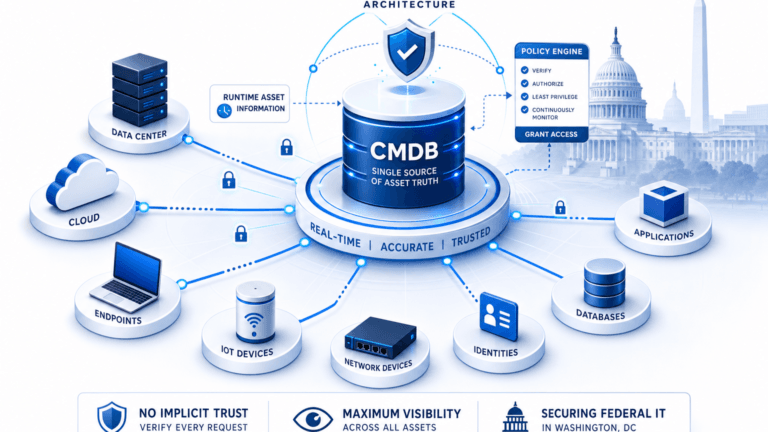
The CMDB is technology: a database that stores CI records, attributes, and relationships. SACM is the governance discipline that determines how that database stays accurate over time.
An organization with a CMDB but no SACM governance has a database that starts accurately and progressively degrades as the environment changes without systematic CI record updates. Discovery finds discrepancies, but nobody reviews them. CI records become stale. Practitioners stop trusting the data and start working around it.
SACM establishes the policies, roles, processes, and controls that prevent this degradation. SACM defines who creates and updates CI records, how discrepancies between discovered reality and CMDB records are resolved, how configuration changes are verified after implementation, and how data quality is measured and reported.
The CMDB is where configuration data lives. SACM is what keeps that data trustworthy.
The 7 core SACM activities
SACM organizes around seven core activities:
- CI Identification: defining which CI types are tracked, what attributes they carry, and what relationships between CIs are maintained in the CMDB.
- CI Control: ensuring only authorized changes are made to CI records, connecting SACM directly to Change Enablement processes.
- Status Accounting: tracking each CI through its lifecycle states (New, Active, Maintenance, Retired, Deleted) with a full state transition history.
- Configuration Verification: confirming that CMDB data matches the actual environment, typically through discovery with discrepancy review processes.
- Configuration Audit: formal reviews of CI data against authoritative records and configuration baselines, either on a schedule or triggered by incidents and change failures.
- Configuration Reporting: producing reports on the configuration estate for compliance, governance, and operational decision-making.
- Configuration Baseline: capturing and maintaining approved snapshots of service or CI configurations that serve as the reference point for drift detection and change verification.
Implementing SACM in practice: a 5-phase approach
Most SACM implementations fail not because teams lack the right tool but because they try to govern everything at once. A phased approach delivers value quickly while building toward comprehensive coverage.
Phase 1: Define CI scope and taxonomy
Before populating the CMDB, define which CI types the organization will track. Start with the CIs that directly support high-impact services: core infrastructure, production applications, and critical network components.
For each CI type, define which attributes to track (hostname, IP, OS, owner, location, etc.), which relationships between CI types to maintain, and which lifecycle states apply and what transitions are allowed.
Keep initial scope narrow. A well-governed CMDB covering 30% of the environment is more valuable than an ungoverned CMDB covering 100%.
Phase 2: Run discovery and populate the CMDB
With CI scope defined, run initial discovery to populate CI records. Discovery, agent-based or agentless, produces an initial CMDB population that would take months to build manually.
In Virima, the initial discovery run creates CI records with attributes and relationships. Discrepancies between discovered data and any pre-existing CMDB data surface for review immediately, so the review process starts from day one rather than after weeks of silent degradation.
Phase 3: Establish configuration baselines
After the initial CMDB population is validated, capture configuration baselines for critical systems. A baseline is a named, timestamped snapshot of CI configuration attributes: the approved reference state.
Baselines serve three purposes: verifying that changes were implemented as planned, detecting unauthorized configuration drift between change windows, and providing structured evidence for compliance audits.
Phase 4: Connect SACM to change and incident processes
SACM data only delivers full value when Change Enablement and Incident Management actually use it. At this phase, integrate CI impact assessment into the change request process, route incident records to CIs using CMDB service maps, and establish post-change verification as a standard step by comparing current CI state to pre-change baseline.
Phase 5: Implement ongoing governance
SACM is not a project that ends. Sustainable governance requires a recurring discovery schedule (frequency depends on environment change rate), a defined discrepancy review process covering who reviews conflicts and how quickly, regular configuration audits including both scheduled reviews and event-triggered reviews after incidents or change failures, and CMDB health metrics reported to IT leadership.
SACM roles and responsibilities
SACM requires defined ownership to function. The core roles are:
- Configuration Manager: Owns the SACM discipline. Responsible for CI scope definition, governance policy, audit schedule, and CMDB health reporting. This is a process owner role, not a hands-on data entry function.
- Configuration Librarian: Manages CI record updates, discrepancy review queue, and configuration audit execution. In smaller organizations, this role may be shared with the Configuration Manager.
- Change Enablement Team: Consumers of SACM data for impact assessment. Responsible for confirming that change plans reflect current CMDB state.
- Discovery Tool Owner: Responsible for the accuracy and schedule of discovery. In Virima, this role manages discovery credentials, scan scope, scan frequency, and the discrepancy review workflow.
- IT Asset Manager: In organizations with a separate ITAM function, coordinates with the Configuration Manager on CI records that span both practices.
Clear ownership prevents the most common SACM failure mode: everyone assumes someone else is maintaining the data.
How Virima supports the SACM practice
Virima provides specific platform capabilities for each SACM activity:
- CI Identification: Virima’s configurable CI type taxonomy lets IT teams define which CI types matter, what attributes each captures, and how relationships between CIs are structured, establishing the scope and schema of the CMDB to match the organization’s service delivery context.
- CI Control: The platform’s business rules engine governs who can create, update, or retire CIs and under what conditions. Rules enforce the authorized-change requirement that SACM CI control demands, ensuring configuration data changes through governed processes rather than ad-hoc edits.
- Status Accounting: Each CI in Virima carries a lifecycle state (New, Active, Maintenance, Retired, Deleted) with a timestamped, user-attributed state transition history. The complete status history is available for operational review and audit.
- Configuration Verification: Virima Discovery scans the environment on a configurable schedule and surfaces discrepancies between what was found and what the CMDB currently records. Discrepancies enter a review queue for practitioners to assess and resolve, creating a structured verification workflow rather than an ad-hoc process.
- Configuration Audit: The audit history log captures changes to CI records (attribute updates, relationship changes, state transitions) with timestamps and user attribution. This log is the structured evidence that configuration audits require, supporting both scheduled reviews and event-driven investigations.
- Configuration Reporting: Exportable configuration reports cover CI lifecycle status, recent changes, unresolved discrepancies, and relationship completeness. Reports serve compliance programs, executive governance, and vendor audit response.
- Configuration Baseline: Virima handles baseline definition and storage, with drift detection that surfaces deviations from the approved baseline after each discovery run.
Configuration baselines and drift detection in Virima
Virima handles configuration baselines as part of its SACM capabilities. A baseline is an approved, named snapshot of CI configuration attributes captured at a specific point in time, typically after a validated change, a successful deployment, or the start of a compliance period.
After a baseline is established, subsequent discovery runs compare current CI attributes against the baseline. Any deviation, a changed attribute, a new relationship, a disappeared dependency, surfaces as a drift event for review.
Drift detection directly supports three operational activities:
- Change verification: Confirming that implementations matched the change plan and that no unintended side effects occurred in adjacent CIs
- Incident investigation: Identifying what changed in CI configuration before an incident occurred, answering “what was different since the last known-good state?”
- Compliance monitoring: Demonstrating to auditors that critical systems stayed within approved configuration parameters during a compliance period
How SACM supports Change Enablement and Incident Management
Change Enablement relies on SACM data for impact assessment. Before approving a change, Virima surfaces which CIs are affected by the proposed change and what services depend on those CIs. This gives the change manager the full impact picture, not just a list of directly affected components, but the service relationships downstream of the change.
Incident Management uses CMDB service mapping to scope incidents and identify affected services. Virima’s ViVID Service Mapping capability maintains the service relationships that incident responders need to assess the scope of an outage and route the incident to the right resolver group. Without accurate, SACM-governed CI data, incident scope assessment relies on manual investigation rather than structured CMDB queries.
Problem Management uses CI audit history, maintained through SACM governance, to identify what changed in the environment before a problem appeared. The configuration audit trail is the primary structured data source for root cause analysis, replacing unreliable human recollection with timestamped configuration evidence.
Configuration audits: what they are and how Virima supports them
A configuration audit is a formal review of CI data against authoritative records, comparing what the CMDB says against what discovery finds, against purchase records, and against approved configuration baselines. The goal is to confirm data integrity and identify discrepancies that require investigation.
The platform provides four audit mechanisms:
Discovery discrepancy review workflow: Conflicts between discovered data and CMDB records surface automatically for practitioner review, creating a continuous, lightweight audit process that runs after every discovery scan.
CI audit history log: A detailed record of CI changes, queryable for any CI, attribute, or time range, provides the structured evidence that configuration audits require.
Baseline comparison reports: Current CI attributes compare against a defined baseline, with deviations highlighted for review. These reports directly address the core question of a configuration audit: “Does the current state match the approved state?”
Exportable configuration reports: Structured configuration documentation (CI status distributions, recent changes, relationship completeness) supports the formal audit process and the compliance frameworks that mandate it.
Configuration audits in Virima can run on demand, on a scheduled basis, or as part of a post-incident or post-change review process, depending on the governance requirements of the organization.
Common SACM implementation challenges
Understanding where SACM implementations typically break down helps teams avoid the same mistakes.
Scope creep. Teams attempt to track every CI type from day one. The result is an ungoverned, inaccurate CMDB that practitioners stop trusting. Start with a narrow, high-impact CI scope and expand only after governance is stable.
Discovery without governance. Running discovery populates the CMDB but does not constitute SACM governance. Without a discrepancy review process, discovered conflicts pile up and CI data still degrades. Define the discrepancy review workflow before the first discovery run.
SACM disconnected from Change. If Change Enablement does not use CMDB data for impact assessment, SACM has no forcing function to stay current. Require CI impact queries as part of every standard and normal change request.
No configuration baselines. Without baselines, drift detection has no reference point and post-change verification relies on practitioner memory. Establish baselines immediately after the initial CMDB validation, before the next change window.
Lack of visible ownership. When no named person owns SACM, nobody reviews discrepancies, nobody runs audits, and CMDB health erodes silently. Assign a Configuration Manager role on day one, before the tooling is configured.
Get started with SACM
SACM is the practice that makes the rest of ITIL 4 work. Change Enablement, Incident Management, and Problem Management all depend on accurate, governed CI data, and SACM is what produces that data.
For organizations serious about implementing SACM at scale, Virima provides the discovery, CI governance, baseline management, and audit infrastructure to make the practice sustainable, without the manual overhead of building and maintaining CI records by hand.
Explore how Virima supports the full SACM lifecycle: Service Asset and Configuration Management.
For a detailed breakdown of how SACM and CMDB differ: CMDB vs SACM.
Schedule a demo to see SACM governance in action, including CI lifecycle tracking, baseline drift detection, and configuration audits in Virima: Schedule a Demo.