Digital Transformation in Businesses Requires a Better Understanding of Your IT Environment

Digital transformation has become a defining priority across IT departments. Companies are finding new ways to put technology to work in their business processes — from big data and IoT to cloud services and digital user experiences.
Technology is changing fast, and it is reshaping how businesses operate. For IT teams, that creates a real challenge. How do you deliver on transformation goals when you do not fully understand what is in your environment?
Why IT teams face mounting pressure during digital transformation
Business users now see the value of technology. They expect IT services that are always available, always current, and that work together without friction. That expectation comes from consumer IT, where mobile apps and web services deliver simple, single-purpose experiences.
Enterprise IT is different. Business environments support far more complex, interconnected capabilities. One change can ripple across dozens of dependent systems.
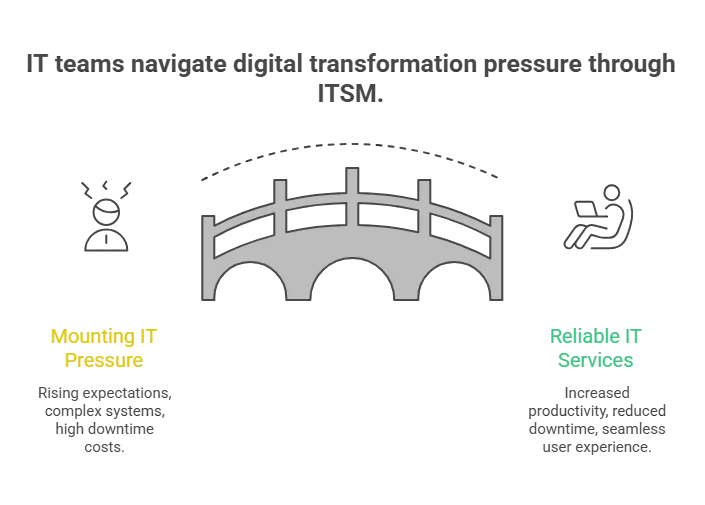
As companies push deeper into ITSM-driven digital transformation in businesses, automation and technology-enabled processes become central to daily operations. That drives productivity, but it raises the stakes too. When technology fails, it hits operational performance directly, with 98% of organizations reporting downtime costs over $100,000 per hour. Downtime during a change window. A misconfigured asset is breaking a dependent service. An unknown dependency is causing an incident to cascade. These are the scenarios IT ops teams live with every week.
The technology just has to work. Making sure it starts with knowing exactly what you have and how it all connects.
Understanding what you have: The starting point for digital transformation
If your team lacks a clear picture of your IT assets, the first step is running an IT discovery to scan and identify assets across your environment. CMDB and IT Asset Management systems then pull those discovered components together and map their relationships, giving you a comprehensive view of your infrastructure.
Virima’s agentless and agent-based discovery scans your on-prem, AWS, and Azure environments using recurring scheduled scans. Your asset inventory stays current without manual effort from your team.
This visibility lets you make safe changes, control IT costs, maintain service assurance, and manage technology risks. All of it depends on knowing what sits in your environment and how the pieces connect.
| How does IT asset discovery work? IT asset discovery uses agentless scanning with hundreds of extendable probes and agent-based methods to identify devices, applications, and configuration items across your infrastructure. Scans run on recurring schedules, so your inventory updates continuously instead of relying on manual audits that go stale within weeks. Discovery tools fingerprint each asset, capture hundreds of hardware and software configuration attributes, and use ML techniques to map relationships and dependencies between components. That depth of detail is what gives the CMDB its authority as a data source, especially since bad data costs the U.S. economy around $3 trillion per year. The result is a living inventory that feeds directly into your CMDB, giving your ops team a single source of truth for every change management request, incident, or capacity decision. |
How IT environment data drives informed decision-making
Collecting data about your IT environment is only the first step. The real value comes from sharing it with the people who need it. Operations managers tracking SLA compliance, analysts identifying capacity constraints, and leaders deciding where to invest next.
In digitally enabled businesses, complete and accurate data is essential for understanding both system performance and business-process performance. When your service mapping shows exactly which business services depend on which infrastructure components, your team can pinpoint bottlenecks, spot inconsistencies in how processes run, and identify where changes will have the most impact.
How does accurate IT data improve change management?
Accurate IT data gives your change advisory board a current dependency map for every change request, so they can assess impact before approving. When a CI changes and your CMDB does not reflect it, the next request proceeds on outdated information. That is how rollbacks happen.
With a current CMDB fed by recurring discovery, your team sees which services sit downstream of any planned change. Fewer emergency rollbacks. Shorter change cycles. Less unplanned downtime.
Continuous improvement starts with IT environment visibility
Digital transformation in businesses delivers value through incremental improvements to systems and processes over time. As your team identifies issues, makes decisions, and measures results, each cycle builds on the last.
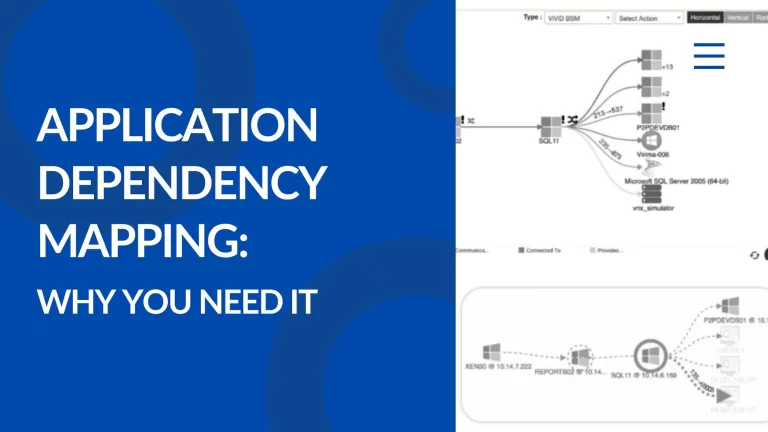
A clear picture of how your IT environment works, powered by Virima Visual Impact Display (ViVID™), lets your ops team visualize dependencies, see open incidents and recent changes overlaid directly on service maps, and trace the impact of planned changes before they happen. That is the difference between proactive operations and reactive firefighting.
What is service mapping, and why does it matter for digital transformation?
Service mapping connects IT infrastructure components to the business services they support. Instead of seeing servers, switches, and applications in isolation, your team sees which infrastructure underpins which revenue-generating service.
For digital transformation specifically, service mapping closes the gap between “we changed something in IT” and “here is what that change means for the business.” Without it, transformation initiatives move forward on incomplete information, and the risk of unintended downstream impact grows with every new technology layer you add.
What tools do you need for IT environment management?
Effective IT environment management requires three core capabilities working together. Discovery to find and inventory assets across your on-prem, cloud, and hybrid environments. A CMDB to store and maintain relationships between those assets. And service mapping to connect infrastructure to business services.
Virima combines IT discovery, CMDB, ITAM, and service mapping in a single platform, so your ops team avoids the integration overhead of stitching together separate point tools. One source of truth for your entire IT environment.
Why Virima is the foundation for IT-driven digital transformation
Virima gives IT operations teams the visibility they need to support digital transformation in businesses without guesswork. From agentless discovery across hybrid environments to dependency mapping that keeps your CMDB accurate, Virima helps your team deliver responsive, dependable services.
To see how it works in your environment, contact us today to schedule a demo.