ITOM for Hospitality: Beyond the Booking Rush | Virima

A hotel’s busiest weekend of the year is rarely a mystery. Advance reservations, group blocks, and last year’s occupancy data tell a property almost exactly how full it will be, often months before the date arrives. That makes it hard to explain how often the booking and check-in systems behind that weekend still fail.
For IT directors and infrastructure leads at hotel groups, resorts, and multi-property operators, the usual story is that “too many guests hit the system at once.” Revenue management and front office already knew the date was full. The honest failure mode is different: nobody could name which link in the booking-and-check-in chain would be the weak one under full occupancy. ITOM for hospitality is less about guessing demand and more about dependency visibility before a date that is already on the calendar.
This piece covers why those outages keep recurring, what tends to break in the chain behind “booking,” and how to run readiness against peak dates the same way you would run risk review before a planned change.
These Aren’t Random Traffic Spikes
Most uptime writing still borrows retail’s Black Friday frame. Online retail estimates demand across a market and adds capacity for a short, brutal surge. A hotel’s peak is narrower and more personal. It is driven by that property’s own pipeline: contracted groups, negotiated blocks, seasonal pattern, and the local events calendar.
Peak still looks different by asset type. A ski resort spikes on winter weekends. A beach resort fills around holidays and shoulder-season events. A convention-city hotel peaks around the local conference calendar. In each case the property’s reservations system, group diary, and historical occupancy already mark the dates that matter.
When booking or check-in fails on one of those dates, traffic volume is the easy story. The harder, more useful story is structural: a known load date exposed a sync path, integration, or supporting system that had never been reviewed under full-house conditions.
Where Uptime Breaks: The Chain Behind “Booking”
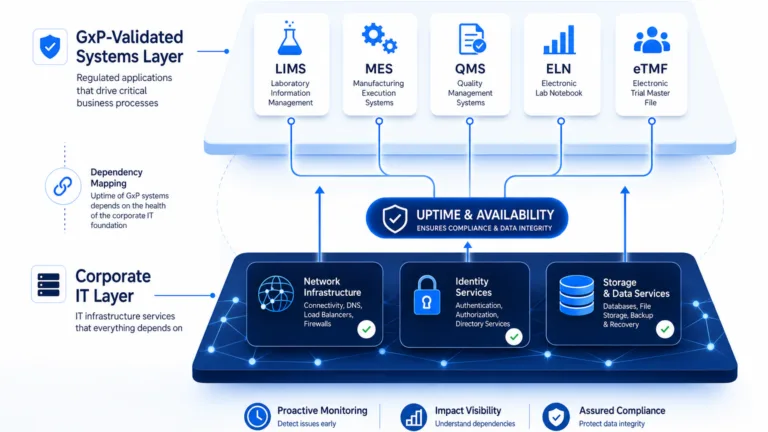
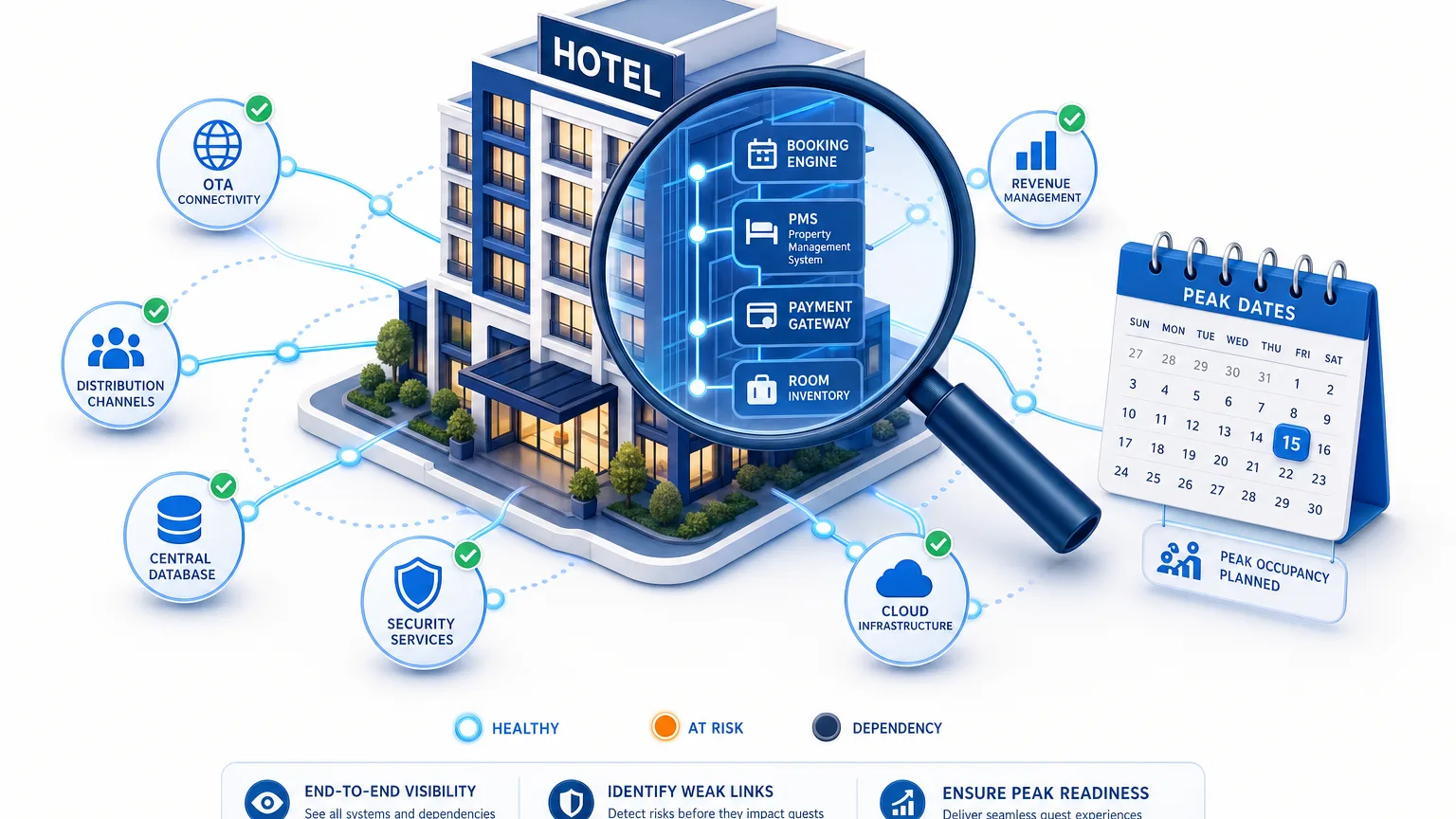
“The booking system” is not one box. Guest-facing booking and front-desk check-in sit on top of a chain that often includes OTA connections, a channel manager, the property management system (PMS) calendar, payment processing, loyalty account lookup, and, at check-in, digital key or access control.
Industry write-ups on channel management keep returning to the same operational risk: slow or broken sync between OTAs, the channel manager, and the PMS does more damage than a long list of unused connections. RateGain notes that weak PMS integration and slow sync create more problems than raw connection count. When the OTA side of a connection stalls, new reservations can still land on the OTA while the property calendar lags. Guests book. The PMS does not yet show the room as taken. Overbooking risk opens until the sync catches up. That window is a chain failure, not a “we ran out of servers” failure.
The same pattern shows up at check-in. The app or desk workflow may look healthy while payment, loyalty, or key-issuance dependencies are the real bottleneck. Peak season does not invent those links. It puts every occupied room and every same-hour arrival on top of them at once.
IT teams that only monitor the guest-facing page miss the dependency that will fail first. Teams that map the full path (OTA and channel manager into PMS, payment, loyalty, access) can put the weak link on a readiness list before the weekend, not after the lobby fills.
When the Stakes Are Highest: A Full Lobby Has No Slack
On July 31, 2026, Hilton reservation and check-in systems went down across properties during a busy summer travel window. Public reporting described website and app trouble, full lobbies, and guests who could not complete check-in because staff could not retrieve reservations. Hindustan Times covered the guest-facing impact the following day. A confirmed root cause was not part of that early public record, so this example is about stakes and timing, not about naming a fix Virima or any other vendor would have blocked.
The operational point still holds. A check-in stack that is “fine most of the year” has almost no slack on the few dates when occupancy is maxed and arrivals bunch into the same afternoon. Revenue management feels the lost walk-up and rebooking chaos. Front office absorbs the queue, the manual workarounds, and the brand damage in the lobby. IT owns the recovery clock while every other system still depends on reservation truth.
A longer timeline makes the same calendar point without confusing cause. In early September 2022, a cyberattack disrupted InterContinental Hotels Group booking channels and related applications, landing on one of the most predictable peak-travel stretches on the U.S. calendar. Volume did not create that outage. The date was already circled. The business still paid the peak-weekend price.
The Trap: Treating This as Only a Capacity Problem
The instinct after a peak booking or check-in failure is to buy more compute or “scale for the season.” Capacity planning still matters when infrastructure is the real constraint. It does not fix an OTA-to-PMS sync gap, a brittle channel-manager job, a payment path that only fails under concurrent full-house check-in, or a key-issuance dependency nobody put on the diagram.
Spending pointed only at servers leaves the weak integration untouched until the next sold-out weekend. ITOM work that stops at host metrics will report green while the business loses rooms to overbook risk or lobby gridlock. The better default question is: for this known date, which dependencies feed booking and check-in, which of them were never exercised under full occupancy, and what is the blast radius if that link stalls?
That is dependency mapping and change-style impact review applied to a calendar the property already trusts. It is not a substitute for capacity where capacity is the true limit.
Getting Ahead of a Date You Already Know
Because peak dates come from the property’s own reservations pipeline, group calendar, and seasonal pattern, readiness can be scheduled like any other planned window. Pull the next twelve months of high-occupancy dates. Treat each as a checkpoint. Review the systems that must be true that day: channel manager and OTA paths, PMS, payment, digital key or access, loyalty.
ViVID service mapping is built for this kind of work once service definitions are provided. It builds application-to-infrastructure dependency views and supports impact path tracing before a change. The same discipline applies when the “change” is a peak date on the books rather than a patch window. A CMDB fed by discovery keeps the map closer to what is running across properties now, instead of a spreadsheet last touched after the prior holiday rush. Virima’s ITOM views and change-risk signals sit on that foundation. None of this sizes booking volume or promises an outage-free weekend. It surfaces which link is weakest and what breaks with it, in time to fix or mitigate before arrivals start.
See how enterprise IT leaders establish trusted runtime truth so peak-date readiness rests on live dependency context, not last quarter’s diagram.
Hospitality teams already working on portfolio asset and PMS visibility can pair this uptime angle with Virima’s companion posts on ITAM across a property portfolio and tracking property management systems across multiple locations. Those pieces frame the inventory and multi-site PMS problem; this one applies the dependency view to the peak-season booking and check-in clock.
Where to Start: Scope Readiness Against the Booking Calendar
- Lock the dates from systems you already run. Export the next twelve months of peak occupancy from reservations, group contracts, and the local event calendar. Put those dates on the IT readiness calendar as named checkpoints, not as surprises.
- Map the chain, not only the PMS. For booking and check-in on each date, list OTA connections, channel manager, PMS calendar, payment, loyalty, and digital key or access. If a link is missing from the diagram, it is already a finding.
- Prioritize sync and integration points. The guest-facing booking engine or check-in app is the easy blame target. Sync lag, failed jobs, and identity or payment hops are where full-house failures often sit. Review those first.
- Run the same pre-event risk review you would for a change. Owners, back-out options, monitoring focus, and front-office / revenue communication paths should be clear before the weekend, not invented in the lobby.
- Refresh the record before the window. Discovery-sourced CMDB data and an updated service map beat a static Visio from last peak season. Stale relationships produce false confidence.
Peak Season Fails on Visibility, Not on Surprise Demand
Peak-season booking and check-in outages are rarely demand surprises. The dates were already in the reservations pipeline. What is often missing is a clear view of which dependency will fail first under full occupancy, and enough lead time to fix it. Capacity still has a place. Dependency-ready ITOM work has a different job: make the weak link findable before the lobby fills.
See how Virima maps the dependencies behind booking and check-in systems before your next peak weekend. Request a demo with your property calendar and stack in hand.
Frequently Asked Questions
Why do hotel booking and check-in systems fail during peak season?
Peak dates put full occupancy and bunched arrivals on top of a multi-system chain (OTA connections, channel manager, PMS, payment, loyalty, digital key). Failures often sit in a sync or integration link that was never reviewed under those conditions, not only in raw traffic volume on the guest-facing page.
Is a peak-season hotel outage always a capacity problem?
No. Capacity matters when infrastructure is the real constraint. Documented channel and PMS integration patterns show overbooking and check-in pain can come from stalled OTA-to-property sync or other chain links that extra servers do not repair. Treat capacity and dependency review as separate questions.
How does a channel manager or OTA outage create overbooking risk?
When the OTA side of a connection is down or lagging, guests can still book on the OTA while the hotel PMS calendar is not yet updated. Until sync recovers, the property may sell a room that is already taken on the OTA. That is a visibility and sync gap across the chain, not a full house of concurrent clicks on the hotel site alone.
How can hotel IT prepare for a peak date that is already on the calendar?
Pull peak dates from reservations, groups, and local events. Map booking and check-in dependencies end to end. Prioritize sync and integration points. Run a change-style impact review before each date, with revenue and front office in the loop. Refresh CMDB and service maps so the review uses current relationships.
How does Virima support ITOM for hospitality booking uptime?
Virima helps teams maintain discovery-sourced CMDB data and, once service definitions are provided, build ViVID dependency maps with impact path tracing. That supports pre-peak readiness and change-style risk review on booking and check-in stacks. It does not replace capacity planning or claim to prevent any named chain outage.