When Corporate IT Fails Under GxP Apps, Uptime Becomes a Compliance Problem

A batch-release e-signature sits unfinished at 11 p.m. The laboratory information management system (LIMS) and the manufacturing execution system (MES) both report green. Nobody rebooted a validated application. The identity service that issues the electronic signature token timed out after a directory replica failed, and the release window closed while operators waited on a corporate authentication path that never appeared on the GxP system inventory.
Quality asks whether a regulated process failed. Infrastructure answers with mean time to repair (MTTR) on a domain controller. Both are telling the truth about different layers. ITOM for Pharmaceuticals and life sciences lives in that gap: the corporate IT layer under validated applications is rarely subject to full computer system validation (CSV), yet when it fails, audit trails stall, continuous monitoring feeds break, and data-integrity questions open without a single “GxP system” going offline.
This piece draws the line between GxP-validated systems and the infrastructure they run on, shows how an infrastructure outage becomes a compliance problem, names the over- and under-correction traps, and shows how dependency mapping lets IT operations, Validation, and Quality apply the right rigor without treating every switch like a LIMS.
What Counts as the Corporate IT Layer in a Regulated Environment
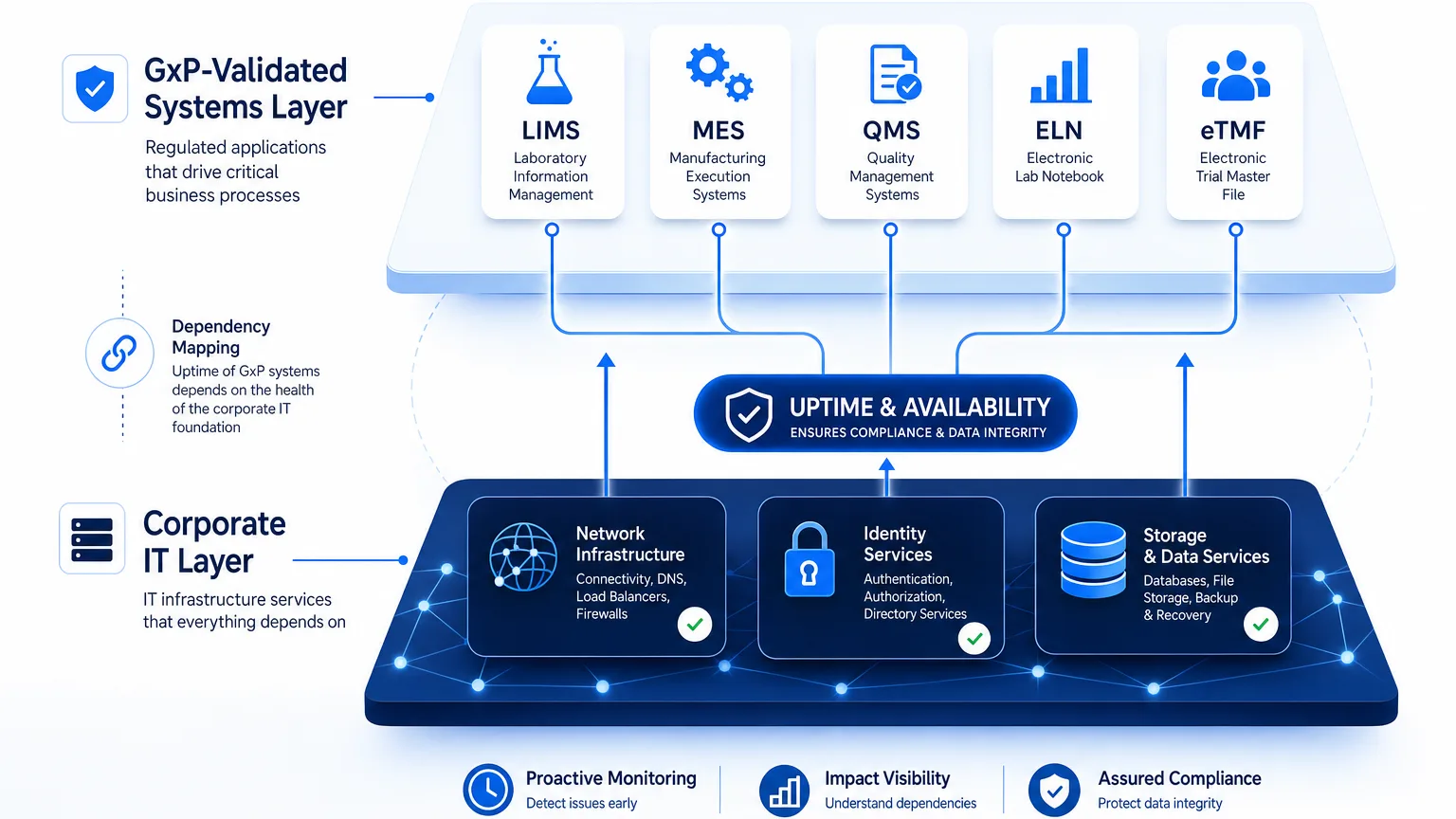
In a pharma, biotech, or contract research / contract development and manufacturing organization (CRO/CDMO) estate, the corporate IT layer is the substrate under the application tier. It typically includes:
- Network infrastructure (core and access switching, firewalls, load balancers, site-to-site and remote access paths)
- Identity and directory services (authentication, authorization, certificate and token services that feed e-signature workflows)
- Storage and backup targets that hold application data, historians, and log streams
- Virtualization and compute hosts for application front ends and middle tiers
- Integration middleware that moves messages between MES, LIMS, enterprise resource planning (ERP), and quality management systems (QMS)
- Corporate Wi-Fi and virtual private network (VPN) paths that plant and remote staff use to reach those systems
GxP-validated systems sit one layer up. Common examples include LIMS, MES, electronic quality management systems (eQMS), ERP modules that touch batch records, and dedicated e-signature platforms. Those applications go through CSV and stay under change control designed for regulated software.
The corporate IT layer is generally not itself a CSV target in the same way. Network gear, directory servers, and hypervisors are usually owned by general IT operations, not by the validation program that owns the LIMS. That ownership split is correct for cost and scope. It becomes dangerous only when nobody can see which infrastructure configuration items (CIs) feed which regulated process.
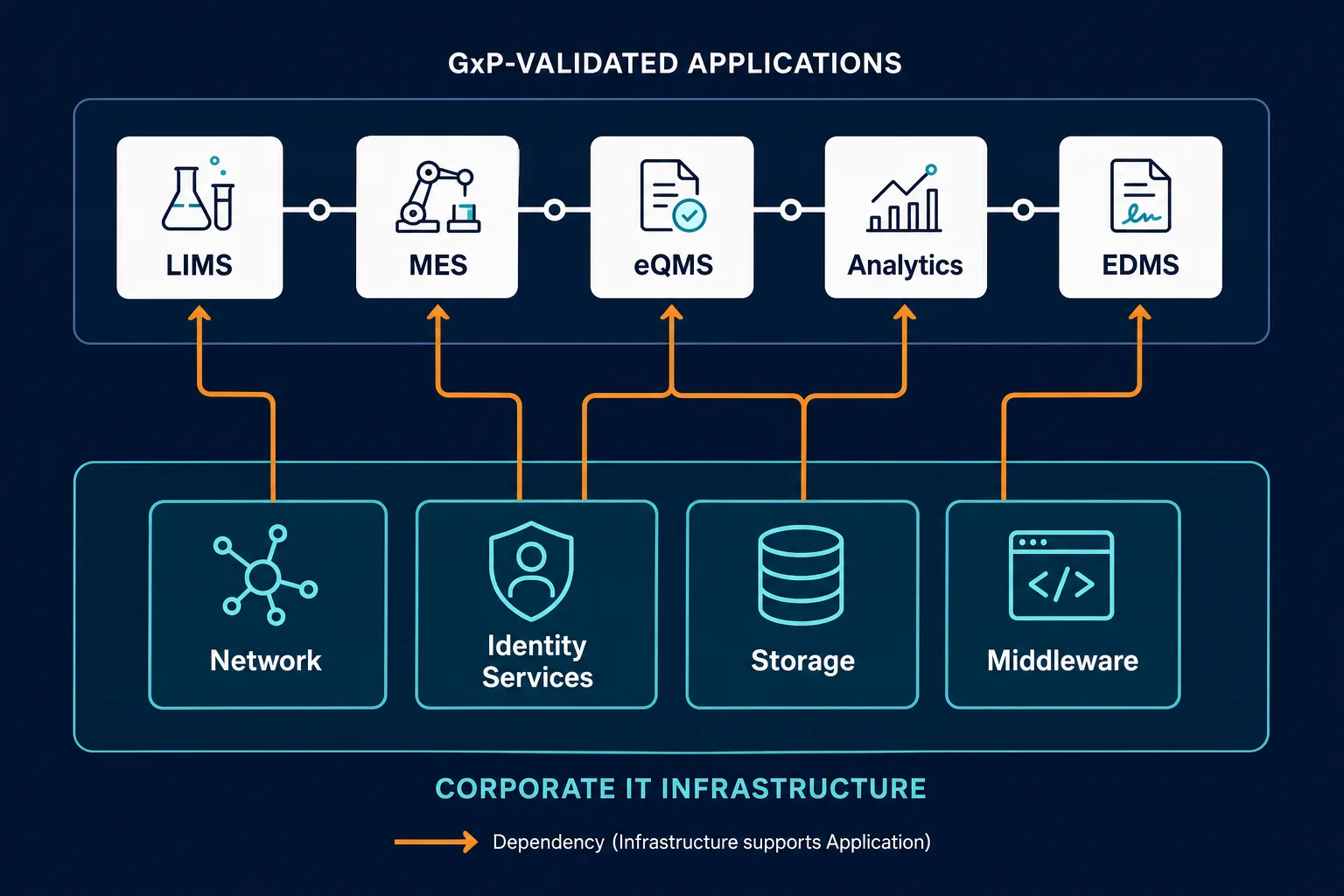
What is the difference between a GxP-validated system and the infrastructure it runs on?
A GxP-validated system is an application or platform under computer system validation (CSV) and regulated change control, such as a laboratory information management system (LIMS) or manufacturing execution system (MES). The corporate IT layer underneath, network, identity, storage, virtualization, and middleware, usually sits outside full CSV, yet every validated workload depends on it for availability, authentication, and data movement.
Why an Outage Here Becomes a Compliance Problem, Not Just an IT Problem
Validated systems are expected to remain in a controlled, validated state. Unassessed change next to a qualified system raises risk even when the change is “only infrastructure.” Vaisala frames this for monitoring contexts: transparency and controlled change around systems that support GxP work matter because drift next to a validated stack can introduce risk without anyone intending to touch the GxP application itself.
Change load in life sciences IT is already high. USDM material on regulated IT notes how heavy change-control volume and long approval cycles strain teams; one quoted path cut IT change approval from about 70 days to just under 21 after process redesign. When every infrastructure ticket competes for the same scarce change bandwidth, teams need a way to see which tickets sit on the path to a regulated outcome and which do not.
U.S. Food and Drug Administration (FDA) guidance on data integrity and CGMP treats complete, consistent, and accurate records as a core expectation. An infrastructure failure does not rewrite a batch record by itself. It can still create a gap: missing continuous values, a blocked signature, or a broken handoff that leaves the record incomplete relative to what the process required.
Illustrative patterns (not named customers):
- Identity path fails at release. Directory or multifactor services that issue e-signature credentials are unavailable. The MES screen is up. The signature cannot complete. Batch release slips while the incident ticket still reads “auth outage,” not “regulated process stop.”
- Storage or network path breaks a continuous feed. Temperature or humidity data that should land in a historian or environmental monitoring system stops arriving. The monitoring application may still be “up.” The integrity problem is the missing interval, not an application crash.
- Middleware drops an MES-to-ERP or MES-to-QMS flow. During a reportable window, messages queue or fail silently. Operators see partial status. Investigation time expands because the break sits between systems, not inside the validated UI.
In each case, MTTR on the infrastructure CI is necessary and insufficient. Without a mapped path from that CI to the regulated process, priority and evidence stay generic.
How does an IT infrastructure outage become a data-integrity or audit-trail problem in pharma?
When network, identity, storage, or middleware fails, electronic signatures can stall, continuous logging can miss intervals, and system-to-system handoffs can drop. The validated application may still report online. The compliance exposure is incomplete or interrupted records against data-integrity expectations, not only a classic application outage ticket.
The Trap Most Pharma IT Teams Fall Into
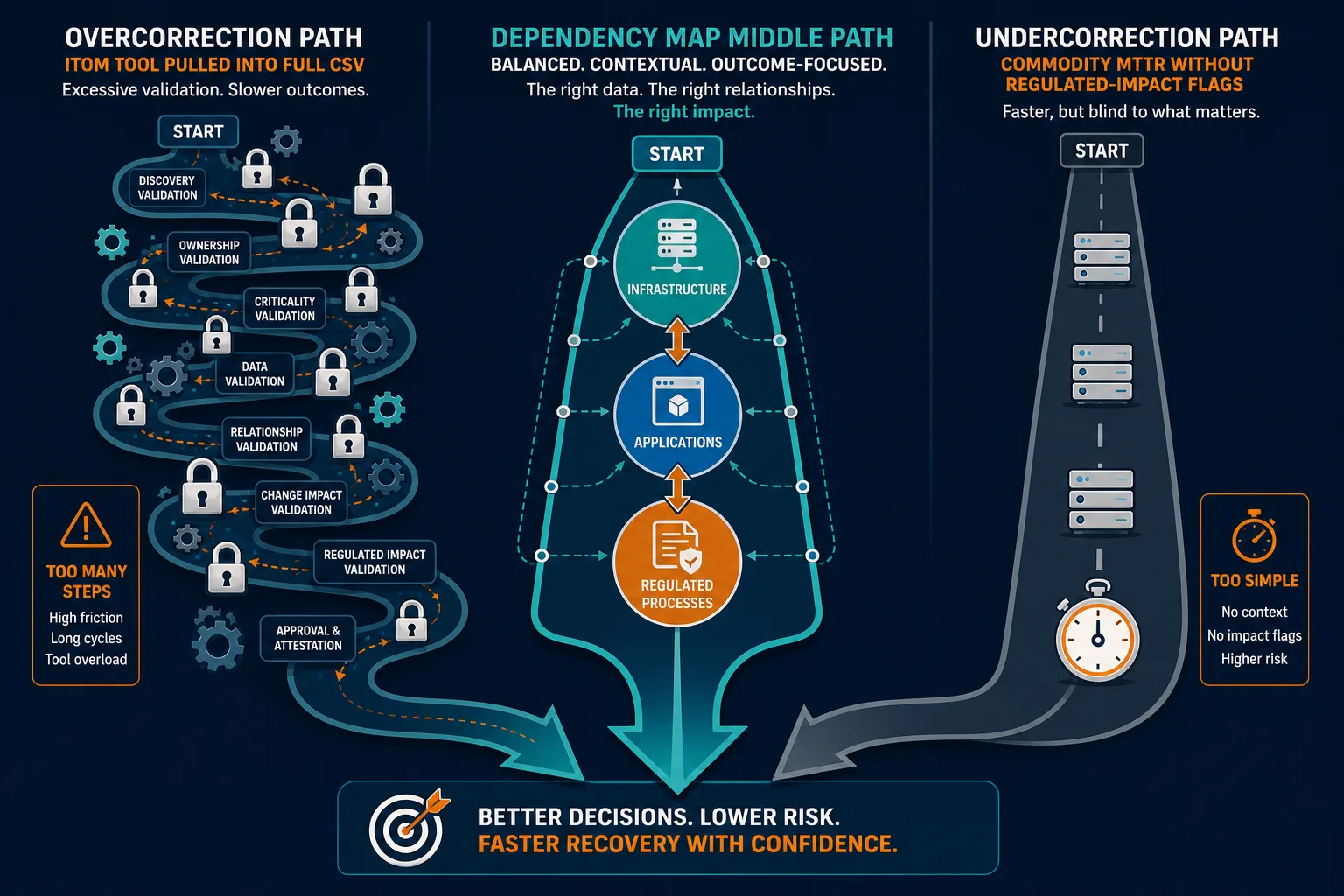
Overcorrection: validating the monitoring stack like a LIMS
Because change near validated systems carries risk, some organizations pull IT operations management (ITOM) and monitoring tools into full CSV as if those tools were GxP applications. Risk-based change control, access control, and configuration transparency for tools that watch GxP-adjacent infrastructure are often justified. Treating a dependency map or infrastructure monitor as equivalent to the LIMS it observes usually is not. That choice multiplies validation cost and slows every tooling upgrade without answering the real question: which infrastructure failures matter to regulated outcomes.
Undercorrection: commodity MTTR with no regulatory relevance
The opposite failure is common. Network and server teams run solid uptime programs. Priority is severity and user count. A core switch that feeds a stability chamber data path and a server that hosts an internal wiki share the same generic priority model. Validation and Quality cannot get a defensible list of “what supports this GxP system” from the CMDB because the CMDB never stored that relationship. Incidents close on technical recovery. The regulated-impact question arrives later, in a worse forum.
Neither trap is fixed by more alerts alone. Both need a shared map of dependency and impact.
See how Virima approaches trusted runtime truth for live, explainable infrastructure and service context teams can defend in operations and audit conversations.
Mapping Dependencies Is How You Draw the Line
The practical resolution is dependency and service mapping that traces physical and virtual infrastructure to the applications and named services those regulated processes use. Service composition (which applications make up a named service) is defined by the business; once definitions are in place, maps show how hosts, network paths, storage, and middleware sit under those applications. A CI’s regulatory relevance becomes visible next to its operational state.
That map supports three concrete behaviors:
- Risk-tier infrastructure change by downstream regulated impact, not only by technical severity or blast radius in pure IT terms.
- Prioritize incidents when two outages compete: the path that blocks batch release or continuous GxP data outranks the path that only hits internal collaboration.
- Answer Validation and Quality with evidence: which CIs support this GxP system, what changed, and what the recorded relationships were at the time of the event.
Virima’s role here is infrastructure-layer visibility and impact analysis, not CSV and not a replacement for Quality or Validation workflows. Discovery populates and refreshes configuration items and relationships on scheduled discovery cycles (not passive real-time event streams). A CMDB holds CI history so teams can show what changed and what it touched. ITOM views tie operational health to that same CI and service context. Impact and blast-radius views help change owners see downstream effect before a window opens.
Virima does not validate GxP systems, perform CSV, or own Part 11 controls inside the application. It helps corporate IT and Validation share one picture of the substrate under those systems. Integrations with IT service management platforms (ServiceNow, Jira Service Management, Ivanti, HaloITSM, Xurrent, Hornbill, and others listed on the integrations hub) keep that picture available where tickets and changes already live.
Adjacent regulated-industry thinking on IT/OT boundaries appears in Virima’s manufacturing IT asset management guidance; the same discipline of “map what the process depends on before you argue scope” applies when the process is GxP rather than pure plant OT.
Does a monitoring or ITOM tool itself need to be GxP-validated?
Usually the tool needs risk-based change control, access control, and configuration transparency when it sits next to GxP-supporting infrastructure. Full computer system validation (CSV) equivalent to a laboratory information management system (LIMS) is a separate decision and is often the wrong default. Scope validation to systems that create, modify, or hold regulated records; scope ITOM to proving which infrastructure supports those systems.
Where to Start: Scope Monitoring Against Regulated Impact
Use a short inventory against regulated outcomes, not a generic “monitor everything” list.
| Priority focus | What to map and watch | Why it is regulatory-adjacent |
|---|---|---|
| Identity and auth | Directory, certificate, and token services on the e-signature and batch-release path | Signature and access failures stop regulated work while apps stay “up” |
| Continuous data paths | Network and storage feeding environmental monitoring, historians, and batch data logging | Missing intervals create data-integrity questions |
| Integration middleware | Buses and interfaces between MES/LIMS and ERP/QMS | Silent handoff gaps surface late in investigations |
| Hosts under validated apps | VMs and servers hosting validated front ends and middle tiers | The application may be validated; the host layer is often the unmapped gap |
Work sequence that stays honest about ownership:
- List the regulated processes that matter this quarter (release, stability, critical lab workflows).
- Name the validated applications on each path.
- Record service definitions for those applications, then map infrastructure CIs underneath.
- Tag or group CIs that sit on regulated paths so incident and change workflows can see the flag.
- Keep monitoring and ITOM tooling under appropriate IT change control; do not default them into full CSV without a documented risk rationale.
- Review the map with Validation and Quality so “what supports this system” is a shared artifact, not an after-the-fact rebuild.
For how ITOM relates to service management more broadly, see Virima’s guide to ITOM versus ITSM.
Build Visibility Before the Outage Forces the Question
Uptime work in a regulated environment is not a project to validate the network. It is a project to know where the corporate IT layer intersects regulated outcomes, and to hold that intersection in a CMDB and service map before an incident forces the question in a worse room. Over-validating tooling burns capacity. Under-mapping infrastructure leaves Quality without evidence. Dependency visibility is the middle path IT operations directors and Validation leads can both defend.
Request a demo to see how Virima maps dependencies between infrastructure and the regulated processes it supports, using discovery-sourced CMDB and service maps built for impact analysis rather than CSV replacement.
Frequently Asked Questions
What should pharma IT operations monitor beyond validated applications?
Monitor the corporate IT layer those applications depend on: identity services on e-signature paths, network and storage on continuous logging paths, integration middleware between MES/LIMS and ERP/QMS, and the hosts under validated front ends. Pair technical health with a dependency map so priority reflects regulated impact, not only generic severity.
Is the corporate network in a pharma company a GxP-validated system?
Typically no. Network, directory, storage, and hypervisor layers are usually run as corporate IT under standard change processes. They still sit under every validated workload. The operating need is mapped dependency and risk-tiered monitoring, not automatic full CSV of every switch.
How should Validation and IT share ownership of infrastructure that supports GxP systems?
IT owns availability and change execution on the corporate layer. Validation and Quality own regulated system scope and evidence standards. A shared CMDB and service map of which CIs support which GxP applications is the handshake: IT operates; Validation can see support paths without absorbing every infrastructure tool into CSV by default.
Does Virima perform computer system validation or replace Quality workflows?
No. Virima provides discovery-sourced configuration data, dependency and service maps, and impact context for infrastructure and applications. CSV, Part 11 controls inside GxP applications, and Quality decision rights stay with the customer’s validation and quality programs.