Hospitality: tracking property management systems across multiple locations

When a guest arrives at a luxury resort or business hotel, front desk staff expect instant access to reservation records, room assignments, and keycard creation systems. If the property management system (PMS) drops connection or experiences local server latency, check-in lines back up into the lobby, loyalty status fails to credit, and guest satisfaction scores drop within minutes.
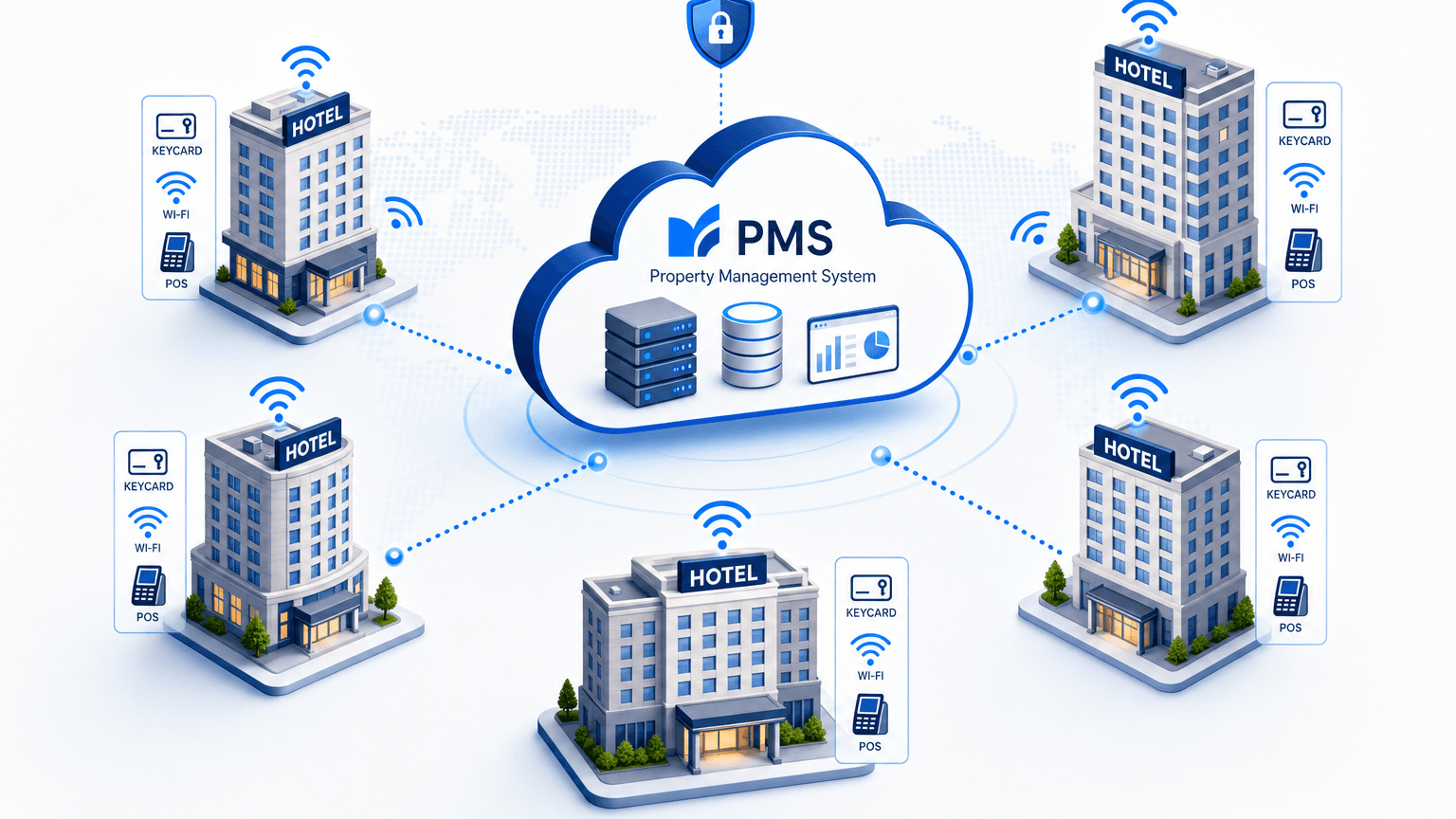
For regional hotel groups and international hospitality brands, tracking property management systems across multiple locations is now a distinct discipline in its own right. Maintaining multi-location hotel PMS availability across dozens of properties, rather than reacting to outages after the fact, is the real challenge. Each hotel property operates as an isolated site running a mix of central cloud PMS modules, local property servers, point-of-sale (POS) terminals, guest Wi-Fi gateways, and keyless door lock controllers.
When corporate IT directors and property infrastructure leads rely on manual inventory logs or site-by-site spreadsheets, unannounced hardware failures and license true-up penalties threaten profitability. Achieving continuous availability for multi-property operations requires continuous automated discovery, core-aware configuration tracking, and dynamic service dependency mapping.
Why is tracking property management systems across multiple hotel locations challenging for IT teams?
Multi-location hospitality groups manage fragmented property IT environments combining cloud-hosted PMS applications, localized property servers, and property-specific peripherals. Lacking central service dependency mapping, local hardware failures or uncoordinated network updates trigger property-wide guest check-in outages and severe vendor audit penalties.
The operational complexity of multi-property hospitality IT
Hospitality IT architectures rarely resemble standard corporate environments. Each hotel property functions as a 24/7 operating site where local staff make unannounced network modifications to resolve immediate guest complaints or install new amenities.
This is a narrower problem than cataloging every device on a property network. Virima’s guide to IT discovery in hospitality covers finding every endpoint across distributed hotel and resort sites. This article focuses specifically on how the PMS itself, and the systems it depends on, create availability and license risk as a hotel group scales past a handful of properties. A 2026 hotel PMS market study found that 51% of hoteliers plan to replace or upgrade their technology stack within the next 12 to 24 months. That churn shows how fragmented and fast-moving property-level technology already is (Stayntouch, 2026) — and it’s exactly what makes a manually maintained asset baseline drift out of date.
1. The localized hardware and peripheral visibility gap
While corporate IT manages central enterprise resource planning (ERP) platforms, local hotel properties depend on physical property-level servers, local credit card terminals, and edge networking hardware.
When a regional hotel upgrades local server hosts or deploys additional front-desk terminals without notifying central IT, the asset baseline drifts. Virima’s blog on why CMDB data goes stale without automated discovery covers this same drift pattern in other industries. When local hardware reaches end-of-life (EOL) without corporate awareness, an abrupt server failure halts local check-in operations, forcing staff onto manual pen-and-paper processes.
2. Software license compliance and core density drift
Property management software and database engines frequently enforce per-core or per-room licensing models. When property-level technicians spin up virtual machines or upgrade physical host processors to speed up local reporting, core counts increase unintentionally.
Because corporate IT asset managers have no automated visibility into localized hypervisor changes, the organization breaches software entitlement agreements. A LicenseFortress analysis of vendor audit outcomes found that 35% of audited companies paid $100,000 or more in fees to reach compliance. Ten percent paid upwards of $1 million (The Rising Cost of Software Compliance, 2025). For a hospitality brand running the same database engine across 40 or more properties, that exposure compounds with every unmonitored core added at the property level — a multi-property IT asset management gap that manual spreadsheets can’t catch.
How does automated discovery unify PMS tracking across regional and global hotel properties?
Automated discovery deploys secure agentless probes across property network segments and central cloud environments. It continuously identifies local PMS servers, OS build numbers, hypervisors, and connected peripherals into one CMDB.
Deploying discovery to track property management systems across every hospitality network
Hospitality organizations must comply with PCI-DSS guidelines to protect guest credit card data transmitted during check-in. Network security policies mandate strict isolation between property payment subnets, guest Wi-Fi networks, and administrative PMS zones. The PCI Security Standards Council’s scoping and segmentation guidance for modern network architectures names current asset inventory as a prerequisite for accurate cardholder-data-environment scoping. That’s exactly the record a manually updated property spreadsheet can’t guarantee.
To establish full visibility across distributed properties without breaching payment compliance standards, hospitality brands implement a secure, multi-tier discovery architecture. Scan windows and credential scope have to respect each property’s segmentation, so a probe assigned to the guest Wi-Fi subnet never gets read access into the payment VLAN, and vice versa. That separation is what lets discovery run continuously without becoming a compliance liability in its own right.
Discovery architecture for multi-property hotel groups
- Property DMZ Gateway Probes: situated within local property management subnets, lightweight gateway probes perform agentless WMI, SSH, and SNMP discovery across local PMS servers, keycard encoders, and POS controllers without exposing cardholder environments.
- Central Cloud Probes: direct API integrations continuously monitor cloud-hosted PMS instances, central reservation databases, and guest loyalty microservices across AWS and Azure environments.
- Remote Field Agents: installed on front-desk workstations and manager laptops, light agents collect device configuration data locally and sync with the central CMDB whenever a secure VPN connection opens.
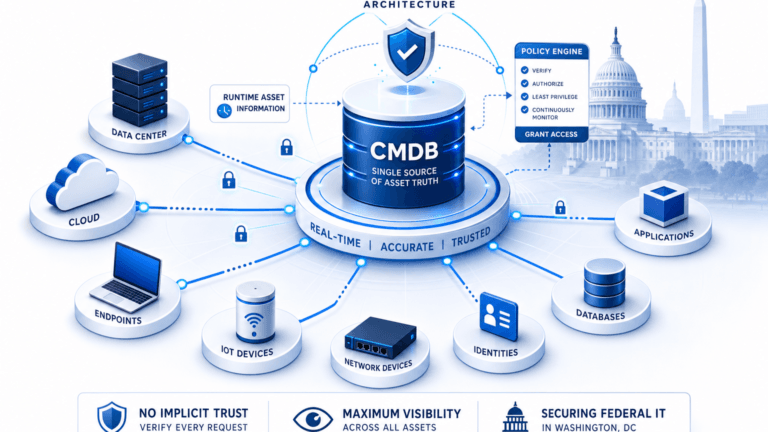
Consolidating these discovery inputs into a centralized hospitality property management system CMDB — a single, always-current record of every PMS-connected asset across every property — equips corporate IT and regional managers with complete asset context across every property. Virima’s IT Discovery supports this agentless, agent-based, and API-based combination across remote sites, and Virima’s guide to IT asset lifecycle visibility covers how that lifecycle data feeds compliance scoping work. To explore how automated discovery integrates with hotel service desk platforms, visit the Virima integrations hub.
Dynamic service mapping: visualizing the property management landscape
Knowing that a server exists at a property in Miami is helpful; knowing that the server hosts the local interface middleware linking property door lock encoders to the central PMS is critical.
ViVID service maps convert static CI inventories into interactive service maps. By analyzing active network connections and process relationships, the mapping engine visualizes complete property operational flows.
Preventing check-in outages through blast-radius analysis
When maintenance or software patching is scheduled at a property location, IT engineers must evaluate how the change affects local operations.
With dynamic service mapping, an IT director reviewing a proposed database patch immediately views its dependency graph. That graph is built from discovered network connections and process relationships, not a manually drawn diagram. It reflects what the PMS is actually talking to today rather than what an architecture document said a year ago. If the map reveals that restarting the server will disrupt keycard creation during peak 3:00 PM check-in hours, the change window is rescheduled to 2:00 AM, preventing guest arrival disruptions.
To learn how hotel brands establish operational context and eliminate data decay, see Virima’s discovery-sourced Trusted Runtime Truth.
Best practices for hotel PMS infrastructure tracking across global properties
Achieving reliable hotel PMS infrastructure tracking across multiple locations requires combining automated discovery tools with structured IT governance. Leading hotel operators put four core management practices in place:
- Standardize Property IT Taxonomies: define uniform naming conventions, asset tiers, and criticality ratings across all domestic and international properties to ensure consistent central reporting.
- Enforce Pre-Change Blast-Radius Reviews: require regional IT managers to review automated service maps before approving hardware maintenance or software updates on property-level servers.
- Automate Core-Based License Audits: reconcile discovered hypervisor core counts against purchased software entitlements monthly to eliminate vendor audit exposure.
- Integrate Discovery with Hospitality ITSM Workflows: connect central CMDB data directly to service desk platforms like ServiceNow or Jira Service Management, providing technicians with instant property context when handling incident tickets.
Virima’s IT Discovery overview covers how agentless, agent-based, and API discovery apply to multi-site environments like these.
What are the main financial benefits of automated PMS tracking for hotel operators?
Automated tracking eliminates software audit penalties, reduces hardware replacement costs through proactive EOL tracking, shortens check-in outage recovery times, and optimizes cross-property software license allocations.
Securing high-availability hospitality operations
As hotel brands adopt contact-free mobile check-in, IoT room controls, and cloud-first PMS architectures, technology dependencies across properties will only increase. Continuing to track multi-location property management systems using static spreadsheets or manual property audits creates unacceptable operational and financial risk.
By implementing continuous multi-site discovery, core-aware configuration tracking, and dynamic service dependency mapping, hospitality organizations build true uptime discipline. They protect property revenue, eliminate compliance exposure, and support reliable guest experiences at every location worldwide as they track property management systems across every site.
Frequently Asked Questions
How does automated discovery maintain PCI-DSS compliance across hotel property networks?
Automated discovery uses read-only, agentless probes placed in non-cardholder subnets or DMZs. Configuration metadata is encrypted during transmission, preserving PCI-DSS isolation while maintaining full property infrastructure visibility.
Can dynamic service mapping track both cloud-based and on-premises property management systems?
Yes. Advanced service mapping platforms correlate API traffic, process connections, and database links across cloud-hosted PMS platforms, local property servers, and on-premises peripherals into a single dependency map.
How does Virima help hotel IT teams reduce Mean Time to Resolution during PMS outages?
Virima’s dynamic service mapping links technical assets directly to property operations. When an incident occurs, technicians immediately see the exact server, network switch, or interface causing the issue, accelerating diagnostic and recovery workflows.