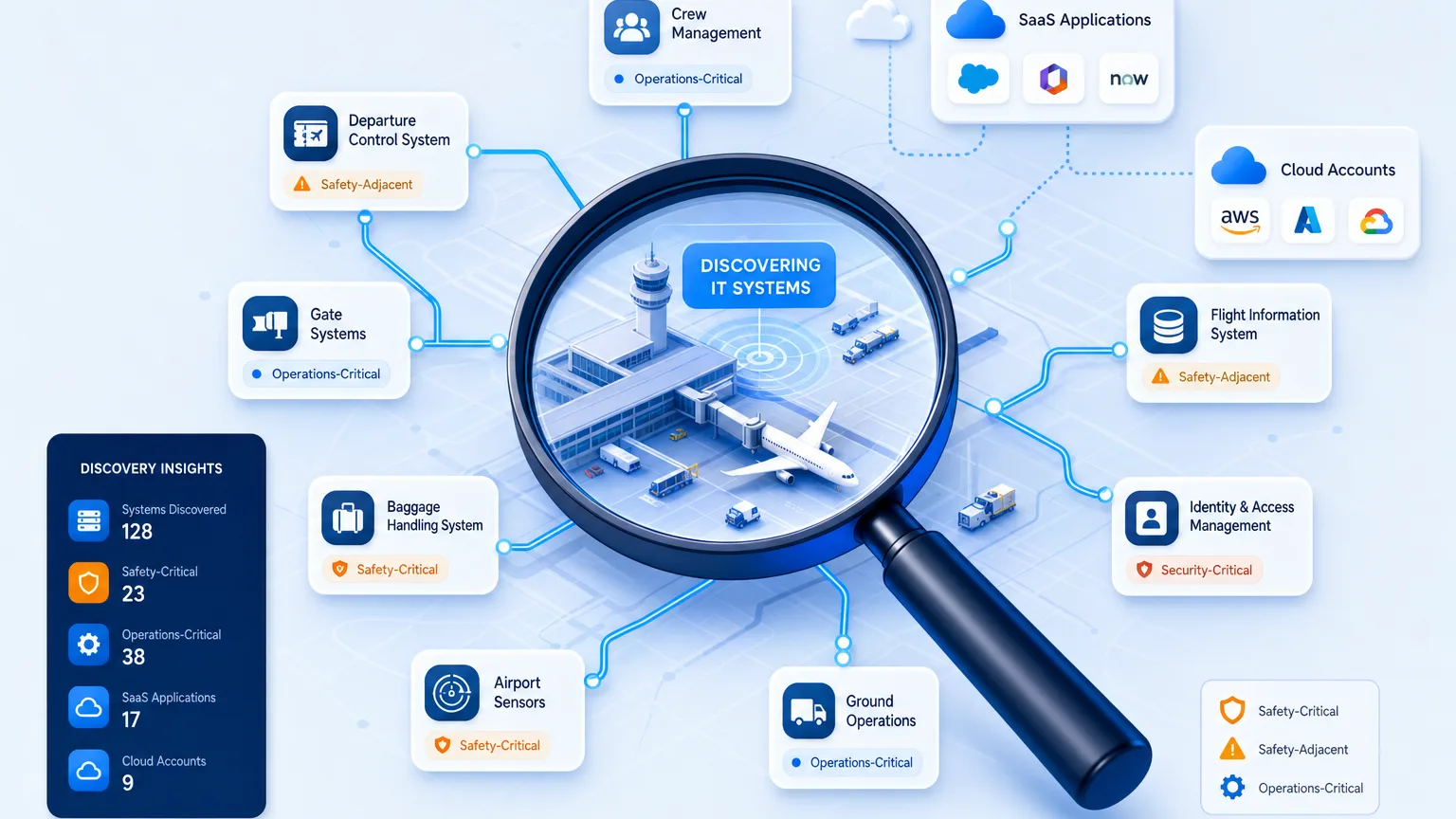
IT Discovery for Aviation and Airlines: Identifying Every System Tied to Safety and Operations

A freeze, a review, or an incident asks for the full set of ground systems tied to safety and operations. The team returns a CMDB export and last week’s scan of corporate VLANs. Station networks, vendor-managed appliances, and terminal paths stay dark. Nobody can show a coverage test, only a last export. The configuration owner owns that gap — and for compliance and incident-response leaders, an unproven gap is a standing liability, not a documentation shortfall.
ITAM audits and ITOM maps both start from the same unspoken list. IT discovery for aviation and airlines is how that list gets proven complete, or exposed as partial. Asset inventories sit at the start of the NIST Cybersecurity Framework Identify function for a reason: controls and recovery plans only cover what you can name.
Discovery starts earlier than audits and maps. You name every ground system tied to safety and operations, classify it, prove the hunt was wide enough, then hand a complete set to ITAM, ITOM, and SecOps.
What “tied to safety and operations” means on the ground
Enterprise discovery in aviation is not airworthiness software and not aircraft-parts MRO tracking. The in-scope estate is ground IT and OT that supports passenger processing, crew and gate workflows, station operations, and the corporate systems those services depend on. Avionics certification, TSA-facing critical cyber systems, and MRO asset software sit outside this discovery scope. For that three-way split, see the Benefits of CMDB customization for IT asset management. What follows is how ground systems enter the estate list in the first place.
A practical tag set for discovery is enough to start:
| Tag | Discovery meaning | Example ground paths |
|---|---|---|
| Safety-adjacent | Failure or compromise can block regulated or safety-linked ground workflows | Weight-and-balance hosts, certain gate and boarding controllers on enterprise paths, station systems that feed dispatch-adjacent processes |
| Operations-critical | Failure stops or degrades flight bank, passenger, cargo, or station throughput | PSS edges, departure control interfaces, baggage sortation IT, crew systems, shared terminal apps |
| Support / general | Needed for IT service, not on the safety/ops shortlist | Office productivity, non-ops lab gear, pure corporate SaaS with no station path |
PSS above means Passenger Service System — the platforms that handle reservations, check-in, and departure control. CI, used throughout the rest of this article, means configuration item: a single discovered asset record.
Tags are not a risk score and not a compliance certificate. They mark which discovered CIs must stay complete, owned, and fresh before anyone argues maps or audits. SecOps still decides the official critical shortlist. Discovery must keep that list off a partial phone book.
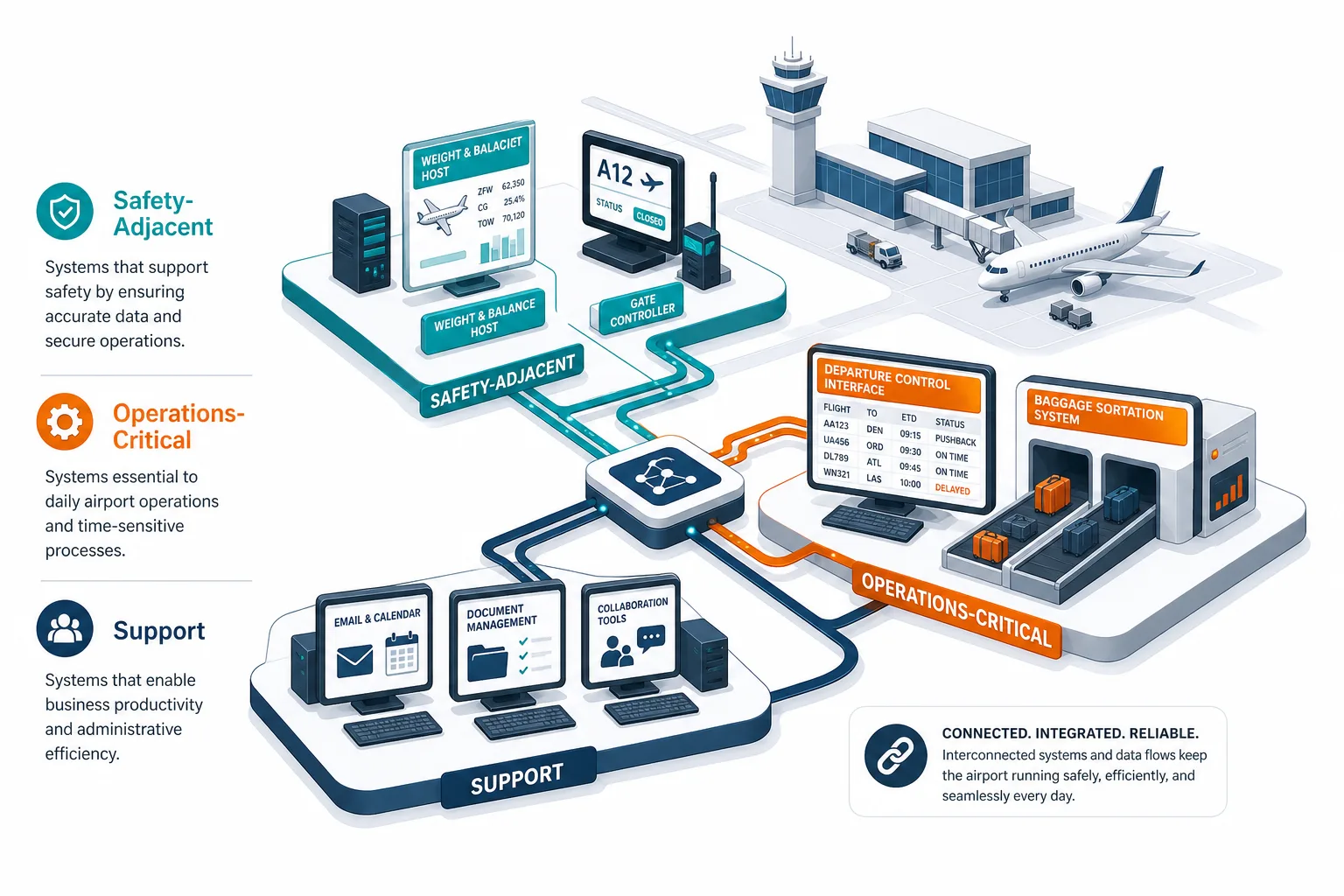
What does IT discovery for aviation and airlines need to identify first?
Ground IT and OT tied to safety-adjacent and operations-critical workflows: station, gate, crew, baggage, PSS edges, and the hosts and network paths that support them. It does not inventory avionics airworthiness software or aircraft-parts MRO systems.
Where aviation IT discovery scopes go blind
Most “we scanned the network” programs cover what the airline already owns and already routes through known subnets. Aviation estates break that assumption. The failure mode is a scope ledger that never listed the hard paths.
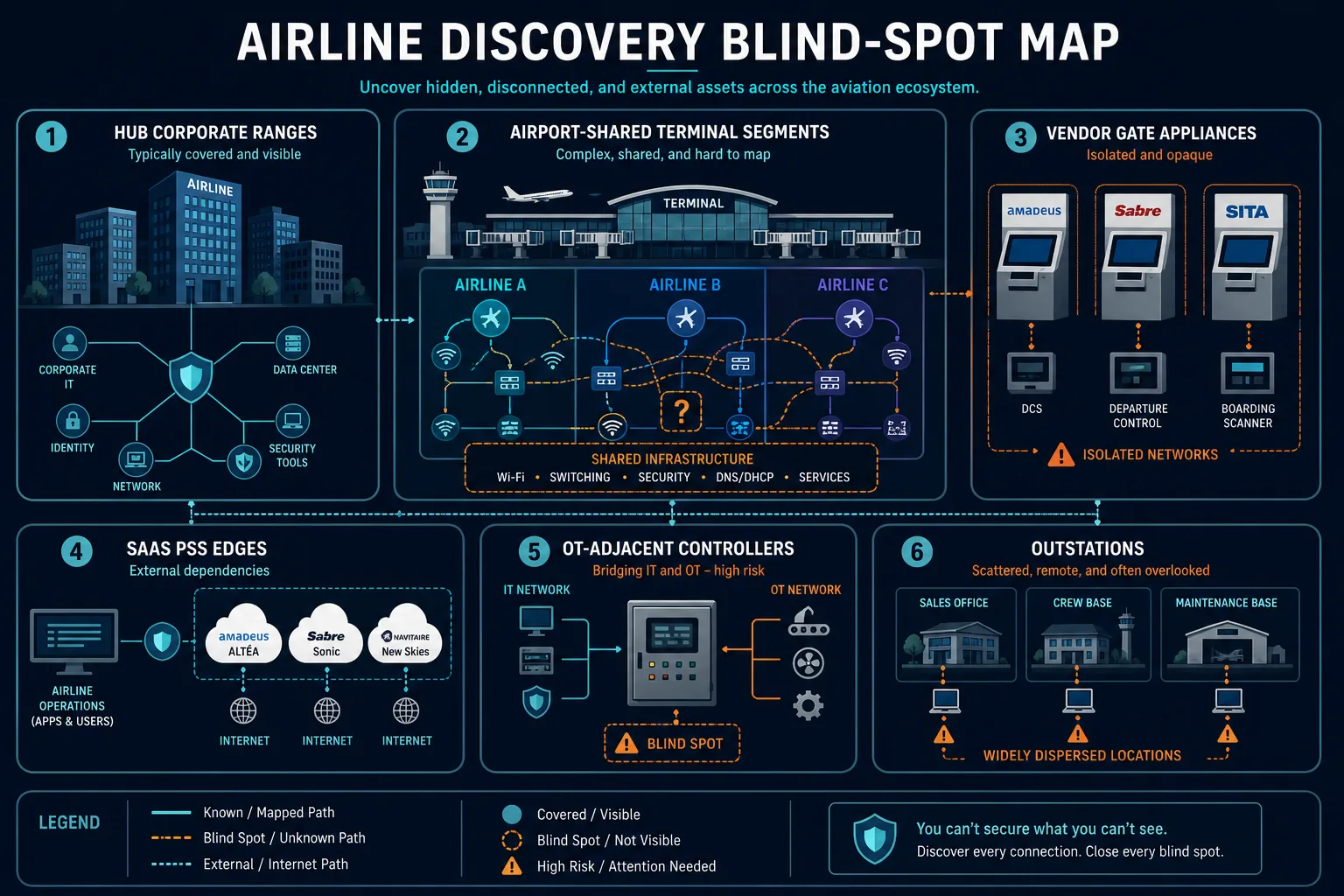
Where corporate and vendor scans stop short
Airline-owned corporate and data-center ranges. Usually scanned. Teams still miss shadow VMs, stale DHCP islands, and cloud accounts never credentialed for discovery. A green job on hub ranges can hide empty station coverage.
Airport-shared and multi-tenant terminal segments. Airline gear shares paths with airport authority systems and other tenants. A single carrier scan rarely has rights or routes to the full segment. Devices appear as unknown MACs or not at all. Without a joint access path, “not seen” is misread as “not present.”
Vendor-managed black boxes. Gate readers, kiosks, specialty appliances, and managed WAN edges often sit under vendor credentials. Agentless scans without those credentials return a hostname hole. Agent installs may be contract-blocked. The CI never forms.
SaaS and PSS edges. Passenger and crew platforms expose APIs, connectors, and hybrid edge hosts. IP discovery alone never inventories the SaaS side. Without API or integration pulls, the system exists only as a URL in a runbook or a line in a contract.
Where operational and ownership gaps hide
OT-adjacent controllers on enterprise paths. Baggage, building, or station controllers that bridge into IT ranges look like odd endpoints. Pure IT scan profiles skip them. Pure OT programs may not feed the airline CMDB.
Station and outstation sprawl. Line stations add routers, local servers, and temporary project gear. Central scopes often stop at hub CIDRs, and project VLANs never rejoin the permanent ledger.
Unowned and orphaned CIs. Even when a device answers a ping, empty owner and empty safety/ops tags mean it will not survive the next review as a named system.
If leadership asks for every system tied to safety and operations, these blind spots are where IT discovery for aviation and airlines fails first.
Eliminate data decay with Virima’s discovery-sourced Trusted Runtime Truth.
Aviation IT discovery methods matched to each blind spot
IT discovery for aviation and airlines succeeds or fails on method coverage — completeness is a methods problem, not a single scanner checkbox. Six methods cover the ground, and each closes a different gap.
Six discovery methods, one per gap
Agent-based discovery deepens hardware, OS, and installed software on hosts the airline can manage. Use it where contracts allow endpoint agents — it can’t open vendor black boxes you can’t install on. Agentless, credentialed discovery reaches network devices, servers, and appliances wherever SNMP, WMI, SSH, or API credentials exist; it’s the main path for routers, switches, firewalls, and many station servers, and without credentials you get presence at best, not a classifiable CI. Cloud account discovery needs hooked cloud subscriptions the airline actually runs — an uncredentialed cloud account is an automatic coverage miss even when on-prem scans look healthy, so treat each account as a scope line item with an owner and a last successful run.
API and integration pulls inventory SaaS, PSS-adjacent platforms, hypervisors, and ITSM-held assets that never speak SNMP; treat connector coverage as part of discovery scope, not a later CMDB cleanup task. Network device and path discovery maps what sits on the routes between hubs, stations, and terminal VLANs — unknown neighbors on shared segments are a signal to expand scope or open a joint airport or vendor access request. Scheduled high-frequency discovery cycles re-walk agreed scopes on a defined cadence, so cadence and demand-driven rescans catch drift between reviews; trigger an extra cycle after a station cutover or vendor swap rather than treating a one-time hub scan as standing coverage.
Reconciling what multiple methods find
Multi-source reconciliation matters because the same router may appear in DNS, a cloud tag, and an agentless sweep. The goal is one CI with clear last-seen, owner, and safety/ops tags, not three conflicting rows. Discovery here means ground IT and OT population and freshness. It does not mean avionics or airworthiness inventory.
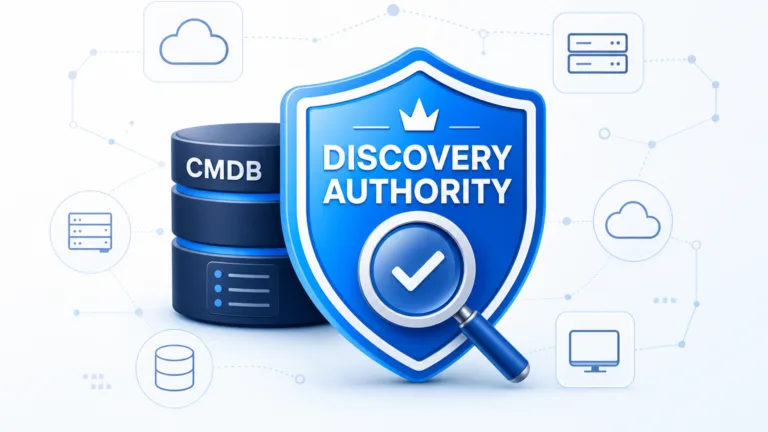
Discovery and the CMDB are not the same layer: discovery finds, classifies, and tags ground systems, while the CMDB stores those CIs and their relationships as the system of record. When those CIs are reconciled, a Virima CMDB and Application Mapping can act as the system of record maps and audits already depend on.
Why does a finished network scan not prove aviation discovery coverage?
Airline scans often cover known corporate CIDRs only. Airport-shared segments, vendor appliances, SaaS edges, OT-adjacent controllers, and uncredentialed cloud accounts stay dark. Completeness needs a scope ledger, credentials, connectors, and scorecard checks, not a single green job status.
Completeness tests before anyone trusts the list
A scan job that finished is not proof of estate coverage. Ground system discovery is only complete when a scorecard says so, not when a job status turns green. Run a short scorecard before ITAM evidence work or dependency mapping starts. Share the pass bar with SecOps and station ops so green is not a private IT definition.
The eight-point scorecard
- Scope ledger. List every CIDR, cloud account, station, vendor segment, and SaaS connector in scope. Mark last successful discovery time. Any blank last-run is an open gap.
- Unscanned space. Diff the ledger against routing and DHCP truth. Unscanned but routed space is incomplete discovery, not “no assets.”
- Unknown device rate. Track endpoints seen only as MAC/IP with no classification. A high unknown rate means credentials, profiles, or OT-adjacent handling is wrong.
- Unowned CI rate. Safety- and ops-tagged CIs without an owner fail review even if the hostname is clean.
- Tag coverage. Percent of CIs on station, gate, crew, baggage, and PSS-related paths that carry safety-adjacent or operations-critical tags, or an explicit not-in-shortlist tag. Untagged critical paths are silent risk.
- SaaS and API inventory share. Count systems that exist only in contracts or runbooks but not in discovery results. Those are identification failures.
- Last-seen age. For shortlist tags, define max age for last-seen. Stale last-seen on a gate path is a coverage and cadence problem.
- Joint-ownership register. For airport-shared and vendor-managed devices, record who can authorize credentials and who stores the CI. Ambiguity here recreates the blind spot after the first clean scan.
Passing the scorecard
Pass or fail should be explicit, so mostly green on corporate with red on stations still isn’t a pass for a safety- and ops-tied list. Publish the scorecard with the export — that’s what turns a scan into evidence.
Tooling that supports multi-source IT Discovery helps only after the ledger and scorecard exist. Otherwise you automate a partial scope and call it done.
How do you prove discovery found every safety- and ops-tied ground system?
Maintain a scope ledger of CIDRs, cloud accounts, stations, vendor segments, and SaaS connectors. Score unscanned space, unknown-device rate, unowned shortlist CIs, tag coverage, API inventory share, and last-seen age. Pass the scorecard before calling the list complete.
What “discovery done” means for handoff
Discovery is done for a wave when the scorecard meets the bar you set with SecOps and ops, not when a single tool job is green. Write the handoff so downstream teams stop re-litigating whether the list is good enough. Name the wave, the scopes included, and the scopes deferred before anyone signs. Record who approved the pass bar and the date the scorecard freezes. Keep deferred scopes visible so they are not mistaken for empty space, and share the freeze packet with ITAM, ITOM, and SecOps leads the same day. No freeze window opens until each lead confirms receipt.
Handoff to ITAM
Every shortlist CI exists with identity, classification, owner, and last-seen. ITAM can then pursue version, patch, lifecycle, and audit evidence on that set. Discovery does not replace that evidence work — it guarantees the population ITAM will be measured against, and a passed scorecard is what makes that population audit-ready. Send ITAM the scorecard export with the CI list so evidence work starts from the same population.
Handoff to ITOM and mapping
The same complete CI set is the input to relationship and dependency work for flight- and station-critical paths. Ops teams need that complete set before they trust change impact views. For recovery and change use of those maps, see the Virima CMDB and Application Mapping. Do not start impact analysis on an estate that still has dark segments.
Handoff to SecOps
Named systems for control scope come from tagged, owned, discovered CIs, not from a workshop whiteboard alone. Discovery supplies the candidate population; security policy still decides the final critical list and its controls.
Keep the handoff written: scorecard date, scopes included, known exceptions, and the owner of each exception. Station cutovers, vendor swaps, and new terminal VLANs should reopen the ledger lines they touch — record vendor credential blocks as exceptions with owners and review dates, and require a single scorecard owner so coverage stays a living control instead of a one-time project badge.
Keeping the freeze record
Store the signed scorecard with the same retention as change records, and bring it into the freeze meeting as a standing packet. When the next freeze arrives, open that file first instead of rebuilding the estate story from chat threads and tribal memory.
A missing packet is a failed control, not a paperwork miss — the freeze does not start without it. Rebuild requires a new discovery cycle and a new signed scorecard. Until then, treat shortlist decisions as provisional and hold them in a deferred register, not in audit packages or change freezes.
Closing the coverage gap
When leadership asks for every system tied to safety and operations, the durable answer is a scored discovery program — clear ground scope, blind-spot methods, completeness tests, and a written handoff into ITAM and ITOM. That is what IT discovery for aviation and airlines is for: proving the list once, not rebuilding it under pressure every time a freeze or an audit lands. The configuration owner’s credibility rests on coverage you can show.
See how CMDB owners raise discovery coverage without manual reconciliation. Request a Demo
Frequently Asked Questions
How do you prove discovery found every safety- and ops-tied system?
Use a scope ledger plus scorecard: unscanned CIDRs and cloud accounts, unknown-device rate, unowned shortlist CIs, tag coverage on station and gate paths, SaaS/API inventory share, and last-seen age. A finished scan job is not proof. A passed scorecard against agreed scopes is.
What usually sits outside typical airline discovery scopes at airports?
Airport-shared terminal segments, vendor-managed gate and kiosk appliances, OT-adjacent controllers on enterprise paths, outstation gear beyond hub CIDRs, and SaaS/PSS edges that never answer IP scans. Corporate VLAN coverage alone misses these paths.
Is identifying systems the same as dependency mapping or ITAM inventory evidence?
No. Identification proves which ground systems exist, how they are tagged, who owns them, and when they were last seen. Dependency mapping relates known CIs for operations impact. ITAM evidence adds version, patch, license, and lifecycle proof on that named set. Discovery is the completeness gate before both.
Who runs discovery when the airline, airport, and vendor share a segment?
Keep a joint-ownership register. The party that can authorize credentials runs or sponsors the scan. The airline CMDB still needs a CI record and owner for anything on a safety- or ops-tied path, even when the airport or vendor operates the box. Ambiguous ownership recreates blind spots after the first clean pass.
Does Virima support the discovery methods aviation IT teams need for airport-shared and vendor-managed systems?
Virima combines agentless, agent-based, API, and cloud-account discovery in one platform, so airline teams can credential vendor-managed appliances and cloud accounts without separate point tools, then feed the same CI set into ViVID™ service maps for ITOM and ITAM.