ITAM in Insurance: Tracking Aging Infrastructure Nearing End of Life

An enterprise server can continue processing insurance policy transactions without throwing a single hardware error. A core network switch can route claim packets across regional field offices with zero dropped frames. An on-premises storage array can continue serving actuary databases every business day. The physical equipment appears healthy across basic infrastructure monitors, but its operational supportability is already deteriorating behind the scenes. Vendor support contracts reach expiration, replacement power supplies become scarce on secondary markets, and underlying operating systems lose vendor security patching. The hardware still operates reliably, yet the enterprise carrier’s ability to maintain that equipment responsibly has quietly vanished.
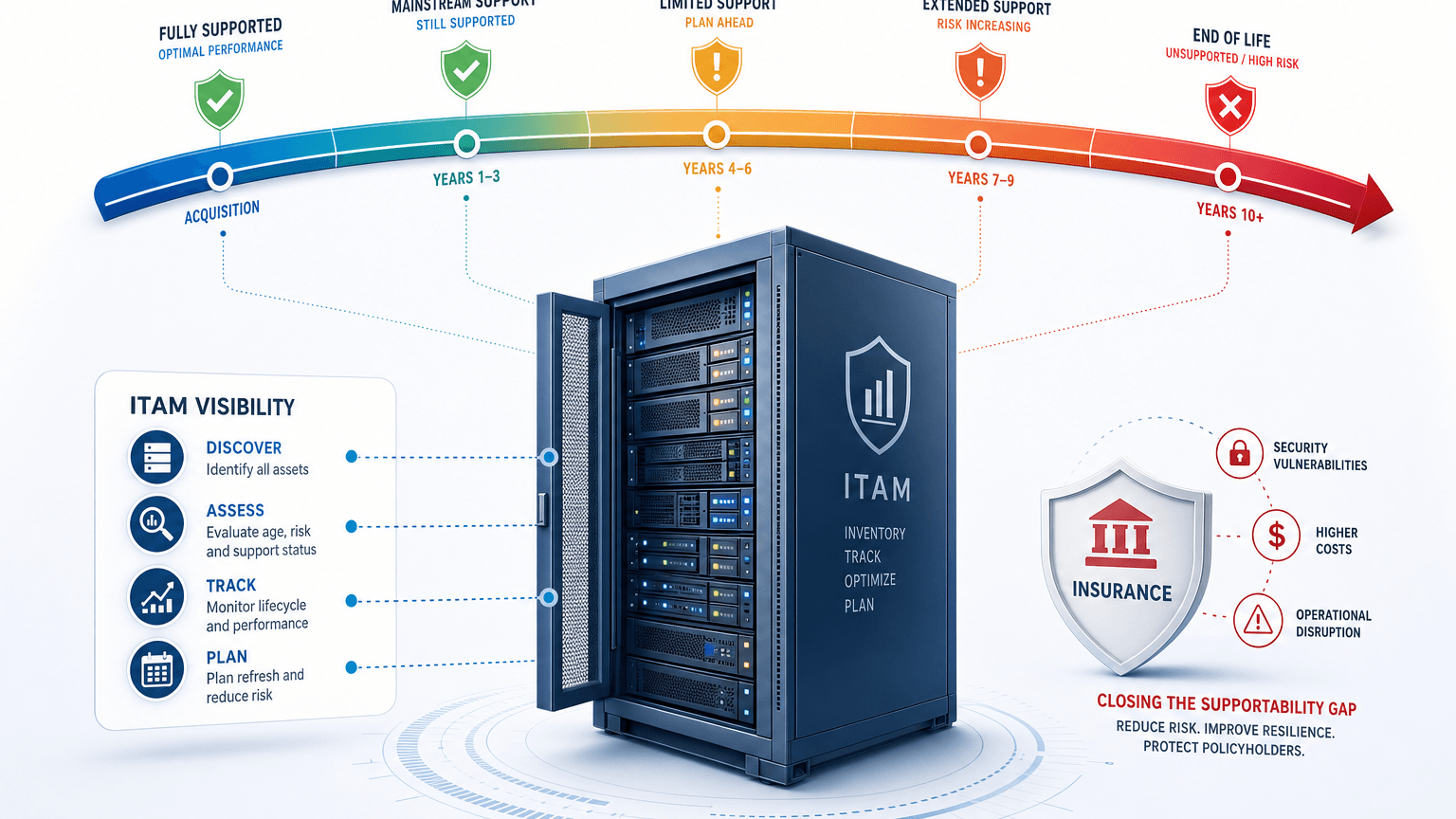
That widening operational gap is why ITAM in insurance must focus on proactive lifecycle governance. Infrastructure does not become obsolete the moment silicon burns out or a drive motor seizes. It becomes dangerous when warranty coverage lapses, vendor maintenance agreements expire, and replacement hardware lead times stretch across quarters while core business applications remain tethered to the physical box. Effective insurance IT asset management identifies this supportability gap early, giving infrastructure and finance leaders sufficient runway to plan migrations before functioning hardware turns into an unsupportable liability.
Aging infrastructure rarely becomes obsolete all at once
Hardware obsolescence is not an instantaneous event. A data center asset travels through distinct operational and financial thresholds throughout its lifecycle: active deployment, unextended operational aging, vendor support risk, active refresh candidacy, and formal retirement. These lifecycle phases rarely coincide with literal mechanical breakdown. A physical host often continues running for years after the original equipment manufacturer ceases software updates and replacement parts manufacturing.
Managing that transition requires tracking granular lifecycle milestones rather than simple installation years. Key lifecycle indicators include initial capital purchase dates, asset commissioning timestamps, original warranty expirations, formal end-of-sale notices, published end-of-support dates, current third-party maintenance contracts, supported operating system versions, designated system owners, and current hardware utilization metrics. Tracking these attributes systematically transforms hardware lifecycle management from emergency triage into an orderly operational discipline.
When does enterprise IT infrastructure reach end of life?
Infrastructure reaches end of life when vendor maintenance agreements, security patch availability, and certified replacement parts expire, not when the physical machine stops running. An asset becomes an operational risk once the organization cannot guarantee timely restoration after an unexpected component failure.
Legacy insurance systems make infrastructure retirement harder
Insurance carriers operate in an environment where technology debt frequently outlives typical commercial refresh cycles. Research from Deloitte on legacy core modernization emphasizes that insurers continue carrying aging platforms because core system retirement is operationally demanding, technically risky, and capital-intensive. Legacy policy administration, actuarial rating engines, and underwriting applications frequently remain in production for decades because they successfully power active policy books.
That application longevity directly complicates hardware decommissioning. An aging rack server cannot simply be unbolted and recycled on a standard four-year lifecycle schedule when a critical commercial underwriting database still relies on its specific storage controller or processor architecture. Migration initiatives frequently stall across multiple fiscal years, leaving production databases dependent on physical machines that vendor support teams no longer acknowledge. Asset managers must evaluate infrastructure age alongside workload dependencies to prevent retirement plans from stalling against unmovable business applications.
End-of-life tracking requires more than purchase dates
Enterprise procurement platforms track when capital assets were purchased, invoice totals, and depreciation schedules. While accounting data remains essential for corporate tax calculations, financial records alone cannot determine whether an individual compute host requires immediate replacement. An enterprise enterprise resource planning (ERP) ledger does not know whether a seven-year-old server runs non-production testing workloads or supports live claims processing during peak storm seasons.
Complete insurance IT asset management unifies procurement records with live technical reality. Asset managers need unified visibility connecting hardware serial numbers, physical rack locations, cost center owners, operational lifecycle designations, active service contracts, firmware levels, installed operating systems, and discovery timestamps. A ten-year-old blade server decommissioned in a staging lab requires minimal oversight, whereas a six-year-old chassis running a mission-critical billing application demands urgent executive visibility. Accurate lifecycle governance relies on operational context rather than purchase dates alone.
Review the architecture behind Trusted Runtime Truth to see how discovery-sourced asset context keeps ITAM records aligned with data center reality.
Discovery verifies which aging assets are still operating
Static asset registers reflect corporate intentions, but actual data center floors often tell a different story. Configuration databases frequently mark legacy servers as decommissioned following a data center consolidation project, yet the physical machines remain plugged in, powered on, and silently processing network traffic. Conversely, records may indicate an active warranty on hardware that was scrapped by local field technicians months earlier.
Scheduled network discovery validates whether aging assets truly exist in an operational state. Discovery processes confirm whether a device responds on the local network, what network interfaces remain active, which software processes execute in memory, and how configuration details have shifted between scan intervals. Merging automated discovery with fixed asset registers prevents carriers from paying maintenance fees on ghost assets while exposing unmanaged legacy hardware that bypassed standard retirement procedures.
Why is automated network discovery essential for hardware lifecycle governance?
Automated network discovery confirms whether an aging device is actively drawing power, hosting running services, and communicating across corporate subnets. Comparing discovered operational state against static asset registers reveals forgotten legacy servers and ensures retirement records reflect physical data center reality.
Refresh planning fails when lifecycle data arrives too late
Hardware replacement in regulated financial services environments requires substantial lead time. Infrastructure engineering teams cannot simply order enterprise server replacements and drop them into production racks over a weekend. Replacing core data center hardware requires validating application compatibility, securing executive capital expenditure approval, navigating extended hardware delivery lead times, scheduling multi-team migration windows, conducting regression tests, and executing secure data sanitization.
When IT asset managers discover an asset has reached end of support only after a component fails, the resulting refresh becomes an expensive emergency. Unplanned hardware replacements force teams to pay steep rush premiums on secondary parts markets or scramble through emergency change approvals that elevate downtime risk. Mature infrastructure lifecycle management surfaces approaching support milestones quarters in advance, allowing engineering squads to budget, procure, and migrate systematically without threatening daily operations.
Ownership matters when aging assets need decisions
An unowned enterprise server is almost impossible to decommission safely. Systems engineering teams often locate aging, out-of-warranty hardware during audit reviews, yet nobody feels authorized to pull the plug. Without a documented application owner or department stakeholder, engineers hesitate to power down the equipment for fear of disrupting an undocumented actuary calculation or monthly reporting batch job.
Complete ITAM bridges technical infrastructure with organizational accountability. Asset records must link physical and virtual machines directly to technical owners, operational teams, and business cost centers. When an asset approaches its published end-of-support milestone, ITAM teams can immediately engage the accountable business stakeholder to determine whether the workload should migrate to modern hardware, transition to a cloud environment, or retire permanently.
Software can make hardware obsolete before hardware fails
A physical server can feature redundant power supplies, clean error logs, and pristine thermal performance while remaining functionally obsolete. Enterprise software vendors frequently retire support for older operating system versions, and modern application frameworks often mandate newer processor instruction sets that older chipsets cannot provide.
Security tooling, backup agents, and hypervisors also advance their hardware compatibility lists over time. An aging physical server that cannot support a certified hypervisor release or modern endpoint protection agent becomes an operational liability, even if its cooling fans and memory chips work perfectly. Tracking end-of-life hardware tracking metrics alongside installed operating systems and software packages ensures that infrastructure teams anticipate these platform compatibility dead-ends before security compliance audits flag them.
How does software compatibility influence physical hardware lifecycles?
Software compatibility forces hardware retirement when modern operating systems, hypervisors, and security agents drop support for legacy chipsets and storage controllers. Hardware becomes obsolete once it can no longer run patched, compliant software stacks, regardless of physical component health.
Replacement priority should consider more than asset age
Simple age-based replacement models treat all aging hardware identically, creating inefficient refresh roadmaps. Replacing hardware strictly from oldest to newest ignores workload criticality, application stability, and real-world failure exposure. A non-critical batch report server deployed seven years ago in an isolated disaster recovery lab poses substantially less organizational risk than a five-year-old core claims transaction host whose vendor support agreement lapsed last month.
Effective refresh prioritization weighs multiple operational criteria:
- Vendor support contract coverage and expiration timelines
- Operating system patch viability and security compliance status
- Workload criticality and the business services dependent on the host
- Availability of certified replacement components on enterprise markets
- Documented ownership and technical migration readiness
- Observed operational performance and discovery verification state
Synthesizing these dimensions enables infrastructure leadership to direct capital expenditures toward the specific systems whose failure would inflict maximum operational disruption on the carrier.
What insurance ITAM should show for aging infrastructure
| Lifecycle Dimension | Operational Context Captured |
|---|---|
| Asset Identification | Physical server chassis, core network switch, storage SAN, hypervisor host |
| Physical & Logical Location | Production data center facility, rack designation, field branch office, cloud edge |
| Organizational Ownership | Technical system administrator, application engineering team, business cost center |
| Deployment Chronology | Original procurement timestamp, commissioning date, total operational lifespan |
| Discovered Operational State | Active network presence, CPU utilization, verified discovery scan timestamp |
| Platform Software Stack | Discovered operating system version, running services, installed agent footprint |
| Vendor Support Standing | Original equipment manufacturer warranty status, active maintenance contract terms |
| Lifecycle Classification | Active production, unextended aging, priority refresh candidate, formal retirement |
| Application Dependency | Dependent business capabilities, policyholder services, database instances |
Maintaining this operational data model ensures that infrastructure lifecycle management functions as a predictive planning engine rather than a static inventory spreadsheet.
A practical workflow: discover, enrich, classify, prioritize, replace, verify
Managing aging infrastructure effectively requires a repeatable operational cycle:
- Discover: Run automated discovery scans across data center racks, branch networks, and hosted facilities to identify all active hardware and running operating systems.
- Enrich: Associate discovered technical assets with procurement records, original warranty timelines, active vendor support contracts, and designated system owners.
- Classify: Assign standardized lifecycle milestones across the hardware inventory, categorizing assets from active deployment to pending obsolescence.
- Prioritize: Score aging assets based on remaining vendor support, software compatibility limits, and the business criticality of supported workloads.
- Replace: Coordinate planned procurement cycles, hardware staging, workload migrations, and scheduled maintenance windows well before support expiration dates.
- Verify: Perform post-decommission discovery sweeps to ensure retired physical equipment has been safely disconnected, powered off, and removed from production networks.
This closing verification stage protects carriers against false retirement assumptions, confirming that retired hardware has truly left the production environment rather than continuing to draw power and harbor unpatched security exposures.
Where Virima fits for insurance infrastructure lifecycle governance
Virima provides a unified IT asset management and discovery platform designed to give insurance carriers authoritative visibility across their complete hardware estate. Rather than relying on manual spreadsheets or disconnected procurement databases, Virima connects physical and virtual infrastructure with live discovery data, lifecycle designations, and financial ownership records.
Through agentless and agent-based scanning technologies, Virima IT Discovery inventories physical servers, network switches, storage arrays, virtual machines, and installed software packages across data centers and edge facilities on scheduled discovery cycles. Discovered hardware attributes, operating system versions, and scan timestamps provide operations teams with a factual baseline of which systems remain operational in the environment.
Virima ITAM organizes those discovered assets into structured lifecycle states, tracking equipment from initial procurement through deployment, maintenance, refresh planning, and decommissioning. The platform maps designated technical owners, financial cost centers, and contract details directly to asset records. Virima synchronizes hardware and lifecycle records across enterprise service management platforms through unified ITSM integrations, including ServiceNow, Jira Service Management, Ivanti, HaloITSM, Xurrent, and Hornbill.
Virima does not replace enterprise ERP platforms or vendor contract negotiations. Instead, it enriches those systems with discovery-verified asset reality, ensuring that insurance infrastructure managers maintain the factual context needed to plan hardware refreshes proactively and verify that retired assets have genuinely departed production.
Plan hardware refreshes before supportability expires
Enterprise insurance infrastructure rarely fails without warning. Long before a legacy server experiences a catastrophic component breakdown, its operational supportability begins to crumble as vendor maintenance agreements expire, replacement parts become scarce, and operating system updates cease.
Relying on flat procurement records or static spreadsheets leaves IT organizations vulnerable to unexpected support cliffs and costly emergency migrations. By pairing automated network discovery with structured asset lifecycle management, insurance carriers can identify aging infrastructure early, engage system owners proactively, and execute orderly hardware refreshes that protect policyholder operations.
Schedule a technical evaluation to see how Virima Discovery and ITAM provide the lifecycle context needed to manage aging infrastructure with confidence.
Frequently Asked Questions
Why does aging infrastructure become an operational risk before physical failure?
An asset becomes an operational risk when vendor technical support ends, firmware patches stop, and certified replacement parts become difficult to source. If a component fails after support expires, recovery times extend dramatically, turning minor hardware glitches into extended outages for dependent policyholder applications.
How does ITAM differ from simple data center inventory tracking?
Inventory tracking merely lists what equipment resides in a data center facility. IT asset management links those physical items to procurement contracts, active warranty coverage, vendor support schedules, financial depreciation, technical owners, and operational lifecycle states required for refresh planning.
Why do insurance companies keep legacy infrastructure in production for so long?
Insurance carriers rely on complex legacy policy administration, rating, and claims systems that are expensive and technically risky to replace. Because these core applications continue functioning reliably, the underlying physical and virtual infrastructure often remains in production well beyond typical commercial refresh cycles.
Can automated discovery detect when hardware reaches end of life?
Discovery tools verify whether physical equipment is actively powered on, communicating across subnets, and running specific operating systems. That discovered technical reality must be combined with published vendor support timelines and maintenance contract terms within an ITAM platform to determine true end-of-life status.
How does Virima help carriers prevent paying maintenance on retired equipment?
Virima pairs ITAM lifecycle tracking with scheduled discovery scans. If an asset is marked as retired or decommissioned in the asset repository, discovery checks confirm whether the host has truly left the network, preventing carriers from paying ongoing vendor maintenance or software licensing on ghost equipment.