ITAM in Hospitality: Stop Losing Tech Assets | Virima

The regional IT lead closed the books on a three-hotel refresh. Purchase orders showed 180 new point-of-sale terminals. Property A’s manager swore twelve never arrived. Property B’s night audit still ran on two terminals marked as disposed two years earlier. Property C’s franchise audit asked for serial numbers that lived only in a local Excel file named final_FINAL_v7. Nobody stole a van of gear. The portfolio simply never owned one list of what technology sat on which floor, under which cost center, with which warranty end date.
ITAM in hospitality is the discipline of recording hardware, software, and related technology assets across every property in the portfolio, then keeping that record current enough for finance, brand standards, guest-facing systems, and security reviews. It is inventory with owners, locations, lifecycle dates, and license truth, not a one-time packing list after a renovation.
What ITAM in hospitality covers on a multi-property estate
Hotel IT inventory management is not one data center with neat racks; it spans far more device classes than a headcount spreadsheet assumes. A mid-size brand mixes:
- Property management systems (PMS), booking engines, and channel managers
- Point of sale, kitchen display, and payment devices on the floor
- Guest Wi-Fi controllers, access points, and in-room entertainment gear
- Back-office PCs, printers, and corporate laptops for sales and revenue teams
- Door locks, digital signage, CCTV, and building systems that touch the IP network
- Cloud subscriptions for HR, loyalty, and corporate email that still need license counts
IT asset management in this setting answers four practical questions for each item in scope: what is it, where is it (property, building, room or closet), who owns the budget and the refresh, and is the license or warranty still valid.
A workable hospitality ITAM program usually needs:
- Asset classes that cover endpoints, network gear, POS and specialty devices, and software titles in use
- Property and location fields that survive brand renames and management-company handoffs
- Purchase, warranty, and EOL/EOS dates finance and engineering can export
- Software installs reconciled to entitlements, not to last year’s true-up spreadsheet
- A refresh method that does not depend on each GM emailing a stocktake once a year
Industry security guidance for lodging still assumes you know which systems process cardholder or guest data. Without asset truth, scope for PCI-related reviews and brand IT standards becomes a reconstruction project every cycle. Treat PCI and similar frameworks as inventory and control evidence needs. ITAM is not a substitute for a GRC system of record.
Where portfolio lists break first
| Pattern | What the portfolio feels |
|---|---|
| Each hotel keeps its own spreadsheet | Corporate IT cannot answer a brand or insurer request without three weeks of chasing GMs |
| POS and locks sit outside “IT inventory” | Guest-path devices never appear in refresh or vulnerability conversations |
| Renovations ship gear without asset tags | New rooms go live; old devices reappear in a sister property’s closet |
| Cloud apps are bought per property | Software spend doubles while true-up reports still undercount installs |
| Franchise and managed properties use different tools | Portfolio dashboards show only the corporate-managed slice |
Why multi-property operators feel ITAM gaps in the P&L
Guest experience programs, brand standard upgrades, and payment device mandates all assume a known device population. When that population is wrong, the bill shows up as emergency buys, rushed truck rolls, failed audits, and software true-ups that surprise the CFO after the budget is locked.
Hardware refresh is capital. Software is often opex with audit risk. Hospitality margins leave little room for buying the same class of laptop twice because Property D never returned the lease fleet. License noncompliance and untracked installs also create quiet cost: seats paid for vacant properties, and unpaid installs on seasonal staff machines that never left the loading dock inventory. For a closer look at how untracked installs turn into surprise invoices, see Best Software License Management Tools in 2026 (Reviewed & Ranked).
IBM’s Cost of a Data Breach research continues to show multi-million-dollar average breach costs, with longer identification and containment when teams lack clear asset context. For brands that store guest profiles and payment data, unknown endpoints and unknown network paths are ungoverned paths. ITAM does not replace detection tools. It tells security and IT which devices and titles exist so those tools have a complete population.
Four ways weak ITAM shows up on property
1. Brand standard rollouts planned on last year’s count.
Central IT orders image packs and docking stations from a headcount model. Floor reality includes kiosks, shared PCs, and temporary machines that never left.
Result: Partial cutovers, guest check-in friction, and a second capital request mid-quarter.
2. Payment and POS fleets without a single owner table.
Devices move between outlets during events. Serials stay on the box in storage.
Result: Broken warranty claims, PCI scope arguments, and overnight courier fees for missing terminals that were in Banquets.
3. Software true-ups built from purchase orders only.
Finance sees invoices. Nobody reconciles installs on property PCs, jump boxes, and vendor-maintained workstations.
Result: Surprise true-up invoices or unused seats that never get reclaimed when a hotel leaves the flag.
4. Disposal and donation without chain of custody.
Decommissioned PCs leave with guest data assumptions untested. Asset records still show in service.
Result: Privacy exposure risk and books that still depreciate ghosts.
The cost of treating each hotel as its own IT island
For brand and portfolio technology leaders
You need one answer for insurers, franchisors, and board risk committees: what technology supports guest journeys across the estate. Property-level heroics do not scale when you add keys in three countries.
For property IT and engineering
Stocktakes steal nights from people who already cover Wi-Fi issues and POS freezes. Manual lists go stale the week a conference lands 400 extra devices on the network.
For finance and procurement
Capex plans, lease returns, and software renewals need serial-level and title-level truth. Without it, every refresh is a negotiation with incomplete receiving reports.
For security and compliance partners
Scope for cardholder and guest-data systems starts with known assets and locations. Spreadsheet archaeology before every assessment burns calendar time you do not get back during peak season.
Operators that want discovery-backed inventory instead of annual clipboard counts need a portfolio ITAM model before the next brand mandate or payment terminal swap. Review how Trusted Runtime Truth frames live, explainable inventory for environments that cannot freeze for a month-long audit.
How portfolio ITAM gets accurate without a perpetual stocktake
Hospitality estates change when flags rebrand, outlets open, and seasonal staff turns over. A durable approach combines receiving discipline, technical discovery where networks allow it, and lifecycle fields finance already understands.
Tag at the dock, not after the complaint
Asset tags, purchase order links, and property codes should attach when gear hits receiving, including drop-ships to the hotel address. Waiting until someone has time guarantees Banquet’s extra handhelds never enter the book.
Discover what the network can see, on a schedule you can defend
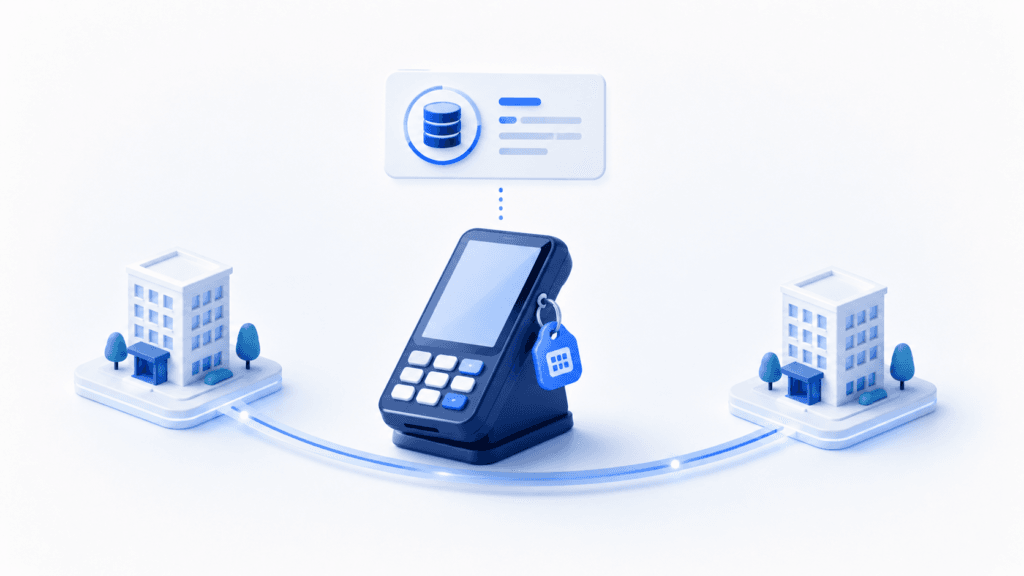
Agent-based inventory deepens hardware and software detail on managed PCs and servers in offices and IT closets. Agentless, credential-based scanning reaches network gear and hosts that will not take an agent. API-based collection pulls cloud and workspace inventories the provider already exposes. Run these as scheduled high-frequency discovery cycles operations can show an auditor, not as a promise of passive continuous listening.
Reconcile specialty devices with a clear exception list
POS, locks, and some OT-adjacent gear may need vendor exports or controlled manual classes. The point is a single CMDB and ITAM record model with explicit exceptions, not three systems that never meet.
Tie software titles to installs and entitlements
Normalization collapses vendor name chaos so true-ups compare like to like. Property-level buyouts still roll to portfolio views without killing local cost centers. See Active vs. passive IT asset discovery: which one works better? for how discovery-fed normalization changes the true-up conversation.
Compare clipboard ITAM to discovery-fed portfolio ITAM
| Need | Clipboard / per-property files | Discovery-fed ITAM with lifecycle |
|---|---|---|
| Multi-hotel visibility | Chase GMs | Portfolio filters by property and owner |
| Floor and back-office devices | Often omits POS and kiosks | In scope when network and process cover them |
| Software truth | PO history | Installs vs entitlements |
| Refresh and warranty | Tribal knowledge | Dates on the asset record |
| Audit population | Rebuilt each time | Exportable register |
| Cadence | Annual panic | Scheduled discovery plus receiving controls |
ITAM in hospitality in the wild
- Flag migration. A management company takes over five assets under a new brand. Discovery plus property codes produce a day-one register instead of a 90-day scavenger hunt.
- POS refresh under a payment mandate. Serials, warranty, and outlet location sit on one list so installers do not guess which drawer holds spare terminals.
- Seasonal properties. Winter closure machines move to storage with status and location updates so spring reopen does not rediscover retired gear as active license demand.
- Corporate vs property buy. Sales laptops bought by corporate still show property assignment when staff sits on-site, so recovery and wipe processes have an owner.
How Virima connects discovery, CMDB, and ITAM for hotel portfolios
Hotel groups already buy PMS, POS, and often an ITSM suite. The gap is rarely another front-desk application. It is a portfolio register that stays honest after renovations, flag changes, and seasonal labor churn.
Discovery, CMDB, and ITAM work as one connected path in Virima, not three disconnected products on a slide. Discovery finds what is on the network and in approved cloud accounts. The CMDB holds configuration items and relationships so teams share one operational model. ITAM applies lifecycle, license, warranty, and financial fields so finance and property IT stop maintaining a second spreadsheet of the same estate. That order matters in hospitality. You cannot license or depreciate what you never reliably found, and you cannot answer a brand questionnaire from relationships alone if the asset never entered the book.
Discovery first: what each property can actually see
Virima IT discovery covers agent-based collection when you need deep hardware and software detail on managed endpoints in offices, admin VLANs, and back-of-house rooms. Agentless, credential-based scanning reaches routers, switches, firewalls, and locked-down hosts common in IDFs and property closets. API-based collection pulls cloud and platform inventories the provider already exposes for corporate and multi-property accounts.
Credentials and network scopes can follow brand, franchise, or management-company boundaries so one hotel’s LAN rules do not block the whole program. Refresh runs as scheduled high-frequency discovery cycles operations can defend to auditors and brand IT. Virima does not claim passive continuous or event-stream discovery today. For hospitality, that honesty matters: night audit and PCI windows need a cadence you can explain, not marketing language about always watching.
Discovery output is the ground layer for everything that follows. Serials, OS fingerprints, installed software, and responding network gear become candidates for the portfolio register instead of waiting on a GM’s annual stocktake email.
CMDB next: one operational model across properties
Findings reconcile into Virima CMDB configuration items with multi-source reconciliation, relationship mapping, health-oriented signals, and lifecycle states. A true multi-property CMDB means corporate IT stops merging three hotel Excel files that disagree on the same access point. Property codes, owners, and location fields sit on the CI so a franchise questionnaire can filter by hotel without a side database.
Relationships matter when a change hits guest-path systems. A wireless controller, a PMS application server, and a payment jump box are not three unrelated rows if check-in depends on all three. The CMDB is where those links live for change and incident context. It is still not a second PMS and not a replacement for your payment switch. It is the enterprise configuration layer hospitality ITSM and security workflows can trust when property tools stay domain-specific.
ITAM on the same foundation: lifecycle, license, and cost questions
Virima ITAM applies hotel technology lifecycle tracking to that discovery-fed inventory: hardware lifecycle tracking, software license management, license compliance reporting, EOL and EOS flags, asset financial tracking, and contract or warranty fields. Finance asks different questions than property engineering. Which terminals are still under warranty before a payment mandate. Which laptop fleet is past refresh. Which software titles are installed versus entitled across the portfolio. Which assets still depreciate after disposal paperwork claimed they left.
In a hotel group, ITAM without discovery becomes a catalog of purchase orders. Discovery without ITAM becomes a technical list finance will not use for capital planning. CMDB without either becomes a relationship diagram that never matches the dock. Virima’s design keeps the three stages on one data path so receiving, runtime findings, and lifecycle reports do not drift into separate truths.
ViVID™ service maps when guest and back-office services need impact context
Asset registers answer what exists and where it sits. Guest journeys also need impact context: what breaks if this CI changes. After operations defines which applications and sites make up a named service (check-in, guest Wi-Fi, payment path, corporate email), ViVID™ service maps build and refresh infrastructure dependency views from discovery-sourced relationships against those definitions.
Service composition stays human-owned. Teams enter definitions manually, import them, or feed them from architecture sources such as LeanIX. Mapping does not invent what “front desk” includes when a GM and corporate IT disagree. That separation keeps brand service catalogs honest while the map stays current as infrastructure moves.
Roll out ViVID™ service maps after the register is stable enough that mapping ghost records would only add noise. For hospitality pilots, start with one or two revenue-critical services on a small property cluster, then expand.
Specialty devices, software truth, and Windows Server risk context
POS, locks, and some OT-adjacent gear may still need vendor exports or controlled manual classes. Keep them in the same CMDB and ITAM model with explicit exceptions so Banquet’s handhelds do not live forever outside the book.
Software inventory and normalization support true-up conversations that purchase orders alone cannot settle. National Vulnerability Database (NVD) CVE context overlays Windows Servers only for risk discussion tied to known inventory. Pair dedicated scanners for broader multi-OS and specialty device vulnerability management. Linux, network, cloud, and other CI types still enter discovery and CMDB records even when the CVE overlay is scoped to Windows Servers.
ITSM stay-in-place integrations
Discovery-sourced assets and CIs can sync toward ServiceNow, Jira Service Management, Ivanti, HaloITSM, Xurrent, or Hornbill through the integrations hub. Property nicknames stop being the only identifier on tickets. Change and incident teams reference the same register finance uses for refresh.
Diligence when discovery needs broad estate access
Virima holds SOC 2 Type 2 and ISO/IEC 27001:2022 certifications, which helps procurement and security review a discovery layer that must reach many properties. Platform controls and inventory evidence can support programs that touch PCI-DSS or other guest-data expectations on the enterprise side. Virima does not replace the brand GRC or QSA workflow. It supplies asset populations those programs consume.
A first property cluster worth proving
Pick two or three hotels that share a brand standard and payment stack. Prove receiving-to-record flow, discovery coverage on office and network gear, CMDB reconciliation with property codes, and an ITAM extract finance trusts for warranty and license questions. Add ViVID maps only after service owners name the guest or back-office services in scope. Expand after GMs see fewer clipboard drills. Leadership can pressure-test the path against Trusted Runtime Truth using the operator’s own missing-serial pain before a whole-portfolio rollout.
For a deeper look at why a CMDB without discovery stalls change and asset work, see CMDB without discovery.
From property closets to portfolio asset truth
| Old habit | Portfolio habit |
|---|---|
| Each hotel’s IT list in a shared drive | One register with property and owner fields |
| Stocktake only before corporate audit | Receiving controls plus scheduled discovery cycles into CMDB and ITAM |
| Software buys per desperate email | Installs reconciled to entitlements |
| Refresh guessed from headcount | Lifecycle and warranty dates on the asset |
How accuracy pays off across the brand
- Stabilize the register on a pilot cluster. Clean duplicates, assign owners, retire ghosts still depreciating.
- Connect refresh, license, and security populations to the same list. Payment device swaps and laptop recalls stop starting from inbox archaeology.
- Use location and service context to sequence capital. Put spend where guest journeys and brand standards actually depend on aging gear.
Five moves that start a hospitality ITAM reset
- Freeze the scope for wave one. Name properties, asset classes, and who can approve credentials.
- Fix receiving and tagging. No tag, no payment release for in-scope tech.
- Match collection to each environment. Agents, agentless, and APIs where each fits; document specialty device exceptions.
- Reconcile into CMDB, then apply ITAM fields. Portfolio view with property-level cost centers intact.
- Schedule discovery and report cadence. Treat refresh as an operating control for brand and finance, not a renovation side quest. Add named services and ViVID maps once definitions exist.
Close the gap before the next brand audit asks for serials
Technology assets in hospitality move with renovations, events, and flag changes. ITAM in hospitality keeps those assets visible across the property portfolio when discovery feeds the CMDB and ITAM fields finance already needs.
If your group still rebuilds inventory from GM spreadsheets before every mandate, start with a scoped assessment on the hotels that drive the most guest volume or audit pressure. Request a demo to see how discovery-sourced inventory keeps your portfolio register accurate across renovations, flag changes, and the next true-up cycle.
Frequently Asked Questions
What is ITAM in hospitality?
It is IT asset management applied to hotels and related properties: tracking hardware, software, and related technology across the portfolio with location, ownership, lifecycle, and license context for finance, IT, and compliance work.
Why do hotel groups need portfolio-level asset tracking?
Brand standards, payment device mandates, software true-ups, and security scope all assume a known population. Per-property spreadsheets go stale between renovations and seasonal changes, so corporate teams rebuild lists under deadline.
How do discovery, CMDB, and ITAM work together for hotels?
Discovery finds devices and software on agreed networks and cloud accounts. The CMDB holds configuration items and relationships across properties. ITAM adds lifecycle, license, warranty, and financial fields on that same inventory so finance and IT share one register.
When should hotels use ViVID service mapping?
After service owners define named services such as check-in or guest Wi-Fi. ViVID then builds infrastructure dependency maps from discovery-sourced relationships. It does not invent service composition, and it does not replace ITAM’s lifecycle and license answers.
Can hospitality ITAM data feed ServiceNow or other ITSM tools?
Yes. Discovery-sourced assets and configuration items can sync into common ITSM platforms, so support and change teams reference the same register without replacing the service desk.